

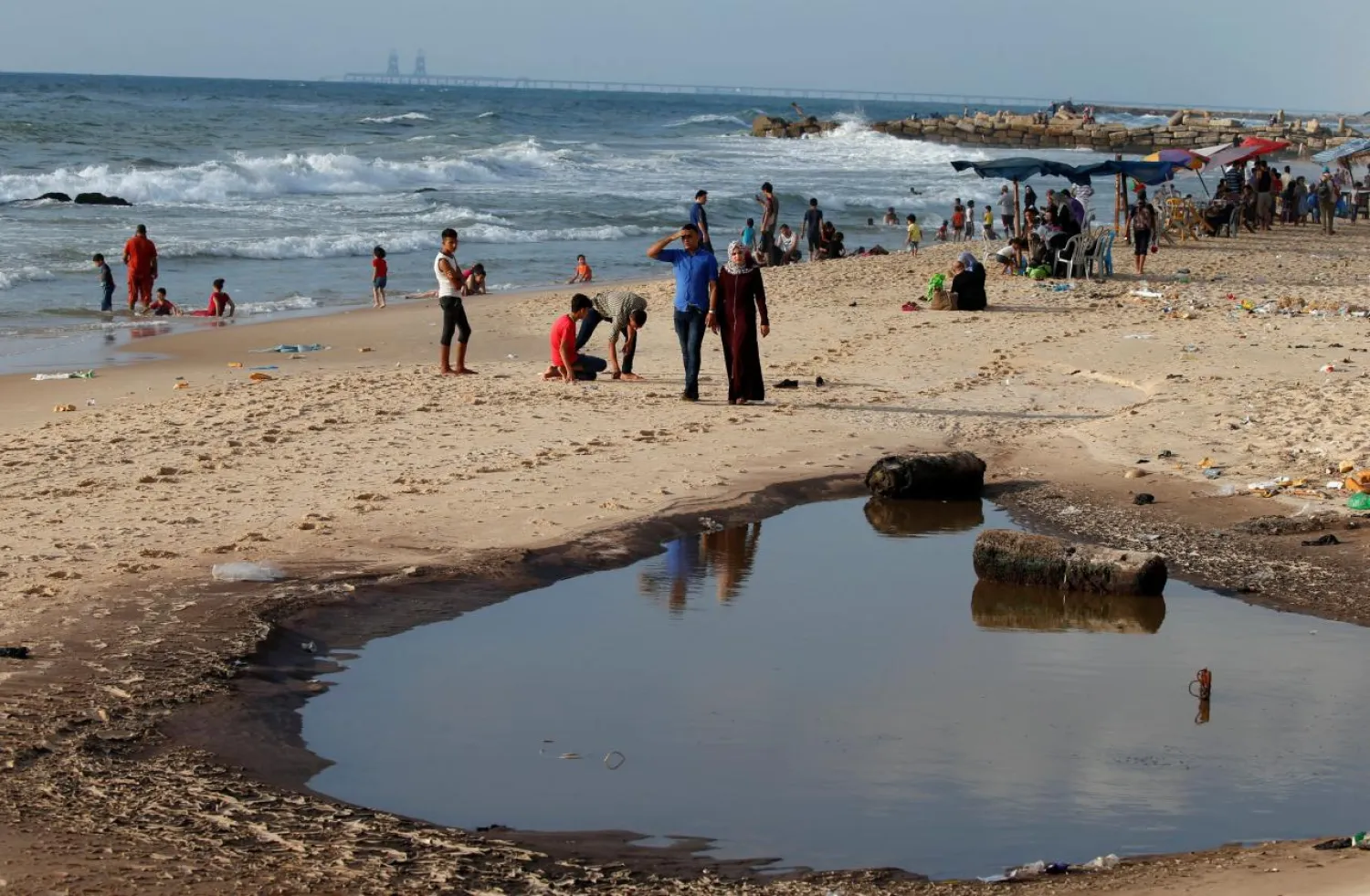

UN Special Rapporteur: Gaza Has Become ‘Unliveable’

Palestinians walk past a pool of sewage on a beach in the northern Gaza Strip July 13, 2018. REUTERS/Mohammed
TT

UN Special Rapporteur: Gaza Has Become ‘Unliveable’

Palestinians walk past a pool of sewage on a beach in the northern Gaza Strip July 13, 2018. REUTERS/Mohammed

The Special Rapporteur on the situation of human rights in the occupied Palestinian territories, Michael Lynk, has lamented that the economy of the Gaza Strip is in free fall, saying the enclave has become “unliveable” amid a 70 percent youth unemployment, widely contaminated drinking water and a collapsed health care system.

Lynk told the Third Committee (Social, Humanitarian and Cultural) of the UN General Assembly this week that Israel continued to block his visits to the occupied territories.

He painted a pessimistic state of affairs, noting that 200 Palestinians have been killed by Israel’s security forces — 40 of them children — during peaceful protests each Friday along the Gaza frontier for the past seven months.

Lynk also said it was high time the international community takes firm action to stop Israel’s annexation of large parts of the West Bank through settlement expansion and legislative initiatives, warning that failure to do so will likely prompt Israel to formalize annexation into domestic law.  

“During five decades of the occupation, Israel has steadily entrenched its sovereign footprint throughout the West Bank,” the Special Rapporteur said in his report to the UN General Assembly. He highlighted settlement construction and expansion, as well as recent legislative measures he said amounted to illegal de facto annexation.

“The Israeli Knesset has adopted a number of laws in the past year that have become a flashing green light for more formal annexation steps,” he said, noting recent measures that sought to apply Israeli law to the West Bank, as well as the 2017 settlement regularization law.

“The strict prohibition against annexation in international law applies not only to a formal declaration, but also to those acts of territorial appropriation by Israel that have been a cumulative part of its efforts to stake a future claim of formal sovereignty over the occupied Palestinian territory.”

The Rapporteur urged the international community to act. “Lacking in repeated condemnations of Israel’s annexationist actions have been any meaningful steps by the international community to insist upon accountability. Despite Israel’s record of non-compliance with the directions of the international community, it has rarely paid a meaningful price for its defiance, and its appetite for entrenching its annexationist ambitions has gone largely unchecked,” Lynk said.

He describing the human rights situation in Gaza as dire.

“The United Nations stated in 2012 that Gaza may well be unliveable by 2020. When electricity has been cut to five hours a day, when safe drinking water has almost disappeared, and when its economy is cratering before our eyes, then the state of unliveability is upon us, and the international community must insist that all parties, and particularly Israel, the occupying power, bring an immediate end to this disaster,” he said.



Few People Left at Syria Camp that Held ISIS Families, Former Director Says

Children, part of a group of detainees, look through a fence at al-Hol camp after the Syrian government took control of it following the withdrawal of Syrian Democratic Forces (SDF), in Hasaka, Syria, January 21, 2026. REUTERS/Khalil Ashawi
TT

Few People Left at Syria Camp that Held ISIS Families, Former Director Says

Children, part of a group of detainees, look through a fence at al-Hol camp after the Syrian government took control of it following the withdrawal of Syrian Democratic Forces (SDF), in Hasaka, Syria, January 21, 2026. REUTERS/Khalil Ashawi

Fewer than 1,000 families remain at a camp where relatives of suspected ISIS militants had been held in Syria's northeast, the camp's former director said on Wednesday, with thousands having fled last month as government forces seized control of the area from Kurdish-led fighters.

Al-Hol, near the Iraqi border, was one of the main detention camps for relatives of suspected ISIS militants who were detained during the US-backed campaign against the terrorist group in Syria.

Control of the camp changed hands last month when government forces under President Ahmed al-Sharaa seized swathes of the northeast from the Kurdish-led Syrian Democratic Forces, including several jails holding ISIS militants. The US military said last week it had completed a mission to transfer 5,700 adult male ISIS detainees to Iraq.

Jihan Hanna, the former director who still coordinates with international agencies and the Syrian government, told Reuters the remaining families were Syrian nationals and were being transferred to a camp in Aleppo. Most of the camp’s foreign nationals had fled, she said.

The Syrian government did not immediately respond to requests for comment.

According to the latest camp data obtained by Reuters, dated January 19 - a day before the government took control of the camp - its population was 6,639 families comprising 23,407 people, mostly Syrians and Iraqis, as well as 6,280 foreigners from more than 40 nationalities.

UNHCR, the UN refugee agency, said it had observed "a significant decrease in the number of residents in al-Hol camp in recent weeks," adding in a statement to Reuters that there were no confirmed figures on the remaining population.

"Over the weekend the camp administration advised UNHCR not to enter the camp due to the unrest and anxiety in the camp," UNHCR added.

The Syrian government accused the SDF of withdrawing from al-Hol on January 20 without any coordination.

The SDF, in a statement that day, said its forces had been "compelled to withdraw from al-Hol camp and redeploy to areas surrounding cities in northern Syria that are facing increasing risks and threats."

A Syrian government security source said most people in the camp fled that day during a five-hour period when it was unguarded, and that some had left with men who came to take their relatives to unknown destinations.

The security source and a source from a non-governmental organization working there said a section of the camp that housed its most dangerous residents, known as the annex, was empty.

The security source said the escapees had spread throughout Syria and that security authorities, working in cooperation with international partners, had established a unit to "follow up on the matter and pursue those who are wanted."

Some have left Syria.

In Lebanon, the army has questioned more than a dozen Lebanese who crossed illegally from Syria after leaving al-Hol, a Lebanese security source said.

The Syrian government’s Directorate of International Cooperation said on Tuesday that hundreds of people, mostly women and children, had been transferred from al-Hol to a newly prepared camp near the town of Akhtarin in northern Aleppo.


Germany Moves Troops Out of Iraq, Citing Mideast 'Tensions'

FILE PHOTO: German Defense Minister Ursula von der Leyen visits the Transport Helicopter Regiment 30 (Transporthubschrauberregiment 30) at the Hermann-Koehl-Kaserne in Niederstetten, Germany, August 20, 2018. REUTERS/Ralph Orlowski
TT

Germany Moves Troops Out of Iraq, Citing Mideast 'Tensions'

FILE PHOTO: German Defense Minister Ursula von der Leyen visits the Transport Helicopter Regiment 30 (Transporthubschrauberregiment 30) at the Hermann-Koehl-Kaserne in Niederstetten, Germany, August 20, 2018. REUTERS/Ralph Orlowski

Germany's military has "temporarily" moved some troops out of Erbil in northern Iraq because of "escalating tensions in the Middle East," a German defense ministry spokesman told AFP on Thursday.

Dozens of German soldiers had been relocated away from the base in Erbil, capital of Iraq's autonomous Kurdistan region.

"Only the personnel necessary to maintain the operational capability of the camp in Erbil remain on site," the spokesman said.

The spokesman did not specify the source of the tensions, but US President Donald Trump has ordered a major build-up of US warships, aircraft and other weaponry in the region and threatened action against Iran.

German troops are deployed to Erbil as part of an international mission to train local Iraqi forces.

The spokesman said the German redeployment away from Erbil was "closely coordinated with our multinational partners".


UN: At Least 15 Children Killed in Sudan Drone Strike

The war in Sudan, ongoing since mid-April 2023, has caused extensive destruction across the country (AFP)
TT

UN: At Least 15 Children Killed in Sudan Drone Strike

The war in Sudan, ongoing since mid-April 2023, has caused extensive destruction across the country (AFP)

A drone strike on a displacement camp in Sudan killed at least 15 children earlier this week, the United Nations reported late on Wednesday.

"On Monday 16 February, at least 15 children were reportedly killed and 10 wounded after a drone strike on a displacement camp in Al Sunut, West Kordofan," the UN children's agency said in a statement.

Across the Kordofan region, currently the Sudan war's fiercest battlefield, "we are seeing the same disturbing patterns from Darfur -- children killed, injured, displaced and cut off from the services they need to survive," UNICEF's Executive Director Catherine Russell said.