


Thousands of Syrians Stuck in the Desert Risk Starvation

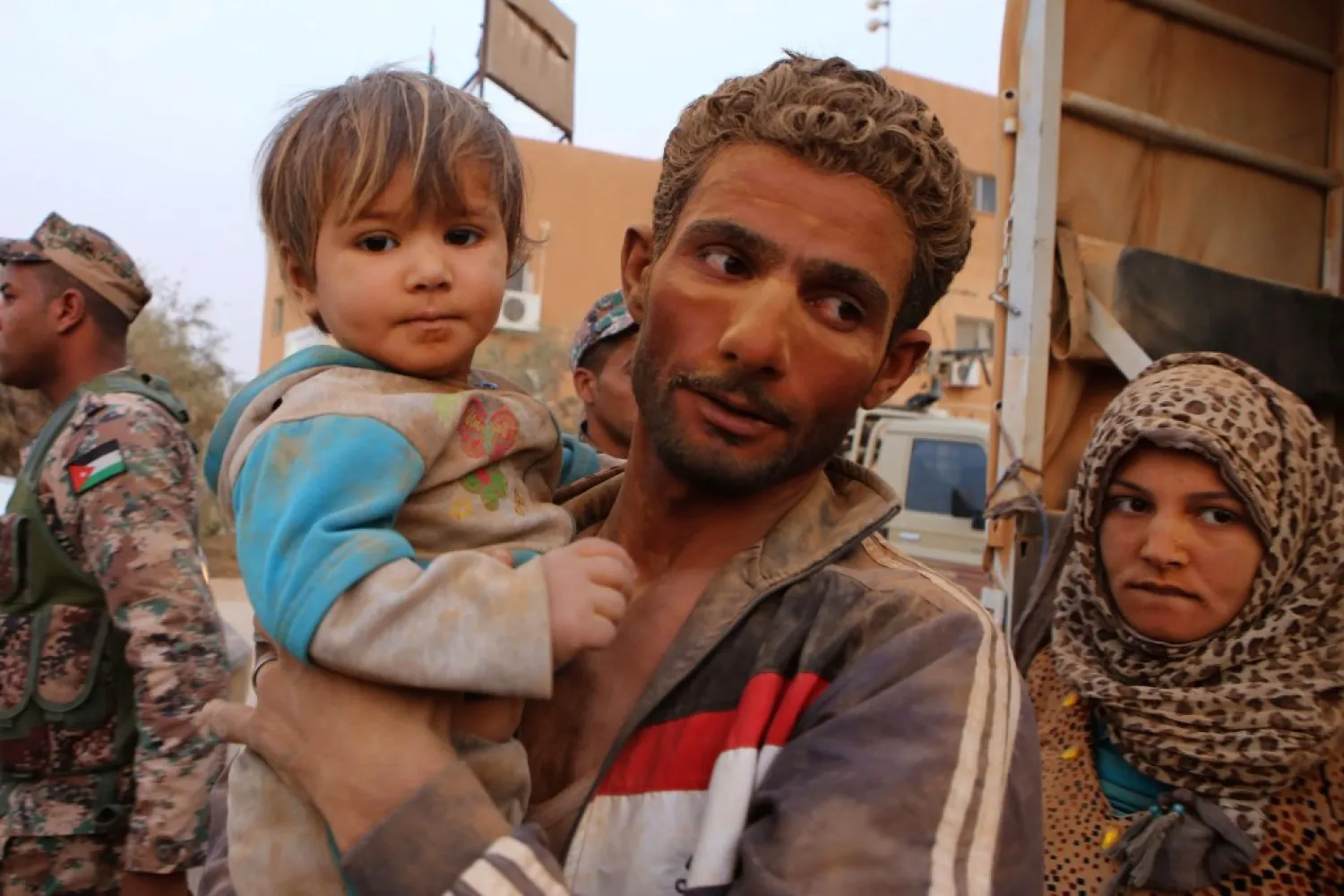
In this Sept. 10, 2015 file photo, Syrian refugees covered in dust arrive at the Trabeel border after crossing into Jordanian territory from Syria, near Ruwaished, Jordan. (AP Photo/Raad Adayleh, File)
TT

Thousands of Syrians Stuck in the Desert Risk Starvation

In this Sept. 10, 2015 file photo, Syrian refugees covered in dust arrive at the Trabeel border after crossing into Jordanian territory from Syria, near Ruwaished, Jordan. (AP Photo/Raad Adayleh, File)

Tens of thousands of Syrians stranded in a desert camp near the Jordanian border are at risk of starvation amid dwindling supplies and the approach of winter, while regional powers trade blame over who is responsible for this latest humanitarian catastrophe in Syria's civil war.

Desperately needed aid deliveries to the besieged Rukban camp have repeatedly failed or been postponed, including a UN convoy which was supposed to go in on Thursday but has now been indefinitely delayed.

The camp is home to around 45,000 people, many of them women and children, who are camped out in the open desert. At least four people have died in the past month, due to malnutrition and lack of medical care.

Sandstorms and heavy rains in recent weeks have left Rukban's tattered tents and clay houses in even worse shape. Imad Ghali, a camp resident, said this isn't the first time Rukban has been promised aid and not received it.

"It's like telling someone dying of thirst to wait for the rain," said Ghali. "How long are we going to wait?"

People started gathering in Rukban three years ago, fleeing ISIS militants and airstrikes by the US-led coalition, Russia and Syria. Jordan sealed its border and stopped regular aid deliveries in 2016 after a cross-border ISIS attack that killed seven Jordanian soldiers.

The last aid delivery from Jordan was in January, leaving the camp's residents dependent on goods largely smuggled from government-held areas. The situation sharply deteriorated after the Syrian government blocked supply routes last month following a botched reconciliation deal with rebel groups in the area, according to the Britain-based Syrian Observatory for Human Rights.

Russia, a close ally of the Syrian government, has blamed the US for the deterioration of the situation in Rukban, which is within a 55 square kilometer (20 sq. mile) "deconfliction zone" set up by US forces in the nearby Tanf military base.

"The inability of the US side to live up to its commitment to provide security in the 55-kilometer area around its base in Tanf stopped the convoy from going," Lt. Gen. Vladimir Savchenko said last week, adding that the area around Tanf has "a large number of armed and uncontrolled militants who can stage any manner of provocation" and endanger aid workers.

The US-led coalition has denied such allegations.

"Any talk of the coalition holding up the process is simply misinformation and others deflecting off themselves," US military spokesman Col. Sean Ryan said in an email.

On Saturday, the White House envoy to the coalition, Brett McGurk, said the Syrian government and Russia are using Rukban as an excuse to question the US presence in the area.

"The question is for the regime and Russians. Do they really want to help these people or use them as something to come after us?" he asked, after stressing the US was going to stay in the Tanf base. He spoke at a security conference in Bahrain last week.

Jordan, which at one point used cranes to drop aid for Syrians struck in Rukban, said it will not shoulder responsibility for this latest episode.

"Rukban is Syrian people on Syrian territory, so it is the responsibility of the Syrian government and the UN and the international community," Jordanian Foreign Minister Ayman Safadi said on Saturday. "We are not going to own Rukban."

He added, however, that Jordan will continue to provide water to Rukban and access to a Jordanian clinic for those in need.

"The camp's location has pushed the warring sides to use it as a way to pressure each other, while simultaneously neglecting the camp," said Rami Abdulrahman, who heads the Observatory.

Conditions will only worsen as the winter approaches, the UN children's agency warned earlier this month.

The Syrian government authorized the UN to deliver aid to Rukban two weeks ago, which would have been the first U. delivery to the camp made through Syria. However, the joint UN and Syrian Arab Red Crescent convoy did not arrive Thursday as promised, and has been indefinitely delayed.

Damascus-based UN official Fadwa Abed Rabou Baroud said the convoy was delayed for logistical and security reasons.

Meanwhile, the camp's residents are running out of food and medicine, the majority surviving off one small meal a day, said Abdul-Fattah al-Khaled, the director of a school in Rukban. Local merchants have hiked up the cost of supplies.

"There is no one organizing, observing or holding anyone accountable in the camp," said al-Khaled. "Our biggest problem is that we are not registered with the UN as a refugee camp and are instead just labeled as 'stuck on the border.'"

Rukban's residents staged a five-day sit-in earlier this month after a series of deaths in September due to malnutrition and lack of medical care. Among the dead were a 5-day-old boy and a 4-month-old girl.

A handful of nurses run a few poorly equipped clinics in the camp, al-Khaled said, and a medical center supported by the UN children's agency across the border takes urgent, life-threatening cases.

Earlier this month, a young woman died from anemia and chronic acute diarrhea. Rukban's bare-bones medical center was unable to treat Bassma Zaarour, and asked for her to be sent to a Jordanian hospital, but she died almost immediately after her appointment.

Jordan is in talks with Russia to find a permanent solution through voluntary returns and reconciliation agreements. Rukban is "a desert and no community can be sustained there," said Safadi, the Jordanian foreign minister. "Russia, Jordan and the US are in agreement that we need to de-establish Rukban for people to go back, and we're working on that."

The camp's residents are exhausted, al-Khaled said, but fear leaving without safe passage, either to government-held areas or parts of the north controlled by Turkish-backed rebels.


US Military Jets Hit in Iran War Are the First Shot Down by Enemy Fire in Over 20 Years

An F-15E Strike Eagle turns toward the Panamint range over Death Valley National Park, Calif., on Feb. 27, 2017. (AP)
TT

US Military Jets Hit in Iran War Are the First Shot Down by Enemy Fire in Over 20 Years

An F-15E Strike Eagle turns toward the Panamint range over Death Valley National Park, Calif., on Feb. 27, 2017. (AP)

Iran shooting down two American military jets marks an exceedingly rare assault for the US that has not happened in more than 20 years and shows Iran’s continued ability to hit back despite President Donald Trump asserting it has been “completely decimated.”

The attacks came five weeks after US and Israeli strikes first pounded Iran, with Trump saying earlier this week that Tehran's “ability to launch missiles and drones is dramatically curtailed."

Iran shot down a US F15-E Strike Eagle fighter jet Friday, with one service member getting rescued and the search still underway for a second, US officials say. Iranian state media also said a US A-10 attack aircraft crashed after being hit by Iranian defense forces.

The last time a US warplane was shot down by enemy fire in combat was an A-10 Thunderbolt II during the 2003 US invasion of Iraq, said retired Air Force Brig. Gen. Houston Cantwell, a former F-16 fighter pilot.

But, he said, that’s because the US had largely been fighting insurgents who didn’t have the same anti-aircraft capabilities. The fact that there have not been more fighter jets lost in Iran, Cantwell said, is a testament to the capabilities of US forces.

"The fact that this hasn’t happened until now is an absolute miracle,” said Cantwell, who served four combat tours and is now a senior resident fellow at the Mitchell Institute for Aerospace Studies. “We’re flying combat missions here, they are being shot at every day.”

Shoulder-fired missile likely used, experts say

US Central Command said in a statement Wednesday that American forces have flown more than 13,000 missions in the Iran war while striking more than 12,300 targets.

After more than a month of punishing US-Israeli airstrikes, a degraded Iranian military nonetheless remains a stubborn foe. Its steady stream of strikes against Israel and Gulf Arab neighbors have been causing regional upheaval and global economic shock.

When it comes to American dominance over Iran's airspace, there’s still a distinction between air superiority and air supremacy, said Behnam Ben Taleblu, Iran program senior director at the Foundation for Defense of Democracies, a hawkish Washington think tank.

“A disabled air defense system is not a destroyed air defense system,” he said. “We shouldn’t be shocked that they’re still fighting.”

American planes have been flying missions at lower altitudes, which makes them more vulnerable to Iran's missiles, Taleblu said. It’s possible that Iran fired at the F-15 with a surface-to-air missile, but it's more likely that a portable, shoulder-fired missile was used, he said. Those are much harder to detect and reflect how Iran is “weak but still lethal.”

“This is a regime that is fighting for its life,” he said.

Mark Cancian, a retired Marine colonel and a senior defense adviser with the Center for Strategic and International Studies, agreed that a shoulder-fired missile was likely used against the fighter jet.

Nonetheless, the American air war against Iran has been a “tremendous success” so far, he said.

To put things in perspective, he said the loss rate for American warplanes flying over Germany during World War II was 3% at one point, which would equal about 350 warplanes in the US war against Iran.

“But then there’s the political side — you have an American public that is accustomed to fighting bloodless wars,” Cancian said. “Then a large part of the country doesn’t support the war. So to them, any loss is unacceptable.”

Pilots are trained on what to do if their plane is hit

The last US jet shot down in combat was struck by an Iraqi surface-to-air missile over Baghdad on April 8, 2003. The pilot safely ejected and was rescued, according to the Air Force.

In high-threat environments like missions over Iran, Cantwell, the retired general, said an aviator's blood pressure goes up and they become highly alert to incoming missiles. Those are typically either infrared- or radar-guided missiles, he said, requiring different evasive tactics.

If they are hit and need to eject from their aircraft, they are trained on what to do next, he said.

Pilots learn to check for wounds after a violent ejection and the shock of a missile explosion and, most crucially, how they are going to communicate their location so rescuers can find them.

At the same time, he said, the enemy is likely working to intercept the communications or even spoof the location.

Helicopters are more at risk than other aircraft

The planes that went down Friday were not the first crewed American aircraft to be lost overall in Iran.

A military helicopter and airplane exploded in 1980 during an aborted mission to rescue several dozen American hostages at the US embassy in Tehran, according to the Air Force Historical Support Division.

After a series of setbacks, including severe dust storms and mechanical failures, the mission was called off. As the aircraft took off, the rotor blades of one of the RH-53 helicopters collided with an EC-130 aircraft full of fuel and both exploded, killing eight.

More US helicopters have been shot down in recent decades, including a MH-47 Army Chinook helicopter that was struck by a rocket-propelled grenade in Afghanistan in 2005, killing 16. Helicopters are more dangerous because “the lower and the slower, the more susceptible you are,” Cantwell said.

That’s why those who went out on this week's rescue missions, likely in helicopters, he said, did “such a brave and honorable act.”


Iran Leaders Join Crowds on Tehran’s Streets to Project Control in Wartime

An Iranian flag is seen on a residential building that was damaged by recent strikes at Vahdat town in Karaj, southwest of Tehran on April 3, 2026. (AFP)
TT

Iran Leaders Join Crowds on Tehran’s Streets to Project Control in Wartime

An Iranian flag is seen on a residential building that was damaged by recent strikes at Vahdat town in Karaj, southwest of Tehran on April 3, 2026. (AFP)

After more than a month of being stalked by targeted assassinations, Iran's leadership has adopted a new tactic to show it is still in control - with senior officials walking openly in the streets among small crowds who have gathered in support of the regime.

In recent days, Iran's president and foreign minister have separately mixed with groups of several hundred people in central Tehran. On Tuesday, state television aired footage of the two posing for selfies, talking to members of the public and shaking hands with supporters who had gathered in public areas.

According to insiders and analysts, the appearances are part of a calculated effort by Iran's theocratic leadership to project resilience and authority — not only over the vital Strait of Hormuz but also over the population — despite a sustained US-Israeli campaign aimed at "obliterating" it.

One insider close to the hardline establishment said such public outings are intended to show that the regime is "unshaken by strikes and that it remains in control and vigilant" as the war grinds on.

The US-Israeli war ‌on Iran began on ‌February 28 with the killing of veteran Supreme Leader Ali Khamenei and several senior military ‌commanders ⁠in waves of ⁠strikes that have since continued to target top officials.

Iran's new Supreme Leader, Mojtaba Khamenei, has not been seen in public since taking over on March 8 from his father. Foreign Minister Abbas Araqchi, meanwhile, was removed from Israel's hit list amid mediation efforts last month, including by Pakistan, to bring Tehran and Washington together for talks to end the war.

Talks aimed at ending the war have since appeared to have petered out, as Tehran brands US peace proposals "unrealistic". Against that backdrop, recent public appearances by President Masoud Pezeshkian and Araqchi appear designed to project defiance, if not a convincing display of public support.

A senior Iranian source said officials' public presence demonstrates that "the establishment is not intimidated by Israel's targeted killing of top Iranian ⁠figures".

Asked whether Iran's foreign minister or president were on any sort of kill list, an Israeli ‌military spokesperson, Nadav Shoshani, said on Friday he would not "speak about specific personnel."

NIGHTLY RALLIES TO ‌SHOW RESILIENCE

Despite widespread destruction, Tehran appears emboldened by surviving weeks of intense US-Israeli attacks, firing on Gulf countries hosting US troops and demonstrating its ability ‌to effectively block the Strait of Hormuz.

On Wednesday, US President Donald Trump vowed more aggressive strikes on Iran, without offering a timeline ‌for ending hostilities. Tehran responded by warning the United States and Israel that "more crushing, broader and more destructive" attacks were in store.

Encouraged by clerical rulers, supporters of the regime take to the streets each night, filling public squares to show loyalty even as bombs rain down across the country.

Analysts say the establishment is also seeking to raise the "political and reputational" cost of the strikes at a time when civilian casualties are deeply disturbing for Iranians.

Omid Memarian, ‌a senior Iran analyst at DAWN, a Washington-based think tank, said the decision to send officials into gatherings reflects a layered strategy, including an effort to sustain the morale of core supporters ⁠at a moment of acute pressure.

"The system ⁠relies heavily on this base; if its supporters withdraw from public space, its ability to project control and authority weakens significantly," Memarian said.

Speaking to state television, some in the crowds voice unwavering loyalty to Iran's leadership; others oppose the bombing of their country regardless of politics; and some have a stake in the system, including government employees, students and others whose livelihoods are tied to it.

Hadi Ghaemi, head of the New York-based Center for Human Rights in Iran, said the establishment is using such loyal crowds as human shields to raise the cost of any assassination attempts.

"By being in the middle of large crowds they have protections that would make Israeli-American attacks against them very bloody and generate sympathy worldwide," he said.

POTENTIAL PROTESTERS STAY OFF STREETS AT NIGHT

The Islamic republic emerged from a 1979 revolution backed by millions of Iranians. But decades of rule marked by corruption, repression and mismanagement have thinned that support, alienating many ordinary people.

While there has been little sign so far of anti-government protests that erupted in January and abated after a deadly crackdown, the establishment has adopted harsh measures, such as arrests, executions and large-scale deployment of security forces, to prevent any sparks of dissent.

Rights groups have warned about "rushed executions" during wartime after Iran hanged at least seven political prisoners during the war.

"Many potential protesters are frightened by the continuing presence of armed men and violent crowds in the streets and largely stay at home once darkness falls," Ghaemi said.


'Metals of the Future': Copper and Silver Flow Beneath Poland's Surface

Smelter workers process copper at the Glogow plant in southwestern Poland, owned by KGHM. Wojtek RADWANSKI / AFP
TT

'Metals of the Future': Copper and Silver Flow Beneath Poland's Surface

Smelter workers process copper at the Glogow plant in southwestern Poland, owned by KGHM. Wojtek RADWANSKI / AFP

Thousands of meters beneath the ground, amid suffocating heat, lies one of the keys to Poland's rumbling mining sector -- and the world economy.

Whitish ore, rich in copper and silver, is extracted from the country's depths and exported around the world to fuel technological and energy transitions.

"These are the metals of the future," Ariel Wojciuszkiewicz, a geologist at the Polkowice-Sieroszowice mine in the west of the country, tells AFP, noting that copper and silver are "indispensable for electronic equipment, electric cars, and renewable energy installations".

Driven by the rise of artificial intelligence, renewable energies, and global defense needs, demand for these metals is expected to keep increasing in the future, with copper even being referred to as "red gold" and a "barometer" for world economic development.

Poland, responsible for as much as half of Europe's supply, is one of the industry's key players.

Equipped with a helmet and an emergency breathing device, Wojciuszkiewicz leads AFP journalists through the Polkowice-Sieroszowice mine -- one of three sites operated by KGHM, the Polish metals giant, which also owns local smelters and companies in the Americas.

The 24-hour operation runs at a constant roar as machines grind rock at deafening volumes, its tunnels stretching for hundreds of kilometers beneath Poland's surface.

The world's second-largest silver producer, the KGHM group also supplies between 40 percent and 50 percent of the copper produced in Europe.

Last year, it ranked eighth worldwide in terms of copper extraction volume, behind global giants such as BHP Group, Glencore Plc and Rio Tinto, according to industry statistics.

Global copper demand, already high, is expected to climb by over 40 percent by 2040, according to a 2025 UN Report.

To meet this demand, "it might take 80 new mines and 250 billion dollars in investments by 2030," the organization estimates.

The International Energy Agency (IEA), however, predicts that supply will lag 30 percent behind demand by as early as 2035.

- 1,200 degrees Celsius -

Dependence on copper is growing exponentially across the world economy's most innovative sectors.

"We don't realize how much we are surrounded by copper on all sides," Piotr Krzyzewski, KGHM vice president in charge of finance, explains to AFP.

"An electric car contains 80 kg of copper, compared with 20 kg in a conventional one," he notes, while "a wind turbine contains between four and ten tons of copper per megawatt."

Farther away, at the Glogow smelter, two workers in protective suits, armed with long lances, open huge furnaces where the ore is melted.

They work diligently as sparks fly from metal heated to 1,200C.

Several processing stages later, 99.99 percent pure copper plates, each weighing more than a hundred kilos, are shipped all over the world.

Last year, the KGHM group as a whole generated more than 36 billion zlotys ($9.7 billion) in revenue. Copper production reached 710,000 tons and silver production 1,347 tons, according to the group's annual report, published at the end of March.

No less than half of the silver is used in industry, mainly for electronics, solar panels, and medical applications. The rest goes to jewelery or serves as a safety net and financial asset.

But it is copper, now an irreplaceable metal for the economy, that has become the object of global strategic contention.

"Copper is on the strategic list of critical metals in Europe, the United States, and China," Krzyzewski tells AFP.

The metal's impact on geopolitics is already being noted in real time.

In July, US President Donald Trump announced a 50 percent tariff on copper, eventually limiting the measure to products made with the metal.

To justify his decision, he invoked the need to "defend national security".

"Copper is the second most used material by the Department of Defense!" he said.

- Record prices -

In 2025, copper prices jumped 41.7 percent, before hitting a record high of $14,527.50 a ton in January of this year.

Even in the face of the war in the Middle East and the slowdown of the global economy, the price remains high at about 12,000 dollars per ton.

In this uncertain context, Poland's subsoil appears to be a major asset for the energy sovereignty of the Old Continent.

"It's no longer about the security of our country alone, but the security of all of Europe," Krzyzewski says, adding that KGHM's resources "are still estimated to last for at least 40 years," not counting new exploration and concessions.

But mining consumes enormous amounts of water, making it subject to the effects of global warming and drought.
