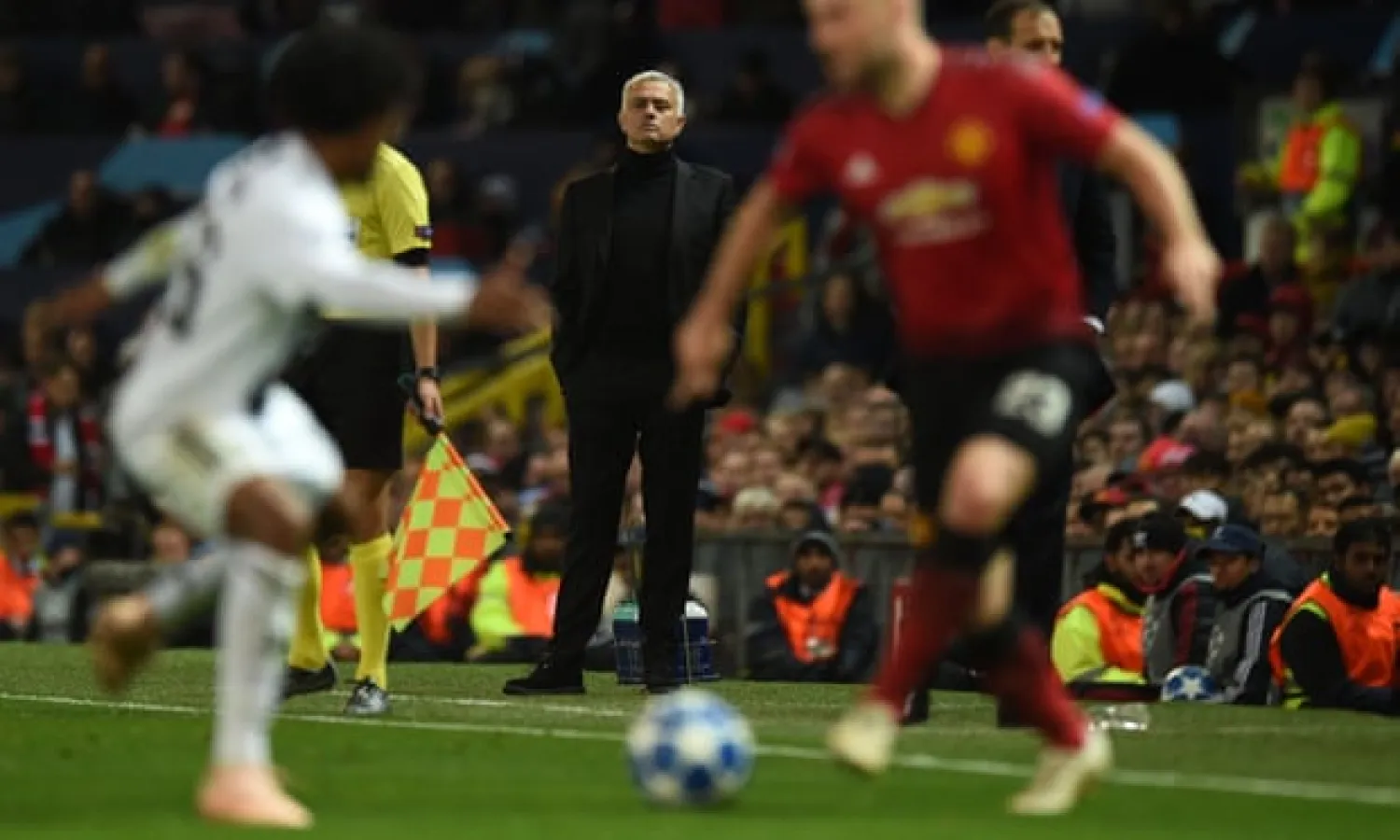
The Addictive Myth of In-Game Managerial Efficacy

 For a decade José Mourinho seemed like he could do anything, but latterly he has looked in thrall to factors largely beyond his control – like any other manager. Photograph: Oli Scarff/AFP/Getty Images
For a decade José Mourinho seemed like he could do anything, but latterly he has looked in thrall to factors largely beyond his control – like any other manager. Photograph: Oli Scarff/AFP/Getty Images
TT

The Addictive Myth of In-Game Managerial Efficacy

 For a decade José Mourinho seemed like he could do anything, but latterly he has looked in thrall to factors largely beyond his control – like any other manager. Photograph: Oli Scarff/AFP/Getty Images
For a decade José Mourinho seemed like he could do anything, but latterly he has looked in thrall to factors largely beyond his control – like any other manager. Photograph: Oli Scarff/AFP/Getty Images

This weekend, in keeping with most others, a much-scrutinised if seldom enlightening ritual will have been enacted once more: the post-match managerial interview. It’s a strange phenomenon, if you think about it, but coverage of a football match without quizzing the manager at the end would now seem as unnatural as the police not questioning the prime suspect in a crime.

It has become an integral part of the mechanism that bestows upon managers a position somewhere between a god and a fool, depending on the result. But once a game has started, what can a manager actually do? Scream from the sidelines at players who are too busy playing to take any notice. Give a half-time team talk that takes one of two forms: keep doing what you’re doing or pull yourselves together. And make up to three substitutions – almost always after 60 minutes of play.

It is almost a Canutian endeavour: trying to stop the tide by shouting at it. But nonetheless we have a deep need to establish accountability in random situations, and that’s the manager’s job – to take responsibility. And they’re well paid for it, even if their stay in the post is, on average, little more than two years.

Of course, the flow of a football game is not entirely random, and it is down to the manager to institute certain formations, styles and patterns of play. But again we tend to overstate their impact, which is what they encourage us to do – unless they are on a losing streak. For it is in the manager’s interests to be seen as the omnipotent architect of success.

There are rare examples of managers whose careers tend to support that picture, most notably Sir Alex Ferguson, though of course he was said to be a match away from the sack at Manchester United before he embarked on his glory years. But a more instructive case is José Mourinho.

By any standards, Mourinho is a supremely successful manager, with a list of major trophies won at Porto, Chelsea, Internazionale, Real Madrid and Manchester United. Perhaps his greatest success, though, has been in convincing everyone – his bosses, the media and not least his players – that he is able to take control of a club and drive it to the top. He famously announced that he was “special” when he arrived in the Premier League, and winning the title in his first year seemed to confirm that he was.

Another way of looking at it would be to say that Mourinho took over a club that was on the verge of major success, and he was able to recruit a number of major players thanks to the largesse of the club’s billionaire owner, Roman Abramovich. Verge is not the same as pinnacle, though, and let’s say Mourinho made the difference.

Then three years after his arrival he was gone, having fallen out with the owner. There is no doubt that he has continued to deliver trophies at other clubs but with each new triumph, followed by player discontent and his departure, Mourinho has grown steadily more mortal. Now at United, after spending £360m (£285m net), he looks much like any other top-flight manager – desperate to make his extravagantly paid squad of underperforming stars gel into something more than the sum of their parts.

For more than a decade he had a psychological edge because the sheer magical strength of his image seemed to cast a debilitating spell on his opponents. But now that advantage is gone, what is left? Tactics, fitness, diet, preparation, and all the things that every other manager and coaching staff are working on too.

When a new manager arrives, such as Unai Emery at Arsenal, it is customary to note how much fitter the players suddenly look. Yet we can be sure that under Arsène Wenger, a man who ate and slept performance statistics, the players were not lolling around on sun loungers. The strange thing is that if Emery leads his team to a Champions League qualifying spot – the achievement Wenger secured for years on end while being said to lack ambition – he will be deemed a success.

But the finest illustration of the mysterious and perhaps illusory role of managers is the man Mourinho originally replaced at Chelsea, Claudio Ranieri. When their paths later crossed in Italy, Mourinho would dismiss him as an old man “who hasn’t won anything”. Then, after a much-travelled career, in which he seemed to specialise in coming second or third, he arrived in 2015 at Leicester, a team that had only just survived relegation the previous season. As Ranieri was known as the Tinkerman for his habit of constantly changing team lineups when he was at Chelsea, it was a safe bet that he would change things around.

But no major signings came in, Ranieri kept a settled team, the same one that was built by his predecessor, Nigel Pearson, and nor did he make any discernible changes in tactics or training. As we know, Leicester went on to win the Premier League, in what was arguably the greatest upset and most extraordinary accomplishment in modern-day football.

Did that make Ranieri, who had never quite made it to the top in his previous 15 managerial jobs, a genius strategist? If so, it did not stop him from being sacked the following season. It’s worth bearing that in mind the next time a manager is hailed as inspired for bringing on a substitute who scores, or damned because a left-back mistimes a tackle in the 90th minute. Managers can have an effect over and above the players at their disposal but it’s usually less than we think and it is, almost without exception, as fleeting as Ranieri’s tenure.

The Guardian Sport


Irish Boxer Lee Reeves Dies at Age 31, Three Months after Dublin Title Fight Injury

Irish boxer Lee Reeves. Reuters
TT

Irish Boxer Lee Reeves Dies at Age 31, Three Months after Dublin Title Fight Injury

Irish boxer Lee Reeves. Reuters

Irish boxer Lee Reeves has died more than three months after being injured during a fight in Dublin, promoter Queensberry said Tuesday. He was 31.

"Everyone at Queensberry is devastated to learn of the passing of Lee Reeves," Queensberry Promotions said in a statement.

Reeves was hospitalized after being knocked out by compatriot Gary Cully in the 10th and final round of their Boxing Union of Ireland Celtic super-lightweight title fight on Aug. 1.

Reeves was carried from the ring on a stretcher after receiving initial treatment.

Queensberry had said after the fight that his condition was critical but stable.

“Lee was an immensely talented boxer, as well as a true role model and inspiration to his community,” the statement added Tuesday, according to The Associated Press. “Our deepest condolences go to Lee’s family, friends and all those who loved him. We ask that their privacy be respected at this incredibly difficult time. Rest in peace, Lee.”


Alonso to Enter Dakar Rally with Loeb and Aston Martin Team

November 5, 2026 Aston Martin's Fernando Alonso during a press conference ahead of the F1 Sao Paulo Grand Prix. (Reuters)
TT

Alonso to Enter Dakar Rally with Loeb and Aston Martin Team

November 5, 2026 Aston Martin's Fernando Alonso during a press conference ahead of the F1 Sao Paulo Grand Prix. (Reuters)

Double Formula One champion Fernando Alonso will compete in next January's Dakar Rally in an Aston Martin Dreadnought entry run by engineering partner Prodrive.

The 45-year-old Spaniard, a 32-time Grand Prix winner and two-time Le Mans 24 Hours winner, will be racing in the annual event for the second time after competing with Toyota in 2020, finishing 13th.

France's nine-time world rally champion Sebastien Loeb and Brazil's reigning world rally-raid champion Lucas Moraes will be his teammates in a three-car entry.

The 49th edition of the Dakar Rally will ‌be held in ‌Morocco from January 9 to 23, with a prologue and first ‌stage ⁠in Portugal, after ⁠being moved from Saudi Arabia due to security concerns.

The 24-round Formula One season is due to start in Bahrain in March after testing in late February.

Alonso, who will again have compatriot and five-time motorcycle Dakar winner Marc Coma as co-driver, is racing in the Las Vegas Grand Prix this weekend. He said he had turned his thoughts to Dakar after deciding to continue in Formula One with Aston Martin.

“In the end, the decision became simple. I wanted to embrace ⁠the challenge completely and take on both Formula One and the ‌Dakar Rally in the same year," he explained in ‌a statement.

"In 2020, Dakar was one of the most challenging and enjoyable experiences of my career. ‌I have enormous respect for this race and the specialists who have mastered it.

"Formula One ‌remains my priority. But I am a racing driver, and challenges like this are why I love competing. I’m looking forward to seeing what we can achieve."

LOEB CHASES FIRST DAKAR WIN

In October, Alonso told reporters at the Singapore Grand Prix that he felt the desert endurance race would be physically ‌incompatible with his Formula One commitments.

Loeb, 52, will also be chasing a first Dakar win after 10 previous attempts that have brought ⁠him 28 stage ⁠wins to date.

“Winning the Dakar is very important to me,” said the Frenchman, who will be partnered by Belgian Fabian Lurquin. “We have come close several times, and the motivation is there to keep working until we achieve it."

The Dreadnought is a digital-only tactical SUV created exclusively for gamers playing "Call of Duty: Modern Warfare 4" that will now be brought into the real world by Prodrive, Aston Martin's partners in endurance GT racing.

The Dakar will be Aston Martin Racing’s debut in the world rally-raid championship.

"Aston Martin's ambition for this program has been clear from the outset: to create a car capable of competing at the front of the world's toughest motorsport event," said Prodrive Chairman David Richards.

"By combining Aston Martin's vision with Prodrive's experience in rallying, endurance racing and Dakar competition, we have built a strong foundation. With an exceptional driver line-up and a highly capable engineering team, we look forward to seeing Dreadnought take on this remarkable challenge."


Owono Does Not Deserve 12-Match Ban Over De Miguel Death, Says Andorra Owner Pique

Equatorial Guinea's goalkeeper #01 Jesus Owono leaves the pitch at half time during the Africa Cup of Nations (CAN) Group E football match between Equatorial Guinea and Algeria at Moulay Hassan Stadium in Rabat on December 31, 2025. (AFP)
TT

Owono Does Not Deserve 12-Match Ban Over De Miguel Death, Says Andorra Owner Pique

Equatorial Guinea's goalkeeper #01 Jesus Owono leaves the pitch at half time during the Africa Cup of Nations (CAN) Group E football match between Equatorial Guinea and Algeria at Moulay Hassan Stadium in Rabat on December 31, 2025. (AFP)

FC Andorra owner Gerard ‌Pique said goalkeeper Jesus Owono did not deserve the 12-match suspension he received following the challenge that led to the death of Tenerife forward Jesus de Miguel.

Owono and De Miguel collided during a Spanish second-tier match on November 2. De Miguel was taken to intensive care and died the following day.

The disciplinary committee of the Spanish football federation (RFEF) banned Owono for violent conduct which resulted in serious ‌injury last week.

"Players, ‌former players, coaches, goalkeepers, everyone has ‌called ⁠it an accident," ⁠Pique said in a video posted on social media late on Monday.

"I truly believe that imposing the maximum sanction on Jesus for this action puts him in a situation he does not deserve, because he is not to blame for all of ⁠this having happened."

Former Barcelona player Pique ‌pointed to the three-match ‌ban handed to Albacete's Jose Corpas for accidentally kicking Sabadell ‌player Quadri Liameed in the head during a ‌recent match in Spain.

"Fortunately Quadri is fine, the consequences in this case were not fatal, and the committee decided to sanction Corpas with three matches," Pique added.

"With ‌all this, my reflection is: what is being sanctioned, the action or the ⁠consequences?"

The RFEF ⁠did not immediately respond to a request for comment outside regular business hours in Spain.

Owono, 25, has withdrawn from Equatorial Guinea's squad for Africa Cup of Nations qualifiers against Zimbabwe this month and Pique said it was unlikely the goalkeeper would return to action as soon as his suspension is up.

"Jesus is going to need far more than 12 matches before he is available and able to compete," he added. "No sanction is going to bring Demi (De Miguel) back to us."