


What Makes a Great Football Stadium?

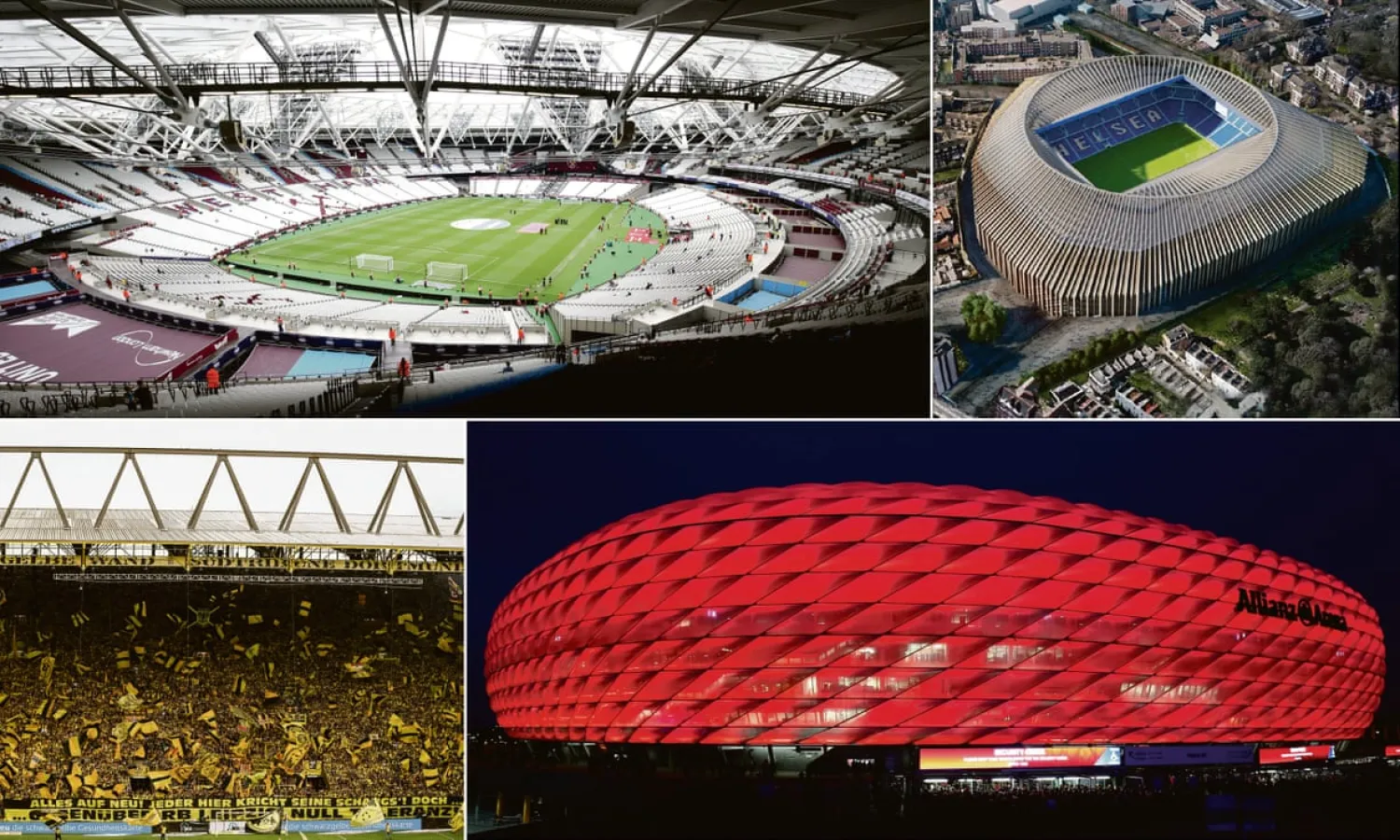
The London Stadium, plans for Chelsea’s on-hold ground, the Yellow Wall at Borussia Dortmund and the Allianz Arena in Munich. Composite: BPI/Rex/Shutterstock; Herzog and de Meuron/Hammersmith and Fulham Council/PA; Bongarts/Getty Images
TT

What Makes a Great Football Stadium?

The London Stadium, plans for Chelsea’s on-hold ground, the Yellow Wall at Borussia Dortmund and the Allianz Arena in Munich. Composite: BPI/Rex/Shutterstock; Herzog and de Meuron/Hammersmith and Fulham Council/PA; Bongarts/Getty Images

I'm a West Ham fan. Our stadium is not good. It’s beautiful, but broken. It hosted the greatest British sporting event of the last 50 years, a grand and gleaming Olympic Games, but cannot handle a lower-mid-table Premier League game. This half-a-billion pound stadium gleams in the sunlight, but it’s full of holes, gaps, missing pieces, large canyons between prefab stands that are papered over, almost literally, with plastic claret sheets. The stadium’s problems are not just physical; they’re also psychological. It doesn’t feel like a football ground because it’s not one. It makes you wonder: what makes a great football stadium?

Grounds grow to match the identity of their team. Character is more important than capacity or having a technologically advanced concourse. You know it when you see it – or feel it: this sense that you are tied only to geography but to history. “Liverpool are one of those clubs who have a really strong identity,” says Professor Murray Fraser of the Bartlett School of Architecture in London. “When you go to Anfield, it very obviously is the ‘church’ of that community around it. I found it quite astonishing when I first went there and saw the houses around it. The people who live in that area see the stadium every day, get to look at Anfield every day as they move around town, and that builds a huge sense of identity.”

There are plenty of grounds that inspire similar feelings of civic pride and awe. Sat bang in the middle of Burnley, Turf Moor feels hard worn and hard-won, its dressing rooms spare and its away seats wooden, typical of a team that have dragged themselves up from the lower reaches of the league. Thirty miles south, Manchester United’s giant Old Trafford still feels like it’s part of the community, lined with red-brick houses up Sir Matt Busby Way, a giant club famous for both its general bigness and its long-held reliance on local talent.

There is Celtic Park’s studied continentalism and Ibrox’s almost parodic Britishness. Dortmund’s legendary Yellow Wall stretches up into the sky and bears down on opposing teams as they attack the goal. At Boca’s La Bombonera, a D-shaped ground with a sweeping half-bowl and a single flat stand, the noise resounds from the curve and reverberates off the opposite stand, evoking a concert hall more than a ground, which is fitting for a team more known for its thrilling atmosphere than its football.

It is easy to write off new stadiums as just physical manifestations of what is wrong with the game today, with every bell and whistle an affront to the charm and reality of the game we love. But these grounds grow and mutate as the game does, changing with the larger culture and community of an area, although there does need to be something real for fans to hold on to.

“When it comes to the design process,” says architect Christopher Lee. “It is about understanding what the DNA of a club is, what their supporters are about and what the nuances and traditions are – whether that’s in east London or northern Mexico.” Lee has worked on the Emirates Stadium, the Millennium Stadium (with Europe’s first moving roof), and has been at the heart of Tottenham Hotspur’s new ground.

“Identity is really important and sometimes that can be lost,” he says. “Which is why, with the new Tottenham stadium, we’ve been looking at how you break it down: people will have come to the new ground who used to sit in the South Stand or the North Stand, with the constant, chanting games that went on between the two, and that’s led us to a little bit of an evolution from creating engineering-driven seating bowls to try and create more of a genuine identity. Until quite recently, in the seventies and eighties, there was basically no such thing as ‘stadium architecture’. It was an engineering pursuit and it was seen as an engineering activity – and the builders were guys who tend to build bridges. It was a very pragmatic approach.”

Pragmatism no longer cuts it. Great stadiums have to resonate with the local community. Where the stadium sits in the city can make or break a ground: there is the London Stadium, situated oh-so-pragmatically in the middle of a park away from residents thanks to security measures put in place during the Olympics, and the old Juventus ground, the Stadio delle Alpi, surely one of the worst stadiums a club of that size has ever had.

The never-used athletics track, terrible sightlines and a location way outside Turin did not inspire fans. The 67,000-seater ground was regularly left only a third full. For one Coppa Italia game against Sampdoria in 2001-02, only 237 supporters showed up. It was demolished in 2008, just 18 unloved years after it opened.

Estádio Municipal de Braga in northwestern Portugal is carved from granite in the face of Monte Castro, with two beautiful lateral stands, rock behind one goal looming like a kop and the city sprawl of Braga behind the other. Bari’s Stadio San Nicola is a stripped-back tribute to the classic amphitheater. Considered something of a classic, with its construction made of 26 concrete “petals”, the stadium is unlike many of the overbearing grounds in Serie A; the structure feels delicate and airy, with fans sat around its uppermost tiers, making the most of the sunshine on the coast of the Adriatic sea.

Then there’s the Allianz in Munich. Designed by renowned Swiss firm Herzog & de Meuron, its central concept was clear. The idea of strength and robustness mixed with eye-catching flair has defined the team, so the stadium was constructed from concrete and steel latticework, and the building’s facade is wrapped in illuminated air cushions that change color to reflect the two teams playing inside.

“It’s a very simple idea that acts as an urban marker,” says Murray of the Allianz. “If Bari’s design was the amphitheater and its simplicity, Bayern’s is the reimagining of the cathedral: the grand physical form as part of the city. I think the most successful stadiums are the ones that approach architectural forms with real clarity. You need to decide what kind of ground you want to create and then follow that.”

Herzog & de Meuron’s proposed design for Chelsea’s next stadium also takes a central theme and pursues it clearly. Surrounded by 264 sculptural brick pillars, it “will have a lightness of expression when viewed directly but also a solidity and textural materiality when seen obliquely,” according to the firm. The design takes a London material – brick – and treats it as a spectacle.

These stadiums of the near future will not be to everyone’s liking. For every fan who marvels at contemporary design, there is another who wants to return to the good old days, splintered arses and all. “Nostalgia is currency in football,” says Owen Pritchard, former editor of design bible It’s Nice That. “The era of a meat pie and a cup of Bovril will be gone for good before too long. To a certain extent, so it should be. Football tickets are expensive. You’d be pissed off if you paid upwards of forty quid to sit behind a post in a creaky stadium. There’s a romance about the days of yore in football but, quite frankly, people sometimes forget it was fucking dangerous.”

Nostalgia is warm and cosy, a blanket. We can fuss, obsess and mythologise every part of the past because we know it can’t come back to bite us. Our nostalgia for stadiums is often the same: the Boleyn Ground was perfect, old Wembley – the dog track with a football ground in the middle – was perfect. They say don’t meet your heroes. You can’t, anymore, because they’ve all been knocked down. It’s safer this way. But having that through-line of nostalgia in new stadiums is important: something that connects you to the past – warped and mythologized though that past maybe – is essential. When Arsenal proposed a move from Highbury to the Emirates, carrying that sense of tradition across proved a challenge for architects.

“Arsenal had been at Highbury since 1908,” says Lee. “It was a much-loved stadium, a beautiful stadium, designed by Archibald Leitch, and the East Stand was grade one-listed art deco. As a local resident, it was my local team, and it was an incredible building to try and deal with. We spent a long time with the club trying to change and expand it until, finally, and slightly sadly, realized that we would have to leave Highbury to design what is now the Emirates.

“One school of thought was: ‘OK, we’ll just replicate some art deco in the interior and that will be the DNA carried over, a sort of pastiche version’. But really what we developed was the idea of trying to distill an air of permanence and longevity. It was all about creating with materials that would last as long as Highbury and get better over time. We invested a lot of time and a lot of money in creating a building which was going to be there for the next hundred years. Fans really latched on to the idea: it wasn’t going to be this thin building metal that would age and look crap in 20 years. It will just look better. When you go there now, and you see the wear and hand marks in materials like the brass in some of the Club levels and the director’s boxes, you get that idea of permanence and longevity coming through. That’s what the club wanted, that was at their roots.”

The Emirates has faced some criticism – I once heard someone call it a stadium for people who go to the London Coffee Festival – but that could be down to the fans not enjoying what’s happened on the pitch. At least it’s a bespoke football stadium that is, ostensibly, just for them.

National stadiums can be difficult. So it has proved for England, where there is little sense of national identity and games at Wembley are seen as fodder for daytrippers. The mythologizing around the new Wembley has often felt artificial, with lots of marketing spiel but very little tradition to experience. It is one of the most famous stadiums in the world, yet visiting Wembley has always felt like a chore.

“The Millennium Stadium – or whatever it is called right now – absolutely nailed it,” says Pritchard. “It’s smack bang in the middle of Cardiff, opposite the train station and on matchday the whole city is bouncing. The roads are shut and everything is geared towards the game. You just can’t miss it; it owns the city. And once inside, the tight site means that the seating is steep and the fans are right on top of the action. There’s not a bad seat in the house. But compare that to Wembley. It’s a pain in the arse to get to and once there, the atmosphere is paper thin. The bowl is too shallow; the whole thing is too slick.”

Instinctive footballers are said to struggle when given too much time to think and perhaps the new Wembley had too much space to play with. With too many ideas stuffed into one building, the purity of the vision was lost. “Wembley Stadium is a business park,” says Murray. “It operates on a kind of model – the density of rooms in the ground, the facilities and conference room, etc – to ensure it makes money. But when you look at it, it just swaddles – all these extra elements makes it feel really puffy and neutralized. The experience of going to the stadium has been lost.”

“The FA calls it ‘the Home of Football’, but it’s not,” adds Pritchard. “It looks like a shopping basket and it’s in Brent.”

(The Guardian)


Inter Boss Chivu Defends Bastoni After Italy Red Card and Media Scrutiny

Italy's defender #21 Alessandro Bastoni (C, bottom) receives a red card from French referee Clement Turpin during the FIFA World Cup 2026 European qualification final football match between Bosnia-Herzegovina and Italy at the Bilino-Polje stadium in Zenica on March 31, 2026. (AFP)
TT

Inter Boss Chivu Defends Bastoni After Italy Red Card and Media Scrutiny

Italy's defender #21 Alessandro Bastoni (C, bottom) receives a red card from French referee Clement Turpin during the FIFA World Cup 2026 European qualification final football match between Bosnia-Herzegovina and Italy at the Bilino-Polje stadium in Zenica on March 31, 2026. (AFP)

Inter Milan boss Cristian Chivu came to the defense of under-fire Alessandro Bastoni on Saturday, praising his center-back's courage and sense of responsibility after Italy's World Cup playoff loss and criticizing the media scrutiny around the club.

Bastoni had already been a target for Italian media and opposition fans since Inter's Valentine's Day win over Juventus, after being accused of diving to get Pierre Kalulu sent off and then celebrating the red card.

The international break did little to ease the pressure. His rash last-man foul in the first half left Italy with 10 men, and they went on to lose the World Cup playoff in ‌Bosnia on penalties.

"In ‌football, what matters is the respect of your teammates. What ‌matters ⁠is your work, ⁠and who you are as a person," Chivu told reporters ahead of Sunday's home game with AS Roma.

"I'm sure he's disappointed about what happened, but at the same time, grateful for the support he received from his national teammates and his teammates here at the club.

"Because he showed his face. Because in a moment of difficulty, he stepped forward with what he had, to represent his country and try to achieve the dream of ⁠all Italians."

Bastoni not only needed to put aside the negative ‌attention, but also missed Inter's most recent game through ‌injury before joining up with Italy.

"Despite the difficulties, despite his physical condition at that moment, ‌he made himself available, and that means a lot to me," Chivu said.

"I understand ‌what it means to spend 10 days on crutches and then step up and take responsibility in such an important match."

Chivu pushed back when asked about the media storm that followed the Juventus game, redirecting the question to the reporters over what he feels are double standards ‌when it comes to Inter.

"I haven't seen the same reaction since, but when it's Inter, when someone claims Inter are favored, ⁠then it becomes ⁠a public flogging," Chivu said.

"But when there are episodes that go against Inter, suddenly no one says anything. That's a question I should be asking you, because you are the ones who should answer it."

PRAISE, NOT BLAME

Inter had five players involved in Italy's loss, and 20-year-old forward Pio Esposito missed the first spot kick in the shootout.

"What mattered to me, and I asked him when I saw him, was whether he had requested to take the penalty," Chivu said.

"His answer was yes, and for me that's enough.

"Taking responsibility at such a young age, knowing full well the importance of the match, is enough for me. Penalties can be missed, and he will miss many in his career. What matters is that he had the courage to step up."

Inter are top of the standings, six points ahead of AC Milan, who are away to third-placed Napoli on Monday.


Bayern Youngsters Deliver Rousing Comeback Win to Stay on Course for Bundesliga Title

Bayern Munich players including Bayern Munich's German midfielder #20 Tom Bischof and Bayern Munich's Colombian forward #14 Luis Diaz (R) celebrate after the German first division Bundesliga football match between SC Freiburg and FC Bayern Munich in Freiburg, southern Germany on April 4, 2026. (AFP)
TT

Bayern Youngsters Deliver Rousing Comeback Win to Stay on Course for Bundesliga Title

Bayern Munich players including Bayern Munich's German midfielder #20 Tom Bischof and Bayern Munich's Colombian forward #14 Luis Diaz (R) celebrate after the German first division Bundesliga football match between SC Freiburg and FC Bayern Munich in Freiburg, southern Germany on April 4, 2026. (AFP)

Lennart Karl scored in the ninth minute of added time to complete a dramatic comeback 3-2 win for Bayern Munich over Freiburg and keep his team on track for the Bundesliga title on Saturday.

Freiburg was heading for an upset win at 2-0 up in the 81st minute before Bayern's young midfielders changed the game, 20-year-old Tom Bischof scoring twice with low shots from distance and 18-year-old Karl slotting in a low cross from Alphonso Davies to turn the game on its head.

Harry Kane was out with an ankle issue ahead of next week's Champions League quarterfinal against Real Madrid and Nicolas Jackson was suspended so Serge Gnabry was tasked with leading the Bayern attack but made little headway.

Bayern's defense was at fault for Freiburg's opening goal, giving Johan Manzambi plenty of space to cut in from the left flank and line up a powerful shot past Manuel Neuer.

Back in the team after injury, Neuer made strong saves in the first half but blundered for Freiburg's second, leaping out of his goal to palm a corner straight to Freiburg striker Lucas Höler for an easy second.

Michael Olise missed a huge chance for Bayern but it was Bischof who made the breakthrough, scoring once from outside the area in the 81st, then again in added time as Freiburg was caught out by Bayern's quick corner routine. Davies' assist for Karl's winner marked an encouraging return from a hamstring injury for the Canada left back ahead of the World Cup.

Leverkusen wins thriller

Bayer Leverkusen surged back from 3-1 down to beat Wolfsburg 6-3 in an action-packed game which pushed relegation-threatened Wolfsburg closer to ending its 29-year stay in the top division.

Leverkusen's Spanish wing back Alejandro Grimaldo scored twice to move to 14 goals for the season in all competitions as he competes for a World Cup spot. Patrick Schick, Edmond Tapsoba, Ibrahim Maza and Malik Tillman also scored for Leverkusen.

Tapsoba's goal marked redemption after he'd conceded a penalty which allowed Christian Eriksen to score Wolfsburg's third, but the Leverkusen defender wasn't the only one to achieve that feat. Wolfsburg defender Joakim Maehle scored with a low drive in the 31st barely 10 seconds after the kickoff following a penalty conceded for his own foul.

Leverkusen stayed sixth and remained firmly in the Champions League race. Wolfsburg was 17th in the 18-team league and winless since January.

Leipzig boosts CL push

Antonio Nusa and Romulo made the most of Leipzig's few chances in a 2-0 win over Werder Bremen to stay on target for a return to the Champions League in fourth.

Leipzig got another boost as fifth-placed Hoffenheim was upset by Mainz 2-1. Union Berlin and Augsburg drew 1-1 and Franck Honorat's goal rescued a 2-2 draw for Borussia Moenchengladbach against last-placed Heidenheim.

Second-placed Borussia Dortmund played third-placed Stuttgart later Saturday.


Slot Urges Liverpool to Stick Together After FA Cup Rout at Man City

 Soccer Football - FA Cup - Quarter Final - Manchester City v Liverpool - Etihad Stadium, Manchester, Britain - April 4, 2026 Liverpool manager Arne Slot speaks to Liverpool's Cody Gakpo, Rio Ngumoha and Alexis Mac Allister as they come on as substitutes. (Reuters)
Soccer Football - FA Cup - Quarter Final - Manchester City v Liverpool - Etihad Stadium, Manchester, Britain - April 4, 2026 Liverpool manager Arne Slot speaks to Liverpool's Cody Gakpo, Rio Ngumoha and Alexis Mac Allister as they come on as substitutes. (Reuters)
TT

Slot Urges Liverpool to Stick Together After FA Cup Rout at Man City

 Soccer Football - FA Cup - Quarter Final - Manchester City v Liverpool - Etihad Stadium, Manchester, Britain - April 4, 2026 Liverpool manager Arne Slot speaks to Liverpool's Cody Gakpo, Rio Ngumoha and Alexis Mac Allister as they come on as substitutes. (Reuters)
Soccer Football - FA Cup - Quarter Final - Manchester City v Liverpool - Etihad Stadium, Manchester, Britain - April 4, 2026 Liverpool manager Arne Slot speaks to Liverpool's Cody Gakpo, Rio Ngumoha and Alexis Mac Allister as they come on as substitutes. (Reuters)

Arne Slot urged his Liverpool flops to stick together after admitting Saturday's dismal 4-0 defeat at Manchester City in the FA Cup quarter-finals summed up their turbulent season.

Slot's side wasted a series of early chances at the Etihad Stadium before capitulating when Erling Haaland bagged City's opener late in the first-half.

Haaland struck again on the stroke of half-time and completed his treble after the break following Antoine Semenyo's goal.

Liverpool's wretched performance, which also included a missed Mohamed Salah penalty when the score was 4-0, increased the pressure on Slot after a miserable campaign.

"It's very disappointing to be out, not only in the manner but also the result and the score. Another big disappointment for us," said Slot, whose team have only two wins in their last seven games.

"The first 35 minutes was the sort of team I would like to see but the 20 minutes after that, we have to defend so much better than we were doing today.

"It's not nice to go in at 2-0 just before half-time, not helpful for your mood especially after the season we have had. That was really hard to take."

In a frank admission of Liverpool's problems, Slot said he was concerned with avoiding an even bigger thrashing ahead of Wednesday's Champions League quarter-final first leg at Paris Saint-Germain.

"The only good thing was that we didn't concede more. If you want to have a good game on Wednesday, a 4-0 loss is already not helpful but an even bigger loss would be a bigger problem for us to go there," he said.

"I tried to get us back into the game, to make it 4-1 or 4-2 but make sure that it stays at four and that was the main thing I thought about."

The Reds are languishing in fifth place in the Premier League, with their title defense in tatters and their bid to qualify for next season's Champions League far from certain to have a happy ending.

- 'A lot of setbacks' -

Slot was taunted by City fans who chanted "you're getting sacked in the morning" and while that might be premature the Dutch coach is under increasing scrutiny.

Liverpool supporters have grown frustrated with their team's limp performances.

The Champions League represents Liverpool's last chance for silverware this season, but they face a daunting task against holders PSG.

Calling for his team to stand up to the pressure against PSG, who knocked Liverpool out of the Champions League last term, Slot said: "We are really looking forward to playing against a very good side again.

"We have had a lot of setbacks and disappointments but that is also part of being a football player and being a human being. You have to stand there when things are not so positive and that's what it is about now.

"Players that have shown so much quality in the past now have a fantastic chance to show that against PSG."

With City boss Pep Guardiola serving a touchline ban, his assistant Pep Lijnders took the post-match media duties.

"Pep is really pleased, that is the most important. It's not easy to please him," Lijnders said.

"The first 25 minutes we were too open. Then we started to control the game and created more chances.

"Erling's header was insane. I love when a striker flies and attacks the ball. What a goal."

City's eighth successive FA Cup semi-final appearance keeps them in contention to win the competition for the first time since 2023.

They have already won once at Wembley this season, beating Arsenal 2-0 in the League Cup final just before the international break.

"Pep was really happy because it's special if you go eight times to Wembley," Lijnders said.

"It's the part of the season where the business has to be done. The boys feel that."
