

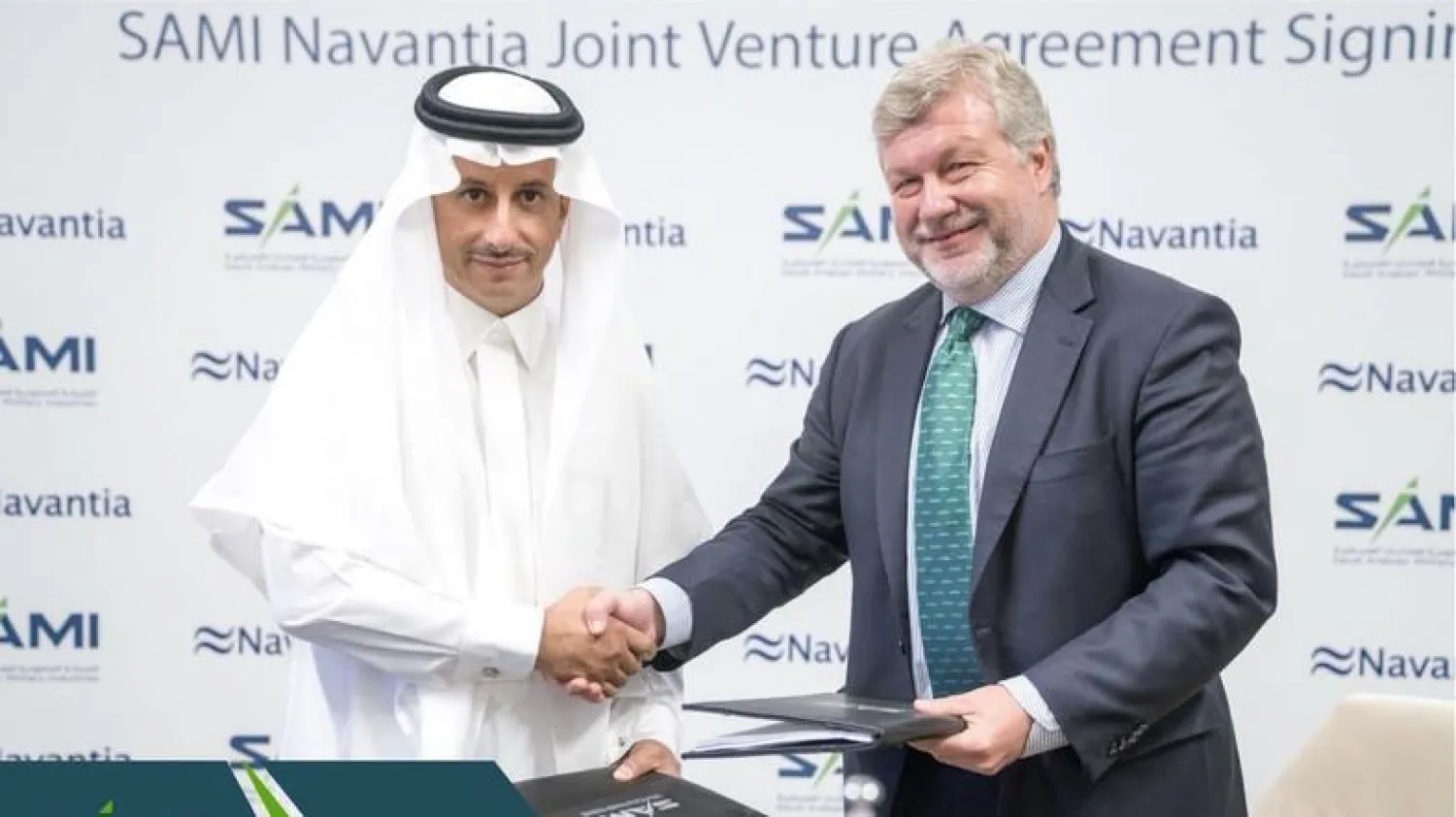

Saudi Military Industries, Spain's Navantia Launch Marine Joint Venture

Chairman of Saudi Military Industries Company Ahmed al-Khatib (L) and Navantia Chief Operating Officer Gonzalo Mateo-Guerrero Alcázar. (SPA)
TT

Saudi Military Industries, Spain's Navantia Launch Marine Joint Venture

Chairman of Saudi Military Industries Company Ahmed al-Khatib (L) and Navantia Chief Operating Officer Gonzalo Mateo-Guerrero Alcázar. (SPA)

Saudi Arabian Military Industries (SAMI) and Spain’s state-owned Navantia have launched a joint venture under the name SAMI Navantia Naval Industries to design and build 5 Avante 2200 corvettes with Combat Management System for the kingdom's Ministry of Defense, the official Saudi Press Agency reported on Wednesday.

The signing ceremony was held in the Saudi capital Riyadh on Tuesday, in the presence of Chairman of Saudi Military Industries Company Ahmed al-Khatib and Chief Operating Officer of Navantia Gonzalo Mateo-Guerrero Alcázar, along with officials from both parties.

“Navantia is proud of being the first company to sign a binding Joint Venture with SAMI," Alcázar said, adding that this partnership will "allow both parties to develop opportunities, both in Arabia and internationally.”

With a strategic focus on building local capacities, the joint venture will focus on program management and naval combat system integration, system engineering and architecture, hardware design, and software ‎development, testing and verification, prototyping, simulation, and modelling, in addition to the installation and integration of combat systems on the last two vessels of the Avante 2200 project, and logistical support and training programs.

According to Saudi news agency SPA, the new project is expected to support Saudi Military Industries’ efforts to keep 50 percent of military spending within the Kingdom as per Vision 2030 by Saudization of all marine military work.

“We are very proud of His Royal Highness Prince Mohammed bin Salman’s confidence in Navantia and we are committed to partnering with Saudi Military Industries and Saudi Arabia to support their national security and technical development needs,” Alcázar stressed.

The joint venture will also contribute significantly to enhancing the readiness of the Saudi military fleet, as well as creating job opportunities and training for the Saudi youth, thus increasing the contribution of Saudi citizens to the industry.

The revenues of this military joint venture for marine military industries might reach $ 8 billion by 2030.

The agreement for the design and construction of the warships will start this autumn, with the last unit to be delivered by 2022, it was reported in July.



Saudi Foreign Minister Receives Phone Call from French Foreign Minister

zSaudi Foreign Minister Prince Faisal bin Farhan bin Abdullah - File Photo/Reuters)
TT

Saudi Foreign Minister Receives Phone Call from French Foreign Minister

zSaudi Foreign Minister Prince Faisal bin Farhan bin Abdullah - File Photo/Reuters)

Saudi Minister of Foreign Affairs Prince Faisal bin Farhan bin Abdullah received a phone call from Minister for Europe and Foreign Affairs of the French Republic Jean-Noël Barrot, SPA reported.

During the call, they discussed bilateral relations and the latest regional and international developments.


Yemen Presidential Leadership Council President Holds Talks with GCC Sec-Gen

President of the Presidential Leadership Council of Yemen Dr. Rashad Mohammed Al-Alimi - Reuters
TT

Yemen Presidential Leadership Council President Holds Talks with GCC Sec-Gen

President of the Presidential Leadership Council of Yemen Dr. Rashad Mohammed Al-Alimi - Reuters

President of the Presidential Leadership Council of Yemen Dr. Rashad Mohammed Al-Alimi met with Secretary-General of the Gulf Cooperation Council (GCC) Jasem Albudaiwi in Riyadh.

According to a press release issued by the GCC General Secretariat, the two sides reviewed GCC-Yemeni relations and discussed the current situation in the Republic of Yemen, with particular focus on recent developments in the governorates of Hadramout and Al-Mahrah. Albudaiwi affirmed that all efforts are being exerted and supported to enhance security and stability in Yemen.

Dr. Al-Alimi commended the stances, leading role, and exceptional efforts made by the GCC states to support Yemen across various fields, contributing to enhancing Yemen’s stability and realizing its development, SPA reported.

Furthermore, Albudaiwi reiterated the GCC’s steadfast position affirming full support for the Presidential Leadership Council, headed by Dr. Al-Alimi, and its supporting entities, in their endeavours to achieve security and stability in Yemen.

He also underscored the GCC’s support for reaching a comprehensive political solution in accordance with the three references, in a manner that preserves Yemen’s sovereignty, unity, territorial integrity, and independence.


No Damage as Quake Strikes Saudi Arabia’s Eastern Region 

No damage was reported from the earthquake. (SPA)
TT

No Damage as Quake Strikes Saudi Arabia’s Eastern Region 

No damage was reported from the earthquake. (SPA)

An earthquake struck Saudi Arabia’s Eastern Region on Wednesday.

Spokesperson for the Saudi Geological Survey (SGS) Tariq Aba Al-Khail said no damage casualties were reported in the 4.0-magnitude quake.

The earthquake resulted from tectonic stresses from the collision of the Arabian and Eurasian geological plates in the Zagros Mountains of Iran, which activated existing faults in the Earth's crust in Eastern Region of the Kingdom, he said.