



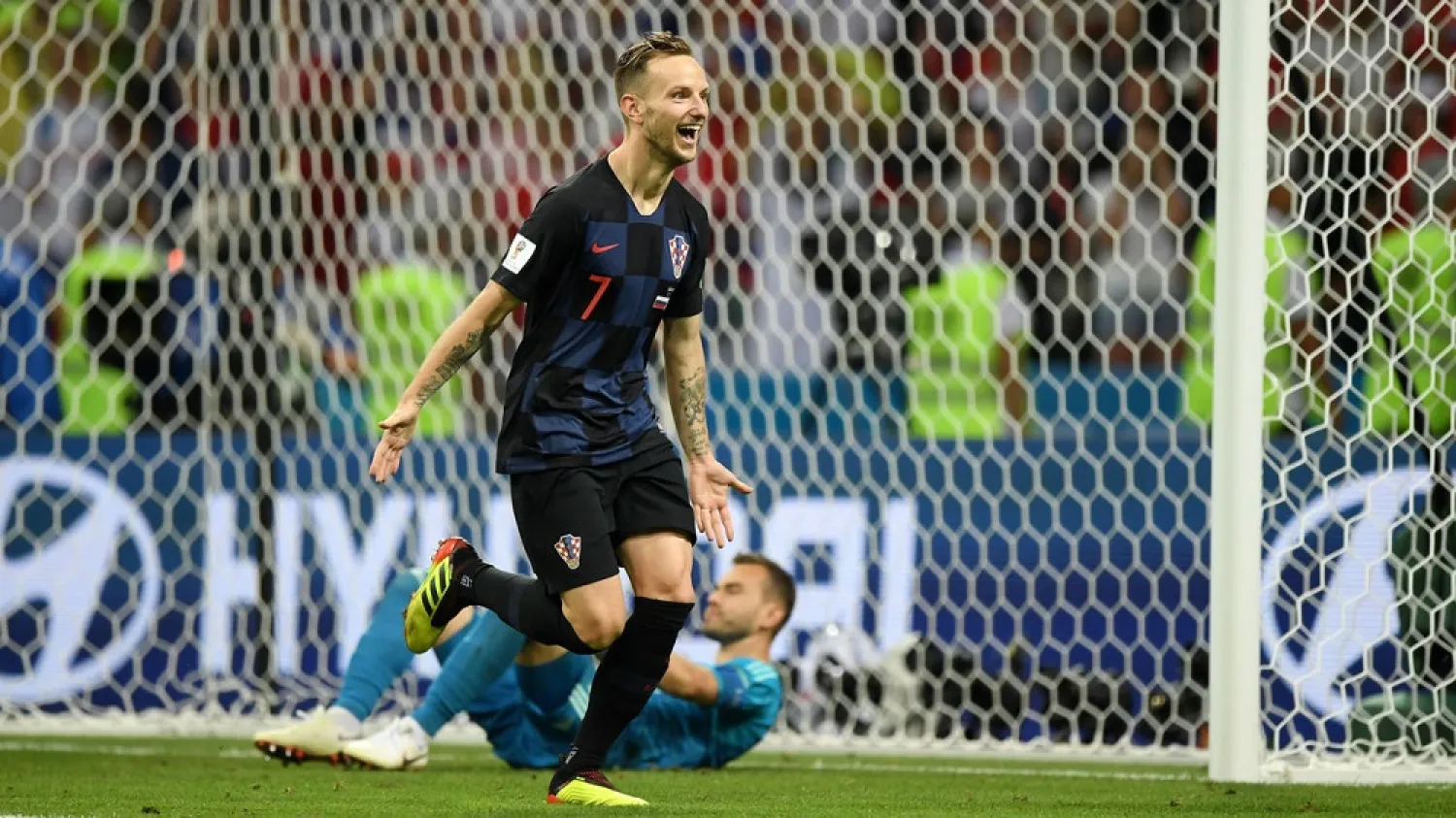

The Barcelona and Croatia midfielder talks about playing England at the World Cup with a virus, how to stay calm when taking penalties and post-tournament exhaustion
Ivan Rakitic packed his bag, kissed his family goodbye and said see you on the 15th. It was early June and he was not planning to be back until mid-July, four days after his daughter’s birthday. His wife, Raquel Mauri, told him he had better explain, so he made a promise: “I told her: ‘Don’t worry, when it’s over we’ll have a big party,’” he grins. “And I kept my word.” The day Althea turned five, he was still in Moscow. That night he called, wished her happy birthday and said sorry: daddy wasn’t coming home just yet. He had a World Cup final to play.
“Nobody had us down as finalists, but the idea was always to reach the last day; I didn’t want to be back sooner,” he says. Just like Sunday’s Nations League match, England stood between Croatia and a final. A final four, this time; the final then. Kieran Trippier put England ahead and around the Luzhniki they sang about football coming home, 52 years later. Rakitic, though, remained convinced he was not. “At half-time we had faith,” he says. “It was a brilliant goal, the game turned their way but we didn’t feel they were better or that it was lost, maybe because of what had happened before.”
Belief had built early, growing with every step, a sense of destiny; by the time they met England, there was a sense of mission about Croatia, a kind of indestructibility. Rakitic says their opening victory against Nigeria got them thinking “maybe we’ll be OK”. Then came the hammering of Argentina – “we had to ensure the ball didn’t reach Messi” – victory over Iceland and two penalty shootouts, first against Denmark then hosts Russia. And that, he insists, “is no coincidence”.
Both times, he scored the decisive penalty. “If I told you I was as calm as I’d be taking any penalty, I’d be lying,” he says, “but …” Still, he looked calm and, listening to him now, he sounds it too. “We’re a small country but there are Croatians in Australia, South America, Africa, the other side of the world, and you think: ‘I can make history with my “brothers”.’ Mostly, though, you think about ‘nothing’: conversations with my wife, FaceTime with my daughters, everyday things.”
Rakitic’s mother-in-law had joked that his dog takes better penalties; his wife, though, has a “sixth sense” and was more optimistic. “Before Denmark, she had a feeling it would go to penalties and I’d get the winner, so I was thinking: ‘Bloody hell, if I score, she’s right.’ I don’t think it’s a lottery. If we close our eyes, maybe, but it’s not like that. A lottery is you calling and saying: ‘You’ve won a prize.’ Well, thanks. Something falls into your lap. But this is about football, quality.”
Against England, there was no need for penalties. Rakitic talks eloquently about the tactical analysis at half-time, the key roles played by John Stones and Jordan Henderson and the need to apply pressure higher and more consistently, denying them a way out. He describes England as an “organized” team with “well-rehearsed” movements, and traces the team’s shifts since the summer, insisting that their victory in Seville was no fluke and dismissing suggestions that they were merely beneficiaries of a kind draw in Russia, noting “no one gives you anything for free”. But he also talks about Croatia’s clarity, their confidence in Moscow – and that was borne out.
Ivan Perisic equalized, a post was struck, and while it went to extra time, the tilt felt decisive. It did to Croatia, certainly. “We could see it in those first 15, 20 minutes when, honestly, they didn’t know what to do,” Rakitic says. “You feel the control, you feel happy, comfortable. They’re finding it harder to reach your goal and you’re getting closer to theirs. You even think: ‘Extra time? Fine, no problem.’”
No problem? Some expected Croatia to collapse; it was their third consecutive match going to extra time. “Yeah, and probably our best,” Rakitic laughs. “There was a bit of luck with our second goal, it fell to Mario Mandzukic, but there was [already] this feeling: no pasa nada. I played with fever – I had a virus – but it gave me great strength knowing we were in a good place.”
Soon, they were in the very best place. “I congratulated Gareth Southgate first, but it was a moment of madness,” Rakitic says. “Someone said we showed a lack of respect because we didn’t shake hands afterwards but you have to understand what it meant. A country like Croatia – I don’t know how many inhabitants London has, probably double our entire population – had reached the final. It’s not that we disrespected England, it’s just that you feel like running to hug every Croatian on the planet. Inside, you feel … I don’t know, you can’t explain it.”
Speaking of respect, Luka Modric suggested that in England they underestimated Croatia, motivating them further. Had they? “Well, we all saw Football’s Coming Home,” Rakitic says. And that offended you? “Offended? No. It’s something positive you created around the team that wasn’t [designed] to offend, although we thought: ‘Yeah, but you still have to play us.’ I understand that a country – the football country – had that desire, and England came close. It was good marketing, and we tried something similar with our hashtag #family, but we thought: ‘Now more than ever, we want it to be coming home to us’.”
It almost did. Croatia were in the final, but in what physical shape? Did exhaustion cost them? It is something Rakitic believes proved more relevant post-World Cup than it was then. Croatia lost 6-0 to Spain in September and were largely outplayed by England during a 0-0 draw behind closed doors in Rijeka, prompting him to insist: “That game was forgotten immediately; it could have been a party but no one will ever talk about it. Football’s nothing without fans; we need different punishments.” Now Croatia have recovered, he says: Thursday’s wild 3-2 win over Spain means that another victory over England, this time at Wembley, would mean another “final”, although Rakitic will not play in that one after being ruled out with a hamstring injury.
“A lot happened in a short time after the World Cup,” says Rakitic. “Some important players retired [Danijel Subasic, Vedran Corluka, Mandzukic], we had three of four injured, and we don’t have 200 players like England. Big nations’ coaches drive themselves mad picking a squad; with us, it’s simpler. Spain can change eight top players; we can’t. And against them, we played 20 spectacular minutes, but then every shot they took was an amazing goal.
“I don’t think it’s coincidence that many of our players started the season late, or have been injured or exhausted. I played maybe 70 games last season, practically two seasons in one, and after the World Cup, those first days home were like …” Rakitic puffs out his cheeks. “There was this bajón, a slump, where I didn’t want to hear anything, see anything. Genuinely, I was completely exhausted, empty inside and out. At the time, though, after the semi-final in Russia, there’s so much joy it gives you strength: ‘If I have to play again tomorrow, I’m up for it.’”
Not tomorrow, but four days later – five for France – Croatia did play again. For the first time, Rakitic’s family traveled. It was his 99th cap. Born and raised in Switzerland, which he calls a “model” of “coexistence”, as a teenager he took a decision he “wouldn’t wish on any kid” and chose to represent his parents’ country. He insists he feels Swiss and a little Spanish, but is Croatian “to the final hair on my head”, and recalls a package arriving in Möhlin during the 1998 World Cup containing Croatia shirts for him and his brother. Now, his team had gone further. How did he feel, standing there pre-final, national anthem playing?
“That’s a great question,” he says. “You think …”
There is a long pause. Eventually, he says: “You feel a pride so strong that if Superman flew down, he couldn’t drag you away; he couldn’t shift you, so powerful is the desire, the will. It’s amazing. You experience emotions you’ll never forget. It’s unique. I’ve been fortunate to win the Champions League but, with respect, even that doesn’t come close. You think: ‘OK, stop everything, let’s play.’”
So, they did. They played well too, but didn’t win. France scored from a nonexistent free-kick and were awarded a debatable penalty by VAR. “Don’t talk to me about VAR; I’ve dreamed about it a thousand nights,” Rakitic says. “That was maybe our best game. For an hour we were better than them, far superior. You can see it in your opponents’ faces sometimes and we could see that France didn’t know how to stop us, how to control us, how to get out, to attack. They were uncomfortable.”
“In that final, luck was on France’s side. The first goal comes from a free-kick that’s not a foul and VAR could have intervened because Pogba was offside. Then VAR didn’t get the penalty wrong exactly but if he hadn’t given it there wouldn’t have been many complaints. If there’s a penalty, I see it once and I know; I don’t need to see it 10 times. Anything that improves football is welcome but with VAR play stops, football loses that something. You score and can’t celebrate, you wait to see if the referee’s finger’s in his ear or he’s …”
Rakitic draws the imaginary TV screen and he’s back in Moscow. “You go over and over it, especially the first night. You say to yourself, to each other: ‘You were the better team, you created chances, France weren’t comfortable.’ There are those goals, then Pogba shoots, and it bounces back to him for another shot. Mbappé’s going at 50kph and scores – we’re caught on the attack, wrong-footed. Little things didn’t go for us. But we played a great, great game and our heads never dropped despite losing for some time.
“You think: ‘Bloody hell, we did everything to win.’ And then a combination of having it taken away from you and them winning it, and … pffff … it doesn’t feel right. But that’s football. The best team doesn’t always win; the team that gives the most isn’t always rewarded. And I don’t know if I’ll make it to the next World Cup. To have come so close and not to have won it, and like that. You congratulate France, who deserved to be champions, but we could have been deserving winners.”
Croatia celebrated as if they were, half a million on the streets, and rightly so; what they achieved was as historic as it was unexpected. “Some things can’t be explained or planned, it just happens,” he says. “The atmosphere was different to previous tournaments. It’s not easy, 23 players on top of each other for a month and a half, but it was spectacular. You miss your family, your children, your friends, but we enjoyed the day-to-day. After the World Cup we said to each other: ‘Wow, it’s over, so fast. It’s gone, what a shame.’” It was time to head home. Ivan Rakitic had a party to go to.
The Guardian Sport


