Technique Developed to Help Disabled People Use Desktop PCshttps://english.aawsat.com/home/article/1479971/technique-developed-help-disabled-people-use-desktop-pcs
Technique Developed to Help Disabled People Use Desktop PCs
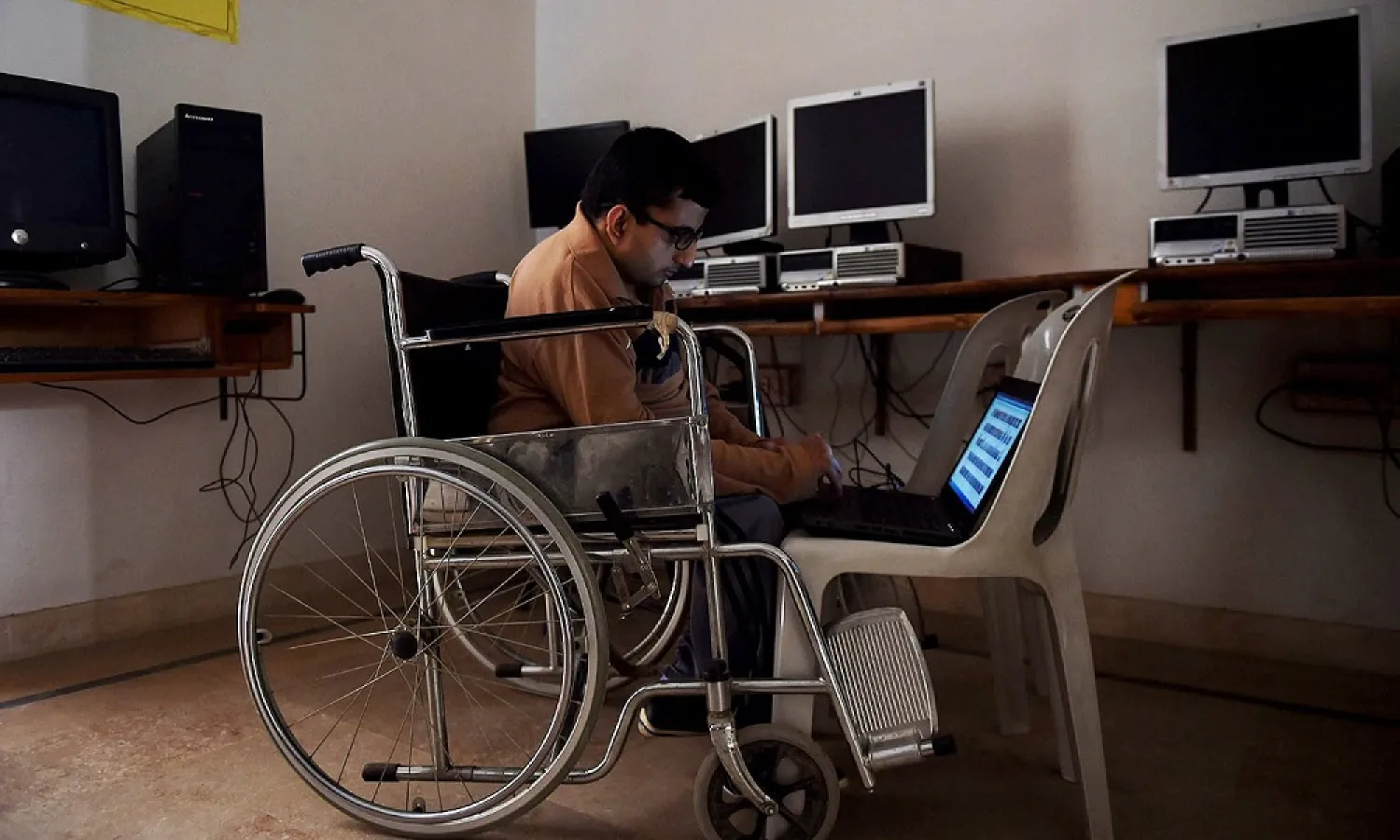
A disabled Pakistani student uses a laptop at a computer training center in Karachi. (AFP)
San Francisco, London - Asharq Al-Awsat
TT
TT
Technique Developed to Help Disabled People Use Desktop PCs
A disabled Pakistani student uses a laptop at a computer training center in Karachi. (AFP)
US researchers have developed a new tcehnique that allows disabled people to use tradition desktop PCs without assistance, reported the German news agency (dpa).
A team from the BrainGate consortium, which specialized in adapting modern technology to serve disabled people, managed to develop a new interface that responds to a disabled person's needs.
It uses a small sensor fixed on the head, above the motor cortex to record neural activity directly and transform it into motor signals to navigate on commonly used tablet screens.
The sensor is an aspirin-sized implant that detects the signals associated with intended movements produced in the brain. Those signals are then decoded and routed to external devices.
BrainGate researchers used this technique to allow people to move robotic arms or to regain control of their own limbs, despite having lost motor abilities from illness or injury.
The innovation allows a disabled person to operate various apps usually used on a tablet, including email, music streaming, video sharing and web browsing.
The Techxplore website quoted Jaimie Henderson, a Stanford University neurosurgeon, who said: "For years, the BrainGate collaboration has been working to develop the neuroscience and neuroengineering to enable people who have lost motor abilities to control smart devices just by thinking about the movement of their own arm or hand."
"It was wonderful to see the participants express themselves or just find a song they want to hear," he added.
How AI Supports Real-Time Decision-Making in Saudi Arabia's Airports and Portshttps://english.aawsat.com/technology/5294121-how-ai-supports-real-time-decision-making-saudi-arabias-airports-and-ports
Airports and ports require an intelligent operational layer that connects data, processes, and resources to support better decision-making during disruptions. (Adobe)
How AI Supports Real-Time Decision-Making in Saudi Arabia's Airports and Ports
Airports and ports require an intelligent operational layer that connects data, processes, and resources to support better decision-making during disruptions. (Adobe)
Infrastructure investment in Saudi Arabia is entering a new phase, one measured not only by the airports, ports, logistics corridors, energy systems, and digital infrastructure that have been built, but also by the ability of these assets to operate as a single integrated system.
The next source of value will not come solely from expanding capacity, but from improving the decisions that determine how aircraft, ships, cargo, energy, and data move from one moment to the next. At this stage, artificial intelligence becomes part of the operational equation itself: how can major infrastructure assets be transformed into operations that are more efficient, reliable, and resilient in the face of disruptions?
Bilal Abu-Ghazaleh, Founder and CEO of 1001. (Company)
In an exclusive interview with Asharq Al-Awsat, Bilal Abu-Ghazaleh, founder and CEO of 1001, a startup developing sovereign artificial intelligence that recently raised $30 million in a Series A funding round, said the difference between building assets and operating them efficiently is the difference between capacity and performance.
"Building an airport, a port, or a logistics corridor gives you capacity, but it does not automatically ensure the best use of it," he said. "A larger asset does not manage itself more efficiently. Instead, it creates a greater number of decisions that must be made correctly."
Intelligence Built into the Design
This idea lies at the heart of understanding the next phase of Saudi Arabia's transformation. Every new asset adds not only physical space or operational capacity, but also an entirely new network of relationships and interdependencies. A new airport terminal, an additional port berth, or a new logistics corridor does not function in isolation from the rest of the system. A delay involving a single aircraft or vessel can alter gate or berth assignments, triggering a chain reaction that affects truck movements, customs operations, warehouses, delivery schedules, and workforce allocation.
Abu-Ghazaleh explained that adding a new terminal, berth, or corridor also means "adding thousands of new connections between things that influence one another." Given the speed and scale of Saudi Arabia's development, he said, no human team, regardless of its experience, can keep track of all these relationships and consistently make the best decisions in real time.
Yet this challenge also presents an opportunity. Countries with aging infrastructure are often forced to introduce artificial intelligence after decades-old systems are already in place. Saudi Arabia, by contrast, can embed an intelligent operational layer into new projects such as King Salman International Airport and newly developed ports and rail networks from the design stage rather than years after operations begin.
Abu-Ghazaleh argued that "most countries around the world are stuck trying to bolt artificial intelligence onto legacy systems," whereas Saudi Arabia has the opportunity to design intelligence directly into its infrastructure assets from the outset.
Solving Complex Problems
At airports and ports, the most difficult challenges are not always a lack of capacity but a lack of coordination. That is why building more facilities, hiring more staff, or introducing another conventional software system is not enough. When a vessel is delayed at a major port such as Jeddah Islamic Port, or when a disruption occurs at a large airport, it sets off a chain of decisions: Which berth should be assigned? How should cranes be rescheduled? What happens to trucks and rail operations? How should yards, warehouses, and resources be reorganized?
Abu-Ghazaleh said, "The hardest problems in airports and ports are not capacity problems. They are coordination problems." He stressed that these cannot be solved simply by pouring more concrete or increasing the workforce. Adding more people can actually increase the coordination burden without necessarily providing a unified view of all the interconnected variables.
Conventional software also cannot fully bridge the gap because the core issue lies in fragmented data spread across multiple systems: one for transportation, another for warehouses, a third for enterprise resource planning, and others for customs or maintenance. Each system performs a specific function within its own domain, but none has visibility across the entire operation. The challenge, therefore, is to build a living operational model that unifies data, relationships, and business rules, enabling decisions to be made based on a single, comprehensive view of the system.
Deploying artificial intelligence in critical infrastructure requires human oversight, explainability, auditability, and a record of every decision. (Shutterstock)
The Role of Operational Intelligence
Abu-Ghazaleh emphasized that there is no single starting point for every industry. The greatest benefit from artificial intelligence may lie in improving capacity utilization at an airline, managing disruptions at a port, optimizing cargo flows across a logistics company, or reducing energy consumption at another infrastructure asset. "We don't start by guessing," he said. "We start by understanding the operation from the inside."
According to Abu-Ghazaleh, 1001's methodology places engineers within clients' teams to understand how an organization actually operates, rather than how it appears in diagrams or presentations. These engineers map workflows, data flows, and the highest-value operational challenges before working with operations teams to identify the first use case capable of delivering a measurable impact. They then build what he describes as a "living operational model," essentially a dynamic digital map that captures assets, processes, business rules, and the relationships between them, while updating continuously in real time.
The significance of this approach is that the value extends far beyond a single use case. Once this foundation has been established, subsequent applications can be developed much more quickly. Abu-Ghazaleh noted that while the first use case typically takes the longest to complete, the second and third benefit from the same underlying model, reducing implementation time from around 16 weeks to roughly four weeks. He added that the returns can be substantial, with a single use case capable of generating more than $100 million in value during its first year.
When a Ship Is Delayed
To illustrate the difference between automation and intelligence, Abu-Ghazaleh uses the example of a ship arriving several hours behind schedule. Such an event does not simply alter one arrival time. It disrupts the entire operational plan. The berth assigned to that vessel may now be needed for another ship, while the cranes and crews waiting for it remain idle. The containers it carries are linked to trucks, trains, and delivery schedules that are no longer aligned, even as the yard has already been organized according to the original arrival timetable.
Automation can handle some routine tasks, such as sending an alert, updating a schedule, or reallocating a slot based on predefined rules. But when real-world conditions diverge from the plan, executing a fixed rule is no longer enough. What is required is a complete reassessment of the operation and the identification of the best recovery plan across thousands of variables within minutes.
Abu-Ghazaleh said this is precisely the type of decision that artificial intelligence can improve because it "sees the entire operation at once." It can rapidly develop a new operating plan by determining which berth should accommodate the delayed vessel, how cranes and yard operations should be reorganized, and how trucks and trains should be rescheduled together while accounting for real-world constraints. Even so, this does not eliminate the role of human operators. The proposed plan is presented to the operator along with the reasoning behind it, while the final decision remains under human control.
AI as Part of the Operation
The risks change when artificial intelligence moves beyond analysis into recommendation or execution. At the analysis stage, the system serves as an advisory tool. If it makes a mistake, a human can identify the error before any harm occurs. But once it begins making recommendations that influence the operation of an airport, port, or energy asset, it becomes part of the operational process itself.
Abu-Ghazaleh explained that "failure in these environments is not a software bug in a report. It is a crisis." For that reason, the standard for trust becomes significantly higher. He identified three essential requirements: consistent reliability, the ability to explain the reasoning behind every recommendation or action, and the recording of every step so that decisions can be audited and reversed when necessary.
He added that the system must be governed rather than trusted unconditionally, while human operators must remain in control. The system should earn greater autonomy gradually, "one decision at a time."
This also explains why many AI projects struggle to move from the pilot stage to live operations. The gap is not merely technological. It is also operational and institutional. There is a significant difference between a convincing demonstration and a system that an operator is willing to trust alongside an airport runway or on a port berth. As a result, system governance, auditability, and operational continuity become essential requirements for deployment in critical infrastructure rather than optional features that can be added later.
The Challenge of Incomplete Data
Large-scale operations often contend with fragmented or incomplete data, particularly when they rely on legacy systems. Abu-Ghazaleh believes the answer is not to wait for perfect data, but to build integration and data lineage instead.
"You will never get perfectly clean data from systems that are decades old, and you do not need to," he said. The objective is to bring together scattered data sources within a consistent operational model while ensuring that every recommendation can be traced back to the data, logic, and alternative options on which it was based.
He added that data alone cannot capture everything that happens within an operation. A significant portion of operational knowledge exists only in the minds of the people who manage these systems every day and is not stored in any database. According to Abu-Ghazaleh, 1001 uses AI agents to capture that context directly from operational teams and integrate it into the model alongside system data. When data gaps or conflicts between sources emerge, they should be made visible to the operator rather than concealed, and the decision should be escalated to a human instead of having the system rely on guesswork.
Sovereignty Alone Is Not Enough
Sovereignty remains an important part of the discussion, particularly when it comes to critical infrastructure. However, Abu-Ghazaleh cautions against equating resilience with local deployment alone, arguing that "deploying systems locally does not automatically make them resilient." In his view, two distinct risks must be addressed: the risk of foreign control, and the risk of depending on a single component, facility, or supplier, even within the domestic market.
From this perspective, sovereignty addresses the risk of an external "kill switch" by ensuring that data, models, and infrastructure remain under national jurisdiction. Resilience, however, also requires an architecture that is not locked into a single model, vendor, or location. Abu-Ghazaleh told Asharq Al-Awsat that this is why model- and vendor-neutral infrastructure is essential, along with the ability to operate across both cloud and on-premises environments. He also stressed the importance of dividing systems into distinct components so that the failure of one does not bring down the entire operation.
He summarized the relationship succinctly: "Local control without redundancy and alternatives is fragile, while redundancy without control leaves you exposed." In other words, intelligent national operations require both sovereignty that reduces external dependence and resilient system design that minimizes domestic points of failure.
The Skills That Matter After Computing Infrastructure Is Built
In recent years, many countries have focused on building data centers and expanding computing capacity. Abu-Ghazaleh argues, however, that leadership in artificial intelligence will not be determined by computing power alone, but by applied AI, meaning the integration of intelligence into real-world operations.
"Applied AI is not won in the laboratory," he said. "It is won inside the most demanding live operations."
In his view, Saudi Arabia holds several advantages, including major infrastructure across aviation, ports, energy, and logistics, the ability to move quickly when institutions are aligned, new projects into which intelligence can be embedded from the outset, and the capacity to invest at scale. Turning those advantages into measurable performance, however, requires three capabilities: a data foundation that transforms fragmented systems into a unified decision-making asset, engineers who understand both software and operational environments, and institutional leadership willing to redesign decision-making processes while maintaining governance, security, and auditability.
If these capabilities are in place, computing infrastructure becomes a productive investment. Without them, it risks becoming expensive but underutilized capacity. As Abu-Ghazaleh put it, shortcomings in these areas turn investment into "costly idle capacity."
The Next Measures of Success
Abu-Ghazaleh believes Saudi Arabia's success will be measured by its ability to move beyond building AI infrastructure and begin embedding artificial intelligence into national operations. The true indicators, he said, will be operational rather than experimental.
The first indicator is that AI becomes part of the daily operations of ports, airports, and energy infrastructure instead of remaining confined to pilot projects. "Ninety-five percent of AI never reaches production," he said. The real test is whether day-to-day deployment is reflected in measurable outcomes such as productivity, on-time performance, uptime, and cost.
The second indicator is sovereignty across data, computing infrastructure, and AI models. When critical systems operate using intelligence built on the Kingdom's own data and models, that intelligence becomes a strategic asset that grows with every decision rather than a service that can be priced, restricted, or switched off from abroad.
The third indicator is ensuring that expertise remains within the domestic market through Saudi engineers and accumulated applied experience gained from each successful deployment.
In this sense, the next phase is not simply about adding artificial intelligence to existing infrastructure. It is a test of whether the entire system can transform major physical assets into smarter, more intelligent operations.
Cerebras Says to Invest Billions in Europehttps://english.aawsat.com/technology/5293979-cerebras-says-invest-billions-europe
A person is silhouetted next to the logo of the first Global Dialogue on AI Governance, in Geneva on July 6, 2026. (Photo by Fabrice COFFRINI / AFP)
US chip maker Cerebras, a US rival of Nvidia, told AFP on Thursday it will invest "several billion dollars" in Europe to boost the computing capacity of its AI data centers on the continent.
"This is a massive expansion" to meet the "rapidly growing" needs of European customers, chief executive Andrew Feldman told AFP in an interview on the sidelines of a Paris artificial intelligence conference.
The Californian company operates three data centers in France, Finland and Norway, which are to be expanded to reach 200MW of computing capacity by 2027.
US Crackdown on Top AI Fuels Open-Source Surgehttps://english.aawsat.com/technology/5293972-us-crackdown-top-ai-fuels-open-source-surge
Early suspicions about Chinese AI models as a security threat are somewhat fading. (AFP)
TT
TT
US Crackdown on Top AI Fuels Open-Source Surge
Early suspicions about Chinese AI models as a security threat are somewhat fading. (AFP)
The US government's shock moves to restrict access to top artificial intelligence systems from Anthropic and OpenAI have sparked growing interest in open-source models -- especially ones from China.
The de facto bans from an anti-regulation White House blindsided the tech world, which had grown accustomed to AI labs releasing ever more powerful models with nary a worry of government intervention.
The episode has thrust a long-simmering debate to the fore: open versus closed AI.
Most of the best-known AI models -- like OpenAI's ChatGPT or Anthropic's Claude -- are "closed," meaning the company keeps the underlying code and data locked away.
Users can access the AI via an app or website, mainly through a subscription, but the company controls who gets in and can shut down access at any time.
"Open-source" or "open-weight" models work differently: the developers release the model's core files for anyone to download, modify and run on their own computers. Once released, no one -- not the company, not a government -- can take them back.
In early June, the Trump administration ordered Anthropic to block non-Americans from using its most powerful -- and closed -- models, Mythos 5 and Fable 5.
Faced with the complexity of screening users, the startup simply pulled the models offline entirely.
Shortly after, OpenAI agreed to let the government approve every customer for its newest model, GPT-5.6.
"If everything you need to do has to be on a specific frontier model, that makes whatever you're building a whole lot less reliable" when it is suddenly unavailable, said Oren Michels, co-founder and CEO of Barndoor AI.
Haitham Mengad, co-founder of Stems Labs, a startup focused on AI-powered music creation, felt the disruption firsthand.
"Fable has been a game-changing model for me. Honestly, when they took it off, it was the first time that I realized... it's almost like a drug," he recalled.
The Mythos episode "was a powerful moment" for seeing open source as an alternative, Mengad said.
'Being flexible'
Open models were already gaining fans because using closed AI keeps getting more expensive.
Around the same time, China's Zhipu AI (also known as Z.ai) released GLM-5.2, an open model that performed nearly as well as top offerings from Anthropic and OpenAI on several benchmarks.
"GLM-5.2 is free to download, fine-tune, and run on an enterprise's own servers, putting pricing pressure on frontier labs at the same time that access looks shaky," AI analyst Andrew Curran noted.
On OpenRouter, a platform that routes requests across different AI models, Google, Anthropic and OpenAI's combined share of usage dropped from 55 percent to 33 percent between January and June.
China's open DeepSeek now leads by a clear margin.
"You want to be as flexible as you can be. Maybe a year and a half ago some large company might say we bought Anthropic or we bought OpenAI, and now no one, no one buys only one," said Michels.
Among Western companies, France's Mistral stands largely alone in championing open models. US tech giant Meta, once a vocal open-source advocate, has stepped back from that.
Meanwhile, early suspicions about Chinese AI models as a security threat are fading, at least somewhat.
"I don't think there's any risk, to be honest," said Mengad. The fears are more "psychological, emotional than rational."
Once you download an open model and run it on your own hardware, the company that made it -- Chinese or otherwise -- has no access to your data or control over how you use it.
Still, some experts think the government crackdown could also end up coming for open models as they become more powerful.
"If Mythos-level models are considered risky, China will also not want them to be open," said Ethan Mollick, a professor at the University of Pennsylvania and a leading voice on AI -- meaning governments everywhere, not just Washington, may want to keep top-tier AI locked down.
لم تشترك بعد
انشئ حساباً خاصاً بك لتحصل على أخبار مخصصة لك ولتتمتع بخاصية حفظ المقالات وتتلقى نشراتنا البريدية المتنوعة