

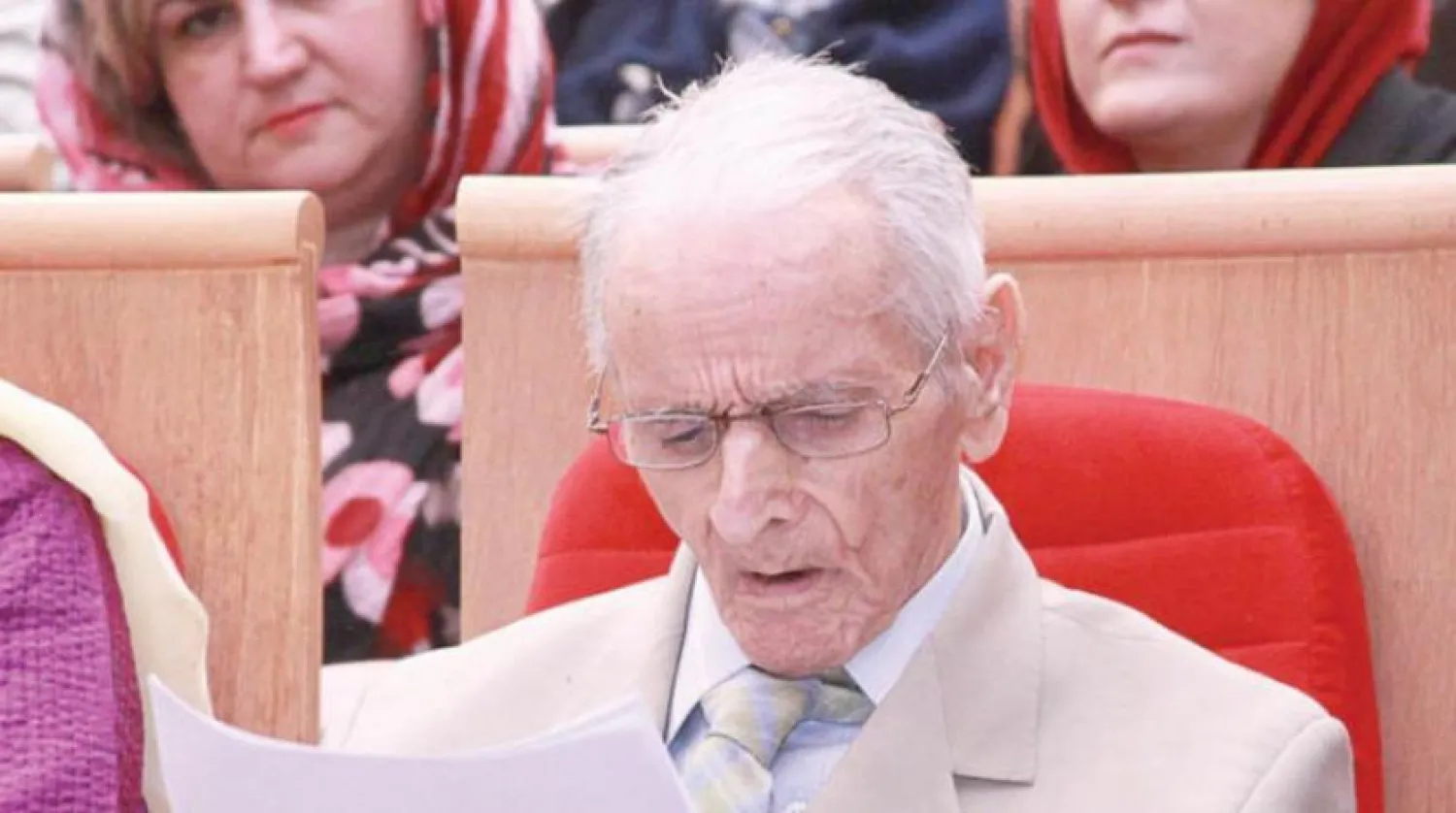

The Last Father of Iranian Communsim Passes Away

Veteran journalist, author and political leader Anwar Khamehi
TT

The Last Father of Iranian Communsim Passes Away

Veteran journalist, author and political leader Anwar Khamehi

Earlier this week, the man known in Iran intellectual circles as the last historic figure of Iranian Communism passed away aged 102. Veteran journalist, author and political leader Anwar Khamehi was one of the almost legendary “53” Iranian intellectuals who, thrown into prison at the start of the Second World War, decided to create the Tudeh (Masses) Party in 1941.

In a life spanning more than a century, Khamehi passed through many epiphanies as hardline Stalinist, Social Democrat, liberal and, eventually, a mild Iranian nationalist. In the process he also created a highly respected body of literary work consisting of 23 books and hundreds of essays and magazine articles.

I first came to know him in the late 1960s when, after more than a decade of exile, he had shed his “Utopian illusions” and was trying to focus on a new literary and journalistic career.

Like many founders of the Tudeh Party, Khamehi had a distinguished family background. On his mother's side he was a descendant of the Qajar Fatah Ali Shah, and on his father's side he was a great grandson of prominent theologian Mullah Muhammad Naraqi. His father was a leading figure in the Constitutional Revolution of 1905-6 and Editor-in-Chief of the newspaper Habl al-Matin (Firm Rope) which was dubbed as the mouthpiece of the reform movement.

After a stint in prison along with other Tudeh leaders, including his guru Dr. Taqi Arani, Anwar operated as a party cadre and assigned various missions, including a memorable one to recruit members among oil workers in Khuzestan.

However, as Stalin's cult of personality reached its peak shortly before the despot's death in March 1953, Anwar was looking for other avenues to spend his political energies.

He found it in the so-called Third Force ( Niruy-e-Sevovom) splinter group led by two Tudeh dissidents, Khalil Maleki and Ishaq Yeprem. When that party also failed to satisfy him, Anwar decided to go into exile and spent almost 16 years away from Iran, mostly in France, where, leaving his initial scientific education behind, he switched to studying politics and history obtaining a Ph.D., but ending up in Mexico.

Years later when he returned to Iran, I made his acquaintance as Editor of the mass circulation weekly Etelaat Haftegi magazine. Khamehi spoke of the "unbearable pains of exile". He claimed that, while in exile, each morning as he left home to go to university or to work, he fantasized about suddenly hearing someone speak Persian. The only way to realize that fantasy, impossible in Mexico, was to return home.

By the time he came back home, Anwar was persuaded that Communism had been little more than an illusion, if not an actual fraud concocted by power-hungry pseudointellectuals.

However, he never regretted his “Marxist years” as he believed that Marxism was an important feature of modern political life on a global scale and that it was important for Iranians to be familiar with it.

Back from exile, he was surprised when the Shah’s much dreaded secret police didn’t even bother to call him in for questioning. "They just ignored me,” he quipped. “ May be they thought that I had died long ago!”

However, thanks to his knowledge of the world and journalistic talents he was quickly reintegrated into the intellectual elite of Tehran and rose to edit some of the most influential publications in the capital. He also wrote and translated a number of books, leaving behind examples of a brilliant and highly disciplined prose.

The word I always associated with Khamehi, who, in the 1970s also wrote occasional columns for the newspaper Kayhan, was "pure heartedness." (khosh-qalbi in Persian). He was a good human being, modest but self-reliant, and, above all, respectful of everyone from the highest to the most humble.

But what most endeared him to me was his boundless love of Iran, rooted in his passion for Persian poetry. He once claimed that it was poetry that had sustained Iranian culture for over a millennium. "It is a gift to be born in our culture," he claimed. "But it is also a great responsibility."



UK PM Announces Ban on Social Media for Under-16s

 Britain's Prime Minister Keir Starmer attends a press conference at Downing Street in central London on June 15, 2026, to announce government action to protect children online. (Pool via Reuters)
Britain's Prime Minister Keir Starmer attends a press conference at Downing Street in central London on June 15, 2026, to announce government action to protect children online. (Pool via Reuters)
TT

UK PM Announces Ban on Social Media for Under-16s

 Britain's Prime Minister Keir Starmer attends a press conference at Downing Street in central London on June 15, 2026, to announce government action to protect children online. (Pool via Reuters)
Britain's Prime Minister Keir Starmer attends a press conference at Downing Street in central London on June 15, 2026, to announce government action to protect children online. (Pool via Reuters)

British Prime Minister Keir Starmer on Monday announced a forthcoming total ban on social media for children under 16, saying that such platforms are "making children unhappy".

Starmer said that the government "will ban access to social media for all children under the age of 16", warning that these platforms are "exposing them to content that is dangerous" and "designed to be addictive".

The government said the ban will "include platforms like Snapchat, TikTok, YouTube, Instagram, Facebook and X" but not messaging services such as WhatsApp.

He added he hoped to pass the regulation by late December and for the ban to come into force in spring next year.

The prime minister also said the government would go further and take "world-leading action on gaming services and live streaming platforms".

The government said in a statement it would also be considering overnight curfews and breaks in infinite scrolling for under 18s, and would announce more detail in July.

Starmer said the upcoming ban was influenced by the experience of Australia, which in December became the first nation to ban people under 16 from social media.

The announcement follows a government-led consultation where British teenagers trialed social media bans and time limits on apps.

A spokesperson for YouTube responded with a warning that such a blanket ban would push children towards "less safe services".

Starmer said that the government was "taking action" on gaming services and live streaming platforms that allow strangers to contact children.

"Is there a situation in the offline world where you would just let your child pair up with a stranger? An adult that you don't know about? No. So we're taking action on that," he said, without giving details.

Canada's culture minister last week introduced legislation that would ban children under 16 from having social media accounts and require AI chatbot services to limit production of harmful content.

The proposed Digital Safety Act makes Canada the latest in a number of countries cracking down on social media platforms over concerns of harm to children.

Indonesia began enforcing its own social media ban for users under the age of 16 in March, while several European governments have announced their desire to make similar moves.

- 'Moral responsibility' -

The UK government's consultation on the issue, which closed in late May, attracted about 116,000 contributions, making it the second-largest response ever received.

Over 83 percent of parents who responded said the risks posed by social media outweighed the benefits for children, with 91 percent backing a minimum age of 16.

The UK announcement comes a week after the government said tech giants must stop children in Britain from being able to send and receive nude images on their devices.

Britain's interior ministry said it was giving companies including Apple and Google three months to introduce safety features to block children from taking and accessing naked photos on phones and tablets.

If they failed to do so, the government would introduce legislation forcing them to activate the technology, it warned.

Starmer's center-left Labour government said technology companies had a "moral responsibility" to "protect children from coercion, abuse and sextortion".

A law change would stop children from being able to access pornography, while also making it more difficult for child abusers to target children, it said.

According to analysis by the Internet Watch Foundation charity cited by the government, 91 percent of online child sexual abuse reports recorded in 2024 contained self-generated content from children themselves.


Sydney Reopens Beach Under Heavy Patrols After Shark Attack

A beach closed sign is displayed at Coogee Beach in Sydney on June 13, 2026. (AFP)
TT

Sydney Reopens Beach Under Heavy Patrols After Shark Attack

A beach closed sign is displayed at Coogee Beach in Sydney on June 13, 2026. (AFP)

Sydney's Coogee Beach reopened on Monday under the watchful eyes of lifeguards and jet ski patrols, after a shark attack over the weekend left a woman critically injured and prompted a safety review at Australia's popular shorelines.

The 35-year-old victim was swimming about 30 meters (100 feet) from the shore on Saturday morning when she was bitten by a three-to-four-meter-long shark, sustaining serious injuries to her arms and lower left leg. She remains in hospital in stable condition.

Local authorities urged swimmers to be cautious.

"Our Lifeguards will continue JetSki patrols throughout the day, and Surf Life Saving NSW is operating a shark-spotting drone at Coogee Beach," Randwick City Council said in a statement.

Coogee, south of iconic Bondi ‌Beach, is symbolic ‌of Sydney's coastal lifestyle. The beaches, which lie east of the city, are famous ‌for ⁠their golden sands ⁠and dramatic coastal cliffs and draw millions of tourists from around the world every year, making water safety a high-stakes priority for the authorities.

"I wouldn't even dip my toe in at the minute," said local resident Ryan Brady. "I used to do a few lengths across the beach but I'd always have in the back of my mind is there sharks around but after, after the weekend, no. It's kind of a nail in the coffin for me."

Saturday's attack was the latest in a series of shark encounters off Australian beaches.

The week before, a man died after ⁠being attacked by a shark while fishing off the coast of Western Australia. Last ‌month, a 39-year-old man died after being attacked while fishing on ‌Queensland's Great Barrier Reef. Ten days before that, a 38-year-old was fatally mauled off an island near Perth in Western Australia.

Dozens ‌of beaches along Australia's east coast were closed in January after four shark attacks in two days.

While ‌shark encounters remain statistically rare, a Reuters analysis of data from the Australian Shark Incident Database shows a gradual rise in encounters, with the country averaging nearly 29 incidents per year over the last decade, up from an average of roughly 16 per year in the 2000s.

"We have seen more shark bites recently but that's probably more to do with population ‌increase," said Leonardo Guida, shark scientist at the Australian Marine Conservation Society.

Climate change was also a factor, he added, with warmer waters prompting people to go ⁠to the beach more ⁠often, and also changing sharks' movements.

"Climate is changing how our ocean works and sharks are just one aspect of it," Guida added.

SHARK CULL DEBATE

The attack has forced a regulatory review of aerial surveillance.

While emergency drones were deployed on Monday, Coogee normally faces strict flight restrictions because it sits directly beneath the flight path for Sydney's airport.

New South Wales Agriculture Minister Tara Moriarty said on Monday that nothing was off the table as the state considered safety measures.

Some experts said Saturday's attack was by a white shark, a protected species under environmental laws. However, the attack has again led some to suggest a cull, a highly contentious issue.

“It’s so wrong that we don’t cull sharks after attacks,” former conservative Prime Minister Tony Abbott said in a video posted on his Facebook page.

Australia already culls sharks as part of its shark meshing program and additional culling was unlikely to produce a measurable difference, said Emeritus Professor Rob Harcourt, from the Sydney Institute for Marine Science at Macquarie University.

"Other safety measures, including drones (and) smart drum lines, and their help with understanding and then predicting when foraging sharks are likely to be present, have already shown to be of high efficacy," he said.


Burnt-Out Indonesians Beat the Blues with Children’s Games

Members of the "Playing Community" group react as they play an Indonesian children's game at the Gelora Bung Karno Stadium compounds in Jakarta on May 22, 2026. (AFP)
TT

Burnt-Out Indonesians Beat the Blues with Children’s Games

Members of the "Playing Community" group react as they play an Indonesian children's game at the Gelora Bung Karno Stadium compounds in Jakarta on May 22, 2026. (AFP)

Flushed and sweating, 31-year-old Annisa Enggracia Fidel runs back and forth to defend her fort from invaders -- hundreds of fellow adults all beating the blues by playing a nostalgic Indonesian children's game.

The tech professional is a member of Jakarta's "Playing Community", a group that gathers after work every Friday to let off steam in ways not usually associated with grown-ups.

Similar get-togethers have sprung up elsewhere in the Southeast Asian nation as larger numbers of burnt-out workers seek novel solutions for handling stress and maintaining mental health.

"The more energy we exert, the more we sweat, the more our stress is released," Annisa told AFP at the capital's main stadium, where about 500 people had come together.

"Of course, our happy chemicals are released too -- endorphins -- and that's what makes us feel more energized and motivated," she said after her game, which was enthusiastically cheered on from the sidelines.

Rapid urbanization has transformed Jakarta's metropolitan area -- now recognized as the world's biggest, with more than 42 million residents.

The expansion has brought faster-paced lifestyles, grinding traffic jams, regular flooding, severe air pollution and a dire shortage of public green spaces to unwind.

The Playing Community dates from 2024, when founder Akihiko Akira was battling work pressure and personal problems.

"It started because, like most Gen Z folks, I was stressed out by work, burnt out with life," he said.

The 24-year-old office worker found solace in "lompat karet" -- a game from infancy that involves jumping over a long rope made from braided elastic bands.

Videos he posted were met with a surge of interest from others wishing to join.

"The games make us reminisce about our childhood... not only can we be healthier, but we can also enjoy that nostalgic feeling with our inner child," Akira said.

That "can help release the stress inside of us, inside of our soul", he told AFP.

- Inner child revived -

The concept has since spread beyond Jakarta to other parts of Java island, such as Bandung and Yogyakarta, as well as to the tourist island of Bali.

Participants -- sometimes up to 1,000 per session -- are not charged a fee. They only need to bring their own water bottles and comfortable clothing.

Many activities are high-energy, including Annisa's beloved fort-guarding game -- known as "bentengan" -- and a variant of tag called "petak jongkok".

But some opt for less physically demanding escapism in the form of "congklak" -- a counting game using seeds or stones -- or "bola bekel", similar to jacks.

IT developer Imam Hidayat said he joined the Jakarta group after jogging past a Playing Community session last year.

"I was very stressed out because of deadlines, especially since I work in a corporate bank," said the 27-year-old.

"It makes me so happy. I played two games tonight, including 'bentengan' with many other people."

Initiatives like Playing Community are invaluable as a drug-free anti-depressant, said Jakarta-based psychologist Ratih Ibrahim.

"There's a sense of togetherness; you meet new people, and in that moment, you become human again," she told AFP.

Intan Permata, a 36-year-old homemaker and mother of three from neighboring Banten province, agreed.

"In our daily lives, we get so caught up in school issues, the kids, the house... It really feels like such a refreshing break," she told AFP.

"My inner child suddenly returned, all the sore muscles disappeared, and I feel happy. Very happy," said Intan.