Andrey Arshavin: Farewell to a Talented but Frustrating Enigma

 Andrey Arshavin celebrates after scoring the first of his four goals for Arsenal against Liverpool at Anfield in 2009. Photograph: Dave Thompson/PA
Andrey Arshavin celebrates after scoring the first of his four goals for Arsenal against Liverpool at Anfield in 2009. Photograph: Dave Thompson/PA
TT

Andrey Arshavin: Farewell to a Talented but Frustrating Enigma

 Andrey Arshavin celebrates after scoring the first of his four goals for Arsenal against Liverpool at Anfield in 2009. Photograph: Dave Thompson/PA
Andrey Arshavin celebrates after scoring the first of his four goals for Arsenal against Liverpool at Anfield in 2009. Photograph: Dave Thompson/PA

A little magic hung in the air during Andrey Arshavin’s first morning in London but it was thick with uncertainty, too. Islington was covered in snow, its streets subdued to muffled stillness, and the only noise swirling around Arsenal was not the kind their fans wanted to hear. Negotiations to sign the in-demand forward had been dragging on for weeks but now, on deadline day, news bulletins suggested they had faltered. Arshavin was seemingly on a plane back to St Petersburg so Arsenal, thin on fit attacking options and trailing fourth-placed Aston Villa by five points, would have to struggle on with that they had.

In fact the reports were wrong and at the precise moment they broke, Arshavin was telling the canteen staff at the club’s Highbury House headquarters how he liked his eggs for breakfast. The loose ends of the £15m deal were eventually tied up and the point of the tale is that, where Arshavin is concerned, the truth has rarely been easy to grasp. Gifted maverick who completed a fairytale rise to the top, or wasted talent who let it all slide when on the edge of greatness; those are just two ways to interpret a body of work that is now, at last, perceivable in completion.

On 11 November, two months shy of a decade after that Islington whiteout, Arshavin played his final competitive game at the age of 37. A career that began during an Intertoto Cup match at Bradford City’s Valley Parade for Zenit St Petersburg reached an even more obscure climax when he appeared for the last 40 minutes of Kairat Almaty’s goalless draw with Shakhter Karagandy. “I want to say thank you for supporting me over these three years,” Arshavin, who had spent that time crossing the steppe to turn out at distant and often desolate venues in the Kazakhstan Premier League, told the crowd. “I hope I left a bit of myself here.”

He certainly did that everywhere he went, although nobody really knows quite how much. Much of the excitement around his arrival at Arsenal stemmed from the suddenness with which he had rocketed to prominence from a faraway haze. He had been around for some while before inspiring Zenit’s Uefa Cup win of 2008 and, most thrillingly of all, Russia’s freewheeling run to the European Championship semi-finals that year; most of his time, though, had been spent out of view in the Russian top flight and the sense was that Arsenal had signed a player who, although now an established, contemporary star, flew in through the blizzard bearing a distinct aura of mystery.

Arshavin’s slaloming first goal against Blackburn was quickly followed by what, even now, seems a dreamlike sequence at Anfield: a scurrying pair of legs appearing at the bottom of the screen in a blur before crashing in his and Arsenal’s fourth goal of the night; a finger raised to the lips once again in trademark celebration that could scarcely conceal his own disbelief.

At that point the feeling around Arshavin was one of limitlessness but, save for a winning goal against Barcelona two years later that ultimately proved a personal and collective false dawn, those moments were as good as it got.

Why was that? Whether consciously or not, Arshavin stopped learning. A year into his time at Arsenal he was asked to reflect on how he had developed at the club. “I think I’m similar really,” he replied. “Young players will of course always improve upon coming to England. But I came here at 27 and already had a lot of experience from earlier in my career.”

It appeared a naive assessment given his surroundings and perhaps explains why the chance to improve under Arsène Wenger was, to all intents and purposes, rejected. Arshavin had, even throughout that 4-4 draw on Merseyside, looked like a player who operated in bursts but the Premier League was no place to carry passengers. To be more than a fly-by-night he needed to track back, cover his man, go the distance in his sprints. It never really happened, despite a reasonably productive first full season in 2009-10; on and off the pitch he increasingly seemed detached, a man set apart, and praise from his peers would become bookended by observations about the aspects he could work harder on once the element of spontaneity had worn thin.

“Ask them,” he would sometimes respond when requested to comment on the team’s performance. After returning from spending the back end of the 2011-12 season on loan at Zenit he proceeded to make 11 more largely despondent appearances for Arsenal, occasionally giving interviews in his car, with the engine humming away, to avoid prying ears at the training ground.

Then it was all over and, via two final seasons at Zenit and a short dalliance with Kuban Krasnodar, he came to that unusual epilogue in Almaty. The common view in Russia is that Arshavin characterised the best elements of a golden generation and the worst of it too: like others who earned big overseas moves he is accused of downing tools, sitting on his laurels, placing destination ahead of ambition.

His stock there dropped sharply after Russia’s group stage exit at Euro 2012, when he snapped at a group of supporters who demanded an apology. Yet for Arshavin the national team had always held an almost disproportionate significance, to the extent that, after Slovenia knocked them out of the 2010 World Cup qualifying play-offs, Wenger was seriously concerned about the intensity of his disappointment.

It all points to a complex character who defies categorisation. During a difficult upbringing in St Petersburg he enjoyed playing chess, a pursuit he believes helped him think logically. He has never been short of opinions, voicing many of them in Q&A sessions on a personal website that would be routinely plundered during his early days in London. Football was one hobby among many: within 12 months at Arsenal he had got through West End performances of Wicked, the Nutcracker and Chicago, never hiding his longstanding interest in fashion and the arts while willingly passing comment on anything from politics to parking tickets.

Perhaps, looking back, a few more platitudes of the kind he offered when leaving Kairat may have served Arshavin well. It always tended to be his way or nobody else’s, a trait that made the man but also ensured the myth appears more satisfying than the reality. Exactly what he took from such a brilliant, bewildering playing career may only become apparent if he chooses coaching as a next step, but the chances have been left typically unclear. “Will you stay in football?” he was asked by the Russian presenter Yevgeny Savin this month. “Probably,” came the reply. And with that Andrey Arshavin was gone: for real, this time.

The Guardian Sport


Ukraine's Officials to Boycott Paralympics over Russian Flag Decision

Milano Cortina 2026 Winter Olympics - Skeleton - Interview with Ukraine Youth and Sports minister Matvii Bidnyi - N H Hotel, Milan, Italy - February 12, 2026 Ukraine Youth and Sports Minister Matvii Bidnyi speaks after the disqualification of Ukrainian skeleton racer Vladyslav Heraskevych from the Winter Games. REUTERS/Kevin Coombs
TT

Ukraine's Officials to Boycott Paralympics over Russian Flag Decision

Milano Cortina 2026 Winter Olympics - Skeleton - Interview with Ukraine Youth and Sports minister Matvii Bidnyi - N H Hotel, Milan, Italy - February 12, 2026 Ukraine Youth and Sports Minister Matvii Bidnyi speaks after the disqualification of Ukrainian skeleton racer Vladyslav Heraskevych from the Winter Games. REUTERS/Kevin Coombs

Ukrainian officials will boycott the Paralympic Winter Games, Kyiv said Wednesday, after the International Paralympic Committee allowed Russian athletes to compete under their national flag.

Ukraine also urged other countries to shun next month's Opening Ceremony in Verona on March 6, in part of a growing standoff between Kyiv and international sporting federations four years after Russia invaded.

Six Russians and four Belarusians will be allowed to take part under their own flags at the Milan-Cortina Paralympics rather than as neutral athletes, the Games' governing body confirmed to AFP on Tuesday.

Russia has been mostly banned from international sport since Moscow invaded Ukraine. The IPC's decision triggered fury in Ukraine.

Ukraine's sports minister Matviy Bidny called the decision "outrageous", and accused Russia and Belarus of turning "sport into a tool of war, lies, and contempt."

"Ukrainian public officials will not attend the Paralympic Games. We will not be present at the opening ceremony," he said on social media.

"We will not take part in any other official Paralympic events," he added.

Ukrainian Foreign Minister Andriy Sybiga said he had instructed Kyiv's ambassadors to urge other countries to also shun the opening ceremony.

"Allowing the flags of aggressor states to be raised at the Paralympic Games while Russia's war against Ukraine rages on is wrong -- morally and politically," Sybiga said on social media.

The EU's sports commissioner Glenn Micallef said he would also skip the opening ceremony.

- Kyiv demands apology -

The IPC's decision comes amid already heightened tensions between Ukraine and the International Olympic Committee, overseeing the Winter Olympics currently underway.

The IOC banned Ukrainian skeleton racer Vladyslav Heraskevych for refusing to ditch a helmet depicting victims of the war with Russia.

Ukraine was further angered that the woman chosen to carry the "Ukraine" name card and lead its team out during the Opening Ceremony of the Games was revealed to be Russian.

Media reports called the woman an anti-Kremlin Russian woman living in Milan for years.

"Picking a Russian person to carry the nameplate is despicable," Kyiv's foreign ministry spokesman Georgiy Tykhy said at a briefing in response to a question by AFP.

He called it a "severe violation of the Olympic Charter" and demanded an apology.

And Kyiv also riled earlier this month at FIFA boss Gianni Infantino saying he believed it was time to reinstate Russia in international football.

- 'War, lies and contempt' -

Valeriy Sushkevych, president of the Ukrainian Paralympic Committee told AFP on Tuesday that Kyiv's athletes would not boycott the Paralympics.

Ukraine traditionally performs strongly at the Winter Paralympics, coming second in the medals table four years ago in Beijing.

"If we do not go, it would mean allowing Putin to claim a victory over Ukrainian Paralympians and over Ukraine by excluding us from the Games," said the 71-year-old in an interview.

"That will not happen!"

Russia was awarded two slots in alpine skiing, two in cross-country skiing and two in snowboarding. The four Belarusian slots are all in cross-country skiing.

The International Paralympic Committee (IPC) said earlier those athletes would be "treated like (those from) any other country".

The IPC unexpectedly lifted its suspension on Russian and Belarusian athletes at the organisation's general assembly in September.


'Not Here for Medals', Nakai Says after Leading Japanese Charge at Olympics

Ami Nakai of Japan competes during the women's short program figure skating at the 2026 Winter Olympics, in Milan, Italy, Tuesday, Feb. 17, 2026. (AP Photo/Ashley Landis)
TT

'Not Here for Medals', Nakai Says after Leading Japanese Charge at Olympics

Ami Nakai of Japan competes during the women's short program figure skating at the 2026 Winter Olympics, in Milan, Italy, Tuesday, Feb. 17, 2026. (AP Photo/Ashley Landis)

Ami Nakai entered her first Olympics insisting she was not here for medals — but after the short program at the Milano Cortina Games, the 17-year-old figure skater found herself at the top, ahead of national icon Kaori Sakamoto and rising star Mone Chiba.

Japan finished first, second, and fourth on Tuesday, cementing a formidable presence heading into the free skate on Thursday. American Alysa Liu finished third.

Nakai's clean, confident skate was anchored by a soaring triple Axel. She approached the moment with an ease unusual for an Olympic debut.

"I'm not here at this Olympics with the goal of achieving a high result, I'm really looking forward to enjoying this Olympics as much as I can, till the very last moment," she said.

"Since this is my first Olympics, I had nothing to lose, and that mindset definitely translated into my results," she said.

Her carefree confidence has unexpectedly put her in medal contention, though she cannot imagine herself surpassing Sakamoto, the three-time world champion who is skating the final chapter of her competitive career. Nakai scored 78.71 points in the short program, ahead of Sakamoto's 77.23.

"There's no way I stand a chance against Kaori right now," Nakai said. "I'm just enjoying these Olympics and trying my best."

Sakamoto, 25, who has said she will retire after these Games, is chasing the one accolade missing from her resume: Olympic gold.

Having already secured a bronze in Beijing in 2022 and team silvers in both Beijing and Milan, she now aims to cap her career with an individual title.

She delivered a polished short program to "Time to Say Goodbye," earning a standing ovation.

Sakamoto later said she managed her nerves well and felt satisfied, adding that having three Japanese skaters in the top four spots "really proves that Japan is getting stronger". She did not feel unnerved about finishing behind Nakai, who also bested her at the Grand Prix de France in October.

"I expected to be surpassed after she landed a triple Axel ... but the most important thing is how much I can concentrate on my own performance, do my best, stay focused for the free skate," she said.

Chiba placed fourth and said she felt energised heading into the free skate, especially after choosing to perform to music from the soundtrack of "Romeo and Juliet" in Italy.

"The rankings are really decided in the free program, so I'll just try to stay calm and focused in the free program and perform my own style without any mistakes," said the 20-year-old, widely regarded as the rising all-rounder whose steady ascent has made her one of Japan's most promising skaters.

All three skaters mentioned how seeing Japanese pair Riku Miura and Ryuichi Kihara deliver a stunning comeback, storming from fifth place after a shaky short program to capture Japan's first Olympic figure skating pairs gold medal, inspired them.

"I was really moved by Riku and Ryuichi last night," Chiba said. "The three of us girls talked about trying to live up to that standard."


PSG’s Mental Strength Hailed as they Come from Behind to Win at Monaco

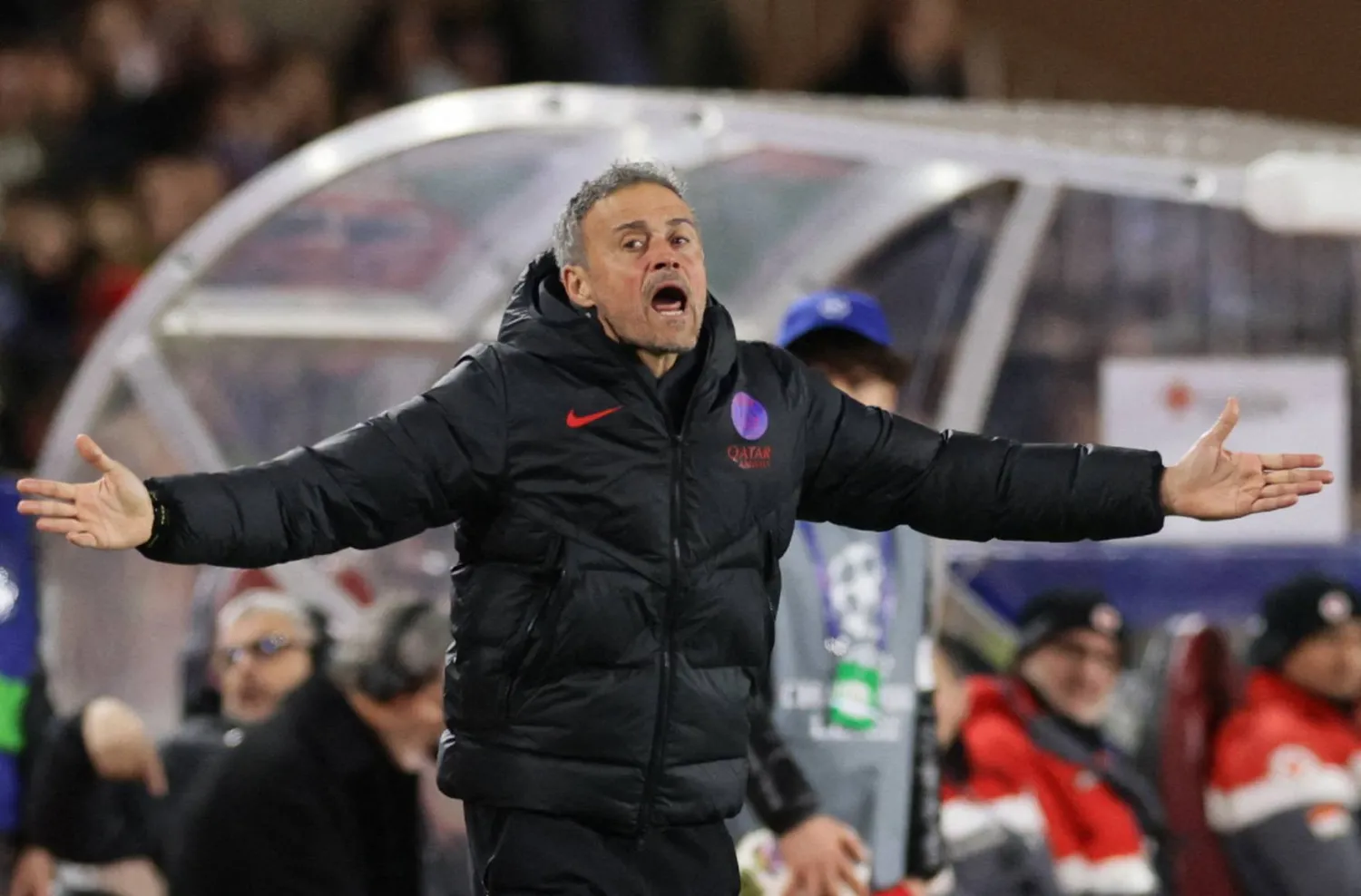
Soccer Football - UEFA Champions League - Play Off - First Leg - AS Monaco v Paris St Germain - Stade Louis II, Monaco - February 17, 2026 Paris St Germain coach Luis Enrique reacts REUTERS/Manon Cruz
TT

PSG’s Mental Strength Hailed as they Come from Behind to Win at Monaco

Soccer Football - UEFA Champions League - Play Off - First Leg - AS Monaco v Paris St Germain - Stade Louis II, Monaco - February 17, 2026 Paris St Germain coach Luis Enrique reacts REUTERS/Manon Cruz

Paris Saint-Germain coach Luis ‌Enrique hailed the mental strength of his side in coming from two goals down to win 3-2 away at Monaco in the Champions League on Tuesday, but warned the knockout round tie was far from finished.

The first leg clash between the two Ligue 1 clubs saw Folarin Balogun score twice for the hosts in the opening 18 minutes before Vitinha had his penalty saved to compound matters.

But after Desire Doue came on for injured Ousmane Dembele, the ‌match turned ‌and defending champions PSG went on to ‌secure ⁠a one-goal advantage ⁠for the return leg.

"Normally, when a team starts a match like that, the most likely outcome is a loss,” Reuters quoted Luis Enrique as saying.

“It was catastrophic. It's impossible to start a match like that. The first two times they overcame our pressure and entered our half, they scored. They ⁠made some very good plays.

“After that, it's difficult ‌to have confidence, but we ‌showed our mental strength. Plus, we missed a penalty, so ‌it was a chance to regain confidence. In the ‌last six times we've played here, this is only the second time we've won, which shows how difficult it is.”

The 20-year-old Doue scored twice and provided a third for Achraf Hakimi, just ‌days after he had turned in a poor performance against Stade Rennais last Friday ⁠and was ⁠dropped for the Monaco clash.

“I'm happy for him because this past week, everyone criticized and tore Doue apart, but he was sensational, he showed his character. He helped the team at the best possible time.”

Dembele’s injury would be assessed, the coach added. “He took a knock in the first 15 minutes, then he couldn't run.”

The return leg at the Parc des Princes will be next Wednesday. “Considering how the match started, I'm happy with the result. But the match in Paris will be difficult, it will be a different story,” Luis Enrique warned.