


Sol Campbell Finally Gets His Chance to Manage After Years in the Shadows

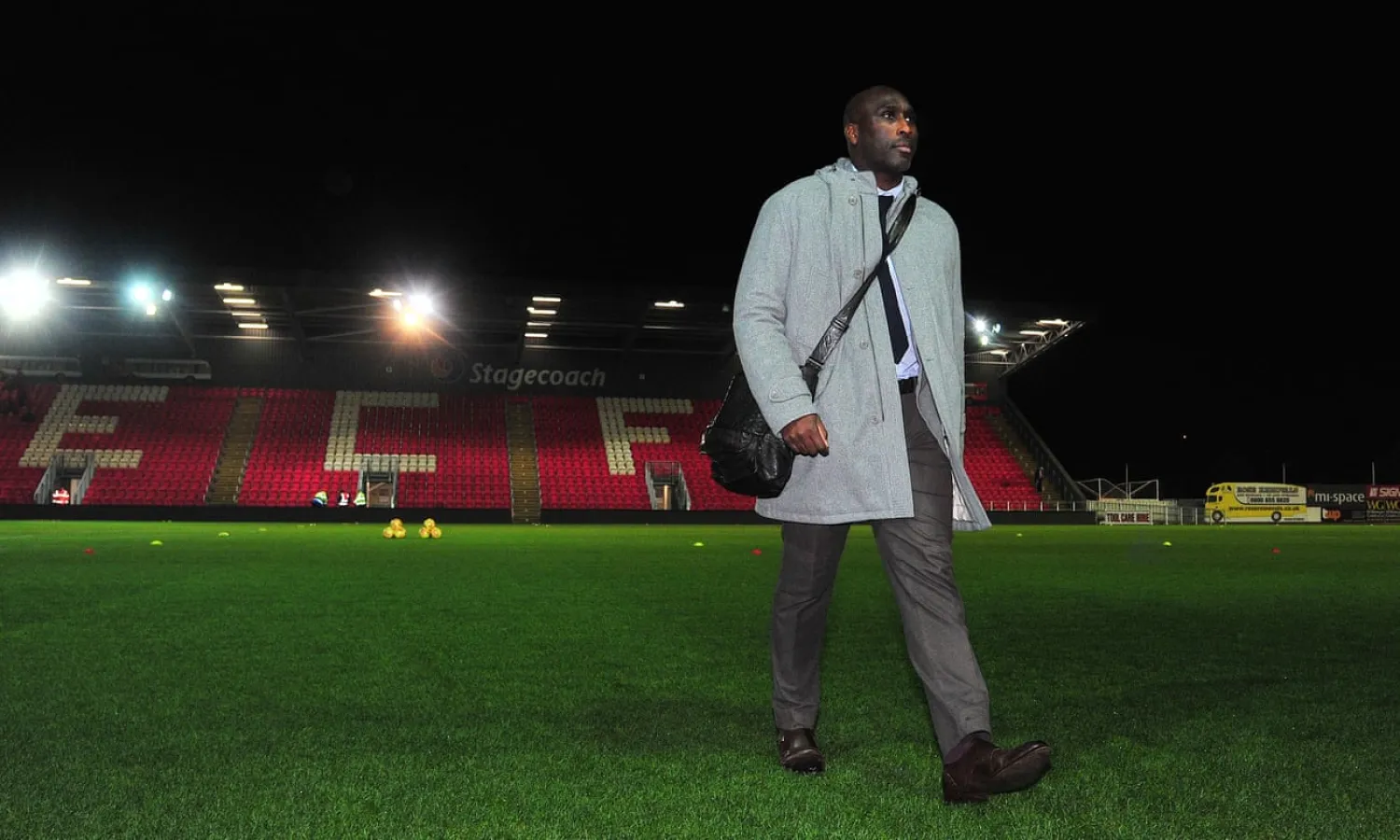
 Sol Campbell surveys the scene at Exeter City, where he watched his new team, Macclesfield Town, win 1-0. Photograph: Tom Sandberg/PPAUK
Sol Campbell surveys the scene at Exeter City, where he watched his new team, Macclesfield Town, win 1-0. Photograph: Tom Sandberg/PPAUK
TT

Sol Campbell Finally Gets His Chance to Manage After Years in the Shadows

 Sol Campbell surveys the scene at Exeter City, where he watched his new team, Macclesfield Town, win 1-0. Photograph: Tom Sandberg/PPAUK
Sol Campbell surveys the scene at Exeter City, where he watched his new team, Macclesfield Town, win 1-0. Photograph: Tom Sandberg/PPAUK

Back in July 2017, I sat down with Sol Campbell at an Italian restaurant off the King’s Road. I had interviewed him at the same venue six years earlier and, having maintained a line of contact with the former Arsenal and England defender in the interim, our latest meeting was designed to be nothing more than an informal chat on a warm summer’s afternoon.

It came as a surprise, then, when Campbell used the opportunity to open up on his desire to become a manager. Normally reserved and a little withdrawn, he spoke like a man at his wits’ end. He had standing, qualifications and coaching experience but simply could not nail down a job, and such was his desperation to do so he claimed he would be willing to work for free. “I’m up for that,” Campbell said. “I’m itching to start, I just need a chance, even just an interview in which I can say: ‘Take me for free and I’ll show you what I can do.’”

Fast-forward 16 months and Campbell has finally made his breakthrough having being appointed manager of Macclesfield Town on Tuesday. The deal is for 18 months and it is safe to presume he is getting paid for the job of lifting the club away from the foot of League Two. Quite right, too, because Campbell should never have actually had to work for free and, in light of managerial appointments elsewhere, it can be argued he should been given such an opportunity much sooner.

Because while Ryan Giggs, Joey Barton, Frank Lampard and Steven Gerrard have walked into jobs of great standing, real potential or both during the past 11 months, Campbell has had to deal with the frustration of being turned down by the likes of Oxford United, Grimsby and Oldham despite having at least as strong credentials as his aforementioned contemporaries.

That is certainly the case in relation to Barton, who was appointed manager of League One Fleetwood Town in April despite serving a 13-month ban from football for betting offences. The former midfielder started work the day after the ban ended and has led Fleetwood to a respectable 13th place, but that does not take away from the sense that when it comes to managerial opportunities in this country it all too often comes down to who you know and what you look like.

Cue a rolling of eyes and shouts of ‘race card’ in some quarters but it requires only a glance at the number of black, Asian and minority ethnic (BAME) managers working across this country’s 92 professional clubs to see there is a problem. Before Tuesday the number stood at seven – Chris Hughton at Brighton, Nuno Espírito Santo at Wolves, Darren Moore at West Brom, Jos Luhukay at Sheffield Wednesday, Chris Powell at Southend United, Dino Maamria at Stevenage Town and Keith Curle at Northampton Town – and while Campbell’s appointment is encouraging in that regard, the fact it took this long is damning.

After all, this is a man who, as well as being one of the finest players of his generation, under one of the most innovative and successful managers of the modern era in Arsène Wenger, has a Uefa pro licence and international coaching experience, having been part of Trinidad & Tobago’s backroom staff during their attempt to qualify for the 2018 World Cup. Yet he still could not get hired during an era when a lack of experience and even a ban from the Football Association were clearly no barriers to doing so. As the Independent’s chief sports writer, Jonathan Liew, wrote in a recent column on the lack of BAME representation in English football, “you don’t need to play the race card if you’re already winning the game”.

There are no guarantees Campbell will be a success at Macclesfield and, I’m not going to lie, I have concerns about his man-management skills. My dealings with him, on the King’s Road and elsewhere, were always fine but he can be as frosty as he seems from a distance, and you have to wonder whether that type of demeanour will work with a group of players who probably need an arm round the shoulder as much as a kick up the backside right now.

Equally, the claim that Campbell is too unorthodox to succeed as a manager is absurd, pointing to the character tests that only people from certain backgrounds have to pass to secure a job in football. Being unorthodox has not, for instance, stopped Ian Holloway from getting work in this country, or for that matter, Marcelo Bielsa.

Campbell is no Bielsa, of course, or for that matter Holloway, but that is because, at 44, he is only now starting his managerial career having recently enhanced his CV by working with England Under-21s as part of the Football Association’s ‘In Pursuit of Progress’ initiative. The hope must be that he has arrived at Macclesfield with his eyes fully open to the challenge of taking over a club seven points from safety and in severe need of direction having been without a manager since early October.

Campbell at least has history on his side. Two other BAME managers, Paul Ince and Keith Alexander, achieved success as well as popularity at Moss Rose, and while Campbell will rightly want to be judged on his own terms there is no getting away from the significance of his appointment.

This is a man who once claimed “archaic attitudes” in this country could ultimately force him to seek a manager’s post abroad. He now has a chance to shine on these shores. About time, too.

The Guardian Sport


Shakhtar Boss Pays Ukrainian Racer $200,000 After Games Disqualification

Ukrainian President Volodymyr Zelenskiy holds helmet as he meets with a Ukrainian skeleton racer Vladyslav Heraskevych , who was disqualified from the Olympic skeleton competition over his "helmet of remembrance" depicting athletes killed since Russia's invasion and his father and coach, Mykhailo Heraskevych, amid Russia's attack on Ukraine, in Munich, Germany February 13, 2026. (Ukrainian Presidential Press Service/Handout via Reuters)
TT

Shakhtar Boss Pays Ukrainian Racer $200,000 After Games Disqualification

Ukrainian President Volodymyr Zelenskiy holds helmet as he meets with a Ukrainian skeleton racer Vladyslav Heraskevych , who was disqualified from the Olympic skeleton competition over his "helmet of remembrance" depicting athletes killed since Russia's invasion and his father and coach, Mykhailo Heraskevych, amid Russia's attack on Ukraine, in Munich, Germany February 13, 2026. (Ukrainian Presidential Press Service/Handout via Reuters)

The owner of ‌Ukrainian football club Shakhtar Donetsk has donated more than $200,000 to skeleton racer Vladyslav Heraskevych after the athlete was disqualified from the Milano Cortina Winter Games before competing over the use of a helmet depicting Ukrainian athletes killed in the war with Russia, the club said on Tuesday.

The 27-year-old Heraskevych was disqualified last week when the International Bobsleigh and Skeleton Federation jury ruled that imagery on the helmet — depicting athletes killed since Russia invaded Ukraine in 2022 — breached rules on athletes' expression at ‌the Games.

He ‌then lost an appeal at the Court ‌of ⁠Arbitration for Sport hours ⁠before the final two runs of his competition, having missed the first two runs due to his disqualification.

Heraskevych had been allowed to train with the helmet that displayed the faces of 24 dead Ukrainian athletes for several days in Cortina d'Ampezzo where the sliding center is, but the International Olympic Committee then ⁠warned him a day before his competition ‌started that he could not wear ‌it there.

“Vlad Heraskevych was denied the opportunity to compete for victory ‌at the Olympic Games, yet he returns to Ukraine a ‌true winner," Shakhtar President Rinat Akhmetov said in a club statement.

"The respect and pride he has earned among Ukrainians through his actions are the highest reward. At the same time, I want him to ‌have enough energy and resources to continue his sporting career, as well as to fight ⁠for truth, freedom ⁠and the remembrance of those who gave their lives for Ukraine," he said.

The amount is equal to the prize money Ukraine pays athletes who win a gold medal at the Games.

The case dominated headlines early on at the Olympics, with IOC President Kirsty Coventry meeting Heraskevych on Thursday morning at the sliding venue in a failed last-minute attempt to broker a compromise.

The IOC suggested he wear a black armband and display the helmet before and after the race, but said using it in competition breached rules on keeping politics off fields of play. Heraskevych also earned praise from Ukraine President Volodymyr Zelenskiy.


Speed Skating-Italy Clinch Shock Men’s Team Pursuit Gold, Canada Successfully Defend Women’s Title

 Team Italy with Davide Ghiotto, Andrea Giovannini, Michele Malfatti, celebrate winning the gold medal on the podium of the men's team pursuit speed skating race at the 2026 Winter Olympics, in Milan, Italy, Tuesday, Feb. 17, 2026. (AP)
Team Italy with Davide Ghiotto, Andrea Giovannini, Michele Malfatti, celebrate winning the gold medal on the podium of the men's team pursuit speed skating race at the 2026 Winter Olympics, in Milan, Italy, Tuesday, Feb. 17, 2026. (AP)
TT

Speed Skating-Italy Clinch Shock Men’s Team Pursuit Gold, Canada Successfully Defend Women’s Title

 Team Italy with Davide Ghiotto, Andrea Giovannini, Michele Malfatti, celebrate winning the gold medal on the podium of the men's team pursuit speed skating race at the 2026 Winter Olympics, in Milan, Italy, Tuesday, Feb. 17, 2026. (AP)
Team Italy with Davide Ghiotto, Andrea Giovannini, Michele Malfatti, celebrate winning the gold medal on the podium of the men's team pursuit speed skating race at the 2026 Winter Olympics, in Milan, Italy, Tuesday, Feb. 17, 2026. (AP)

An inspired Italy delighted the home crowd with a stunning victory in the Olympic men's team pursuit final as

Canada's Ivanie Blondin, Valerie Maltais and Isabelle Weidemann delivered another seamless performance to beat the Netherlands in the women's event and retain their title ‌on Tuesday.

Italy's ‌men upset the US who ‌arrived ⁠at the Games ⁠as world champions and gold medal favorites.

Spurred on by double Olympic champion Francesca Lollobrigida, the Italian team of Davide Ghiotto, Andrea Giovannini and Michele Malfatti electrified a frenzied arena as they stormed ⁠to a time of three ‌minutes 39.20 seconds - ‌a commanding 4.51 seconds clear of the ‌Americans with China taking bronze.

The roar inside ‌the venue as Italy powered home was thunderous as the crowd rose to their feet, cheering the host nation to one ‌of their most special golds of a highly successful Games.

Canada's women ⁠crossed ⁠the line 0.96 seconds ahead of the Netherlands, stopping the clock at two minutes 55.81 seconds, and

Japan rounded out the women's podium by beating the US in the Final B.

It was only Canada's third gold medal of the Games, following Mikael Kingsbury's win in men's dual moguls and Megan Oldham's victory in women's freeski big air.


Lindsey Vonn Back in US Following Crash in Olympic Downhill 

Milano Cortina 2026 Olympics - Alpine Skiing - Women's Downhill 3rd Official Training - Tofane Alpine Skiing Centre, Belluno, Italy - February 07, 2026. Lindsey Vonn of United States in action during training. (Reuters)
TT

Lindsey Vonn Back in US Following Crash in Olympic Downhill 

Milano Cortina 2026 Olympics - Alpine Skiing - Women's Downhill 3rd Official Training - Tofane Alpine Skiing Centre, Belluno, Italy - February 07, 2026. Lindsey Vonn of United States in action during training. (Reuters)

Lindsey Vonn is back home in the US following a week of treatment at a hospital in Italy after breaking her left leg in the Olympic downhill at the Milan Cortina Games.

“Haven’t stood on my feet in over a week... been in a hospital bed immobile since my race. And although I’m not yet able to stand, being back on home soil feels amazing,” Vonn posted on X with an American flag emoji. “Huge thank you to everyone in Italy for taking good care of me.”

The 41-year-old Vonn suffered a complex tibia fracture that has already been operated on multiple times following her Feb. 8 crash. She has said she'll need more surgery in the US.

Nine days before her fall in Cortina d'Ampezzo, Italy, Vonn ruptured the ACL in her left knee in another crash in Switzerland.

Even before then, all eyes had been on her as the feel-good story heading into the Olympics for her comeback after nearly six years of retirement.
