


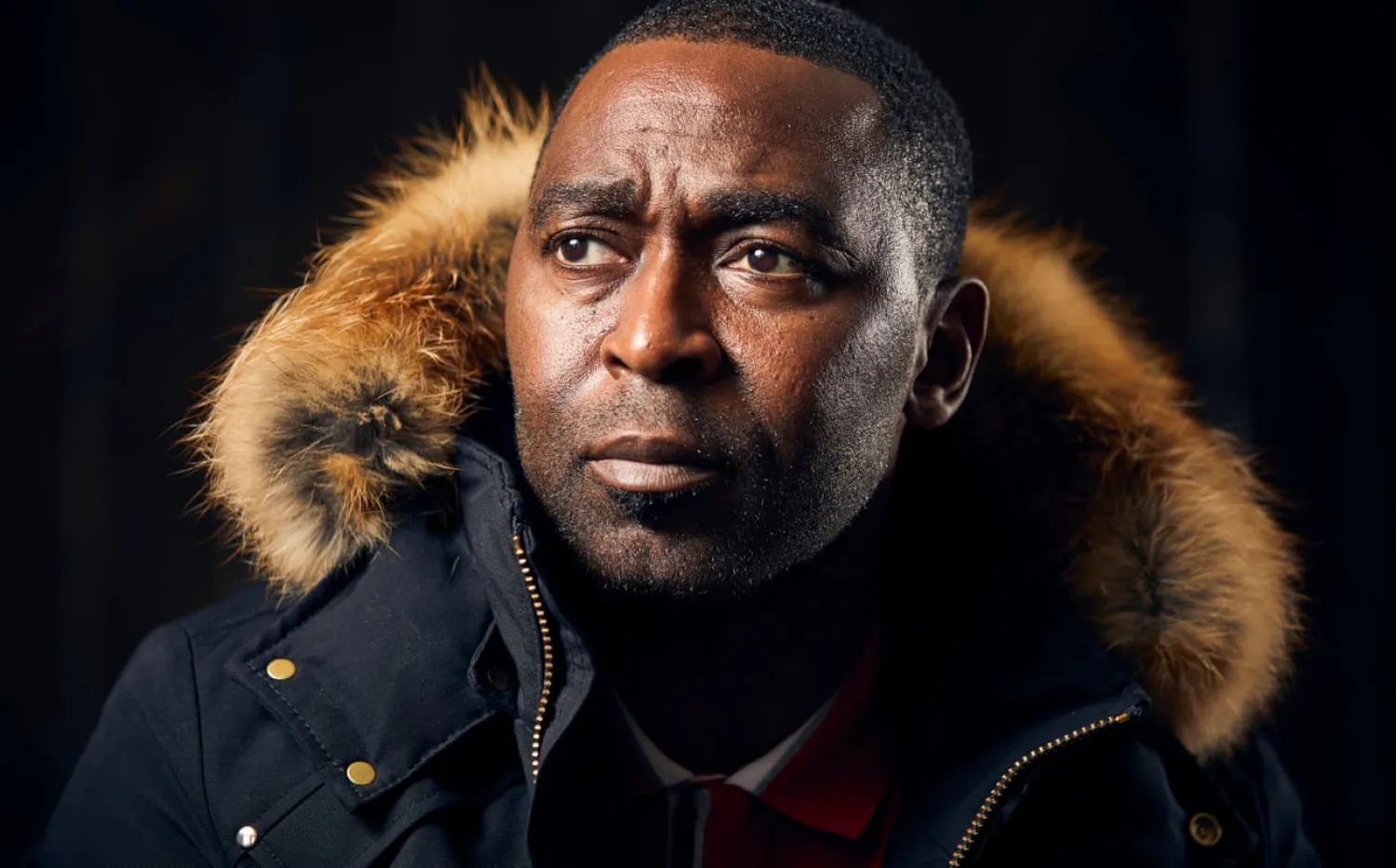

“I’m not ungrateful because I get to live another day,” Andy Cole says as he shivers and pulls on his coat. A cold wind gusts through the sunlit garden where we sit in Alderley Edge. Fifteen miles from Old Trafford, which the former striker still thinks of as the Theatre of Dreams, it’s just me, Cole and an emptying pot of tea. As a Manchester United player who won five league titles, the Champions League and three FA Cups, including the treble in 1999, Cole lived a fantasy life for years, even if his wounded quietness gave the wrong impression that he was surly.
Yet when the 47-year-old says, “I’m never going to be the individual I was before”, Cole is not mourning the end of his career. His lament about the “internal battle” and “torture”, which has deepened his depression and made him consider taking his own life, is rooted in ill health.
Cole has accepted for the last decade that his footballing days are long gone, confined to flickering memories which provide a gloss to the solid statistics confirming he is third on the list of scorers in Premier League history, behind only Alan Shearer and Wayne Rooney. He is also 12th on the all-time list of assists – primarily when playing for Manchester United or as a shy hero at Newcastle.
“The fantastic thing is you can live another day,” Cole says intently before his voice grows husky as he tries to explain how he is struggling to cope 18 months since being saved by a kidney transplant. Cole had fallen seriously ill after he contracted a virus on a trip to Vietnam as a Manchester United ambassador in 2015. Trying to shrug off his exhaustion, and his swollen face and body, Cole denied he was sick until he finally saw a doctor who discovered his kidney function had reduced to 7% of usual capacity. His life was saved by a nephew, Alexander Palmer, who donated a kidney in a seemingly successful transplant in April 2017.
That surgical battle might have been won but the larger war has consumed him. “I was depressed after the transplant because it’s very tough to understand the trauma you still face. I remember emptying a big bag of medication and just crying and thinking, ‘For me to survive another day, this is what I’ve got to take. For the rest of my life. I’m not sure I can continue.’
“I’m still struggling emotionally. Physically I’m also struggling. No two days are the same and the medication means you’re up and down. I would never wish this on anybody because it’s a very telling experience. It brings destruction to your family life as well.”
We spend 90 minutes together and Cole is a revelation in talking so openly, and with such gritty detail, about his post-transplant life. Unlike an ordinary interview with a former sportsman, Cole does not have a book or a product to plug. He is not on a mission to spread any educational message or offer an upbeat mantra about how life is now lit with serenity and hope.
Cole just wants to talk so that he can “put it all out there”. He also wants to say sorry to everyone he has hurt. His family, and in particular his wife, Shirley, have suffered from all his doubts and blues. “I apologise now to everybody for being the way I’ve been. What I was doing, torturing myself over an illness, is horrible. You push them away because you’re trying to quantify what’s gone on. Eighteen months since the transplant, I know it’s a lifetime illness.”
The surgical procedure of transplanting a kidney is less complicated than the post-operative battle against rejection. “Don’t forget my new kidney is a foreign object. My body attacks it. So I have to take these anti-rejection drugs to stop my body winning. People say, ‘Stay positive.’ But you never know how long your kidney will last. It could be here for five or 10 years. It could fail tomorrow. Each day you go into the unknown.
“I have good days like when I went to parliament, regarding changing the bill [so that people’s organs can be transplanted once they die unless they specifically opt out of the donor scheme]. But to speak that day to people in my position, and to wives and husbands, the common denominator was that the person who had the transplant has pushed their family away. They’ve been an absolute nightmare. I thought it was just me. I started to believe my partner thought I was an ogre – but she’s been unbelievable.”
Has it taken a toll on his marriage? “Massive. It pushes everything to the brink. Before, I would watch people who are depressed and suicidal and not really understand. Now I’m in the same position. Depression kicks in, you have suicidal thoughts. They understand it more than most but I’ve pushed my family to the brink. Me not telling them exactly how I feel has made this past year the toughest I’ve had.
“When you go through a life-saving [operation] it’s like your credit card. You don’t read the small print. Obviously I tell myself I’m more than happy for everything that’s been given to me. But if I wake up one morning and my kidney decides ‘I don’t fancy it today’, I’m back to square one.”
Listening to a middle-aged man open up so graphically is moving – especially when it is a former Premier League footballer who once shut himself off from the world because he felt judged. “I’ve always been quiet, and people can look on quietness as a weakness,” Cole says, considering his media image. “It’s like Raheem Sterling today. What they do to him they did to me. Some of the comments people make about you, not even knowing you, that’s the most upsetting thing about football. In my case, it’s often been, ‘He’s arrogant, difficult.’ But then people get to know you. They turn around and say, ‘You’re not like that.’”
Cole does not labour the point but, as with Sterling, the suspicion lurks that racism underpins these stereotypes. His father emigrated from Jamaica to England, ending up in Nottingham, in the 1960s. “My dad never really spoke about it but when he first came over, and tried to find lodgings, he saw signs saying, ‘No blacks. No Irish. No dogs.’”
Was Cole exposed to racism? “Yeah, it was crazy because one of the senior pros [at Nottingham Forest] kept calling me ‘Chalky’. One day I said: ‘My name’s Andrew. This Chalky business has to stop.’ I was 13. He was taken aback because in those days you could say what you wanted. It left a bitter taste in my mouth as a kid.”
Even as a young pro, Cole’s attitude was sometimes misunderstood. “At Arsenal [where he made only one appearance from 1989-1992] the manager, George Graham, thought I was arrogant. When I had a meeting with him, aged 18, I said: ‘I’m good enough to be in the first team.’ It became very difficult because in those days football was very much a culture of do as you’re told. The manager looked at me as if to say, ‘Who the hell are you?’”
After a couple of loan spells he was signed by Bristol City but, after less than a season, Newcastle broke their transfer record and signed him for £1.5m in February 1993. Cole scored a dozen goals in 12 matches to help the side, under Kevin Keegan, sweep into the Premier League. The following season he scored 32 league goals in a devastating partnership with Peter Beardsley and became a St James’ Park favourite.
“It was absolutely frightening,” Cole says. “I really struggled to embrace the adulation because that’s not my bag. Even now, I struggle with adulation. I’m getting inducted into Newcastle’s hall of fame next month. Obviously I’m going to try enjoy it but it was just my job to score goals. The adulation feels surreal.”
Cole was bought by Manchester United in January 1995 for a then record transfer in English football. “It weighed heavy to join Manchester United, the biggest club in the world. I cost £6m and Keith Gillespie [valued at £1m] went the other way as part of the deal. Chris Sutton had gone to Blackburn for £5m and nothing was made of it. I cost a million more and everyone said: ‘Oh my God, that’s ridiculous money for this kid.’
“I soon realised what it was all about. Brian Kidd, the United coach, called me over. He said: ‘Coley, if you think 41 goals a season at this club is good enough, not a chance.’ I looked at Kidd, thinking, ‘He’s got two heads, this fellow.’ But I soon understood there’s more to playing for United than scoring goals. At Newcastle I was just expected to score goals. But at Old Trafford I became a better all-round footballer.”
What was it like playing for Sir Alex Ferguson? “Tough. But then I got to like him. I don’t mind managers who have a go at me if that brings the best out of me. Working with Sir Alex was an eye-opening experience. He was fantastic and the only manager I’ve ever come across who could manage different generations. But the way he spoke to us then would definitely not work now. The power is with the players now. But he was the only manager who could get the best out of me. He understood me as a person and even with the Teddy Sheringham thing he was fantastic. He mentioned it to me once and then let it go.”
Cole and Sheringham were infamous for never speaking to each other despite forging a highly effective partnership up front. Cole was upset by Sheringham snubbing him as he ran on the field to make his England debut as a substitute in 1995 and never forgave him. He was close instead to Dwight Yorke and they terrorised defences in England and Europe – particularly in 1999 when United won the treble.
His face lights up as I remind him of the duo being at their devastating best in the Champions League semi-final when they came from 2-0 down against Juventus to win 3-2 in Turin. “That was the best game I ever played in. I think more about the semi than the final [when United scored two injury-time goals to beat Bayern Munich]. In the final we didn’t play well and probably scored the scrappiest two goals in Champions League history but I don’t care. We won it.”
From such career highs it was hard for Cole 18 years later on the morning of his transplant. “I had a lot of fear. All my concerns were with my family. I was thinking, ‘I’m not going to be here. So let me try to put everything in place before I’m gone.’ I was lucky my nephew was so kind giving up his kidney. They took a kidney from Alexander first and when they came for me I didn’t want to go. It really hit me. My wife was walking me down. I kept saying to her, ‘I’m not sure.’ Walking to the theatre was going into the unknown.
“All I remember then is waking up with tubes up my nose. And them saying, ‘It’s a very good kidney, a big one.’ Within a few days you’re passing water properly, you’re getting better.”
Cole speaks warmly of his close bond with his nephew. We also talk about, in his own words, “the upsetting trials and tribulations” that have affected his two favourite clubs, Manchester United and Newcastle, recently. But football matters little when it is set against real life.
He had been close to tears an hour earlier but Cole seems stronger – if typically candid. “I’ve absolutely hated being ill. Everyone says you shouldn’t feel like that but you think, ‘Shit, I’ve let so many people down.’ But talking about it is my release.”
As the sun shines more brightly on cue, Cole wants to look forward. “I turned 47 [last Monday week]. I’m happy to see the back of 46. I can go into my 48th year with more understanding of how difficult this journey’s going to be. I’ve said to myself, ‘Things are going to be brighter this year. It’s going to be tough but accept who you are and try to move forward every day.’ This battle has been the toughest battle of my life but I know this battle has to continue.”
The Guardian Sport


