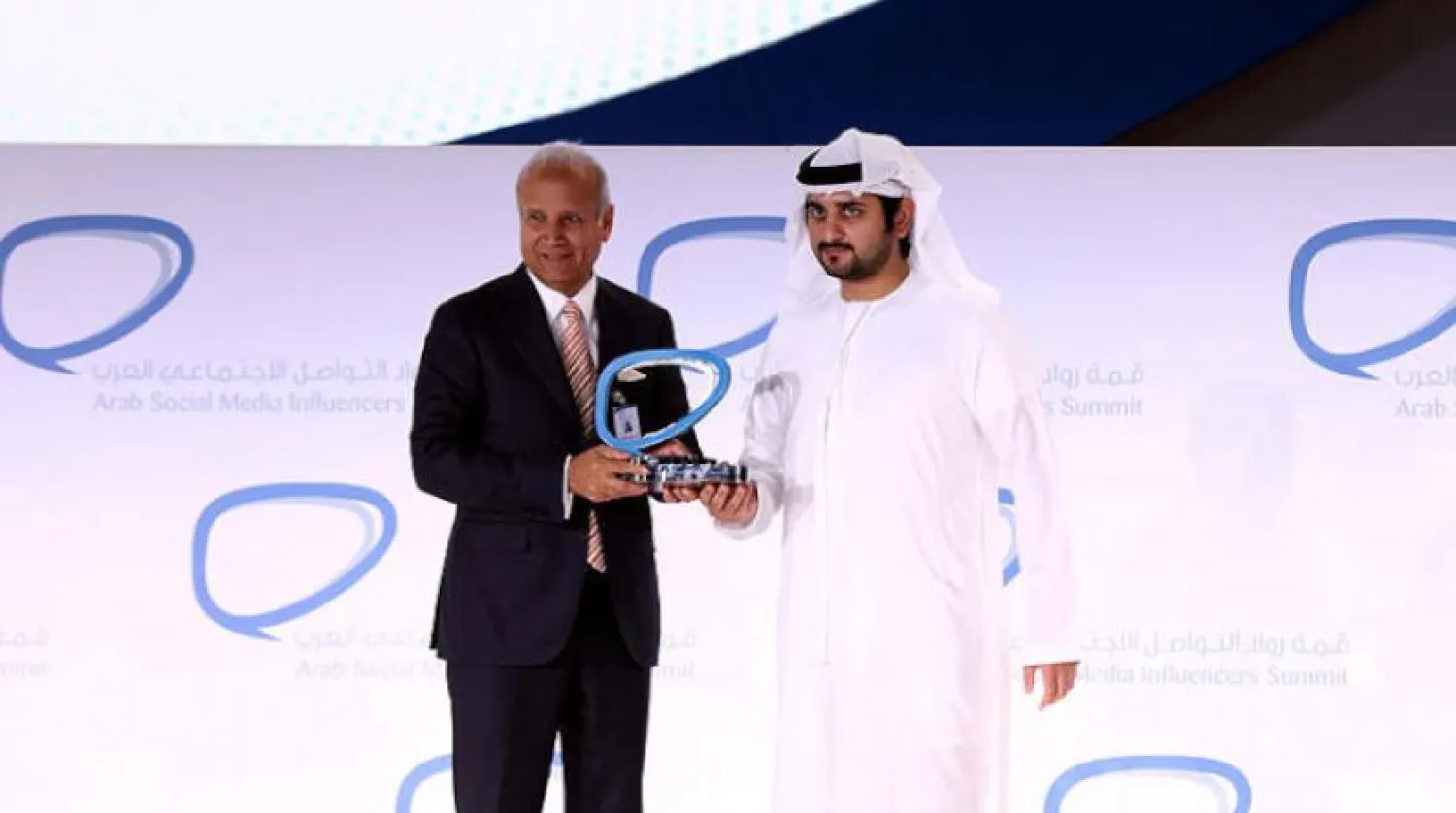
Dubai Summit Honors Arab Social Media Influencers

Sheikh Maktoum bin Mohammed bin Rashid Al Maktoum awards Abdul Rahman al-Rashid
TT

Dubai Summit Honors Arab Social Media Influencers

Sheikh Maktoum bin Mohammed bin Rashid Al Maktoum awards Abdul Rahman al-Rashid

Vice President and Prime Minister of the UAE and Ruler of Dubai Sheikh Mohammed bin Rashid Al Maktoum honored the winners of the Arab Social Media Influencers awards, led by Queen Rania Al Abdullah, wife of King Abdullah II of Jordan, for the "Personality of the Year" award.

Also, Minister of Foreign Affairs of Algeria Abdelkader Messahel was awarded in the "Politics" category for his diplomatic efforts and his use of social media in the best ways.

Sheikh Nasser bin Hamad Al Khalifa, King’s Representative for Charity Works and Youth Affairs, Supreme Council for Youth and Sports Council (SCYS) Chairman and Bahrain Olympic Committee (BOC) President., received the "Youth" award.

Saudi Arabia’s Princess Reema, vice president for development and planning at the General Sports Authority, won the "Sports" category award for her efforts in promoting sports via social media.

Saudi media personality Abdulrahman Al-Rashid was the winner in the "Media" category for being one of the most active social media influencers in the media world. Al-Rashed is famous for his political and profound writings. He held several leadership positions in the field of media, won numerous awards and was selected as Media Person of the Year at the Arab Media Forum in 2016.

Meanwhile, Sheikh Rashid Al Nuaimi, Head of the Municipality and Planning Department in Ajman, was awarded in the "Youth" category for individuals.

Dubai Police were awarded in the "Safety and Security" category for institutions while Al Waleed Humanitarian Organisation was awarded in the "Community Service" category.

The Audience Award, which was introduced this year in order to enable social media users to nominate an influential Arab figure who had a significant impact on the development of their communities, went to Egyptian comedy actor Mohammad Henedi.

Other winners were also honoured in different categories, which included: tolerance, community service, education, entrepreneurship, youth, technology, economics, politics, health, culture and arts, security and safety, environment, tourism and recreation.


China's LandSpace Hopes to Complete Rocket Recovery in Mid-2026

Zhuque-3 rocket by China’s private rocket firm LandSpace, takes off from the Jiuquan Satellite Launch Center, China, December 3, 2025, in this screengrab taken from handout drone footage provided by LandSpace. LandSpace/Handout via REUTERS
TT

China's LandSpace Hopes to Complete Rocket Recovery in Mid-2026

Zhuque-3 rocket by China’s private rocket firm LandSpace, takes off from the Jiuquan Satellite Launch Center, China, December 3, 2025, in this screengrab taken from handout drone footage provided by LandSpace. LandSpace/Handout via REUTERS

Chinese rocket developer LandSpace plans to successfully recover a reusable booster in mid-2026, a company executive said in an interview, underscoring the Beijing-based firm's ambition to become China's answer to SpaceX.

The ability to return, recover, and reuse a rocket's engine-packed first stage, or booster, after launch is crucial to reducing costs and making it easier for countries to send satellites into orbit, and to turn space exploration into a commercially viable business similar to civil aviation, Reuters reported.

Earlier this month, privately-owned LandSpace ‌became the first ‌Chinese entity to conduct a full reusable rocket ‌test, when ⁠Zhuque-3 ​blasted off ‌from a remote area in northwest China for its maiden flight, drawing comparisons to US aerospace giant SpaceX.

SECOND ATTEMPT PLANNED

While LandSpace failed to complete the crucial final step of landing and recovering the rocket's engine-packed booster, it hopes to clear this challenge in mid-2026 with a second test flight, Zhuque-3 deputy chief designer Dong Kai told Chinese podcast Tech Early Know in an interview published on Tuesday.

"If the second flight's recovery (stage) succeeds, we ⁠plan that on the fourth flight we will use a reused first stage to launch," Dong said.

So far, ‌the only company that has mastered reusable rocket technology is ‍SpaceX, founded by the world's richest ‍person Elon Musk. SpaceX's Falcon 9 launches around 150 times a year, or roughly ‍three times per week, with its booster reused dozens of times if necessary.

Musk said in October that LandSpace's Zhuque-3 design could allow it to beat the Falcon 9, but went on to state that the Chinese challenger's launch cadence would take more than five years to ​reach that of SpaceX's workhorse model, at which point the US firm would have transitioned to its heavier, new-generation model Starship and "doing over ⁠100 times the annual payload to orbit of Falcon".

INITIAL PUBLIC OFFERING

LandSpace's Dong said that, while the company was already building an engine for a future Starship-like model, he was not optimistic that in five years Falcon 9's work rate could be surpassed, noting that all rocket models in China combined this year totalled only around 100 launches.

"It's very difficult for a single company to reach that kind of frequency. It requires the support of an entire ecosystem," Dong said, adding that LandSpace had 10 launches planned next year for all its models.

Other executives have previously said that the financial cost of a high-frequency testing and launch regimen was crucial to SpaceX's success, and that LandSpace's only ‌hope of amassing enough funds to sustain a similar programme would be by tapping China's capital markets, pointing to plans for an initial public offering next year.


Russia Plans a Nuclear Power Plant on the Moon within a Decade

November's full moon, also known as Beaver Moon, rises over Fort-de-France in the French overseas island of Martinique, on November 5, 2025. (AFP)
TT

Russia Plans a Nuclear Power Plant on the Moon within a Decade

November's full moon, also known as Beaver Moon, rises over Fort-de-France in the French overseas island of Martinique, on November 5, 2025. (AFP)

Russia plans to put ​a nuclear power plant on the moon in the next decade to supply its lunar space program and a joint Russian-Chinese research station as major powers rush to explore the earth's only natural satellite.

Ever since Soviet cosmonaut Yuri Gagarin became the first human to go into space in 1961, Russia has prided itself as ‌a leading power in ‌space exploration, but in recent ‌decades ⁠it ​has fallen ‌behind the United States and increasingly China.

Russia's ambitions suffered a massive blow in August 2023 when its unmanned Luna-25 mission smashed into the surface of the moon while attempting to land, and Elon Musk has revolutionized the launch of space vehicles - once a Russian specialty.

Russia's state space corporation, Roscosmos, ⁠said in a statement that it planned to build a lunar power ‌plant by 2036 and signed a contract ‍with the Lavochkin Association ‍aerospace company to do it.

Roscosmos said the purpose of ‍the plant was to power Russia's lunar program, including rovers, an observatory and the infrastructure of the joint Russian-Chinese International Lunar Research Station.

"The project is an important step towards the creation of ​a permanently functioning scientific lunar station and the transition from one-time missions to a long-term lunar exploration program," ⁠Roscosmos said.

Roscosmos did not say explicitly that the plant would be nuclear but it said the participants included Russian state nuclear corporation Rosatom and the Kurchatov Institute, Russia's leading nuclear research institute.

The head of Roscosmos, Dmitry Bakanov, said in June that one of the corporation's aims was to put a nuclear power plant on the moon and to explore Venus, known as earth's "sister" planet.

The moon, which is 384,400 km (238,855 miles) from our planet, moderates the earth's wobble ‌on its axis, which ensures a more stable climate. It also causes tides in the world's oceans.


Seasonal Rains Transform Saudi Arabia’s Rawdat Muhanna into Natural Lake

People visit Rawdat Muhanna after recent rainfall. (SPA)
TT

Seasonal Rains Transform Saudi Arabia’s Rawdat Muhanna into Natural Lake

People visit Rawdat Muhanna after recent rainfall. (SPA)

Rawdat Muhanna, or Muhanna's Garden, located near the town of Al-Nabqiyah in the eastern part of Saudi Arabia’s Qassim region, has witnessed a notable influx of visitors and picnickers in recent days following rainfall that filled the Rawdat with water, transforming it into a vast natural lake.

The rare and striking scene has drawn residents and visitors from within and outside the region, reported the Saudi Press Agency on Tuesday.

Stretching over more than 10 kilometers, Rawdat Muhanna has become a breathtaking natural landscape amid the sands of Al-Thuwairat. The contrast between the blue waters and the red desert sand has created a picturesque panorama, making the site a favored destination for nature enthusiasts and photographers.

Rawdat Muhanna is one of the region’s prominent seasonal parks, as several valleys flow into it, most notably Wadi Al-Mustawi. These valleys contribute to the accumulation of large volumes of water, which in some seasons can remain for nearly a year, boosting the site’s ecological value and making it one of the most beautiful natural areas in the Qassim desert.

Visitors said Rawdat Muhanna has become an ideal destination for outdoor recreation and relaxation.