

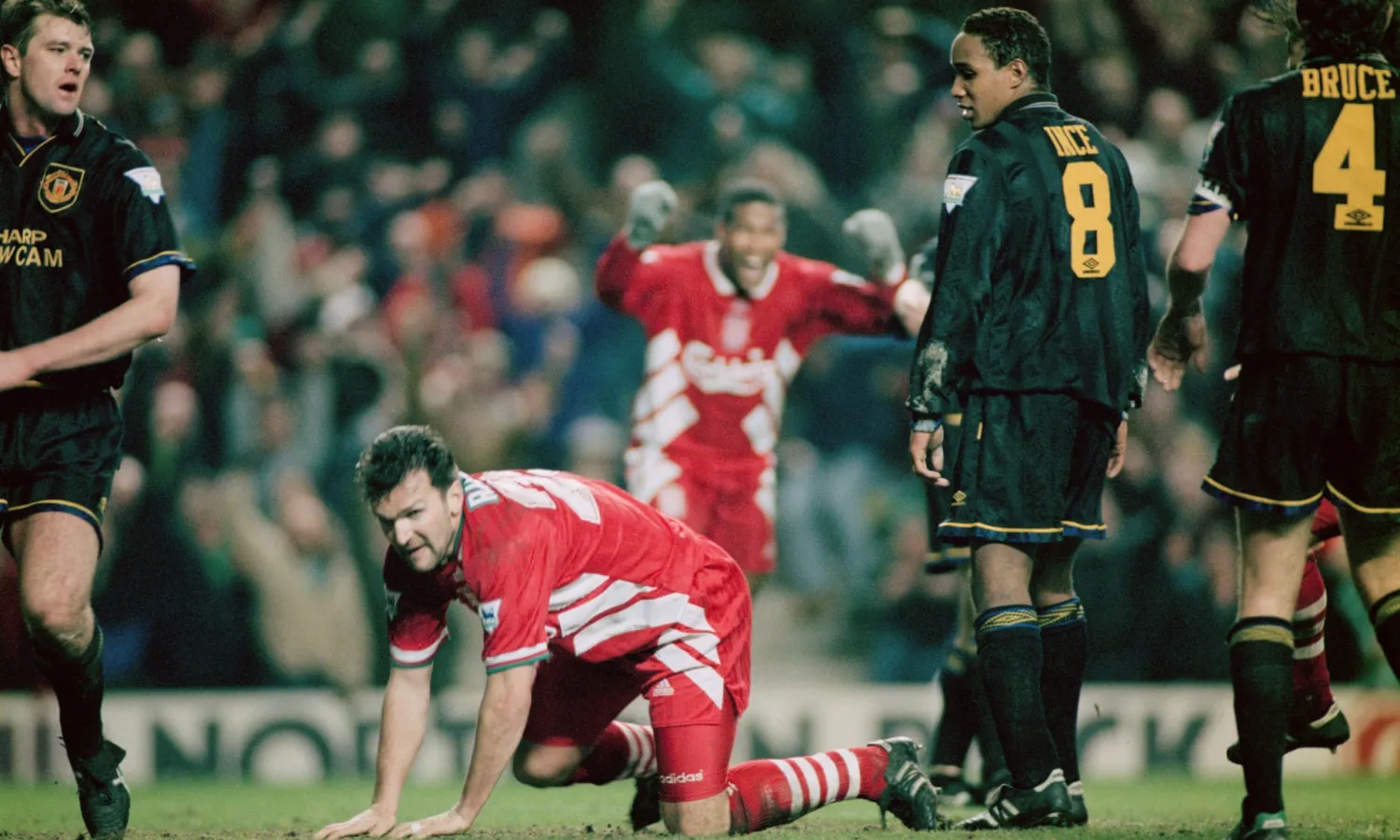

The Joy of Six: Great Liverpool v Manchester United Games

Neil Ruddock heads in Liverpool’s third goal as they came back from 3-0 down to earn a draw at Anfield in 1994. Photograph: Clive Brunskill/Getty Images
TT

The Joy of Six: Great Liverpool v Manchester United Games

Neil Ruddock heads in Liverpool’s third goal as they came back from 3-0 down to earn a draw at Anfield in 1994. Photograph: Clive Brunskill/Getty Images

1. Liverpool 4-4 Manchester United (August 1953)
We begin with the highest-scoring post-war match between the two clubs. United arrived at Anfield with a prototype of the famous Busby Babes side - Roger Byrne, Tommy Taylor and David Pegg all starred - and took an early lead through Jack Rowley. But Don Welsh’s side fought back, Louis Bimpson equalising and Bill Jones adding another on the stroke of half time. Byrne levelled the match soon after the restart, but Bimpson crashed home two Billy Liddell corners in quick succession to give the home team a 4-2 lead by 58 minutes. United would pull one back almost immediately through Eddie Lewis, before Taylor controversially made it 4-4 by bundling the ball and keeper Charlie Ashcroft into the net, Nat Lofthouse style, with seven minutes to play; Anfield was so incensed police formed a line in front of the Kop. United would win the return game 5-1, at which point the teams would go their separate ways for the remainder of the 1950s: Liverpool were eventually relegated that season, while within two years United had been bolstered by Duncan Edwards and Bobby Charlton and were busy defining the decade.

2. Manchester United 3-3 Liverpool (November 1962)
United had just beaten champions Ipswich Town 5-3 thanks to four goals from Denis Law, and things seemed to be going to form in their next game when David Herd gave them a half-time lead against newly promoted Liverpool, who had only won four of their first 16 games and were struggling near the bottom of the First Division table. The second half would, however, be a different story. Ian St John quickly equalised after a mistake from United keeper Harry Gregg, only for Albert Quixall to restore United’s advantage with a hotly disputed penalty midway through the half. With five minutes to go the jig looked up for Bill Shankly’s side, but Jimmy Melia scrambled in an equaliser and then, with a minute left, Ronnie Moran rifled in a 25-yard free kick for what would surely be the winner. It wasn’t: Johnny Giles scored with the last kick of the match to force a draw. Liverpool were nonetheless buoyed by the result, winning their next nine games, while United’s form dipped alarmingly - they ended the season only two places and three points from the relegation zone. United would however win the FA Cup that year - while the following season saw Liverpool crowned champions.

3. Liverpool 2-1 Manchester United (March 1983)
If Liverpool rode their luck a tad in the 1982 Milk Cup final, requiring a last-minute scramble to save themselves from defeat against Tottenham before running out easy winners in extra time, the Gods were really smiling on them a year later. Norman Whiteside’s amazing Hansen-bothering early goal allowed United to soak up waves of Liverpool pressure, and with Ian Rush suffering an off day, squandering two glorious chances, it looked like United would win their first trophy under Ron Atkinson – until central defender Kevin Moran was injured with 20 minutes to go. Within two minutes Alan Kennedy had shaved the bar with a fierce shot; within another three he had scored. Extra time saw what little was left of United’s luck totally run out, as their other centre half Gordon McQueen was crocked and had to spend the remainder of the match up front, striker Frank Stapleton moving back to cover. Though whether that affected the outcome is moot, for Franz Beckenbauer couldn’t have done anything about the winner, a glorious Ronnie Whelan curler into the top right corner. United could also legitimately moan about Bruce Grobbelaar’s bodycheck on McQueen late in the day, which denied the hobbling “striker” a goalscoring chance yet went unpunished, but United’s Wembley luck would turn a few weeks later: Ray Wilkins would repeat Whelan’s trick with a curler of his own, before Brighton striker Gordon Smith’s largesse gifted them a replay and the FA Cup trophy.

4. Manchester United 3-1 Liverpool (January 1989)
The Murphy years apart, Liverpool have never quite managed to irritate United on a regular basis when underdogs. That wasn’t such a problem for United during Liverpool’s golden era: United denied them the treble in 1977, knocked them out of the FA Cup at the semi-final stage in 1979 and 1985, and during the 1980s enjoyed a record in all competitions of W11 D11 L4. Their final victory of a decade of local (if not national or European) dominance came on New Year’s Day 1989, when Fergie’s Fledglings ripped the champions to pieces for 70 minutes only to fall behind to a John Barnes goal. No matter: within seven minutes 20-year-old midfielder Russell Beardsmore had stepped up to the plate, setting up goals for Brian McClair and Mark Hughes, then wrapping up the result himself with a calm finish. “The best team lost,” claimed Ronnie Moran after the match, which was true in a wider context, but not of this game.

5. Liverpool 3-3 Manchester United (January 1994)
There’s an argument that United’s two-goal comeback in the famous 3-3 draw at Anfield in 1988 was a better game than this - Peter Beardsley and John Barnes rampant for an hour, Norman Whiteside’s reducer on Steve McMahon, cigar-smoking Gordon Strachan capping the comeback for ten-man United - but while Liverpool were streets ahead in terms of quality at the time, they were still playing a side who would finish second in the league. In 1994, the gap between the two sides was as embarrassing as it’s ever been, a point hammered home within 24 minutes as United romped into a three-goal lead. This utter humiliation represented Liverpool’s Anfield nadir - against bitter enemies, it surely cut the Kop deeper than Michael Thomas’s 1989 title strike - but lasted less than a minute. Nigel Clough cost the Reds £2.3m, did nothing else in his time at the club, but by snapping home from 25 yards then repeating the trick a tad closer in 13 minutes later, he repaid most of that fee there and then. Neil Ruddock completed a ludicrous comeback with 11 minutes to play and Anfield erupted; they had little else to shout about during the 1990s.

6. Manchester United 2-2 Liverpool (October 1995)
This game explained 1990s football in a nutshell. It was Eric Cantona’s much-anticipated return after being banned for whacking an ignorant goon upside his head, and sure enough he made his mark, scoring the 71st minute penalty which salvaged a draw for United. That the result needed saving spoke volumes about how well Roy Evans’s Liverpool played against a United side which would go on to claim the double, Robbie Fowler taking centre stage by cancelling out Nicky Butt’s early effort then making toast of Gary Neville then beating Peter Schmeichel with an exquisite lob. But it was also typical of Liverpool’s mental fragility at the time: there was a three-season spell around that time when, without exaggeration, Liverpool outplayed United in every single league game, yet only managed to win a couple of games at Anfield. Gerard Houllier and Danny Murphy would deal with this situation comprehensively around the turn of the century, but Liverpool would never again outplay a superior United team without winning quite like this.

(The Guardian)


Second Season of ‘Kings League–Middle East' to Kick off in March in Riyadh 

The second season of the Kings League-Middle East will kick off in Riyadh on March 27. (Kings League-Middle East on X)
TT

Second Season of ‘Kings League–Middle East' to Kick off in March in Riyadh 

The second season of the Kings League-Middle East will kick off in Riyadh on March 27. (Kings League-Middle East on X)

The Kings League-Middle East announced that its second season will kick off in Riyadh on March 27.

The season will feature 10 teams, compared to eight in the inaugural edition, under a format that combines sporting competition with digital engagement and includes the participation of several content creators from across the region.

The Kings League-Middle East is organized in partnership with SURJ Sports Investments, a subsidiary of the Public Investment Fund (PIF), as part of efforts to support the development of innovative sports models that integrate football with digital entertainment.

Seven teams will return for the second season: DR7, ABO FC, FWZ, Red Zone, Turbo, Ultra Chmicha, and 3BS. Three additional teams are set to be announced before the start of the competition.

Matches of the second season will be held at Cool Arena in Riyadh under a single round-robin format, with the top-ranked teams advancing to the knockout stages, culminating in the final match.

The inaugural edition recorded strong attendance and wide digital engagement, with approximately a million viewers following the live broadcasts on television and digital platforms.


Shakhtar Boss Pays Ukrainian Racer $200,000 After Games Disqualification

Ukrainian President Volodymyr Zelenskiy holds helmet as he meets with a Ukrainian skeleton racer Vladyslav Heraskevych , who was disqualified from the Olympic skeleton competition over his "helmet of remembrance" depicting athletes killed since Russia's invasion and his father and coach, Mykhailo Heraskevych, amid Russia's attack on Ukraine, in Munich, Germany February 13, 2026. (Ukrainian Presidential Press Service/Handout via Reuters)
TT

Shakhtar Boss Pays Ukrainian Racer $200,000 After Games Disqualification

Ukrainian President Volodymyr Zelenskiy holds helmet as he meets with a Ukrainian skeleton racer Vladyslav Heraskevych , who was disqualified from the Olympic skeleton competition over his "helmet of remembrance" depicting athletes killed since Russia's invasion and his father and coach, Mykhailo Heraskevych, amid Russia's attack on Ukraine, in Munich, Germany February 13, 2026. (Ukrainian Presidential Press Service/Handout via Reuters)

The owner of ‌Ukrainian football club Shakhtar Donetsk has donated more than $200,000 to skeleton racer Vladyslav Heraskevych after the athlete was disqualified from the Milano Cortina Winter Games before competing over the use of a helmet depicting Ukrainian athletes killed in the war with Russia, the club said on Tuesday.

The 27-year-old Heraskevych was disqualified last week when the International Bobsleigh and Skeleton Federation jury ruled that imagery on the helmet — depicting athletes killed since Russia invaded Ukraine in 2022 — breached rules on athletes' expression at ‌the Games.

He ‌then lost an appeal at the Court ‌of ⁠Arbitration for Sport hours ⁠before the final two runs of his competition, having missed the first two runs due to his disqualification.

Heraskevych had been allowed to train with the helmet that displayed the faces of 24 dead Ukrainian athletes for several days in Cortina d'Ampezzo where the sliding center is, but the International Olympic Committee then ⁠warned him a day before his competition ‌started that he could not wear ‌it there.

“Vlad Heraskevych was denied the opportunity to compete for victory ‌at the Olympic Games, yet he returns to Ukraine a ‌true winner," Shakhtar President Rinat Akhmetov said in a club statement.

"The respect and pride he has earned among Ukrainians through his actions are the highest reward. At the same time, I want him to ‌have enough energy and resources to continue his sporting career, as well as to fight ⁠for truth, freedom ⁠and the remembrance of those who gave their lives for Ukraine," he said.

The amount is equal to the prize money Ukraine pays athletes who win a gold medal at the Games.

The case dominated headlines early on at the Olympics, with IOC President Kirsty Coventry meeting Heraskevych on Thursday morning at the sliding venue in a failed last-minute attempt to broker a compromise.

The IOC suggested he wear a black armband and display the helmet before and after the race, but said using it in competition breached rules on keeping politics off fields of play. Heraskevych also earned praise from Ukraine President Volodymyr Zelenskiy.


Speed Skating-Italy Clinch Shock Men’s Team Pursuit Gold, Canada Successfully Defend Women’s Title

 Team Italy with Davide Ghiotto, Andrea Giovannini, Michele Malfatti, celebrate winning the gold medal on the podium of the men's team pursuit speed skating race at the 2026 Winter Olympics, in Milan, Italy, Tuesday, Feb. 17, 2026. (AP)
Team Italy with Davide Ghiotto, Andrea Giovannini, Michele Malfatti, celebrate winning the gold medal on the podium of the men's team pursuit speed skating race at the 2026 Winter Olympics, in Milan, Italy, Tuesday, Feb. 17, 2026. (AP)
TT

Speed Skating-Italy Clinch Shock Men’s Team Pursuit Gold, Canada Successfully Defend Women’s Title

 Team Italy with Davide Ghiotto, Andrea Giovannini, Michele Malfatti, celebrate winning the gold medal on the podium of the men's team pursuit speed skating race at the 2026 Winter Olympics, in Milan, Italy, Tuesday, Feb. 17, 2026. (AP)
Team Italy with Davide Ghiotto, Andrea Giovannini, Michele Malfatti, celebrate winning the gold medal on the podium of the men's team pursuit speed skating race at the 2026 Winter Olympics, in Milan, Italy, Tuesday, Feb. 17, 2026. (AP)

An inspired Italy delighted the home crowd with a stunning victory in the Olympic men's team pursuit final as

Canada's Ivanie Blondin, Valerie Maltais and Isabelle Weidemann delivered another seamless performance to beat the Netherlands in the women's event and retain their title ‌on Tuesday.

Italy's ‌men upset the US who ‌arrived ⁠at the Games ⁠as world champions and gold medal favorites.

Spurred on by double Olympic champion Francesca Lollobrigida, the Italian team of Davide Ghiotto, Andrea Giovannini and Michele Malfatti electrified a frenzied arena as they stormed ⁠to a time of three ‌minutes 39.20 seconds - ‌a commanding 4.51 seconds clear of the ‌Americans with China taking bronze.

The roar inside ‌the venue as Italy powered home was thunderous as the crowd rose to their feet, cheering the host nation to one ‌of their most special golds of a highly successful Games.

Canada's women ⁠crossed ⁠the line 0.96 seconds ahead of the Netherlands, stopping the clock at two minutes 55.81 seconds, and

Japan rounded out the women's podium by beating the US in the Final B.

It was only Canada's third gold medal of the Games, following Mikael Kingsbury's win in men's dual moguls and Megan Oldham's victory in women's freeski big air.
