

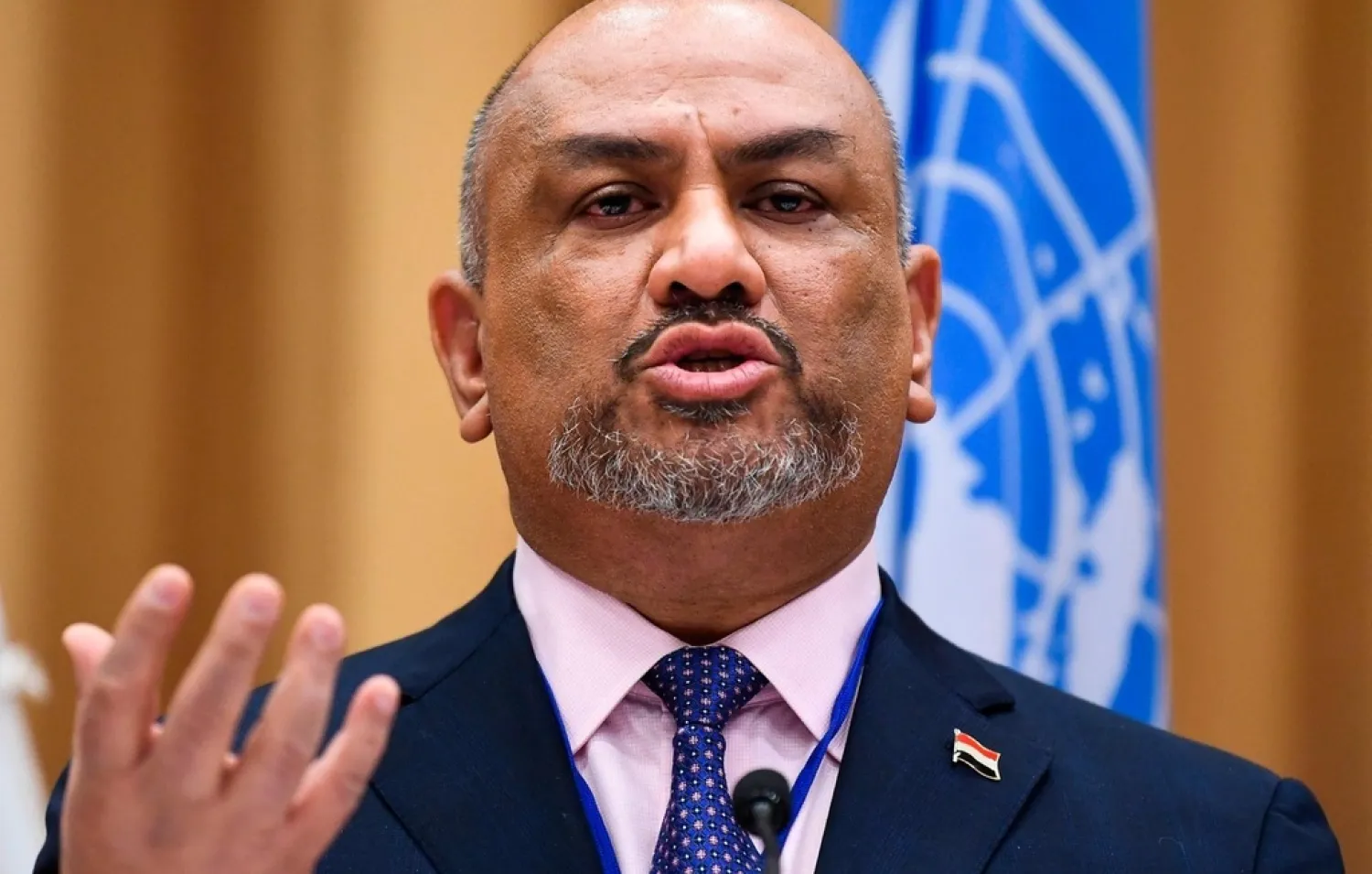

Yemen FM to Asharq Al-Awsat: Houthis Must Withdraw from Hodeidah in 4 Days

Yemeni Foreign Minister Khaled al-Yamani. (AFP)
TT

Yemen FM to Asharq Al-Awsat: Houthis Must Withdraw from Hodeidah in 4 Days

Yemeni Foreign Minister Khaled al-Yamani. (AFP)

The United Nations-brokered agreement on Yemen’s coastal Hodeidah province, which was reached in Sweden last week, will go into effect on Tuesday amid high hopes among the people that peace could be restored in the region.

Yemeni Foreign Minister Khaled al-Yamani told Asharq Al-Awsat that the agreement stipulates that the Iran-backed Houthi militias must withdraw from Hodeidah and al-Salif ports within four days of its implementation.

“While the Hodeidah agreement states an immediate start of the ceasefire, it is normal that it takes 48-72 hours to be communicated at the operational level,” a UN source said according to Reuters. “We expect the ceasefire to be implemented starting Tuesday.”

UN special envoy to Yemen Martin Griffiths had said that international monitors will be deployed in Hodeidah and armed groups will withdraw from the region within 21 days.

The envoy “expects the two parties to respect their obligations as per the text and the spirit of the Stockholm Agreement, and to engage in the immediate implementation of its provisions,” Griffiths said in a tweet.

The UN is working closely with the legitimate government and Houthis “to ensure that the provisions of the Hodeidah Agreement are implemented timely and properly,” he added.

Yamani said that UN officials will monitor the redeployment of forces in Hodeidah after the Houthi withdrawal.

“The Houthis will withdraw completely from the city during the next 20 days. Our forces will redeploy to the southern and eastern city border,” he added.

A UN-chaired Redeployment Coordination Committee including both sides would oversee implementation. The committee is expected to start its work this week, the UN source said.

The next round of talks between the government and Houthis is expected to be held in January.

Yamani said that the concerned parties should only be invited to the consultations after all articles of the Stockholm deal are implemented.

This includes the release of abductees and prisoners and withdrawal from Hodeidah and reinstatement of legitimate agencies there.



Al-Khanbashi: Hadramout Has Been Liberated from Al-Zubaidi, UAE's Hegemony

Hadramout Governor and a member of the Yemeni Presidential Leadership Council, Salem al-Khanbashi gives a media briefing in the port city of Mukalla in Hadramout, Yemen, January 19, 2026. (Reuters)
TT

Al-Khanbashi: Hadramout Has Been Liberated from Al-Zubaidi, UAE's Hegemony

Hadramout Governor and a member of the Yemeni Presidential Leadership Council, Salem al-Khanbashi gives a media briefing in the port city of Mukalla in Hadramout, Yemen, January 19, 2026. (Reuters)

Presidential Leadership Council (PLC) member and Governor of Yemen's eastern Hadramout province Salem al-Khanbashi accused on Monday the United Arab Emirates of exploiting its participation in the coalition to support legitimacy in Yemen to pursue its own agenda.

Speaking at a press conference in Mukalla city, he said the UAE's actions in Hadramout were a shock to the people and local authorities.

The authorities had hoped that the UAE would act as a supporter to the Yemeni people as part of the coalition, but its actions on the ground went against those expectations, he remarked.

Hadramout has suffered from the hegemony of armed factions affiliated with Aidarous al-Zubaidi, leader of the Southern Transitional Council, with direct support from the UAE, added all-Khanbashi.

Hadramout has been liberated from al-Zubaidi and the UAE's hegemony, he stressed.

He accused groups loyal to al-Zubaidi of looting public institutions, terrorizing the people and committing wide violations against them, leading to instability in Hadramout.

He vowed that the authorities will take "all legal measures" against the UAE and al-Zubaidi's armed groups.

Justice will prevail, he declared, pledging to support the victims of the violations and hold to account the perpetrators.

Moreover, al-Khanbashi revealed that the UAE was running "several large secret prisons" in Hadramout. Explosives were also stored in the al-Riyan airbase that were going to be used to in assassinations and attacks in the province.

He said that Hadramout has closed a "dangerous and bitter chapter" in its history through direct support from Saudi Arabia.

This backing has helped restore stability, boost the state's authority and end a period of chaos and violations, he continued.


Syria Says Sharaa, Trump Discuss Kurdish Rights as Forces Deploy in Country’s North, East

Syrian government forces brandish their weapons as they take possession of the SDF military base as they enter the city of Raqqa on January 19, 2026. (AFP)
TT

Syria Says Sharaa, Trump Discuss Kurdish Rights as Forces Deploy in Country’s North, East

Syrian government forces brandish their weapons as they take possession of the SDF military base as they enter the city of Raqqa on January 19, 2026. (AFP)

Syrian President Ahmed al-Sharaa and US President Donald Trump discussed guaranteeing Kurdish rights in a phone call on Monday, Syria's presidency said, a day after Damascus reached a deal with Kurdish forces including a truce.

Sharaa met Mazloum Abdi, head of the Kurdish-led Syrian Democratic Forces, to discuss the agreement, which includes integrating the Kurds' administration into the state, but a Kurdish source with knowledge of the talks told AFP they were not positive.

Analysts said the deal -- following rapid government gains in Kurdish-controlled territory after driving Kurdish fighters out of Aleppo city earlier this month -- marked a blow for the minority's long-held ambitions of preserving the de facto autonomy they had exercised in swathes of north and northeast Syria for over a decade.

In the phone call, Sharaa and Trump, "emphasized the need to guarantee the Kurdish people's rights and protection within the framework of the Syrian state", the Syrian presidency said.

They "affirmed the importance of preserving the unity and independence of Syrian territory" and discussed "cooperation on combating" the ISIS extremist group, it added.

Requesting anonymity, the Kurdish source with knowledge of Monday's talks between Sharaa and Abdi said differences concerned "the mechanism for implementing the terms of the agreement".

Despite the ceasefire, brief clashes erupted on Monday evening in Raqqa city, with an AFP correspondent hearing heavy bombardment.

The SDF said government forces shelled the Al-Aqtan prison "which holds ISIS members and leaders, in an attempt to storm it".

Raqqa was once the extremist group's de facto capital in Syria.

A defense ministry source later told AFP that the clashes had halted, without elaborating.

- 'Stability' -

Sunday's agreement included the Kurdish administration's immediate handover of Arab-majority Deir Ezzor and Raqqa provinces to the government, which will also take responsibility for ISIS prisoners and their families held in Kurdish-run jails and camps.

A defense ministry map published on Monday showed the government controlled all of Deir Ezzor and Raqqa provinces, while the eastern parts of Hasakeh province were still under Kurdish control.

In Deir Ezzor province, an AFP correspondent saw military vehicles heading east of the Euphrates, while cars and pedestrians waited at a bridge leading to the eastern bank.

Driver Mohammed Khalil, 50, told AFP that "we hope things will be better than before. There was... no freedom" under the SDF.

Teacher Safia Keddo, 49, said that "we're not asking for a miracle, we just want stability and a normal life".

Authorities announced a curfew in Hasakeh province's Shadadi after the army said the SDF released ISIS detainees from the town's prison, while the Kurds said they lost control of the facility after an attack by Damascus.

The sides had earlier traded blame for attacks that the military said killed three soldiers.

The SDF had seized swathes of Deir Ezzor and Raqqa provinces as they expelled ISIS during Syria's civil war, supported by an international coalition led by Washington.

- 'Protecting civilian lives' -

Raqqa resident Khaled al-Afnan, 34, said "we support Kurdish civil rights... but we don't support them having a military role".

Turkish President Recep Tayyip Erdogan, a close ally of Damascus who is hostile to the SDF, hailed Syria's army for its "careful" offensive despite what he called "provocations".

EU foreign policy chief Kaja Kallas instead said "all military activities must cease immediately".

The SDF on Sunday withdrew from areas under its control including the Al-Omar oil field, the country's largest, and the Tanak field.

Local fighters from tribes in the Arab-majority Deir Ezzor province sided with Damascus and seized the areas before the arrival of government forces.

The SDF's Abdi said Sunday he agreed to the deal to avoid civil war and end a conflict "imposed" on the Kurds.

Mutlu Civiroglu, a Washington-based analyst and expert on the Kurds, said the government's advance had raised "serious doubts about the durability" of the ceasefire and a March agreement between the government and the Kurds.

Sharaa had on Friday issued a decree granting the Kurds official recognition, but the Kurds said it fell short of their expectations.

In Qamishli, the main Kurdish city in the country's northeast, activist Hevi Ahmed, 40, said Sunday's deal was "a disappointment after years of hope that the Syrian constitution might contain a better future for the Kurds".


Syria Tightens Grip After Kurdish Pullback, Says ISIS Prisoners Escape

 A member of Syrian military police stands guard near Raqqa prison, after the army took control of the city of Raqqa, Syria January 19, 2026. (Reuters)
A member of Syrian military police stands guard near Raqqa prison, after the army took control of the city of Raqqa, Syria January 19, 2026. (Reuters)
TT

Syria Tightens Grip After Kurdish Pullback, Says ISIS Prisoners Escape

 A member of Syrian military police stands guard near Raqqa prison, after the army took control of the city of Raqqa, Syria January 19, 2026. (Reuters)
A member of Syrian military police stands guard near Raqqa prison, after the army took control of the city of Raqqa, Syria January 19, 2026. (Reuters)

Syrian government troops tightened their grip on Monday across a swathe of northern and eastern territory after it was abruptly abandoned by Kurdish forces in a dramatic shift that has consolidated President Ahmed al-Sharaa's rule. 

A day after the Kurdish-led Syrian Democratic Forces (SDF), once the main US ally in Syria, agreed to quit large areas under a ceasefire, the Syrian army said "a number of" ISIS militants had escaped a prison that had been under SDF control in the eastern city of Shaddadi, accusing the SDF of releasing them. 

The SDF said it had lost control of the prison following an attack by government fighters. The Syrian army denied attacking the jail and said its forces would work to secure the prison and re-arrest the escapees. 

The SDF said Shaddadi prison had held thousands of militants. The army did not say how many ISIS detainees had fled. 

The SDF withdrawals mark the biggest change in Syria's control map since fighters led by Sharaa toppled President Bashar al-Assad in 2024, tilting the power balance Sharaa's way after months of deadlock in talks with the SDF over government demands its forces merge fully with Damascus.  

After days ‌of fighting with ‌government forces, the SDF agreed on Sunday to withdraw from both Raqqa and Deir al-Zor - two Arab-majority ‌provinces ⁠they had controlled for ‌years and the location of Syria's main oil fields. 

GOVERNMENT TROOPS DEPLOY AT OILFIELD, IN RAQQA 

Türkiye, which has repeatedly sent forces into northern Syria to curb Kurdish power since 2016, welcomed the deal signed by its ally Sharaa and SDF commander Mazloum Abdi. Turkish President Recep Tayyip Erdogan urged the swift implementation of the agreement that requires the full integration of Kurdish fighters into Syria's armed forces. 

The SDF, spearheaded by the Kurdish YPG militia, had established control of a quarter or more of Syria during the 2011-2024 civil war, whilst fighting with the support of US troops against ISIS. The United States, which has since established close ties with Sharaa under President Donald Trump, has been closely involved in mediation between the sides. 

The SDF media office said in a statement that the prison at Shaddadi - one of ⁠three under its control in the Hasakah region - had come under repeated attack by "Damascus factions", and that dozens of SDF fighters were killed or wounded defending it. 

The statement added that the ‌US-led coalition against ISIS had not intervened despite repeated appeals to a nearby coalition base. The ‍US military's Central Command did not immediately respond to an emailed ‍request for comment. 

In its denial of the SDF account, the Syrian Ministry of Defense said army forces had bypassed Shaddadi, in line with deployment ‍plans, and offered aid to SDF forces inside. The Syrian army announced it had established control over the city of Shaddadi and the prison. 

The Syrian Defense Ministry also denied an SDF account of clashes between government and SDF forces near a jail in Raqqa, which the SDF said was holding ISIS inmates. It said the army had arrived "at the vicinity of al-Aqtan prison ... and began securing it and its surroundings despite the presence of SDF forces inside". 

The SDF said nine of its fighters were killed and 20 wounded in clashes around al-Aqtan. 

Hasakah province, which largely remains under SDF control, is home to the Kurdish-majority city of Qamishli, the main prisons holding ISIS detainees, and a camp holding thousands of IS-linked prisoners. 

GOVERNMENT FORCES DEPLOY 

Reuters journalists saw ⁠government forces deployed in the city of Raqqa that the SDF had captured from ISIS in 2017, and at oil and gas facilities in the eastern province of Deir Ezzor - both areas the Kurdish forces had held for years. 

It follows the withdrawal of Kurdish forces from districts of Aleppo city they had controlled for years after fighting there earlier this month. 

The 14-point deal published by Syria's presidency showed Abdi's signature alongside Sharaa's. 

It stipulates that the prisons, along with all border crossings and oil and gas fields, would be handed to government control - steps the SDF had long resisted. 

The timing of the handover of the prisons and camps was not announced. 

Abdi, the SDF commander, confirmed on Sunday that the SDF had agreed to withdraw from Deir Ezzor and Raqqa provinces. 

Abdi said he is set to meet Sharaa in Damascus on Monday and would share the details of the agreement with the public after his return to SDF-held territory, Kurdish media reported. 

The deal says that all SDF forces will be merged into the defense and interior ministries as "individuals" and not as units, as the SDF had sought. 

It commits the SDF to expel all non-Syrian figures affiliated to the Kurdistan Workers' Party (PKK), a Kurdish militant group which fought a decades-long insurgency in Türkiye. 

Senior figures ‌from Erdogan’s ruling AK Party said this removed a major obstacle to Türkiye’s peace process with PKK militants.