2018 in Football Tactics: France, Real Madrid Did it Their Way

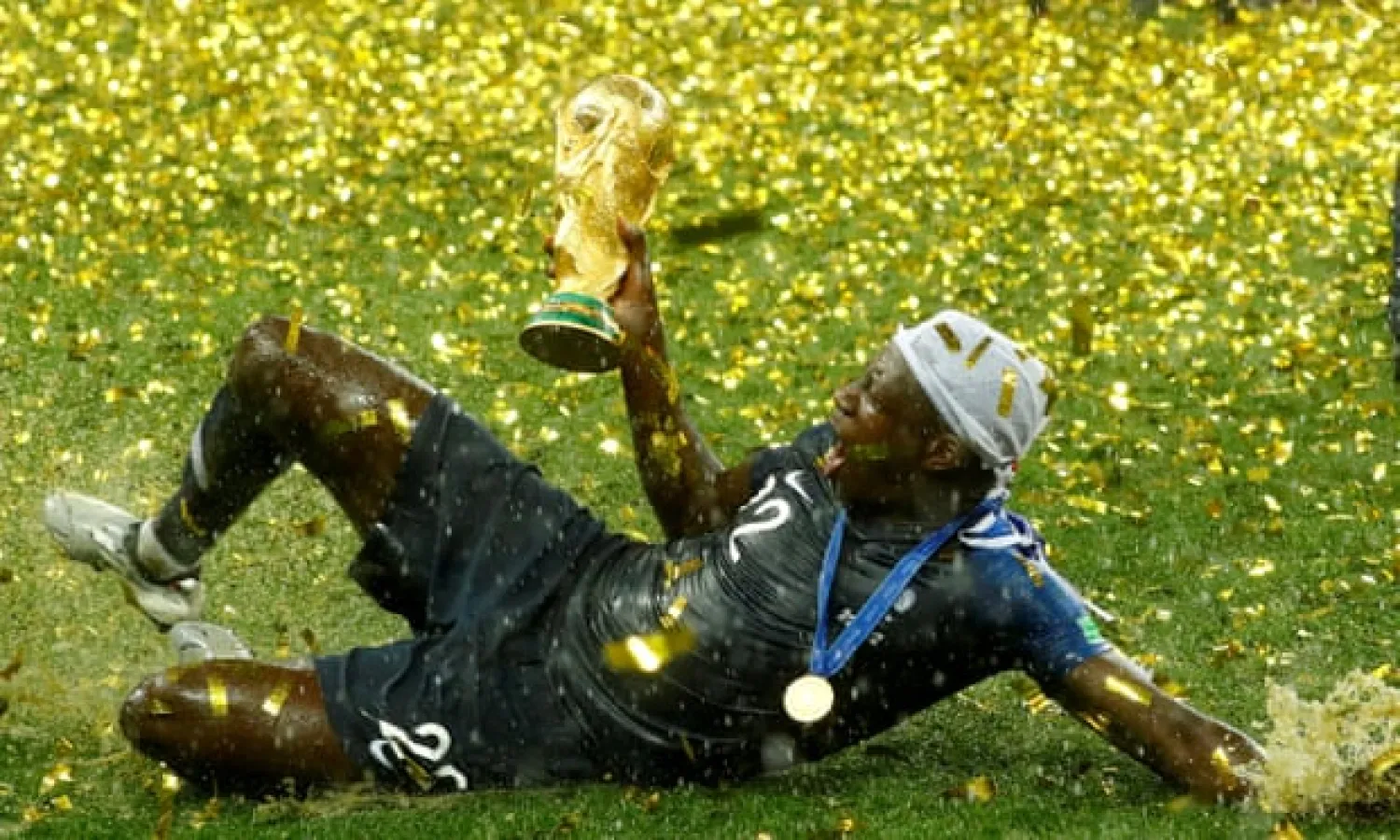
France’s Benjamin Mendy celebrates with the World Cup after his side saw off Croatia 4-2 at the Luzhniki Stadium in Moscow. Photograph: Kai Pfaffenbach/Reuters
TT

2018 in Football Tactics: France, Real Madrid Did it Their Way

France’s Benjamin Mendy celebrates with the World Cup after his side saw off Croatia 4-2 at the Luzhniki Stadium in Moscow. Photograph: Kai Pfaffenbach/Reuters

he same basics everywhere: it would be easy to believe that football in 2018 was about the victory of press and possess. Manchester City do it, Liverpool do it, Tottenham do it, Chelsea do it, Arsenal do it, Barcelona do it, Juventus do it, Napoli do it, Bayern Munich do it, Borussia Dortmund do it, even Paris Saint-Germain have been showing signs of doing it under Thomas Tuchel. Manchester United didn’t do it and José Mourinho was sacked after a grim opening to the season in which his ideas had seemed increasingly outmoded.

And yet the two biggest competitions of the year were won by teams that did not play in that way. Try to find a pattern based on France winning the World Cup and Real Madrid winning the Champions League and the only conclusions likely to be drawn are that you have has a better chance of winning if a) you have has Raphaël Varane in the team; b) your coach won the World Cup with France in 1998 and has an alliterative name.

Part of the reason the best World Cup in years was so much fun was that it did not conform to expectation. The pattern in recent international tournaments has been for stodgy football as coaches, with limited time to work with their squads, end up focusing on defensive shape and neglect attacking coherence, but that was not the case in Russia.

France were out of step with the general attacking mood, their performances at times only slightly less boring than Didier Deschamps’ press conferences. Yet even they found themselves embroiled in 4-3 and 4-2 thrillers, and it was a French right-back who scored the goal of the tournament on a forward surge. None of it made much sense.

Real Madrid’s success in the Champions League was equally difficult to fit into an overall tactical narrative. Their success was rooted less in any great strategic plan than in winning the moments. Cristiano Ronaldo kept scoring decisive goals, Sergio Ramos kept making decisive interventions, Zinedine Zidane kept making vital substitutions and opposing goalkeepers kept making dreadful mistakes. That is not a blueprint for anybody else to follow; it is not even a blueprint for winning La Liga.

But almost everywhere else press-and-possess dominated. There are variations, of course; Pep Guardiola’s football is not the same as Jürgen Klopp’s. But the underlying principles are the same: press hard to win the ball back as high up the pitch as possible, try to attack with a swift counterand, if that is not possible, maintain possession until it is.

And yet perhaps there is something telling in the fact that Madrid and France were successful in not playing that way. It is a reminder that football is a broad church open to many interpretations and perhaps also an indication that, thrilling as much elite football is these days, it is often a facade. Put simply: nobody is much good at defending any more – which is what makes recent changes made by Liverpool so fascinating.

For the top sides that is not especially surprising. Why would they be good at defending? They do not need to do it very often. As the economic disparity between the top and bottom of leagues has grown, so matches have become increasingly one-sided. That is apparent even in the Premier League, which has so far avoided the sort of crushing domination enjoyed by a Bayern, a Juve, a PSG or the Barça-Madrid duopoly.

A snapshot of the mismatches is given by possession stats. In the first three seasons that Opta collected data, between 2003‑04 and 2005‑06, there were only three games in which one team had 70% or more of the ball. That figure rose gradually to 36 in 2016-17. Last season there were 63. This season there had been 30 by Christmas – which is to say on course for 63 again.

The overwhelming reason for that is obvious: if one side have much better players, they can keep the ball far more easily. The trend then becomes exponential: where once there was a stigma about not having the ball for long periods, weaker sides have come to believe that the best way for them to compete is to maintain defensive shape and play without the ball. As their attacking ambitions become more limited, so the priority for players at the back in the stronger team becomes less defending than initiating attacks.

Which is all fine and logical until those players come up against a stronger team and actually have to start defending. That is why Manchester City last season had, statistically, the best defence in the Premier League but at the same time let in three goals in quick succession against Liverpool (twice) and Manchester United. They are hard to get at but once one has got at them, they are very getatable.

That pattern, repeated across Europe, is why so many games in the latter stages of the Champions League last season were so dramatic.

It is great for the viewer but it also means there is an opportunity for a team that can successfully pair the attacking dynamism that has become standard for elite teams with defensive solidity. Liverpool have been notably more cautious this season, while City played with unexpected reserve in their 0-0 draw at Anfield.

That perhaps is where football is heading. It seems implausible that the present frenzy will endure and the future is probably a more pragmatic variant of press-and-possess.

The Guardian


Irish Boxer Lee Reeves Dies at Age 31, Three Months after Dublin Title Fight Injury

Irish boxer Lee Reeves. Reuters
TT

Irish Boxer Lee Reeves Dies at Age 31, Three Months after Dublin Title Fight Injury

Irish boxer Lee Reeves. Reuters

Irish boxer Lee Reeves has died more than three months after being injured during a fight in Dublin, promoter Queensberry said Tuesday. He was 31.

"Everyone at Queensberry is devastated to learn of the passing of Lee Reeves," Queensberry Promotions said in a statement.

Reeves was hospitalized after being knocked out by compatriot Gary Cully in the 10th and final round of their Boxing Union of Ireland Celtic super-lightweight title fight on Aug. 1.

Reeves was carried from the ring on a stretcher after receiving initial treatment.

Queensberry had said after the fight that his condition was critical but stable.

“Lee was an immensely talented boxer, as well as a true role model and inspiration to his community,” the statement added Tuesday, according to The Associated Press. “Our deepest condolences go to Lee’s family, friends and all those who loved him. We ask that their privacy be respected at this incredibly difficult time. Rest in peace, Lee.”


Alonso to Enter Dakar Rally with Loeb and Aston Martin Team

November 5, 2026 Aston Martin's Fernando Alonso during a press conference ahead of the F1 Sao Paulo Grand Prix. (Reuters)
TT

Alonso to Enter Dakar Rally with Loeb and Aston Martin Team

November 5, 2026 Aston Martin's Fernando Alonso during a press conference ahead of the F1 Sao Paulo Grand Prix. (Reuters)

Double Formula One champion Fernando Alonso will compete in next January's Dakar Rally in an Aston Martin Dreadnought entry run by engineering partner Prodrive.

The 45-year-old Spaniard, a 32-time Grand Prix winner and two-time Le Mans 24 Hours winner, will be racing in the annual event for the second time after competing with Toyota in 2020, finishing 13th.

France's nine-time world rally champion Sebastien Loeb and Brazil's reigning world rally-raid champion Lucas Moraes will be his teammates in a three-car entry.

The 49th edition of the Dakar Rally will ‌be held in ‌Morocco from January 9 to 23, with a prologue and first ‌stage ⁠in Portugal, after ⁠being moved from Saudi Arabia due to security concerns.

The 24-round Formula One season is due to start in Bahrain in March after testing in late February.

Alonso, who will again have compatriot and five-time motorcycle Dakar winner Marc Coma as co-driver, is racing in the Las Vegas Grand Prix this weekend. He said he had turned his thoughts to Dakar after deciding to continue in Formula One with Aston Martin.

“In the end, the decision became simple. I wanted to embrace ⁠the challenge completely and take on both Formula One and the ‌Dakar Rally in the same year," he explained in ‌a statement.

"In 2020, Dakar was one of the most challenging and enjoyable experiences of my career. ‌I have enormous respect for this race and the specialists who have mastered it.

"Formula One ‌remains my priority. But I am a racing driver, and challenges like this are why I love competing. I’m looking forward to seeing what we can achieve."

LOEB CHASES FIRST DAKAR WIN

In October, Alonso told reporters at the Singapore Grand Prix that he felt the desert endurance race would be physically ‌incompatible with his Formula One commitments.

Loeb, 52, will also be chasing a first Dakar win after 10 previous attempts that have brought ⁠him 28 stage ⁠wins to date.

“Winning the Dakar is very important to me,” said the Frenchman, who will be partnered by Belgian Fabian Lurquin. “We have come close several times, and the motivation is there to keep working until we achieve it."

The Dreadnought is a digital-only tactical SUV created exclusively for gamers playing "Call of Duty: Modern Warfare 4" that will now be brought into the real world by Prodrive, Aston Martin's partners in endurance GT racing.

The Dakar will be Aston Martin Racing’s debut in the world rally-raid championship.

"Aston Martin's ambition for this program has been clear from the outset: to create a car capable of competing at the front of the world's toughest motorsport event," said Prodrive Chairman David Richards.

"By combining Aston Martin's vision with Prodrive's experience in rallying, endurance racing and Dakar competition, we have built a strong foundation. With an exceptional driver line-up and a highly capable engineering team, we look forward to seeing Dreadnought take on this remarkable challenge."


Owono Does Not Deserve 12-Match Ban Over De Miguel Death, Says Andorra Owner Pique

Equatorial Guinea's goalkeeper #01 Jesus Owono leaves the pitch at half time during the Africa Cup of Nations (CAN) Group E football match between Equatorial Guinea and Algeria at Moulay Hassan Stadium in Rabat on December 31, 2025. (AFP)
TT

Owono Does Not Deserve 12-Match Ban Over De Miguel Death, Says Andorra Owner Pique

Equatorial Guinea's goalkeeper #01 Jesus Owono leaves the pitch at half time during the Africa Cup of Nations (CAN) Group E football match between Equatorial Guinea and Algeria at Moulay Hassan Stadium in Rabat on December 31, 2025. (AFP)

FC Andorra owner Gerard ‌Pique said goalkeeper Jesus Owono did not deserve the 12-match suspension he received following the challenge that led to the death of Tenerife forward Jesus de Miguel.

Owono and De Miguel collided during a Spanish second-tier match on November 2. De Miguel was taken to intensive care and died the following day.

The disciplinary committee of the Spanish football federation (RFEF) banned Owono for violent conduct which resulted in serious ‌injury last week.

"Players, ‌former players, coaches, goalkeepers, everyone has ‌called ⁠it an accident," ⁠Pique said in a video posted on social media late on Monday.

"I truly believe that imposing the maximum sanction on Jesus for this action puts him in a situation he does not deserve, because he is not to blame for all of ⁠this having happened."

Former Barcelona player Pique ‌pointed to the three-match ‌ban handed to Albacete's Jose Corpas for accidentally kicking Sabadell ‌player Quadri Liameed in the head during a ‌recent match in Spain.

"Fortunately Quadri is fine, the consequences in this case were not fatal, and the committee decided to sanction Corpas with three matches," Pique added.

"With ‌all this, my reflection is: what is being sanctioned, the action or the ⁠consequences?"

The RFEF ⁠did not immediately respond to a request for comment outside regular business hours in Spain.

Owono, 25, has withdrawn from Equatorial Guinea's squad for Africa Cup of Nations qualifiers against Zimbabwe this month and Pique said it was unlikely the goalkeeper would return to action as soon as his suspension is up.

"Jesus is going to need far more than 12 matches before he is available and able to compete," he added. "No sanction is going to bring Demi (De Miguel) back to us."