Plunge in Oil Prices Threatens Iraq's Postwar Recovery

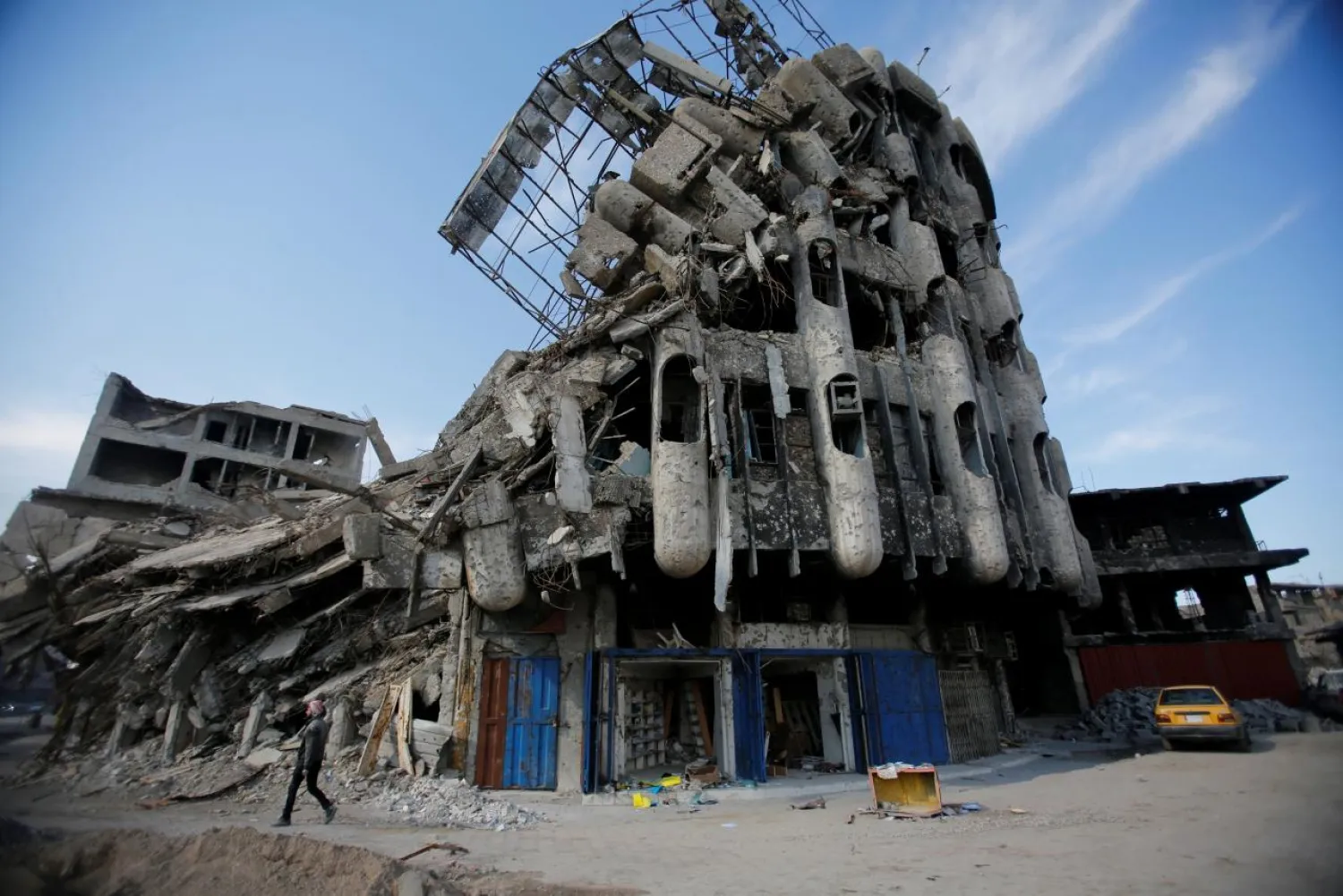
Destroyed building from previous clashes are seen in Mosul, Iraq January 28, 2018. (Reuters)
TT

Plunge in Oil Prices Threatens Iraq's Postwar Recovery

Destroyed building from previous clashes are seen in Mosul, Iraq January 28, 2018. (Reuters)

The latest plunge in oil prices has dealt a heavy blow to Iraq's stagnating economy, threatening the new government's ability to rebuild after the war with the ISIS terrorist group and provide basic services to areas roiled by recent protests, said The Associated Press Tuesday.

Brent crude oil, used to price international purchases, briefly rose above $85 a barrel in October but has since plummeted to less than $55 — a nightmare for a country like Iraq that derives 95 percent of its revenue from oil exports.

A $111.9 billion draft budget sent to parliament in October projects crude exports of 3.8 million barrels per day to be sold at $56 per barrel. The bill, which includes a 23 percent increase in spending, would leave a deficit of $22.8 billion.

But that won't even begin to address the colossal challenge of reconstruction after years of war. Some 1.8 million people have yet to return to their homes, according to the United Nations. Mosul, the country's second largest city, lies partly in ruins, as do many other cities, towns and villages once held by ISIS, said the AP.

Iraq's Planning Ministry estimates the country needs approximately $88 billion for reconstruction. In February, donors at a Kuwait summit pledged $30 billion in loans and investments to finance a portion of the bill, but little progress has been made to fulfill the pledges.

In Iraq's oil-rich south, meanwhile, which was spared from the war's devastation, protests have erupted in recent months over unemployment and poor public services. Rolling power outages have been a nationwide problem going back to the US-led invasion in 2003, and in the south the tap water is undrinkable.

"We were surprised by the plunging oil prices and we have fallen into a big problem," said lawmaker Haneen al-Qado, who chairs parliament's Economy Committee. "The government is not in an enviable position."

Iraqis elected a new government earlier in 2018, but it is dominated by the same bickering political factions that have governed the country for the last 15 years. Lawmakers have rejected the draft budget, calling for a new one that would estimate an even lower oil price and allocate even more funds for public investments, explained the AP.

Qado said they may not be able to approve a budget until sometime in the first quarter of next year. Until then, the government can only spend one-twelfth of the previous year's allocation each month.

While international attention has been focused on the devastation in northern and western Iraq, and the protests in the south, the budget crisis has also taken a heavy toll on Iraqis living in more stable areas. Construction projects across Baghdad have been stalled for years, with half-finished buildings turned into neighborhood garbage dumps.

Kadhim Nima Khudair's construction company signed contracts in 2014 to build four schools at a cost of $5 million. By the following year, three of them were 80 percent complete, but then public funds dried up as the government launched the costly war against ISIS. When oil prices started to recover in 2017, the government began paying installments again, but only for the projects that were mostly completed. Now the payments have stopped again pending the budget negotiations.

None of the schools have been completed, and Khudair has fallen deeply into debt, forcing him to lay off some 500 workers and sell family homes and cars.

"I don't want any profit now, I only want my capital back," Khudair said. "We have been struggling all these years. People are still knocking on my door, asking for their money."

Sami al-Araji, the head of the National Investment Commission, told an economic conference in December that hundreds of projects worth an estimated $54 billion are delayed. He called for a major overhaul of the economy that would promote investment and lessen the country's reliance on oil. "We have to think of all alternatives," he said. "The country has promising opportunities."

That's easier said than done. Efforts to diversify the economy have been stymied by political infighting and corruption going all the way back to 2003, fueling cycles of war and instability, said the AP.

"Our fate is attached to oil," Khudair said. "When it's down, our blood pressure rises."


Saudi Stocks Rebound 0.9%, Recouping Previous Session's Losses

An investor monitors stock market data on a screen at the Saudi Exchange (Tadawul) in Riyadh (Reuters)
TT

Saudi Stocks Rebound 0.9%, Recouping Previous Session's Losses

An investor monitors stock market data on a screen at the Saudi Exchange (Tadawul) in Riyadh (Reuters)

Saudi stocks closed higher on Monday, recovering some of the losses sustained in the previous session as heavyweight shares strengthened and the banking sector advanced.

The benchmark Tadawul All Share Index (TASI) rose 0.90% to close at 10,106 points, gaining 90 points. Total trading value reached approximately SAR 3.5 billion ($933 million).

The index had fallen 0.8% on Sunday amid selling pressure on heavyweight stocks.

Anaam International Holding Group, Fitaihi Holding Group and Raoom were among the session's top gainers, rising between 7% and 9% to close at SAR 11.93, SAR 2.11 and SAR 72.30, respectively.

On the losing side, Almunajem Foods led the declines, shedding 9.20% to SAR 49.94, followed by Saudi Paper Manufacturing Co., which fell 6.18% to SAR 48.88, and Alamar Foods, which dropped 4.63% to SAR 44.06.

At the sector level, banks led the gains, advancing 1.60%, supported by a 2.06% rise in Bank AlJazira shares, which closed at SAR 10.89.


Tesla to Refund Many Cybertruck Deposits as Demand Exceeds Production, Musk Says

Tesla Cybertruck electric vehicles sit parked in a storage lot in San Diego, California on April 11, 2025. (AFP)
TT

Tesla to Refund Many Cybertruck Deposits as Demand Exceeds Production, Musk Says

Tesla Cybertruck electric vehicles sit parked in a storage lot in San Diego, California on April 11, 2025. (AFP)

Tesla will have to refund Cybertruck deposits for many customers as orders far exceed production capacity, CEO Elon Musk said, following last week's announcement that the electric vehicle maker is winding down the pickup truck's production at its Texas factory.

"We will try ‌to make ‌as many as ‌possible ⁠before shutting down the ⁠line in about 8 months, but will have to return deposits for a lot of people," the billionaire said in a post on X on Monday.

The comments ⁠come after Musk said ‌Tesla would ‌add an extra production shift to fulfill outstanding ‌Cybertruck orders before dismantling the production ‌line next year to expand output of its Cybercab robotaxi.

The production winddown is slated for mid-2027, Musk announced on ‌Friday, with the resources being redirected to the Cybercab, a vehicle ⁠central ⁠to the automaker's autonomous-driving ambitions.

Tesla began delivering the Cybertruck in late 2023, but demand has fallen far short of Musk's expectations. US sales fell 48% to 20,237 units last year, according to Kelley Blue Book, well below Musk's earlier projection that annual Cybertruck sales could reach 250,000 vehicles.


China Extends Suspension of New Rare Earth Controls Until January

A mining machine is seen at the Bayan Obo mine containing rare earth minerals, in Inner Mongolia, China July 16, 2011. (Reuters)
TT

China Extends Suspension of New Rare Earth Controls Until January

A mining machine is seen at the Bayan Obo mine containing rare earth minerals, in Inner Mongolia, China July 16, 2011. (Reuters)

China on Monday announced a two-month extension of export-control waivers due to expire this month, preserving part of a wide-ranging deal struck after a summit between Presidents Xi Jinping and Donald Trump.

China introduced export controls on certain rare earths ‌in April 2025, ‌only to expand ‌them ⁠further in October ⁠of that year, dramatically widening their scope and also adding new controls on certain diamonds with industrial applications and lithium battery technology.

The measures were then ⁠paused for one year last ‌November after ‌a summit in South Korea ‌between Xi and Trump.

The Ministry of ‌Commerce said in a short statement on Monday that the pause would be extended for two months ‌until January 10. It gave no other details.

The extension ⁠is ⁠part of a broader suspension of trade countermeasures and tariffs announced by China on Monday as it negotiates with Washington over an enduring trade deal.

Trump is set to travel to Shenzhen in southern China later this month for an APEC leaders summit, where he is expected to meet with Xi.