Mertesacker: ‘It Gives You the Goosebumps ... on the Pitch You See Actual Joy’

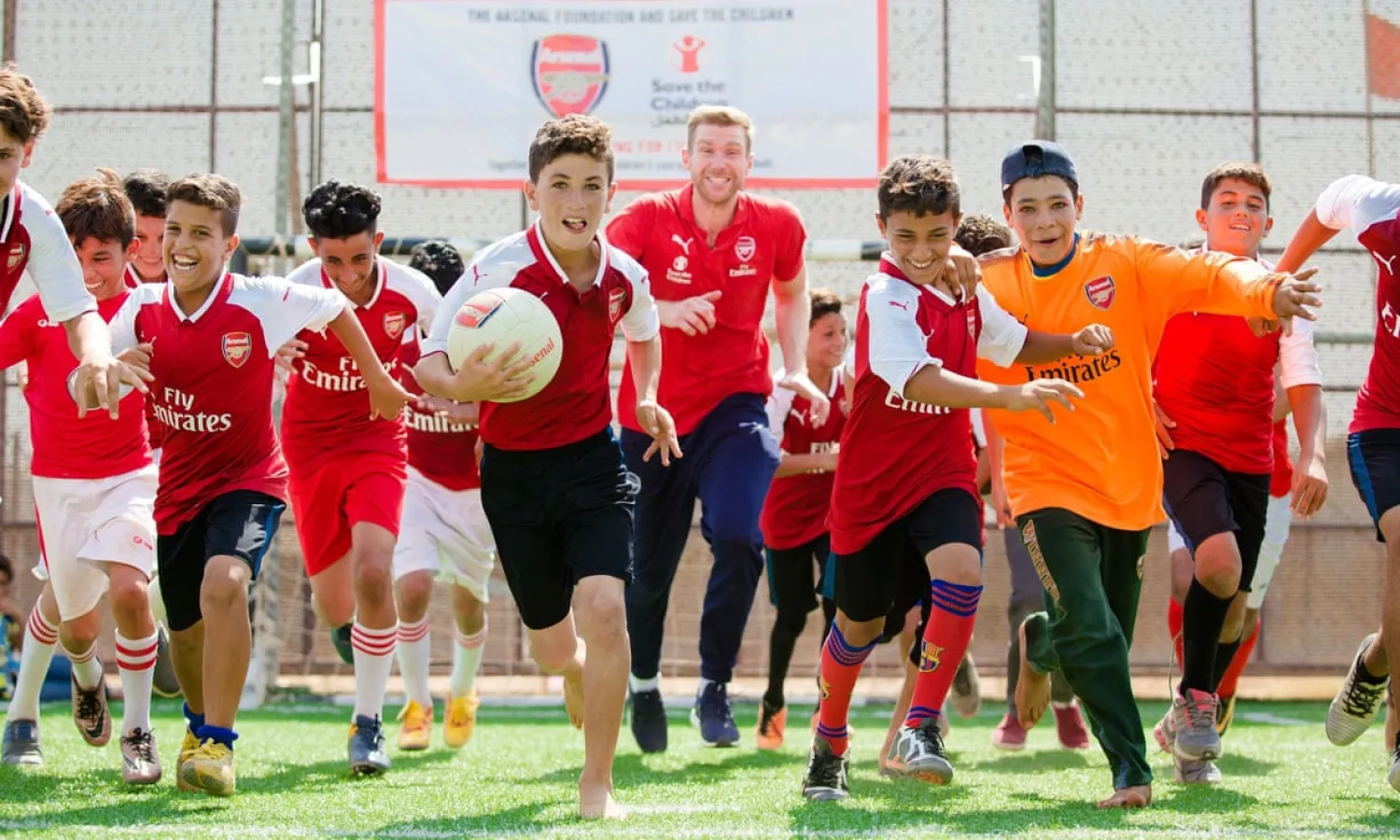
Per Mertesacker launches Save the Children’s coaching program with youngsters at Zaatari refugee camp in the north of Jordan, near the border with Syria. Photograph: Save the Children/AP
TT

Mertesacker: ‘It Gives You the Goosebumps ... on the Pitch You See Actual Joy’

Per Mertesacker launches Save the Children’s coaching program with youngsters at Zaatari refugee camp in the north of Jordan, near the border with Syria. Photograph: Save the Children/AP

As a footballer who used to be assailed by anxiety before matches, Per Mertesacker felt the butterflies rising as he made his approach to a pitch with a difference. He spent much of the hour-long drive from Amman, the capital of Jordan, to Zaatari, one of the largest refugee camps on earth, wondering what to expect. Mertesacker is a deep thinker and his mind whirred. “It gives you the goosebumps,” he says. “You are a little bit depressed to go there. You have respect and know it is important for everything to sink in. When you arrive it’s tight, very hot and very dry. And then you go to a football pitch and see actual joy.” The collision of that joy with the hardship and trauma around it strikes him profoundly.

In his new role as head of Arsenal’s academy, Mertesacker spends most of his days in the world occupied by boys with their heads full of the challenges involved in becoming a professional footballer. Away from the bubble, the former center-back, who made 156 appearance for Arsenal, meets thousands more in everyday life who share that dream even though they will never get anywhere closer than in their imagination.

Mertesacker is comfortable talking to boys and their families about the realities of a life in football but sitting in the temporary home of Mohammad, a displaced Syrian, taking tea with his family and enjoying hospitality as the boy outlined his ambitions with such conviction, Mertesacker was hit by the paradox: here was Mohammad, in conditions that make a professional career seem almost impossible, with his pure love for the game intact.

Back in England, players in elite academies with refined facilities and financial rewards find their natural instincts get dulled along the way. “Mohammad explained: ‘Football is my life,’ with tears in his eyes,” Mertesacker says earnestly. “It is his dream to be like me, and he really believes it. Speaking to him was very emotional because you can feel he didn’t want to talk about what happened and how they ended up there. They want to talk about what they have now – a corrugated iron structure made into a home, their own little garden, a chance to get an education, football in their lives. They were actually counting what they have, not what they left.”

During his time in Zaatari, Mertesacker began to appreciate how the football pitch there, built by Arsenal in conjunction with Save the Children, is a trigger for the much deeper work that goes on around this patch of artificial turf. He understands it could feel tokenistic, or even incongruous. But the key to it all is that giving children who have fled a war zone a space to kick a ball around and feel joy is only part of what they do.

The mission here is about developing resilience, feeling part of a group. There is also a focus on training the coaches to detect signs of stress in young people, to identify a change in behavior and get suitable support for them, whether they are depressed or undernourished or uncommunicative.

All in all, it was a particularly meaningful experience for Mertesacker as he begins a new phase of his life. “You spend some time with kids, you always take something with you,” says the 33-year-old. “Here we are developing youngsters in an environment where they feel they have almost everything. There are still so many issues around young players, and we need to find the right way for them. What is really important? What does he need for his self-belief? For his development? That reminder was basic. Youngsters need self-esteem, simple targets in life which give energy. In the academy they can be so easily distracted by so many other things it’s amazing.

“We are getting rid of so many natural instincts that youngsters have. There are so many people around young kids nowadays it can make it very tough and difficult – people who think they are going to care for those kids but do the opposite. As long as the money comes in as it does at the moment, we don’t understand what impact money has on kids and parents in football. That is a huge topic in football.”

Is it a losing battle in the modern world? “I am for honesty and trying to explain things, taking parents on board. You can’t turn back the clock. Twenty years ago I wasn’t paid until I was 18 and that really helped me in my development. My parents did not go mad. I had no agent. I had no shoe deal. There is a part of me that would like to do it how it was but that’s impossible. We have to try to bring a little bit more reality and normality. If you just get given things along your way, you don’t have joy anymore. You lose that joy, that appreciation for what you can do, and what privilege you have. I don’t want them to lose their personality. Locking them in our facilities, where they just have the tunnel vision of just performing on the pitch? I get that. We judge them on their football. But you lose a lot of personality and then you are not able to perform at any level.”

With luxury training centers, top coaching and total organization, Mertesacker feels we are missing something much more vital about the human behind the footballer. “Do we misunderstand what care means? That is the key question for me,” he says. “If we throw money at them and give them everything they need, build beautiful facilities, is that really care which helps them for the future? That is my question as I step into the academy. Because not everyone will be a professional footballer. This is obvious. The ratios are quite shocking. The more leaders we have that bring more reality into that life in the bubble – when this bubble gets burst not everyone can cope with society – the better. This is a topic I will always attack and be very honest about.”

Mertesacker is throwing himself and his ideas into his new role. It is his first season outside of the players’ zone for a long time, a seismic personal change. Many are daunted by that shift. He isn’t. “That moment when I felt I don’t need to start running was the best feeling I have had for years,” he says, candidly. “It gave me relief. I don’t miss anything now. I am grateful for the experience but 15 years was intense enough for me. I have closed that chapter. This new one is so exciting right now. As a player you are in a tunnel. Now the understanding has to be much broader.

“I want to find out more, to build something here so that we have youngsters who can cope with any challenge in life. Talent is not enough for me. I want strong young characters who can cope if they get injured, or released, or play at the Emirates in the first team. That is our responsibility.”

(The Guardian)


South Africa Chooses Durban as Its Preferred City to Host 2036 or 2040 Olympics

TT

South Africa Chooses Durban as Its Preferred City to Host 2036 or 2040 Olympics

Durban is South Africa 's preferred candidate to host the first Olympics in Africa.

South Africa is bidding to host the 2036 or 2040 Summer Olympics and Paralympics. The International Olympic Committee will choose the host city for 2036 in mid-2029.

The country's choice to put forward Durban, South Africa's third biggest city, was announced by South African Olympic committee acting president Lwandile Simelane on Thursday. She said Durban would be the main candidate city for South Africa's bid, but it would likely be a “multi-city bid” that would propose some events are held in other cities.

South Africa's economic hub of Johannesburg and Cape Town were also considered as the candidate city, The Associated Press said.

Durban, a city of around 4 million on the subtropical Indian Ocean coast, was touted as a possible Olympic host city more than a decade ago following South Africa's staging of the 2010 soccer World Cup, the first in Africa. But an official bid didn't materialize then, largely due to concerns over costs.

The city was stripped of hosting the 2022 Commonwealth Games because it couldn't make financial or other guarantees required for that event.

Officials said on Thursday they were not yet able to provide any estimates regarding how much it might cost South Africa to stage the Olympics if its bid was successful. They said Durban's bid would be centered on the 56,000-seat Moses Mabhida Stadium, which was built for the 2010 World Cup.

South Africa is among seven countries bidding for the 2036 Games. The others are India, Qatar, South Korea, Germany, Hungary and Türkiye.

The IOC gave Oct. 31 as the deadline for national Olympic committees to formally declare their interest in bidding for the 2036 Games.

Candidates have an opportunity to make virtual presentations to the IOC next month to start the official bidding process. A key date is in March, the IOC has said, when its board will approve a shortlist of candidates.

South Africa would be a first African host of the Summer Games since the modern Olympics was created in 1896 if it wins. Africa's biggest economy previously failed with a bid to stage the 2004 Games in Cape Town.

The Youth Olympics open this weekend in Dakar, Senegal, marking the first Olympic sports event to be held in Africa.


MLS Announces Key 2027 'Sprint Season' Matches Ahead of Calendar Shift

Inter Miami's Argentine forward #10 Lionel Messi looks on during a Major League Soccer (MLS) regular season football match between Inter Miami CF and FC Cincinnati at Nu Stadium in Miami, Florida, on October 28, 2026. (Photo by Giorgio VIERA / AFP)
TT

MLS Announces Key 2027 'Sprint Season' Matches Ahead of Calendar Shift

Inter Miami's Argentine forward #10 Lionel Messi looks on during a Major League Soccer (MLS) regular season football match between Inter Miami CF and FC Cincinnati at Nu Stadium in Miami, Florida, on October 28, 2026. (Photo by Giorgio VIERA / AFP)

Lionel Messi's Inter Miami will kick off Major League Soccer's 2027 "Sprint Season" when they face Cincinnati on February 19, launching the league's transition to a traditional autumn-to-spring calendar.

The standalone match at Nu Stadium in Miami will begin a truncated 14-game regular season and playoff tournament designed to bridge the gap as MLS shifts away from its traditional summer schedule to align with Europe's top leagues.

The schedule, previewed on Apple TV's "MLS Countdown," emphasizes weekly rivalry ⁠matchups. Among the ⁠headline games announced, LA Galaxy will host Los Angeles FC on April 10 in the "El Trafico" derby.

The sprint season will conclude its regular-season slate on May 8 with "Decision Day," anchored by the Hudson River Derby between New York ⁠City FC and the New York Red Bulls, setting the stage for the May playoffs.

The four-month sprint serves as the prelude to the league's full operational shift. The first standard season under the new timetable will run from mid-to-late July 2027 through May 2028, featuring a midwinter break and no matches in January.

MLS Commissioner Don Garber previously called the calendar change "one of the ⁠most ⁠important decisions in our history,” Reuters reported.

The strategic overhaul was approved following a two-year review to synchronize the league's transfer activity with the global summer window, minimize scheduling conflicts with FIFA's international fixtures, and hold the MLS Cup playoffs in May when the North American sports calendar is less crowded.

US men's national team coach Mauricio Pochettino is among those who have endorsed the change, noting that calendar alignment with the global soccer landscape will benefit clubs, coaches, and player development.


Rybakina Clinches Year-end Top Ranking with Tokyo Second-round Win

Tennis - WTA 500 - Pan Pacific Open - Ariake Coliseum, Tokyo, Japan - October 29, 2026 Kazakhstan's Elena Rybakina celebrates after winning her round of 16 match against Kazakhstan's Yulia Putintseva REUTERS/Kim Kyung-Hoon
TT

Rybakina Clinches Year-end Top Ranking with Tokyo Second-round Win

Tennis - WTA 500 - Pan Pacific Open - Ariake Coliseum, Tokyo, Japan - October 29, 2026 Kazakhstan's Elena Rybakina celebrates after winning her round of 16 match against Kazakhstan's Yulia Putintseva REUTERS/Kim Kyung-Hoon

Elena Rybakina beat fellow Kazakh Yulia Putintseva 6-2 6-3 in the second round of the Pan Pacific Open in Tokyo on Thursday to secure the year-end world number one ranking for the first time, more than a week before the season-ending WTA Finals.

Rybakina received a bye into the last 16 of the WTA 500 event in Tokyo and arrived at the Ariake Coliseum after capturing her fourth ⁠title of the ⁠season and first as the top-ranked player at last week's Ningbo Open in China.

The 27-year-old, who rose to world number one for the first time en route to winning the US Open last month, ⁠needed only one more victory this year to ensure that world number two Aryna Sabalenka could not overtake her.

Rybakina is enjoying a marquee year with wins at the Australian Open and US Open to take her Grand Slam tally to three, after winning Wimbledon four years ago.

Rybakina next faces Leylah Fernandez in a rematch of their Ningbo final, ⁠after ⁠the Canadian beat Elise Mertens 6-2 7-6(8), Reuters reported.

Rybakina endured a brief dip after her US Open triumph, losing her opening match in Beijing and missing the Wuhan Open due to a leg injury, before defending her title in Ningbo.

She is targeting a 16th career title before heading to Indian Wells, California, for the WTA Finals, where the season's top eight players will compete from November 8-15.