The Pressure Is Permanent’: A Football Agent on January’s Transfer Window

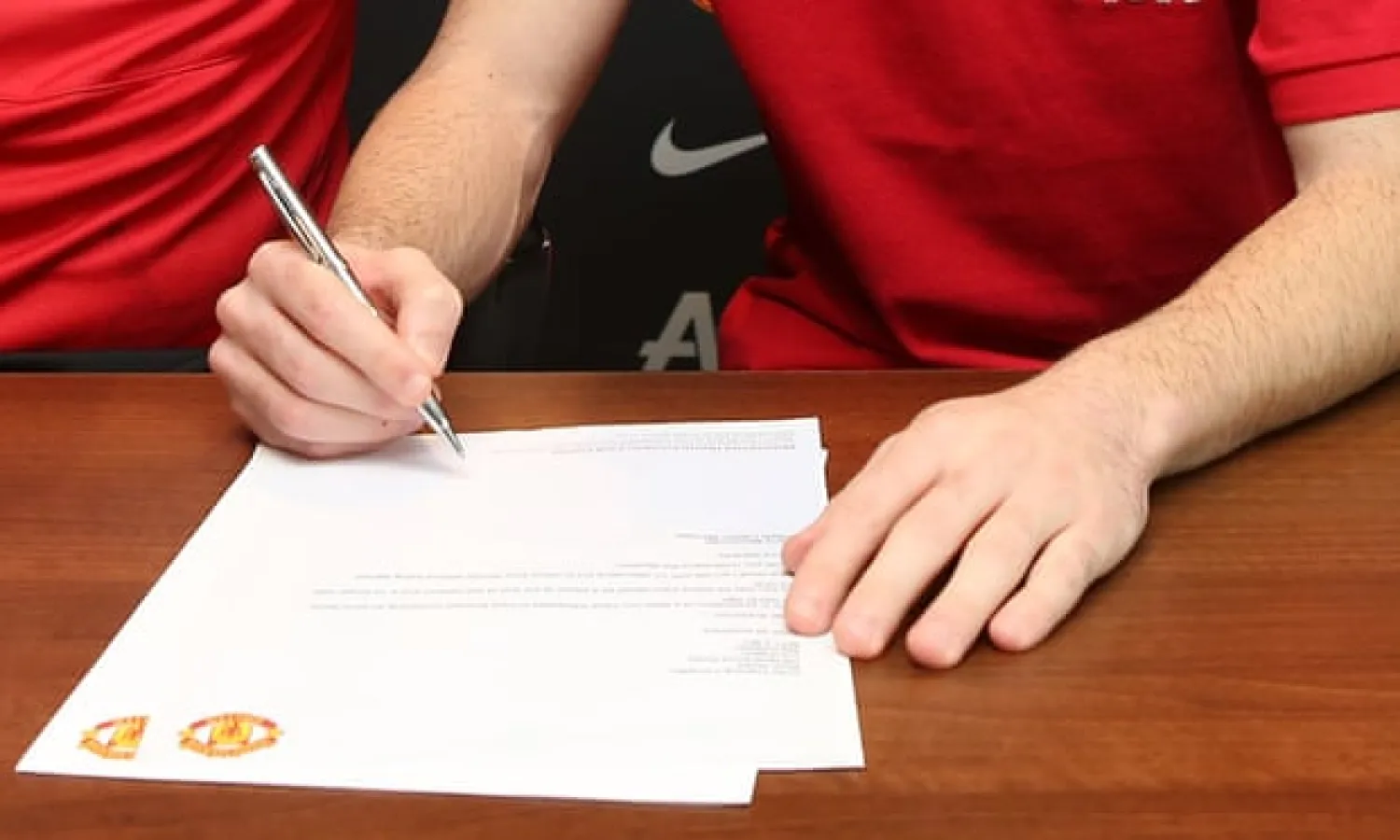
 Getting a player to sign on the dotted line is only a small part of the process in making a transfer happen. Photograph: John Peters/Man Utd via Getty Images
Getting a player to sign on the dotted line is only a small part of the process in making a transfer happen. Photograph: John Peters/Man Utd via Getty Images
TT

The Pressure Is Permanent’: A Football Agent on January’s Transfer Window

 Getting a player to sign on the dotted line is only a small part of the process in making a transfer happen. Photograph: John Peters/Man Utd via Getty Images
Getting a player to sign on the dotted line is only a small part of the process in making a transfer happen. Photograph: John Peters/Man Utd via Getty Images

The midwinter transfer window is an ‘emergency’ window. It is an opportunity for clubs to patch up a problem rather than find long-term solutions and can also be a difficult time to undertake business given prices soar. A few years ago, £15m might have bought pedigree. These days it could secure a Premier League side a promising right-back from a lower-ranked Bundesliga club. Yet, in what is a cut-throat environment for both clubs and agents, desperation drives the market and deals will be done.

As well as representing individual players, I have been registered as an FA intermediary for most of the last seven years – barring a brief spell when I concentrated on developing commercial agreements with some clients – and it is in that capacity that the January window will keep me busy, most obviously helping to bring players to England. The intermediary’s role is that of a facilitator whose contacts, knowledge or even language skills might benefit sporting directors in this country or agents based overseas.I would typically spend the leadup to December putting out feelers to clubs or scouts, usually face-to-face at games, before supplying sporting directors with lists of options to pursue in the window. Simultaneously, I will have cultivated relationships with agents abroad to ascertain what their clients offer, securing written mandates to represent their players in negotiations in England or even with specific teams. The mandate system is not foolproof. The Chelsea forward Willian posted a photograph on Instagram last summer of a mandate document on which someone had forged his signature. Agents can also give out multiple mandates, and there are occasions when the whole system is abused.

Three years ago I was contacted personally by a player, freed by a Premier League club, who assured me verbally – I was naive in that regard – he did not operate with an agent and supplied a mandate to secure him a move to a Major League Soccer club. I negotiated a four-year deal which included an annual salary of $3.5m, a car and a house, and he claimed to be happy. Then, as the club was drawing up the formal offer, he called to say the deal was off. The next day he announced on Instagram that he had signed for a side in Europe. He had apparently worked with an agent for around 10 years and had merely been using me to coax out a better deal over there.

You learn quickly, but the pressure is permanent. Take a scenario: it is 10am on transfer deadline day and a club, to whom I have already sent videos of a mandated player based abroad, belatedly decide they want to push through a deal before the 11pm cut-off. They will be aware of the player’s asking price so, as the intermediary, you have to assume that aspect of the move will not prove problematic. It is now a matter of securing the best contract possible in what time remains. So, having spoken at length with the player’s existing agent, I would fire off an email to the club – it is essential it is in written form – laying down the basic pay and, just as significantly, the bonus structure acceptable to the player.

Those bonuses can be incredibly intricate, and quite volatile. There are standard team clauses: the amount owed for winning the league, gaining promotion or avoiding relegation; for lifting the Champions League or qualifying for Europe. Then there is the potentially prickly issue of image rights, as well as personal incentives – top scorer, goal or appearance bonuses – and sums due for playing a certain number of games. Within that you might specify what constitutes an appearance: 45 minutes, an hour or even coming off the bench for a minute of stoppage time. If you are doing a deal for a club going for promotion you could seek a guarantee to raise the player’s salary in the new division. Likewise, you might accept a salary drop, or insert a release clause, in the event of relegation.

The demands are then emailed to the club, who could make amendments of their own. Once the deal is agreed in principle, you await the formal contract offer, usually drawn up by the club’s in-house solicitors and emailed over . That, too, has to be legalled at our end and there may be more to-ing and fro-ing over the finer details before, once the green light is given by both sides, you address the logistics of bringing the player over.

Nowadays there are concierge companies who work in the industry and can fly a player over to a private airport – a Farnborough or Biggin Hill – at short notice. Those costs are covered by the intermediary but if the player ends up signing for the club, his new employers tend to reimburse the costs. I would always seek to pick the player up myself from the airport to take him to his medical, a procedure that tends to last around an hour and is usually undertaken at a private hospital.

As for the fees due to the ‘fixers’ – the agent and intermediary – the FA recommends the equivalent of 3% of the player’s gross salary over the duration of the contract signed. That might be pushed to 5% taking in legal, accountancy and commercial guidance, with the fee split 50/50 between the agent and intermediary and, generally, paid either quarterly or six-monthly.

It can all be a frenzied process. But the hope is that all parties – buying club, selling club, the player and the agents – are satisfied once the deadline has passed.

The Guardian Sport


Irish Boxer Lee Reeves Dies at Age 31, Three Months after Dublin Title Fight Injury

Irish boxer Lee Reeves. Reuters
TT

Irish Boxer Lee Reeves Dies at Age 31, Three Months after Dublin Title Fight Injury

Irish boxer Lee Reeves. Reuters

Irish boxer Lee Reeves has died more than three months after being injured during a fight in Dublin, promoter Queensberry said Tuesday. He was 31.

"Everyone at Queensberry is devastated to learn of the passing of Lee Reeves," Queensberry Promotions said in a statement.

Reeves was hospitalized after being knocked out by compatriot Gary Cully in the 10th and final round of their Boxing Union of Ireland Celtic super-lightweight title fight on Aug. 1.

Reeves was carried from the ring on a stretcher after receiving initial treatment.

Queensberry had said after the fight that his condition was critical but stable.

“Lee was an immensely talented boxer, as well as a true role model and inspiration to his community,” the statement added Tuesday, according to The Associated Press. “Our deepest condolences go to Lee’s family, friends and all those who loved him. We ask that their privacy be respected at this incredibly difficult time. Rest in peace, Lee.”


Alonso to Enter Dakar Rally with Loeb and Aston Martin Team

November 5, 2026 Aston Martin's Fernando Alonso during a press conference ahead of the F1 Sao Paulo Grand Prix. (Reuters)
TT

Alonso to Enter Dakar Rally with Loeb and Aston Martin Team

November 5, 2026 Aston Martin's Fernando Alonso during a press conference ahead of the F1 Sao Paulo Grand Prix. (Reuters)

Double Formula One champion Fernando Alonso will compete in next January's Dakar Rally in an Aston Martin Dreadnought entry run by engineering partner Prodrive.

The 45-year-old Spaniard, a 32-time Grand Prix winner and two-time Le Mans 24 Hours winner, will be racing in the annual event for the second time after competing with Toyota in 2020, finishing 13th.

France's nine-time world rally champion Sebastien Loeb and Brazil's reigning world rally-raid champion Lucas Moraes will be his teammates in a three-car entry.

The 49th edition of the Dakar Rally will ‌be held in ‌Morocco from January 9 to 23, with a prologue and first ‌stage ⁠in Portugal, after ⁠being moved from Saudi Arabia due to security concerns.

The 24-round Formula One season is due to start in Bahrain in March after testing in late February.

Alonso, who will again have compatriot and five-time motorcycle Dakar winner Marc Coma as co-driver, is racing in the Las Vegas Grand Prix this weekend. He said he had turned his thoughts to Dakar after deciding to continue in Formula One with Aston Martin.

“In the end, the decision became simple. I wanted to embrace ⁠the challenge completely and take on both Formula One and the ‌Dakar Rally in the same year," he explained in ‌a statement.

"In 2020, Dakar was one of the most challenging and enjoyable experiences of my career. ‌I have enormous respect for this race and the specialists who have mastered it.

"Formula One ‌remains my priority. But I am a racing driver, and challenges like this are why I love competing. I’m looking forward to seeing what we can achieve."

LOEB CHASES FIRST DAKAR WIN

In October, Alonso told reporters at the Singapore Grand Prix that he felt the desert endurance race would be physically ‌incompatible with his Formula One commitments.

Loeb, 52, will also be chasing a first Dakar win after 10 previous attempts that have brought ⁠him 28 stage ⁠wins to date.

“Winning the Dakar is very important to me,” said the Frenchman, who will be partnered by Belgian Fabian Lurquin. “We have come close several times, and the motivation is there to keep working until we achieve it."

The Dreadnought is a digital-only tactical SUV created exclusively for gamers playing "Call of Duty: Modern Warfare 4" that will now be brought into the real world by Prodrive, Aston Martin's partners in endurance GT racing.

The Dakar will be Aston Martin Racing’s debut in the world rally-raid championship.

"Aston Martin's ambition for this program has been clear from the outset: to create a car capable of competing at the front of the world's toughest motorsport event," said Prodrive Chairman David Richards.

"By combining Aston Martin's vision with Prodrive's experience in rallying, endurance racing and Dakar competition, we have built a strong foundation. With an exceptional driver line-up and a highly capable engineering team, we look forward to seeing Dreadnought take on this remarkable challenge."


Owono Does Not Deserve 12-Match Ban Over De Miguel Death, Says Andorra Owner Pique

Equatorial Guinea's goalkeeper #01 Jesus Owono leaves the pitch at half time during the Africa Cup of Nations (CAN) Group E football match between Equatorial Guinea and Algeria at Moulay Hassan Stadium in Rabat on December 31, 2025. (AFP)
TT

Owono Does Not Deserve 12-Match Ban Over De Miguel Death, Says Andorra Owner Pique

Equatorial Guinea's goalkeeper #01 Jesus Owono leaves the pitch at half time during the Africa Cup of Nations (CAN) Group E football match between Equatorial Guinea and Algeria at Moulay Hassan Stadium in Rabat on December 31, 2025. (AFP)

FC Andorra owner Gerard ‌Pique said goalkeeper Jesus Owono did not deserve the 12-match suspension he received following the challenge that led to the death of Tenerife forward Jesus de Miguel.

Owono and De Miguel collided during a Spanish second-tier match on November 2. De Miguel was taken to intensive care and died the following day.

The disciplinary committee of the Spanish football federation (RFEF) banned Owono for violent conduct which resulted in serious ‌injury last week.

"Players, ‌former players, coaches, goalkeepers, everyone has ‌called ⁠it an accident," ⁠Pique said in a video posted on social media late on Monday.

"I truly believe that imposing the maximum sanction on Jesus for this action puts him in a situation he does not deserve, because he is not to blame for all of ⁠this having happened."

Former Barcelona player Pique ‌pointed to the three-match ‌ban handed to Albacete's Jose Corpas for accidentally kicking Sabadell ‌player Quadri Liameed in the head during a ‌recent match in Spain.

"Fortunately Quadri is fine, the consequences in this case were not fatal, and the committee decided to sanction Corpas with three matches," Pique added.

"With ‌all this, my reflection is: what is being sanctioned, the action or the ⁠consequences?"

The RFEF ⁠did not immediately respond to a request for comment outside regular business hours in Spain.

Owono, 25, has withdrawn from Equatorial Guinea's squad for Africa Cup of Nations qualifiers against Zimbabwe this month and Pique said it was unlikely the goalkeeper would return to action as soon as his suspension is up.

"Jesus is going to need far more than 12 matches before he is available and able to compete," he added. "No sanction is going to bring Demi (De Miguel) back to us."