

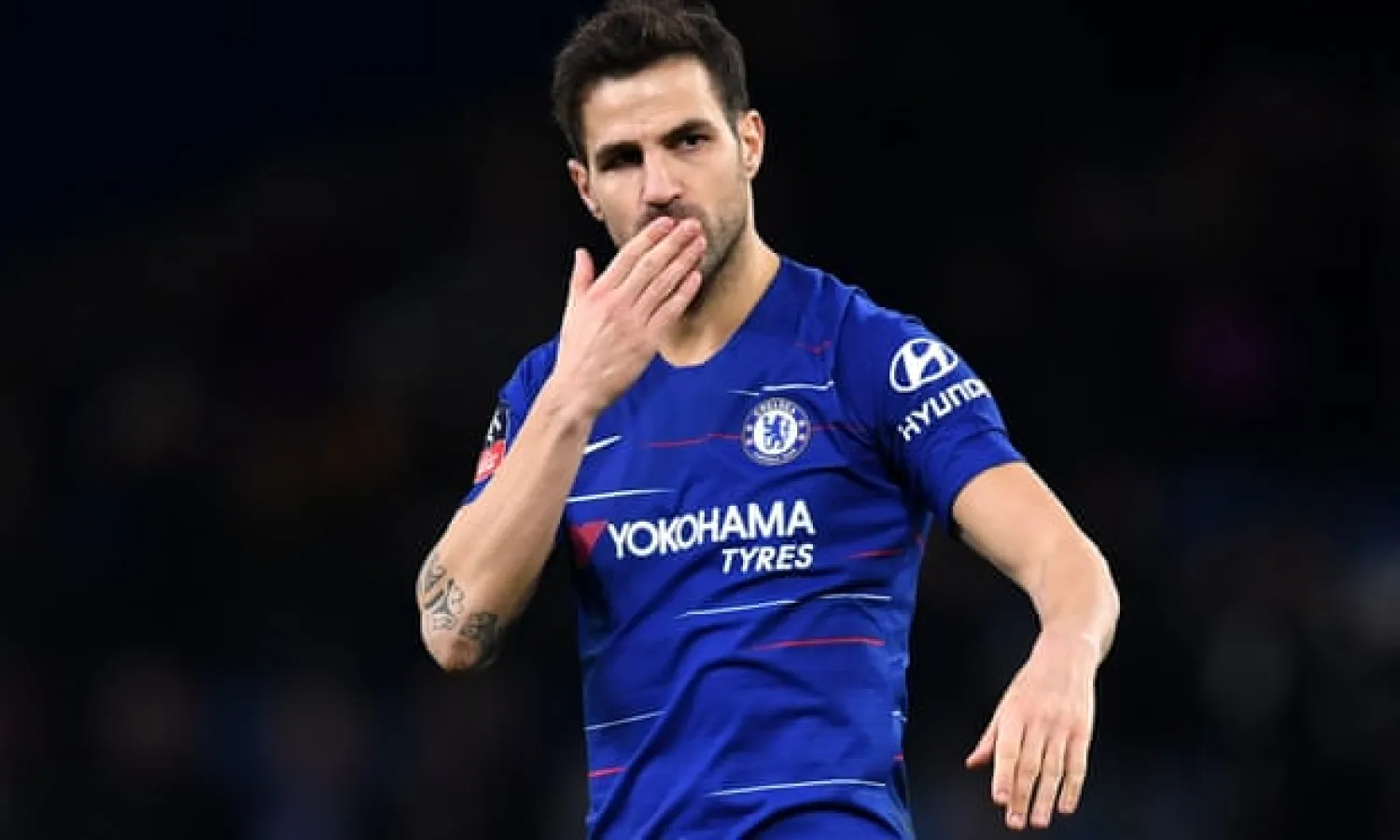

Farewell to Cesc Fàbregas, the Conjuror, Creator and Tempo Dictator

 Cesc Fàbregas is leaving Chelsea for Monaco after spells at Arsenal and Barcelona. Pep Guardiola once descrobed him as “the most special player in the world for that ball in behind”. Photograph: Darren Walsh/Chelsea FC via Getty
Cesc Fàbregas is leaving Chelsea for Monaco after spells at Arsenal and Barcelona. Pep Guardiola once descrobed him as “the most special player in the world for that ball in behind”. Photograph: Darren Walsh/Chelsea FC via Getty
TT

Farewell to Cesc Fàbregas, the Conjuror, Creator and Tempo Dictator

 Cesc Fàbregas is leaving Chelsea for Monaco after spells at Arsenal and Barcelona. Pep Guardiola once descrobed him as “the most special player in the world for that ball in behind”. Photograph: Darren Walsh/Chelsea FC via Getty
Cesc Fàbregas is leaving Chelsea for Monaco after spells at Arsenal and Barcelona. Pep Guardiola once descrobed him as “the most special player in the world for that ball in behind”. Photograph: Darren Walsh/Chelsea FC via Getty

After Cesc Fàbregas had uttered his fond farewells to Chelsea on Friday night, the club’s social media team posted a collection of his greatest assists. Most were 40- or 50-yard passes, launched from within his own half. Yet whether the ball was caressed or caned, sent skyward or scuttling along the ground, it always landed precisely on the foot of a teammate. It provoked the same quiet awe as seeing a major golf winner repeatedly hit a flop wedge to within four feet of the flag, no matter how dicey the approach, or dangerous the lie.

That, I think, is how the Premier League will remember the Spaniard. Sitting deep, unlocking defences, redefining the art of the assist. Yet at his peak, somewhere in his early to mid 20s, Fàbregas was much more than that. Not only a conjuror but a conductor too, able to dictate the tempo and flow of a game as well as change it in an instant – and also buzzy enough to get around the pitch and in opponent’s faces.

And boy, could he could create. According to data from Opta between 2006-07 and 2010-11 no one in Europe’s five biggest leagues managed more assists than Fàbregas’s 60 – or created more than his 466 chances. Not Lionel Messi. Not Xavi or Mesut Özil, Frank Lampard or Steven Gerrard, although they all made the top 10. Fàbregas also averaged 3.5 chances created for every 90 minutes he played – again better than anyone else in Europe.

How many more goals might Arsenal have scored if Thierry Henry and Fàbregas had stayed together? Instead the Spaniard had to service Nicklas Bendtner, a Robin Reliant of a striker compared to Henry’s Lamborghini, as well as Andrey Arshavin and Eduardo. Despite that, he continued to excel, contributing 15 goals and 13 assists from 27 games in the Gunners’ 2009-10 season despite several injuries. As Ted Knutson, the head of the football consultancy StatsBomb, who later did statistical analysis on Fàbregas’s merits for Barcelona, puts it: “That guy was the best young midfielder in the world. He was also the best attacking passer the Premier League has ever seen.”

Looking back, it is bizarre that Fàbregas was selected only twice for the PFA’s team of the year. Then again, he is in good company given that Paul Scholes was also picked only twice.

Perhaps Fàbregas is not rated as highly as he deserves because, like Wayne Rooney and Mike Tyson, his developmental trajectory was so steep and spectacular that his best years came so early and are now long behind him. Remember, he was Arsenal’s youngest ever player, aged 16 and 177 days, one of several debutants in a Carling Cup victory over Rotherham in October 2003, and became the club’s youngest scorer two months later. That goal came in a 5-1 mauling of an experienced Wolves side, after which my colleague Jon Brodkin hailed Fàbregas’s performance and purred: “This was men against boys all right, and the men were outclassed”.

The next day Brodkin spoke to Arsenal’s head of youth development, Liam Brady, who warned him that the Gunners’ starlets would be “20 or 21” before they could “handle the physical side” of the Premier League. Yet by August 2004 Fàbregas, at 17, had forced his way into the Invincibles team that had just gone unbeaten in winning the Premier League. Shortly afterwards he made one of the best assists of his career, a stunning no-look reverse pass to Freddie Ljungberg in a thrilling 5-4 victory over Spurs. There were many more to come.

Yet when it comes to assessing his place in the pantheon his time at Barcelona always counts again him. Being played as a false nine always felt a little false. During his three years at the Camp Nou, Fàbregas still ranked in the top six in Europe for assists, behind only Messi, Özil, Ángel Di María, Franck Ribéry and Eden Hazard, despite several injuries. And as Pep Guardiola put it: “When Cesc has the ball, in one second he is the most special player in the world for that ball in behind.”

Nowadays there is also a recency bias when assessing Fàbregas’s legacy. In the past two years he has become slower of mind and foot, and inevitably less effective. But it is not so long ago that he set up Andrés Iniesta’s winner in the 2010 World Cup final, crossed for David Silva’s opener in Spain’s 4-0 thumping of Italy in the Euro 2012 final, or had 18 assists during Chelsea’s title-winning 2014-15 season – the joint-second highest in Europe behind Kevin De Bruyne.

How Chelsea could do with that version of Fàbregas now. No one has passed more in the Premier League than Jorginho this season, but he does not have a single assist. Four Chelsea defenders are also in the top 10 of passes played, highlighting – as Jermaine Jenas pointed out on Match of the Day – the fact that Maurizio Sarri’s side are overplaying at the back and not getting the ball forward quickly enough.

That is a charge you could never level at Fàbregas. No wonder Henry is hoping that the Spaniard, who provided so many assists during their time together at Arsenal, can help him once more by getting Monaco out of a relegation dogfight. Do not be surprised if the 31-year-old locksmith still proves capable of unpicking the toughest of defences.

The Guardian Sport


Sinner Sees off Popyrin to Reach Doha Quarters

 Italy's Jannik Sinner greets the fans after defeating Australia's Alexei Popyrin in their men's singles match at the Qatar Open tennis tournament in Doha on February 18, 2026. (AFP)
Italy's Jannik Sinner greets the fans after defeating Australia's Alexei Popyrin in their men's singles match at the Qatar Open tennis tournament in Doha on February 18, 2026. (AFP)
TT

Sinner Sees off Popyrin to Reach Doha Quarters

 Italy's Jannik Sinner greets the fans after defeating Australia's Alexei Popyrin in their men's singles match at the Qatar Open tennis tournament in Doha on February 18, 2026. (AFP)
Italy's Jannik Sinner greets the fans after defeating Australia's Alexei Popyrin in their men's singles match at the Qatar Open tennis tournament in Doha on February 18, 2026. (AFP)

Jannik Sinner powered past Alexei Popyrin in straight sets on Wednesday to reach the last eight of the Qatar Open and edge closer to a possible final meeting with Carlos Alcaraz.

The Italian, playing his first tournament since losing to Novak Djokovic in the Australian Open semi-finals last month, eased to a 6-3, 7-5 second-round win in Doha.

Sinner will play Jakub Mensik in Thursday's quarter-finals.

Australian world number 53 Popyrin battled gamely but failed to create a break-point opportunity against his clinical opponent.

Sinner dropped just three points on serve in an excellent first set which he took courtesy of a break in the sixth game.

Popyrin fought hard in the second but could not force a tie-break as Sinner broke to grab a 6-5 lead before confidently serving it out.

World number one Alcaraz takes on Frenchman Valentin Royer in his second-round match later.


Ukraine's Officials to Boycott Paralympics over Russian Flag Decision

Milano Cortina 2026 Winter Olympics - Skeleton - Interview with Ukraine Youth and Sports minister Matvii Bidnyi - N H Hotel, Milan, Italy - February 12, 2026 Ukraine Youth and Sports Minister Matvii Bidnyi speaks after the disqualification of Ukrainian skeleton racer Vladyslav Heraskevych from the Winter Games. REUTERS/Kevin Coombs
TT

Ukraine's Officials to Boycott Paralympics over Russian Flag Decision

Milano Cortina 2026 Winter Olympics - Skeleton - Interview with Ukraine Youth and Sports minister Matvii Bidnyi - N H Hotel, Milan, Italy - February 12, 2026 Ukraine Youth and Sports Minister Matvii Bidnyi speaks after the disqualification of Ukrainian skeleton racer Vladyslav Heraskevych from the Winter Games. REUTERS/Kevin Coombs

Ukrainian officials will boycott the Paralympic Winter Games, Kyiv said Wednesday, after the International Paralympic Committee allowed Russian athletes to compete under their national flag.

Ukraine also urged other countries to shun next month's Opening Ceremony in Verona on March 6, in part of a growing standoff between Kyiv and international sporting federations four years after Russia invaded.

Six Russians and four Belarusians will be allowed to take part under their own flags at the Milan-Cortina Paralympics rather than as neutral athletes, the Games' governing body confirmed to AFP on Tuesday.

Russia has been mostly banned from international sport since Moscow invaded Ukraine. The IPC's decision triggered fury in Ukraine.

Ukraine's sports minister Matviy Bidny called the decision "outrageous", and accused Russia and Belarus of turning "sport into a tool of war, lies, and contempt."

"Ukrainian public officials will not attend the Paralympic Games. We will not be present at the opening ceremony," he said on social media.

"We will not take part in any other official Paralympic events," he added.

Ukrainian Foreign Minister Andriy Sybiga said he had instructed Kyiv's ambassadors to urge other countries to also shun the opening ceremony.

"Allowing the flags of aggressor states to be raised at the Paralympic Games while Russia's war against Ukraine rages on is wrong -- morally and politically," Sybiga said on social media.

The EU's sports commissioner Glenn Micallef said he would also skip the opening ceremony.

- Kyiv demands apology -

The IPC's decision comes amid already heightened tensions between Ukraine and the International Olympic Committee, overseeing the Winter Olympics currently underway.

The IOC banned Ukrainian skeleton racer Vladyslav Heraskevych for refusing to ditch a helmet depicting victims of the war with Russia.

Ukraine was further angered that the woman chosen to carry the "Ukraine" name card and lead its team out during the Opening Ceremony of the Games was revealed to be Russian.

Media reports called the woman an anti-Kremlin Russian woman living in Milan for years.

"Picking a Russian person to carry the nameplate is despicable," Kyiv's foreign ministry spokesman Georgiy Tykhy said at a briefing in response to a question by AFP.

He called it a "severe violation of the Olympic Charter" and demanded an apology.

And Kyiv also riled earlier this month at FIFA boss Gianni Infantino saying he believed it was time to reinstate Russia in international football.

- 'War, lies and contempt' -

Valeriy Sushkevych, president of the Ukrainian Paralympic Committee told AFP on Tuesday that Kyiv's athletes would not boycott the Paralympics.

Ukraine traditionally performs strongly at the Winter Paralympics, coming second in the medals table four years ago in Beijing.

"If we do not go, it would mean allowing Putin to claim a victory over Ukrainian Paralympians and over Ukraine by excluding us from the Games," said the 71-year-old in an interview.

"That will not happen!"

Russia was awarded two slots in alpine skiing, two in cross-country skiing and two in snowboarding. The four Belarusian slots are all in cross-country skiing.

The International Paralympic Committee (IPC) said earlier those athletes would be "treated like (those from) any other country".

The IPC unexpectedly lifted its suspension on Russian and Belarusian athletes at the organisation's general assembly in September.


'Not Here for Medals', Nakai Says after Leading Japanese Charge at Olympics

Ami Nakai of Japan competes during the women's short program figure skating at the 2026 Winter Olympics, in Milan, Italy, Tuesday, Feb. 17, 2026. (AP Photo/Ashley Landis)
TT

'Not Here for Medals', Nakai Says after Leading Japanese Charge at Olympics

Ami Nakai of Japan competes during the women's short program figure skating at the 2026 Winter Olympics, in Milan, Italy, Tuesday, Feb. 17, 2026. (AP Photo/Ashley Landis)

Ami Nakai entered her first Olympics insisting she was not here for medals — but after the short program at the Milano Cortina Games, the 17-year-old figure skater found herself at the top, ahead of national icon Kaori Sakamoto and rising star Mone Chiba.

Japan finished first, second, and fourth on Tuesday, cementing a formidable presence heading into the free skate on Thursday. American Alysa Liu finished third.

Nakai's clean, confident skate was anchored by a soaring triple Axel. She approached the moment with an ease unusual for an Olympic debut.

"I'm not here at this Olympics with the goal of achieving a high result, I'm really looking forward to enjoying this Olympics as much as I can, till the very last moment," she said.

"Since this is my first Olympics, I had nothing to lose, and that mindset definitely translated into my results," she said.

Her carefree confidence has unexpectedly put her in medal contention, though she cannot imagine herself surpassing Sakamoto, the three-time world champion who is skating the final chapter of her competitive career. Nakai scored 78.71 points in the short program, ahead of Sakamoto's 77.23.

"There's no way I stand a chance against Kaori right now," Nakai said. "I'm just enjoying these Olympics and trying my best."

Sakamoto, 25, who has said she will retire after these Games, is chasing the one accolade missing from her resume: Olympic gold.

Having already secured a bronze in Beijing in 2022 and team silvers in both Beijing and Milan, she now aims to cap her career with an individual title.

She delivered a polished short program to "Time to Say Goodbye," earning a standing ovation.

Sakamoto later said she managed her nerves well and felt satisfied, adding that having three Japanese skaters in the top four spots "really proves that Japan is getting stronger". She did not feel unnerved about finishing behind Nakai, who also bested her at the Grand Prix de France in October.

"I expected to be surpassed after she landed a triple Axel ... but the most important thing is how much I can concentrate on my own performance, do my best, stay focused for the free skate," she said.

Chiba placed fourth and said she felt energised heading into the free skate, especially after choosing to perform to music from the soundtrack of "Romeo and Juliet" in Italy.

"The rankings are really decided in the free program, so I'll just try to stay calm and focused in the free program and perform my own style without any mistakes," said the 20-year-old, widely regarded as the rising all-rounder whose steady ascent has made her one of Japan's most promising skaters.

All three skaters mentioned how seeing Japanese pair Riku Miura and Ryuichi Kihara deliver a stunning comeback, storming from fifth place after a shaky short program to capture Japan's first Olympic figure skating pairs gold medal, inspired them.

"I was really moved by Riku and Ryuichi last night," Chiba said. "The three of us girls talked about trying to live up to that standard."
