Arsenal’s Era of Austerity Is Not Over Yet: Emery Must Make Do and Mend

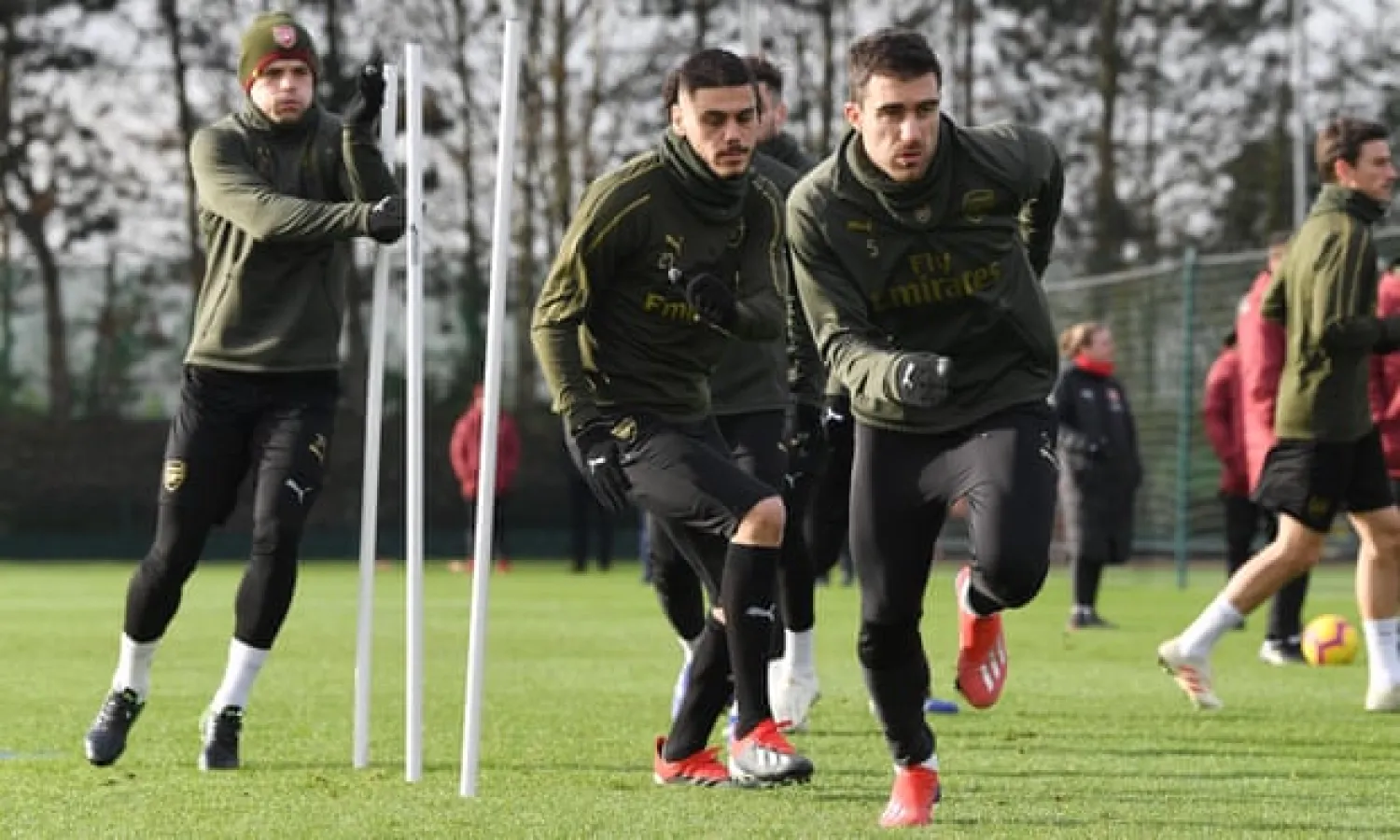
 Arsenal’s move to the Emirates Stadium in 2006 left them with huge debts to pay off, but even now they appear to be struggling to compete financially with the elite. Photograph: Stuart MacFarlane/Arsenal FC via Getty Images
Arsenal’s move to the Emirates Stadium in 2006 left them with huge debts to pay off, but even now they appear to be struggling to compete financially with the elite. Photograph: Stuart MacFarlane/Arsenal FC via Getty Images
TT

Arsenal’s Era of Austerity Is Not Over Yet: Emery Must Make Do and Mend

 Arsenal’s move to the Emirates Stadium in 2006 left them with huge debts to pay off, but even now they appear to be struggling to compete financially with the elite. Photograph: Stuart MacFarlane/Arsenal FC via Getty Images
Arsenal’s move to the Emirates Stadium in 2006 left them with huge debts to pay off, but even now they appear to be struggling to compete financially with the elite. Photograph: Stuart MacFarlane/Arsenal FC via Getty Images

It was the news that Arsenal supporters had longed to hear and it was delivered with an uncharacteristic flourish by Ivan Gazidis. The date was 6 June 2013 and the club’s then chief executive told a group of journalists that Arsenal’s austerity era – necessitated by the move to Emirates Stadium in 2006 – was over.

The long-term commercial deals that Arsenal had felt compelled to lock into so they could secure money up front for the stadium were expiring and the result, according to Gazidis, was an “escalation” in the club’s “financial firepower”. Anything was possible on the transfer market, he suggested, including the signing of A-list players. “We are moving into a new phase where, if we make our decisions well, we can compete with any club in the world,” Gazidis said.

At the end of that summer, Arsenal would sign Mesut Özil and there have since been a smattering of other statement purchases – namely Alexis Sánchez, Alexandre Lacazette and Pierre-Emerick Aubameyang. But as the club prepare for Saturday’s pivotal Premier League game at home to Chelsea, the mood is edgy and not only because defeat could leave them nine points adrift of the Champions League places by the end of the weekend.

This month Arsenal cannot compete with any club for any permanent signing because, quite simply, the money is not there. It will be a loan or two, at best – perhaps, with a built-in option to buy in the summer, when the new sponsorship arrangements with Emirates and Adidas kick in – and there is bewilderment, to say the least, among some fans.

The club’s most recently published accounts, for the six months ended November 2017, showed a profit before tax of £25.1m and cash reserves of £160.7m – including debt service reserves of £23m, which are not available for football purposes. This time last year Arsenal were listed at No 6 on Deloitte’s world football money league. What is going on?

The sense of unease has been swelled by the looming loss of Aaron Ramsey to Juventus as a free agent at the end of the season for reasons that are impossible to disconnect from finance. Then, there is Sven Mislintat, the head of recruitment, who arrived from Borussia Dortmund in November 2017. He has grown so frustrated that he has decided to quit; he is expected to leave after the closure of the January window.

Mislintat was one of the three decision-makers who appointed Unai Emery as the managerial successor to Arsène Wenger last May. Gazidis was another but he walked out last October to join Milan, which means that Raúl Sanllehí, the director of football, is set to be the last man standing. The impression is one of behind-the-scenes turmoil.

Arsenal’s financial freeze can be explained by a number of factors. According to the club, the cash reserves in the bank are not merely savings, they are to help with the annual running costs. Large sums of money routinely move in and out of the accounts – such as the instalments on transfer fees or commercial deals – and they might do so after the cut-off for a specific financial period.

The analogy is to a family’s monthly budget. In some months, it is necessary to dip into the overdraft. It is not as simple as looking at Arsenal’s year-to-year numbers. As for the half-yearly profits, they were heavily influenced by player sales in the summer of 2017 and that of a development site near the Emirates Stadium on Holloway Road.

A more convincing point takes in the fundamental reality under Stan Kroenke, who has been the majority shareholder since April 2011 – the club are wedded to a self-financing business model. What comes out must first have been generated from within.

The statistics show that since the summer of 2011, Arsenal have a net spend on permanent transfer fees of £239.9m, which works out at £30m per season. Since the summer of 2013, when Gazidis talked the talk and the shackles came off, it has been £265.8m or £44.3m per season. In other words, not enough to buy a Kyle Walker and significantly short of a Virgil van Dijk.

A club’s net spend is not the perfect barometer of its financial health; player wages are also a massive part of it and Arsenal’s investment in this area has soared from year to year. But it is nevertheless a decent one. There have been seasons under Kroenke in which Arsenal have pushed the boat out by this measure, namely 2014-15, 2016-17 and the current one. They have invariably been followed by a levelling-off.

This season illustrates the point in microcosm. Last summer the club spent £71.4m on five players, including Bernd Leno, Sokratis Papastathopoulos and Lucas Torreira, and recouped only £7.6m in sales. It added up to a net spend that was significantly above the mean but it meant the cupboard was always going to be bare come January. Emery knew it would be the case. When he accepted the job, he knew what he was signing up for.

Arsenal’s headache is that they have a squad on Champions League wages in year two of a Europa League cycle. The push last summer was an attempt to catapult them back to the elite level and it has increased the jeopardy. The Champions League resembles an express train and when teams fall off it they have to work even harder to reboard – and that can equate to spending.

When Manchester United slipped out of the Champions League for 2016-17, they spent over the odds to persuade Paul Pogba, Zlatan Ibrahimovic, Eric Bailly and Henrikh Mkhitaryan to join up for a Europa League campaign with the promise of clawing back to the top level. In the end, they won the Europa League to regain their Champions League status. Each year a club is out of the competition, it becomes harder to get back in. Liverpool could attest to that.

Arsenal’s self-sustaining model has been squeezed by Europa League revenues and the circle can, in time, become vicious. “The reduction in distributions from Uefa for Arsenal last season when they reached the Europa League semi-final, which reflect broadcast revenues, was €26.8m – compared to the amount they received from being in the Champions League the season before,” said Tim Bridge, a director in Deloitte’s sports business group. “But any club in the Europa League will also likely see an impact on match-day and commercial revenues compared with those in the Champions League.”

Have Arsenal made their decisions well, as Gazidis hoped they would? The one to give Özil a new £350,000-a-week contract last February to run until 2021 (total value: £62.2m) was based on how it might cost them more to sign a replacement and the nightmare prospect of him leaving on a Bosman, so soon after Sánchez had forced his way to United.

One of the consequences has been the withdrawal of the contract offer to Ramsey but Emery has come to doubt Özil’s worth. The manager has integrated the summer signings and those on Mislintat’s watch – chief among them Aubameyang – have generally been positive. But further surgery is required and while money is not everything – witness the work of Mauricio Pochettino at Tottenham – it is certainly something.

Emery has brought stirring home performances, tactical variety and genuine excitement, at times. The scale of his challenge, and how delicately it is poised, remains clear.

The Guardian Sport


Irish Boxer Lee Reeves Dies at Age 31, Three Months after Dublin Title Fight Injury

Irish boxer Lee Reeves. Reuters
TT

Irish Boxer Lee Reeves Dies at Age 31, Three Months after Dublin Title Fight Injury

Irish boxer Lee Reeves. Reuters

Irish boxer Lee Reeves has died more than three months after being injured during a fight in Dublin, promoter Queensberry said Tuesday. He was 31.

"Everyone at Queensberry is devastated to learn of the passing of Lee Reeves," Queensberry Promotions said in a statement.

Reeves was hospitalized after being knocked out by compatriot Gary Cully in the 10th and final round of their Boxing Union of Ireland Celtic super-lightweight title fight on Aug. 1.

Reeves was carried from the ring on a stretcher after receiving initial treatment.

Queensberry had said after the fight that his condition was critical but stable.

“Lee was an immensely talented boxer, as well as a true role model and inspiration to his community,” the statement added Tuesday, according to The Associated Press. “Our deepest condolences go to Lee’s family, friends and all those who loved him. We ask that their privacy be respected at this incredibly difficult time. Rest in peace, Lee.”


Alonso to Enter Dakar Rally with Loeb and Aston Martin Team

November 5, 2026 Aston Martin's Fernando Alonso during a press conference ahead of the F1 Sao Paulo Grand Prix. (Reuters)
TT

Alonso to Enter Dakar Rally with Loeb and Aston Martin Team

November 5, 2026 Aston Martin's Fernando Alonso during a press conference ahead of the F1 Sao Paulo Grand Prix. (Reuters)

Double Formula One champion Fernando Alonso will compete in next January's Dakar Rally in an Aston Martin Dreadnought entry run by engineering partner Prodrive.

The 45-year-old Spaniard, a 32-time Grand Prix winner and two-time Le Mans 24 Hours winner, will be racing in the annual event for the second time after competing with Toyota in 2020, finishing 13th.

France's nine-time world rally champion Sebastien Loeb and Brazil's reigning world rally-raid champion Lucas Moraes will be his teammates in a three-car entry.

The 49th edition of the Dakar Rally will ‌be held in ‌Morocco from January 9 to 23, with a prologue and first ‌stage ⁠in Portugal, after ⁠being moved from Saudi Arabia due to security concerns.

The 24-round Formula One season is due to start in Bahrain in March after testing in late February.

Alonso, who will again have compatriot and five-time motorcycle Dakar winner Marc Coma as co-driver, is racing in the Las Vegas Grand Prix this weekend. He said he had turned his thoughts to Dakar after deciding to continue in Formula One with Aston Martin.

“In the end, the decision became simple. I wanted to embrace ⁠the challenge completely and take on both Formula One and the ‌Dakar Rally in the same year," he explained in ‌a statement.

"In 2020, Dakar was one of the most challenging and enjoyable experiences of my career. ‌I have enormous respect for this race and the specialists who have mastered it.

"Formula One ‌remains my priority. But I am a racing driver, and challenges like this are why I love competing. I’m looking forward to seeing what we can achieve."

LOEB CHASES FIRST DAKAR WIN

In October, Alonso told reporters at the Singapore Grand Prix that he felt the desert endurance race would be physically ‌incompatible with his Formula One commitments.

Loeb, 52, will also be chasing a first Dakar win after 10 previous attempts that have brought ⁠him 28 stage ⁠wins to date.

“Winning the Dakar is very important to me,” said the Frenchman, who will be partnered by Belgian Fabian Lurquin. “We have come close several times, and the motivation is there to keep working until we achieve it."

The Dreadnought is a digital-only tactical SUV created exclusively for gamers playing "Call of Duty: Modern Warfare 4" that will now be brought into the real world by Prodrive, Aston Martin's partners in endurance GT racing.

The Dakar will be Aston Martin Racing’s debut in the world rally-raid championship.

"Aston Martin's ambition for this program has been clear from the outset: to create a car capable of competing at the front of the world's toughest motorsport event," said Prodrive Chairman David Richards.

"By combining Aston Martin's vision with Prodrive's experience in rallying, endurance racing and Dakar competition, we have built a strong foundation. With an exceptional driver line-up and a highly capable engineering team, we look forward to seeing Dreadnought take on this remarkable challenge."


Owono Does Not Deserve 12-Match Ban Over De Miguel Death, Says Andorra Owner Pique

Equatorial Guinea's goalkeeper #01 Jesus Owono leaves the pitch at half time during the Africa Cup of Nations (CAN) Group E football match between Equatorial Guinea and Algeria at Moulay Hassan Stadium in Rabat on December 31, 2025. (AFP)
TT

Owono Does Not Deserve 12-Match Ban Over De Miguel Death, Says Andorra Owner Pique

Equatorial Guinea's goalkeeper #01 Jesus Owono leaves the pitch at half time during the Africa Cup of Nations (CAN) Group E football match between Equatorial Guinea and Algeria at Moulay Hassan Stadium in Rabat on December 31, 2025. (AFP)

FC Andorra owner Gerard ‌Pique said goalkeeper Jesus Owono did not deserve the 12-match suspension he received following the challenge that led to the death of Tenerife forward Jesus de Miguel.

Owono and De Miguel collided during a Spanish second-tier match on November 2. De Miguel was taken to intensive care and died the following day.

The disciplinary committee of the Spanish football federation (RFEF) banned Owono for violent conduct which resulted in serious ‌injury last week.

"Players, ‌former players, coaches, goalkeepers, everyone has ‌called ⁠it an accident," ⁠Pique said in a video posted on social media late on Monday.

"I truly believe that imposing the maximum sanction on Jesus for this action puts him in a situation he does not deserve, because he is not to blame for all of ⁠this having happened."

Former Barcelona player Pique ‌pointed to the three-match ‌ban handed to Albacete's Jose Corpas for accidentally kicking Sabadell ‌player Quadri Liameed in the head during a ‌recent match in Spain.

"Fortunately Quadri is fine, the consequences in this case were not fatal, and the committee decided to sanction Corpas with three matches," Pique added.

"With ‌all this, my reflection is: what is being sanctioned, the action or the ⁠consequences?"

The RFEF ⁠did not immediately respond to a request for comment outside regular business hours in Spain.

Owono, 25, has withdrawn from Equatorial Guinea's squad for Africa Cup of Nations qualifiers against Zimbabwe this month and Pique said it was unlikely the goalkeeper would return to action as soon as his suspension is up.

"Jesus is going to need far more than 12 matches before he is available and able to compete," he added. "No sanction is going to bring Demi (De Miguel) back to us."