

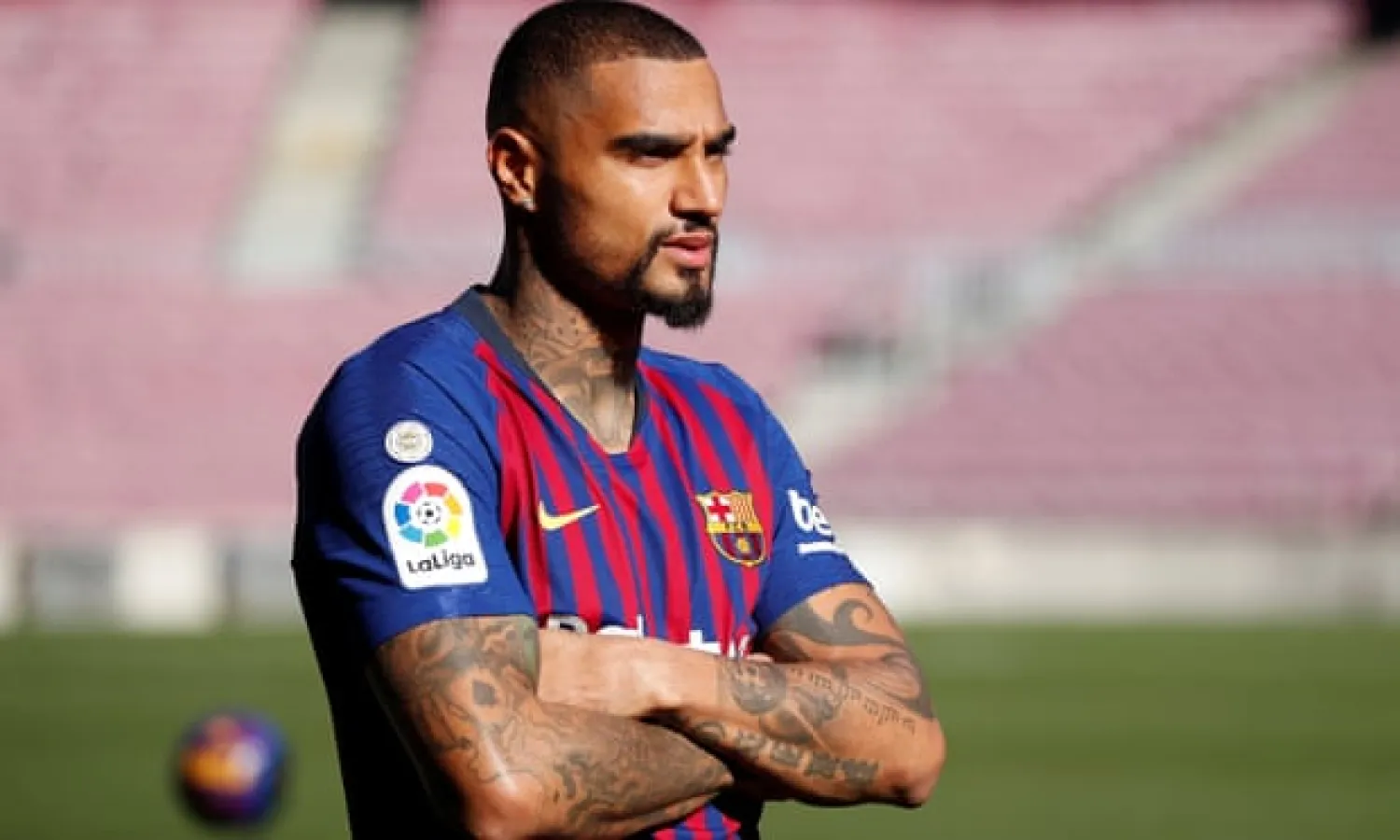

How Did Barcelona End up Signing Kevin-Prince Boateng?

 Kevin-Prince Boateng is Barcelona’s short-term solution to a specific problem up front. Photograph: Albert Gea/Reuters
Kevin-Prince Boateng is Barcelona’s short-term solution to a specific problem up front. Photograph: Albert Gea/Reuters
TT

How Did Barcelona End up Signing Kevin-Prince Boateng?

 Kevin-Prince Boateng is Barcelona’s short-term solution to a specific problem up front. Photograph: Albert Gea/Reuters
Kevin-Prince Boateng is Barcelona’s short-term solution to a specific problem up front. Photograph: Albert Gea/Reuters

Barcelona’s latest signing is football royalty, just not the way they expected. Late on Monday night, in the club store just across the concourse from the Camp Nou, closed to the public, he stood smiling and holding up his new shirt: “Prince, 19”. From Hertha to Tottenham, from Dortmund to Portsmouth and, five clubs and nine years later, from Sassuolo to Barcelona, Kevin-Prince Boateng’s 10th club is the biggest of them all. It was also the biggest surprise; their new centre-forward comes from leftfield, unforeseen by anyone.

Boateng described this as a huge “opportunity”. It is one he did not expect, echoes of the day that his agent told him he was going to Milan and Boateng thought he was joking. Some in Spain reacted similarly when the news broke with the deal already done. Boateng joins on loan, with an €8m optional purchase clause in the summer. The headlines in the Catalan papers came with exclamation marks. Boateng, the “hidden option”, “the surprise”, ran the front pages.

Barcelona had been searching for a back-up striker, someone to take some of the pressure, and the minutes, off Luis Suárez. The criteria was clear and it limited their options: they wanted a player with experience and the personality to contribute from the start, but prepared to be substitute. Someone cheap too, although the cumulative effects of hurried deals costs. And someone who could leave as easily, and fuss-free as he arrived. A short-term solution to a specific problem, which could have been foreseen in the summer. Perhaps it should have been. What they didn’t foresee then was Antoine Griezmann opting to stay at Atlético.

Last year’s Champions League defeat in Rome weighs on their minds, their great regret at the end of a season in which the won a domestic double which felt almost eclipsed by European failure. Suárez later admitted that he wished he had rotated more before that night and Barcelona have made no secret of the fact that they are desperate to win the Champions League. They felt they needed numbers, but also personality. When Munir El Haddadi departed, it underlined that they felt he was not the support striker they sought and so they turned to the market.

Álvaro Morata had been offered but the cost was high and they remained unsure about his mid- to long-term fit. Cristhian Stuani seemed a perfect solution but his buy-out clause is €15m. The idea of bringing Carlos Vela back from the United States was discussed. Sights were being lowered, it seemed. In the end, it was Boateng who arrived from Sassuolo. His last club in Spain was Las Palmas. Just the names of those two clubs raise questions and naturally there are some doubts about his level, even if there is a willingness to wait, an awareness that this is about resolving a specific, smaller issue.

Boateng comes as a centre-forward and he has played up front, although he is not a natural No 9. His arrival, while it makes some sense, hints at a certain improvisation, an uncertainty, in Barcelona’s planning. It also underlines some of the pressures placed upon that planning. This market is not one Barcelona and Madrid can dominate any more, and the Catalan club had to confront some of the consequences of their spending. Over the summer, Barcelona’s expenditure on salaries came down by €28m – because it had to. 70% of their budget went on salaries last season; it is down to 66%, but that remains high and there is still a need to cut costs.

A clear model can sometimes appear difficult to discern, and the departure of Neymar deepened that sensation, increasing the pressure on the board. Barcelona had expressed their certainty that he would stay but he did not. “If we said we had spent €270m on two players we would have to resign for [being] irresponsible,” said Albert Soler, the club’s director of sport. In total, they spent more than that on Ousmane Dembélé and on Philippe Coutinho, who they did not succeed in signing that summer. Face was lost. In the autumn, Soler departed.

There have been other changes in the structure of the sporting directorate. Robert Fernández has departed. Before him, there was Andoni Zubizarreta. Raul Sanllehi left just before Soler. The sporting manager is Pep Segura, Eric Abidal is the technical secretary, and Ramon Planes his assistant. Planes is considered the most capable, but does not carry great authority. There’s the president Josep Maria Bartomeu and his direct advisors too. Ernesto Valverde is the coach, not the manager, and his own future is far from secure. Ariedo Braida is reported to have been the key man in bringing in Boateng. He has long felt unheard at Barcelona, lost amidst may voices.

Robert Fernández signed Artur, one of the few players seen as a “Barcelona” style player, and at a time when fewer footballers are making it from the youth system. The signing of Paulinho surprised and didn’t exactly delight purists, seemingly a total rupture with the club’s identity, but he was successful – and then immediately returned to China. Arturo Vidal surprised too, although his signing was justified as being a player in the Paulinho mould. He is not really, just as Coutinho has not proven to be quite the “Iniesta” he was proclaimed to be.

After a difficult start, Dembélé is impressing greatly. Malcom was taken off Roma at the last minute, Barcelona leaping in on Monchi’s deal. The manager, though, did not really want him and a departure in this window is a possibility. And other pursuits are ongoing, from Adrien Rabiot to Frenkie De Jong. But it would be fair to suggest that some fans are lacking faith that they will be completed. Rodri, perhaps the most natural replacement for Sergio Busquets, joined Atlético. And Griezmann of course stayed there, when Barcelona were convinced they were getting him.

The Frenchman was a market opportunity: he might not have been a natural fit in the Barcelona first XI, but he was a player of the very highest level available for just €100m (£88.1m). Barcelona chased and thought they had closed a deal. They brief that it was done. But Griezmann announced that he was not going to Barcelona after all on a TV documentary, produced by the Barcelona defender Gerard Piqué. The president didn’t know and Barcelona didn’t have their striker. They do now.

The Guardian Sport



Mexico, Korea Eye World Cup Knockout Berths

The build-up to co-hosts Mexico's clash with South Korea has seen shrouded with intrigue, with a mystery drone spotted over Korea's training ground. CARL DE SOUZA / AFP
TT

Mexico, Korea Eye World Cup Knockout Berths

The build-up to co-hosts Mexico's clash with South Korea has seen shrouded with intrigue, with a mystery drone spotted over Korea's training ground. CARL DE SOUZA / AFP

Mexico and South Korea will aim to punch their ticket to the World Cup knockout rounds on Thursday when they meet in Guadalajara knowing a win would guarantee a last 32 berth.

The Group A rivals head into the fixture at the Estadio Akron fresh from respective victories over South Africa and the Czech Republic in their opening games last week, said AFP.

The expanded 48-team format for this year's World Cup -- and the fact that the eight best-ranked third-placed teams will advance from the group stage -- means that a win for either Mexico or South Korea would see them advance.

Co-hosts Mexico eased past a poor South Africa in their opening game last week but are bracing for a significantly tougher test against a South Korean side studded with quality.

"We have to be very wary of the opponents' attacking transitions," Mexico coach Javier Aguirre said.

"When we are attacking, we can't let our guard down; if there are two Koreans up front, there need to be three Mexicans."

The build-up to Thursday's game has seen shrouded with intrigue, with a mystery drone spotted over South Korea's training ground on Tuesday.

Yonhap news agency reported that a South Korea team security officer spotted the device, and a Mexican military drone-interdiction specialist stationed at the training camp brought it down by emitting radio signals.

Two men who were suspected to be the drone operators retrieved the crashed device and fled the scene in an incident which South Korea coach Hong Myung-bo described as "unfortunate" but insisted "did not impact us significantly."

Hostile atmosphere

Hong meanwhile is preparing his team for an intimidating atmosphere against the hosts on Thursday.

"We fully understand that it's going to be a match with the home team, and we know that that's going to give benefits to the home team," Hong said.

"But my players have experienced such matches before, so it will be different tomorrow, and we need to control the rhythm and the flow of the match."

In other games on Thursday, Switzerland will look to bounce back from their disappointing opening Group B draw with Qatar when they take on Bosnia-Herzegovina, while co-hosts Canada face the Qataris in Vancouver.

Bosnia coach Sergej Barbarez is eyeing another upset, urging his team to summon the spirit of their qualifying campaign, when they knocked out Italy during the playoffs.

Barbarez brushed off suggestions that Switzerland would expect to beat a team ranked 44 places below them by FIFA.

"Everyone has the right to their own opinion and show their confidence," the coach said.

"When we were playing against Italy in the playoffs, we had a similar sort of sentiment publicly, but we stayed focused on ourselves," he added.

Thursday's games kick off the second round of group fixtures.

On Wednesday, England lit up the tournament with a roller coaster 4-2 win over Croatia in Group L which included two goals from captain Harry Kane and one from Real Madrid star Jude Bellingham.

But while England got off the mark in style, there was disappointment for Portugal, who were held to a surprise 1-1 draw by the Democratic Republic of Congo.

The result once again renewed scrutiny of Portugal coach Roberto Martinez's support for Cristiano Ronaldo, the 41-year-old icon who is playing in his sixth World Cup.

The veteran striker gave an ineffective performance, managing just 25 touches in the whole match, but Martinez defended the decision not to replace him.

"It makes no sense to take off the best goal scorer in world football in a game that you need goals," Martinez said.

Ronaldo has now failed to score in 10 consecutive matches in major tournaments and his country's press turned against him on Thursday.

Sports newspaper A Bola said that Ronaldo appeared "crushed by the pressure" and had become "himself a problem", while Publico said the team "remains hostage to its faith in Ronaldo".


Bosnia Ready to Shed Underdog Reputation, Face Switzerland as Equals

Bosnia-Herzegovina's defender Nikola Katic (R) gives a press conference in Los Angeles, California on June 17, 2026, on the eve of the 2026 World Cup football match between Switzerland and Bosnia and Herzegovina.  (Photo by Patrick T. Fallon / AFP)
Bosnia-Herzegovina's defender Nikola Katic (R) gives a press conference in Los Angeles, California on June 17, 2026, on the eve of the 2026 World Cup football match between Switzerland and Bosnia and Herzegovina. (Photo by Patrick T. Fallon / AFP)
TT

Bosnia Ready to Shed Underdog Reputation, Face Switzerland as Equals

Bosnia-Herzegovina's defender Nikola Katic (R) gives a press conference in Los Angeles, California on June 17, 2026, on the eve of the 2026 World Cup football match between Switzerland and Bosnia and Herzegovina.  (Photo by Patrick T. Fallon / AFP)
Bosnia-Herzegovina's defender Nikola Katic (R) gives a press conference in Los Angeles, California on June 17, 2026, on the eve of the 2026 World Cup football match between Switzerland and Bosnia and Herzegovina. (Photo by Patrick T. Fallon / AFP)

Bosnia and Herzegovina ‌are fighting to dispel the notion that they are underdogs at the World Cup, key player Nikola Katic told reporters on the eve of their match with Switzerland.

Despite dispatching four-times world champions Italy and favored side Wales in the qualification playoffs, then battling co-hosts Canada to a 1-1 draw in their opening match, Bosnia are still underestimated, Katic said on Wednesday.

"After that (defeating Italy) we didn't get the respect we deserved, because it was more bad-Italy than good-Bosnia" in post-match commentary, said central defender Katic.

Bosnia manager Sergej Barbarez said his team won't be seeking a draw against ‌the Swiss, despite ‌their emphasis on compact defending and quick counter-attacks, Reuters said.

"Tomorrow ‌we ⁠are coming to ⁠play for the three points," said Barbarez, who was a top player for his country and in the Bundesliga in the 1990s and 2000s.

He became national team manager in 2024 and overhauled the squad, with more than a dozen new players being brought in since, allowing the side to have seasoned talent and leadership while enjoying the resilience of young players.

Barbarez ⁠said his team's opening Group B draw with ‌Canada gave confidence to the squad because ‌facing a host nation in the first match can be an emotional challenge ‌for young players.

"Of course there was a certain anxiety, but I ‌would say it was more of an excitement," said Barbarez.

The draw against Canada showed Bosnia-Herzegovina to be a tough side who are not intimidated by a fast-attacking team.

Barbarez and Katic said they will focus on their style of play ‌on Thursday rather than worrying about what opponents Switzerland will throw at them.

Bosnia's 40-year-old captain, Edin Dzeko, will ⁠be a ⁠towering presence in front of goal, with the country's all-time-leading scorer expected to be playing at his last World Cup.

With a robust defensive shell looking to force quick breaks, Dzeko's scoring precision will be vital to his side's hopes of success on Thursday.

Katic paid tribute to Dzeko, saying there were not enough words to explain how important his presence is on the field, in training and off the pitch.

Barbarez declined to say whether he would put Dzeko in the starting 11.

Reporters repeatedly raised the win over Italy, which Barbarez and Katic enjoyed recalling. Bosnia won 4-1 on penalties following a 1-1 draw after extra time.

"It is one of the games that will stay in our memories for always," said Barbarez.


Caleb Yirenki's Late Goal Gives Ghana a 1-0 Victory over Panama in the World Cup

Semenyo celebrates Ghana's sole goal in the match (Reuters)
TT

Caleb Yirenki's Late Goal Gives Ghana a 1-0 Victory over Panama in the World Cup

Semenyo celebrates Ghana's sole goal in the match (Reuters)

It was a play Ghana has been practicing throughout its World Cup preparation.

And after a night of missed chances, it worked.

Caleb Yirenkyi tapped in a cross from Brandon Thomas-Asante in the fifth minute of second-half stoppage time, and Ghana beat Panama 1-0 on Wednesday night in the teams’ World Cup opener.

Thomas-Asante got loose on the left side and fired the ball across the goal mouth. Yirenkyi knocked it in, sending his teammates streaming onto the field to embrace both players.

“Get the ball to the wings, and then put it in the box, and we get runs — people in the box to finish,” said the 20-year-old Yirenkyi, who scored his first international goal earlier this month in a friendly against Wales. “I tried (to) just play forward and run forward, and then hope to see what comes in, and yeah, I got the ball in the box and finished.”

Ghana played without midfielder Thomas Partey, who was denied entry into Canada while he awaits trial on rape charges in England, The Associated Press said.

The late goal denied Panama its first World Cup point.

The only shot on goal in the first half came two minutes in, when Panama forward Cecilio Waterman latched onto a low cross from Amir Murillo and clipped a ball from the center of the box toward the net. Lawrence Ati-Zigi dove to his right and palmed the ball away.

The goalkeeper left the game at halftime after a couple of hard collisions. He was replaced by Benjamin Asare. Ghana coach Carlos Queiroz said Ati-Zigi would be evaluated further on Thursday.

The result puts Ghana at the top of Group L with England, which beat Croatia 4-2 earlier in the day.

After the first hour, when chances came at a premium at rainy BMO Field, the match opened up and both teams started smashing shots toward the net.

In the 65th minute, Thomas-Asante broke through Panama’s back line and played a ball along the 6-yard box toward Jordan Ayew, but Jiovany Ramos ran up from behind with a tackle to prevent the tap-in.

“Panama, they had a great first half. They kept the ball really well and we struggled with the press,” said Antoine Semenyo, who started the scoring play with a pass to Thomas-Asante. But “slowly into the second half we had that energy to go up and press and cause problems, and that led to the winner.”