

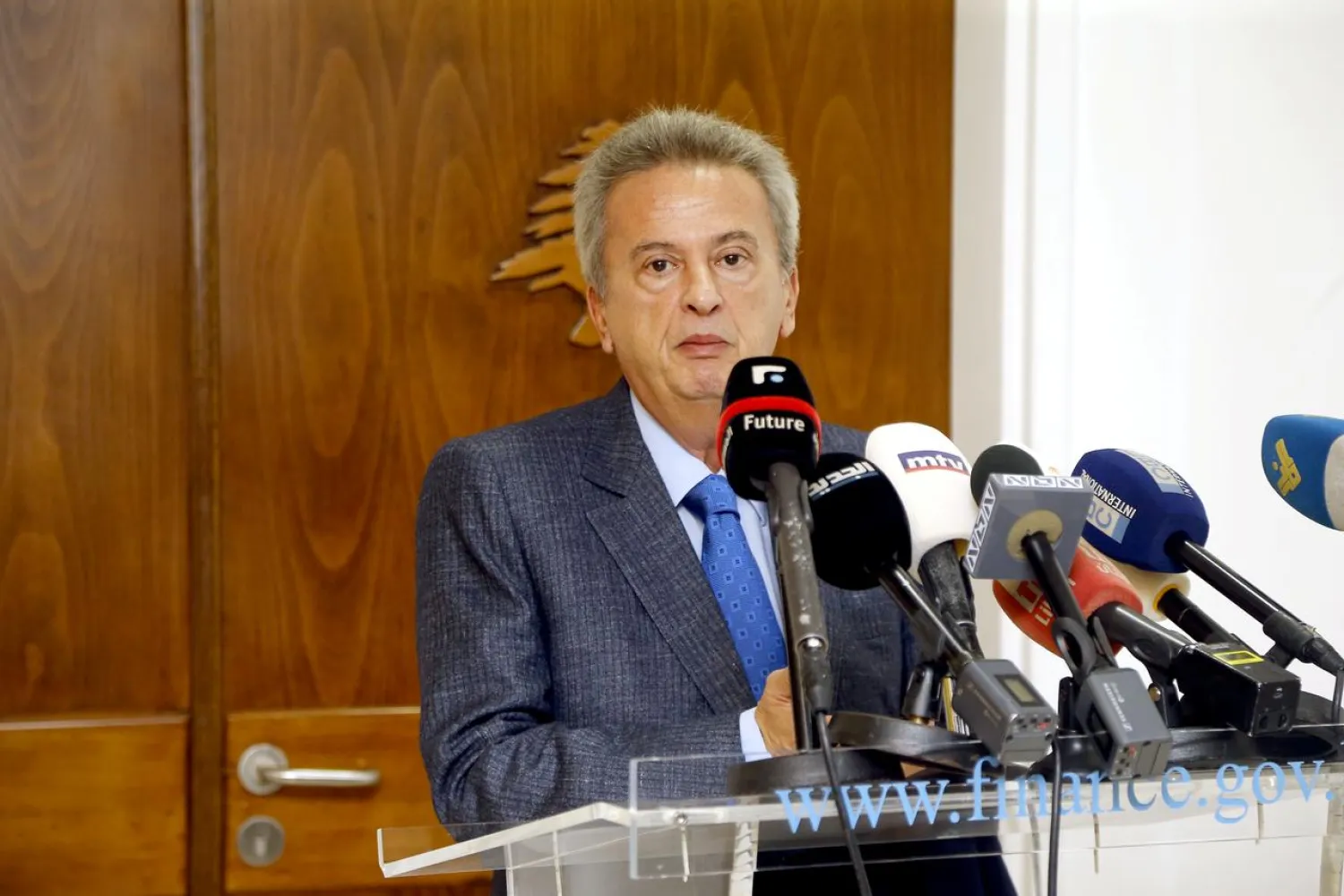

Lebanon: Salameh Says Dollar Offered in Market Since Govt Formed

Lebanon's Central Bank Governor Riad Salameh holds a news briefing in Beirut, Lebanon December 4, 2018. REUTERS/Dalati Nohra/Handout via REUTERS
TT

Lebanon: Salameh Says Dollar Offered in Market Since Govt Formed

Lebanon's Central Bank Governor Riad Salameh holds a news briefing in Beirut, Lebanon December 4, 2018. REUTERS/Dalati Nohra/Handout via REUTERS

US dollars are being offered in Lebanon's local market to buy Lebanese pounds since the formation of a new government, Lebanese al-Jadeed television quoted the central bank governor, Riad Salameh, as saying on Tuesday.

Lebanese leaders agreed a new national unity government last week after nearly nine months of political wrangling over how to share out cabinet portfolios.

Prime Minister Saad al-Hariri has said bold reforms must now be taken to address problems in the heavily indebted state, which has suffered from years of low economic growth and has some of the world's worst debt and balance-of-payment ratios.

The Lebanese pound has been pegged against the dollar at its current level for more than two decades.

"After the formation of the government the dollar has been offered in the local market to buy pounds and this restores the strength of the role of national currency in savings," Salameh said from the presidential palace.

Presidential sources said President Michel Aoun had discussed the monetary situation at a meeting with Salameh.

Moody's said on Monday the government formation was positive for the country's credit rating as it should help unlock an $11 billion, five-year international support package offered last year.

The international institutions and foreign governments that pledged the support, mostly in the form of concessional loans, want to see government reforms to put the state finances on a sustainable path.

Lebanon's 150 percent debt-to-GDP level and its near 25 percent current account gap - a figure that effectively shows how much a country borrows from the rest of the world - are its most worrying statistics.

Moody's estimates the interest bill from its debt alone absorbs roughly half of all government revenues and represents about one-third of total government spending.

The current account gap meanwhile is worth around $15 billion in real money terms according to Goldman Sachs, and although $500 billion of aid from Qatar and as much as $3.5 billion from Saudi Arabia might cover some of it, there is still likely to be an $11 billion black hole in the finances.

For the time being, it can easily be covered by the country's near $40 billion of central bank reserves, which are equivalent to 71 percent of GDP and enough to cover 13 months of imports.

It also has gold holdings of $11.8 billion, the second highest in the MENA region after Saudi Arabia. But with a pegged currency, plundering that cash or gold could cause problems, said Reuters.

Authorities must hold sufficient dollar buffers to maintain faith in the exchange rate, while ensuring steady inflows to keep coffers topped up.



Riyadh Air Launches ‘Employment First’ Overseas Aviation Training Scholarship Program

Riyadh Air Launches ‘Employment First’ Overseas Aviation Training Scholarship Program
TT

Riyadh Air Launches ‘Employment First’ Overseas Aviation Training Scholarship Program

Riyadh Air Launches ‘Employment First’ Overseas Aviation Training Scholarship Program

Riyadh Air has announced its ‘Employment-First’ Overseas Scholarship Program, which aims to launch several scholarship tracks, starting with two specialized paths for engineers in Australia, followed by a pilot training program in the United States.

The initiative falls under ‘Promising Path’, one of the tracks within the Custodian of the Two Holy Mosques Scholarship Program, in collaboration with the Ministry of Education, the Ministry of Transport and Logistic Services, and the General Authority of Civil Aviation (GACA).

This strategic step aims to build national competencies and train a new generation of specialists in the aviation sector, SPA reported.

According to a recent press release from Riyadh Air, the program will introduce several global training pathways, with the initial phase focusing on sending scholarship students to Australia to study towards Bachelor’s degrees in Aircraft Maintenance Engineering, covering both Mechanical Engineering and Avionics (Electronics). Next month, Riyadh Air will launch a Commercial Aviation training program in the United States.

In line with Riyadh Air’s commitment to supporting students' career progression, participants will be employed before commencing their scholarships. This ensures that their years of experience are registered with the General Organization for Social Insurance, enhancing their professional readiness from day one.

The program's launch is part of Riyadh Air’s continuous efforts to empower national talent and provide the Kingdom’s young and vibrant workforce with essential skills and knowledge, representing an even greater long-term investment in the future of the Kingdom's aviation industry.

Vice President of Talent Acquisition and Business Partners at Riyadh Air Nahar Aljahani stated: "The 'Employment-First' Scholarship Program is a part of our commitment to developing national human capital and enabling Saudi youth - both men and women - to access world-class education.

Its impact will reflect positively on the development of the aviation sector in the Kingdom, contributing to the company's goal of creating over 200,000 direct and indirect jobs."

With these programs, Riyadh Air continues to play a part in building a promising future for Saudi citizens and enhancing the competitiveness of our graduates in the global aviation industry.


Japan PM Reassures Markets with Fiscal Discipline in Next Year’s Budget

Japan's Prime Minister Sanae Takaichi delivers a speech at the 14th Council Meeting of the Japan Business Federation, or Keidanren, in Tokyo on December 25, 2025. (AFP)
TT

Japan PM Reassures Markets with Fiscal Discipline in Next Year’s Budget

Japan's Prime Minister Sanae Takaichi delivers a speech at the 14th Council Meeting of the Japan Business Federation, or Keidanren, in Tokyo on December 25, 2025. (AFP)

Japanese Prime Minister Sanae Takaichi sought on Thursday to ease market concerns over her expansionary fiscal policy, saying the government's draft budget maintains discipline by limiting reliance on debt.

There has been growing investor unease about fiscal expansion under Takaichi's administration, which has driven super-long government bond yields to record highs and weighed on the yen.

The budget for the year starting in April, to be finalized on Friday and submitted to parliament early in 2026, ‌will total 122.3 trillion ‌yen ($785.4 billion), Takaichi told ruling coalition executives.

The huge ‌spending ⁠will come ‌on top of a 21.3 trillion-yen stimulus package, compiled in November and funded by a supplementary budget for the current fiscal year, that focused on cushioning the blow to households from rising living costs.

Despite the record size, new government bond issuance for the next fiscal year will be capped at 29.6 trillion yen, staying below 30 trillion yen for a second straight year, ⁠she said.

The reliance on debt will fall to 24.2% from 24.9% in the initial fiscal 2025 ‌budget, which dipped below 30% for the ‍first time in 27 years, she said. ‍The 24.2% debt dependence ratio would be the lowest since 1998.

"We ‍believe this draft budget strikes a balance between fiscal discipline and achieving a strong economy while ensuring fiscal sustainability," Takaichi said.

In a separate speech at Japanese business lobby Keidanren, Takaichi said that her "responsible, proactive" fiscal policy means strategic spending with a long-term perspective.

"It does not mean expanding expenditures indiscriminately based solely on scale," she said.

In a report to clients, Yusuke Matsuo, ⁠Mizuho Securities' senior market economist, said Takaichi would still need to promote proactive fiscal spending to avoid alienating her political base. He added that financial markets could be reassured if the government sticks to a less aggressive stance on spending.

Signaling a shift in the government's reflationary policy push, private-sector members of a government panel on Thursday called on the government to clearly show the public how the debt-to-gross domestic product ratio can be steadily reduced under Takaichi's government.

The four private-sector members include former Bank of Japan Deputy Governor Masazumi Wakatabe and economist Toshihiro Nagahama - known as reflationist aides of Takaichi.

Their proposals were discussed at ‌the Council on Economic and Fiscal Policy (CEFP), which oversees Japan's fiscal blueprint and long-term economic policies.


Asian Shares are Mixed after US Stocks Drift to More Records

Currency dealers monitor exchange rates as a screen (R) shows South Korea's benchmark stock index in a foreign exchange dealing room at the Hana Bank headquarters in Seoul on November 5, 2025. (Photo by Jung Yeon-je / AFP)
TT

Asian Shares are Mixed after US Stocks Drift to More Records

Currency dealers monitor exchange rates as a screen (R) shows South Korea's benchmark stock index in a foreign exchange dealing room at the Hana Bank headquarters in Seoul on November 5, 2025. (Photo by Jung Yeon-je / AFP)

Asian shares were mixed Thursday in thin holiday trading, with most markets in the region and elsewhere closed for Christmas.

In Tokyo, the Nikkei 225 edged 0.1% higher to 50,407.79. It has gained nearly 30% this year.

The dollar slipped to 155.85 Japanese yen from 155.94 yen. The euro climbed to $1.1786 from $1.1780.

Markets in mainland China advanced, with the Shanghai Composite index up 0.5% at 3,959.62. Hong Kong's exchange was closed, The Associated Press said.

Investors were encouraged by a statement by the People’s Bank of China, China’s central bank, promising to ensure adequate money supply to support financing, economic growth and inflation targets. Earlier in the week, the PBOC had opted to keep its key short-term lending rates unchanged.

Shares fell in Thailand and Indonesia.

On Wednesday, the S&P 500 index rose 0.3% to 6,932.05 and the Dow Jones Industrial Average added 0.6% to close at 48,731.16. The Nasdaq composite added 0.2% to 23,613.31

Trading was extremely light as markets closed early for Christmas Eve and will be closed for Christmas on Thursday. US markets will reopen for a full day of trading on Friday, though volumes will likely remain light this week with most investors having closed out their positions for the year.

The S&P 500 is up more than 17% this year, as investors have embraced the deregulatory policies of the Trump administration and been optimistic about the future of artificial intelligence in helping boost profits for not only technology companies but also for Corporate America.

Much of the focus for investors for the next few weeks will be on where the US economy is heading and where the Federal Reserve will move interest rates. Investors are betting the Fed will hold steady on interest rates at its January meeting.

The US economy grew at a surprisingly strong 4.3% annual rate in the third quarter, the most rapid expansion in two years, driven by consumers who continue to spend despite strong inflation. There have also been recent reports showing shaky confidence among consumers worried about high prices. The labor market has been slowing and retail sales have weakened.

The number of Americans applying for unemployment benefits fell last week and remain at historically healthy levels despite some signs that the labor market is weakening.

US applications for jobless claims for the week ending Dec. 20 fell by 10,000 to 214,000 from the previous week’s 224,000, the Labor Department reported Wednesday. That’s below the 232,000 new applications forecast of analysts surveyed by the data firm FactSet.

Dynavax Technologies soared 38.2% after Sanofi said it was acquiring the California-based vaccine maker in a deal worth $2.2 billion. The French drugmaker will add Dynavax’s hepatitis B vaccines to its portfolio, as well as a shingles vaccine that is still in development.

Novo Nordisk's shares rose 1.8% after the weight-loss drug company got approval from US regulators for a pill version of its blockbuster drug Wegovy. However, Novo Nordisk shares are still down almost 40% this year as the company has faced increased competition for weight-loss medications, particularly from Eli Lilly. Shares of Eli Lilly are up 40% this year.

US crude oil closed at $58.35 a barrel and Brent crude finished at $61.80 a barrel.