


PSG's Long and Sometimes Successful Relationship with Brazilian Footballers

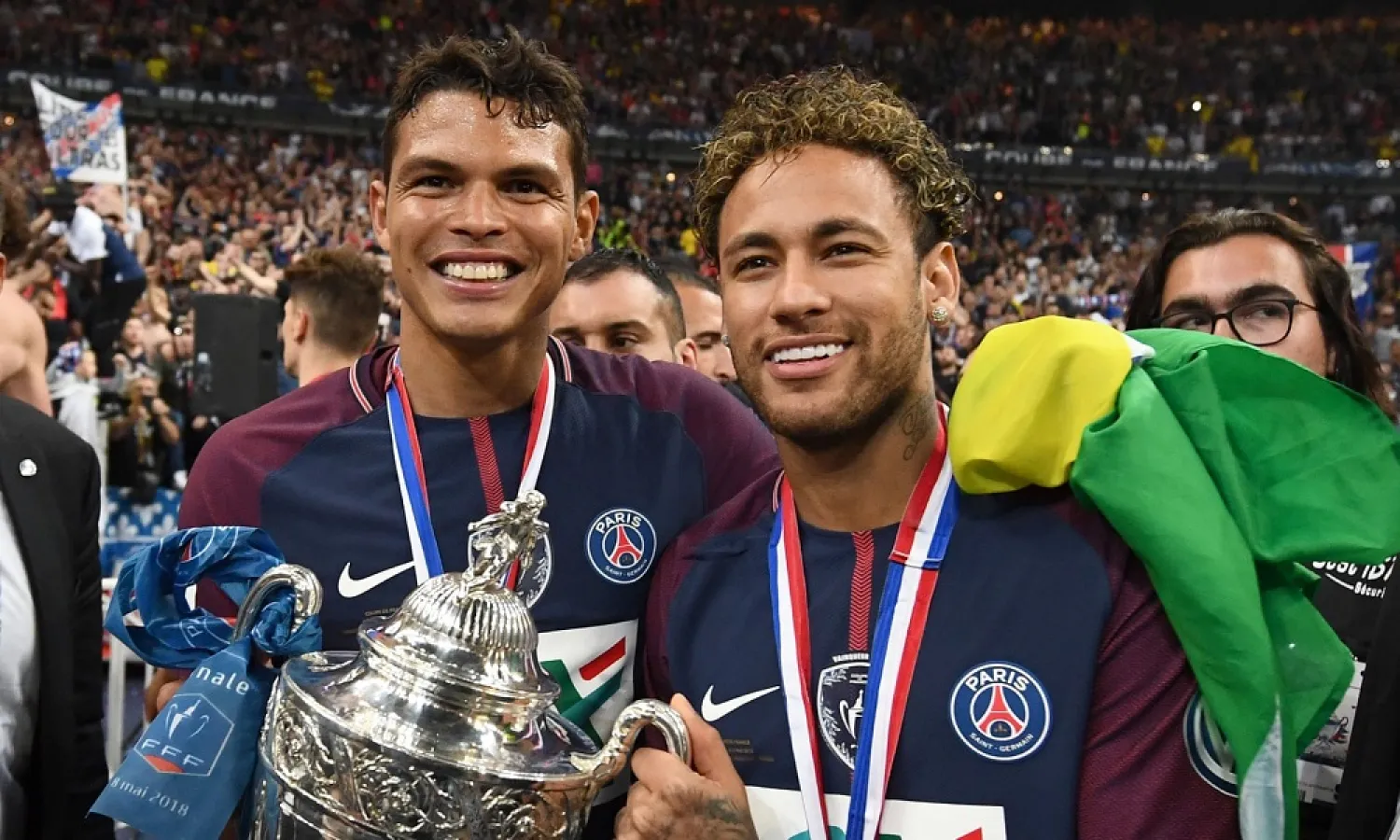
PSG captain Thiago Silva and Brazil captain Neymar celebrate after winning the Coupe de France in 2018. (Getty Images)
TT

PSG's Long and Sometimes Successful Relationship with Brazilian Footballers

PSG captain Thiago Silva and Brazil captain Neymar celebrate after winning the Coupe de France in 2018. (Getty Images)

The build-up to PSG’s tie against Manchester United in the Champions League was centered around a player who is unlikely to even set foot on the pitch in either leg. Such is life with Neymar, a continual source of histrionics wrapped up in a soap opera inside a melodrama. His latest metatarsal drama has inflicted a sense of angst on the PSG camp and perpetuated the creeping sense that, for all the club’s bountiful array of playing talent, they depend to an unhealthy degree on the availability of their precocious Brazilian star.

There is some precedent here as PSG have long had a symbiotic relationship with Brazilian footballers. Indeed, were Neymar more inclined towards reflecting on the long and fruitful association his compatriots have enjoyed with PSG than personal brand building, he would have chosen 33 as his squad number rather than the predictable 10. When he and Dani Alves arrived in the French capital in 2017, the pair became the 32nd and 33rd boys from Brazil to have worn a PSG shirt since the club’s formation in 1971.

The roots of this relationship lie in the complex historical nature of the typical Parisian football fan. This was a city that for decades thumbed a collective nose at run-of-the-mill league fixtures, yet would readily turn out in huge numbers for big European nights and cup finals. Beleaguered club owners came to understand that football was little different to show business for the Parisian footballing public, so to gain their fickle attentions you had to serve up big names and box-office attractions. And no footballer suggests glamour and exoticism like a Brazilian.

This long-running liaison between Paris and Brazil was not love at first sight. The first Brazilian to pitch up in Paris for the club’s debut season in Ligue 1 in 1971 was the World Cup-winning central defender Joel Camargo. It was a signing that proved terribly judged. A player of undoubted pedigree he might have been, but Joel spectacularly failed to adapt to a new country and culture. His performances were substantially affected and he made just two appearances before returning home a matter of months later.

Eight years elapsed before the club were brave enough to dip their toe into the Brazilian market again. The belated second signing was Abel Braga, a central defender with one cap who arrived at the club from Vasco da Gama and proved more dependable than his predecessor, playing regularly over the next two seasons.

After signing just a couple of central defenders during their first two decades of existence, PSG began to adopt a more determinedly Brazil-first transfer policy in the early 1990s – and with some success. In 1991, the club acquired a trio of Brazilians from Portuguese giants Porto and Benfica: the powerful center-back Geraldão, the elegant sweeper Ricardo Gomes (who now manages Bordeaux) and the skilled wide player Valdo. The difference this time was that all three players were already assimilated into European club football and PSG did not have to face the cultural issues encountered with Joel. Ricardo and Valdo would prove to be great successes in Paris.

Two years later the club pulled off something of a coup when they acquired midfield playmaker Raí from São Paulo. Serie A dominated the European game at the time and every Brazilian star wanted to play in Italy. PSG understood they would have to box clever and try to woo players who were not yet prominent on the radar of the traditional giants of the European game. This approach, allied to a willingness to meet the often onerous personal and financial demands made by Brazilian footballers and their coterie of hangers-on, was also particularly evident when they signed Ronaldinho in 2001.

Raí spent five hugely influential years at the club. He also won the USA 94 World Cup while on the books at PSG, although perhaps not in the way he would have planned it. Having started the tournament as Brazil captain and scored in their opening game, he was dropped for the knockout stages and watched as Dunga lifted the trophy in his place. Regardless, his time in France helped PSG establish a valuable relationship with São Paulo. Lucas Moura (now at Tottenham) and Gustavo Hebling (now at Portimonense) both followed this path, and Leonardo – who played for PSG in the mid-1990s and went on to serve as the club’s director of football – also had two spells at São Paulo before arriving in France.

The late-1990s and early 2000s were something of a lost decade for the relationship. Sixteen Brazilians arrived at PSG between 1997 and 2007, but most left having made no meaningful impact whatsoever. The exception was Ronaldinho and even his contributions were fairly fitful during his two seasons at the Parc des Princes, the football too often getting in the way of his party lifestyle. As his manager at the time, Luis Fernández, put it: “I don’t have a problem with him. Ronaldinho has a problem with himself. He doesn’t have the lifestyle of a top-level sportsman.”

Brazilians flooded in from all quarters: the failing “next-big-things” Adailton and Christian, the Serie A midfield liability Vampeta, the successes-in-Saint-Etienne-but-flops-in-Paris Alex Dias and Aloísio. Then there was a succession of anonymous names that even PSG supporters will struggle to recall: César Belli, Denilson (not the famous one or the Arsenal one), André Luiz, Souza, Reinaldo, Everton Santos and Edmilson. Unsurprisingly the club’s abject transfer failings in the Brazilian market mirrored their general failings on the field during this era.

In 2011 the club undertook a necessary reset in their relationship with Brazilians, something that would be further shaped by the huge influx of Qatari money flooding in the following year. The signings of Chelsea center-back Alex and Barcelona full-back Maxwell started a concerted push to install a sizable clique of Seleção players in the capital. Eight seasons later, their first team regularly has more Brazilian players than French players, with captain Thiago Silva, vice-captain Marquinhos, right-back Dani Alves and, of course, Neymar, taking key positions on the pitch and in the dressing room.

PSG’s power brokers clearly want to make the club the go-to European destination for Brazil’s brightest and best stars, so expect that total of 33 to rise sharply in the years to come.

The Guardian Sport


Sinner Sees off Popyrin to Reach Doha Quarters

 Italy's Jannik Sinner greets the fans after defeating Australia's Alexei Popyrin in their men's singles match at the Qatar Open tennis tournament in Doha on February 18, 2026. (AFP)
Italy's Jannik Sinner greets the fans after defeating Australia's Alexei Popyrin in their men's singles match at the Qatar Open tennis tournament in Doha on February 18, 2026. (AFP)
TT

Sinner Sees off Popyrin to Reach Doha Quarters

 Italy's Jannik Sinner greets the fans after defeating Australia's Alexei Popyrin in their men's singles match at the Qatar Open tennis tournament in Doha on February 18, 2026. (AFP)
Italy's Jannik Sinner greets the fans after defeating Australia's Alexei Popyrin in their men's singles match at the Qatar Open tennis tournament in Doha on February 18, 2026. (AFP)

Jannik Sinner powered past Alexei Popyrin in straight sets on Wednesday to reach the last eight of the Qatar Open and edge closer to a possible final meeting with Carlos Alcaraz.

The Italian, playing his first tournament since losing to Novak Djokovic in the Australian Open semi-finals last month, eased to a 6-3, 7-5 second-round win in Doha.

Sinner will play Jakub Mensik in Thursday's quarter-finals.

Australian world number 53 Popyrin battled gamely but failed to create a break-point opportunity against his clinical opponent.

Sinner dropped just three points on serve in an excellent first set which he took courtesy of a break in the sixth game.

Popyrin fought hard in the second but could not force a tie-break as Sinner broke to grab a 6-5 lead before confidently serving it out.

World number one Alcaraz takes on Frenchman Valentin Royer in his second-round match later.


Ukraine's Officials to Boycott Paralympics over Russian Flag Decision

Milano Cortina 2026 Winter Olympics - Skeleton - Interview with Ukraine Youth and Sports minister Matvii Bidnyi - N H Hotel, Milan, Italy - February 12, 2026 Ukraine Youth and Sports Minister Matvii Bidnyi speaks after the disqualification of Ukrainian skeleton racer Vladyslav Heraskevych from the Winter Games. REUTERS/Kevin Coombs
TT

Ukraine's Officials to Boycott Paralympics over Russian Flag Decision

Milano Cortina 2026 Winter Olympics - Skeleton - Interview with Ukraine Youth and Sports minister Matvii Bidnyi - N H Hotel, Milan, Italy - February 12, 2026 Ukraine Youth and Sports Minister Matvii Bidnyi speaks after the disqualification of Ukrainian skeleton racer Vladyslav Heraskevych from the Winter Games. REUTERS/Kevin Coombs

Ukrainian officials will boycott the Paralympic Winter Games, Kyiv said Wednesday, after the International Paralympic Committee allowed Russian athletes to compete under their national flag.

Ukraine also urged other countries to shun next month's Opening Ceremony in Verona on March 6, in part of a growing standoff between Kyiv and international sporting federations four years after Russia invaded.

Six Russians and four Belarusians will be allowed to take part under their own flags at the Milan-Cortina Paralympics rather than as neutral athletes, the Games' governing body confirmed to AFP on Tuesday.

Russia has been mostly banned from international sport since Moscow invaded Ukraine. The IPC's decision triggered fury in Ukraine.

Ukraine's sports minister Matviy Bidny called the decision "outrageous", and accused Russia and Belarus of turning "sport into a tool of war, lies, and contempt."

"Ukrainian public officials will not attend the Paralympic Games. We will not be present at the opening ceremony," he said on social media.

"We will not take part in any other official Paralympic events," he added.

Ukrainian Foreign Minister Andriy Sybiga said he had instructed Kyiv's ambassadors to urge other countries to also shun the opening ceremony.

"Allowing the flags of aggressor states to be raised at the Paralympic Games while Russia's war against Ukraine rages on is wrong -- morally and politically," Sybiga said on social media.

The EU's sports commissioner Glenn Micallef said he would also skip the opening ceremony.

- Kyiv demands apology -

The IPC's decision comes amid already heightened tensions between Ukraine and the International Olympic Committee, overseeing the Winter Olympics currently underway.

The IOC banned Ukrainian skeleton racer Vladyslav Heraskevych for refusing to ditch a helmet depicting victims of the war with Russia.

Ukraine was further angered that the woman chosen to carry the "Ukraine" name card and lead its team out during the Opening Ceremony of the Games was revealed to be Russian.

Media reports called the woman an anti-Kremlin Russian woman living in Milan for years.

"Picking a Russian person to carry the nameplate is despicable," Kyiv's foreign ministry spokesman Georgiy Tykhy said at a briefing in response to a question by AFP.

He called it a "severe violation of the Olympic Charter" and demanded an apology.

And Kyiv also riled earlier this month at FIFA boss Gianni Infantino saying he believed it was time to reinstate Russia in international football.

- 'War, lies and contempt' -

Valeriy Sushkevych, president of the Ukrainian Paralympic Committee told AFP on Tuesday that Kyiv's athletes would not boycott the Paralympics.

Ukraine traditionally performs strongly at the Winter Paralympics, coming second in the medals table four years ago in Beijing.

"If we do not go, it would mean allowing Putin to claim a victory over Ukrainian Paralympians and over Ukraine by excluding us from the Games," said the 71-year-old in an interview.

"That will not happen!"

Russia was awarded two slots in alpine skiing, two in cross-country skiing and two in snowboarding. The four Belarusian slots are all in cross-country skiing.

The International Paralympic Committee (IPC) said earlier those athletes would be "treated like (those from) any other country".

The IPC unexpectedly lifted its suspension on Russian and Belarusian athletes at the organisation's general assembly in September.


'Not Here for Medals', Nakai Says after Leading Japanese Charge at Olympics

Ami Nakai of Japan competes during the women's short program figure skating at the 2026 Winter Olympics, in Milan, Italy, Tuesday, Feb. 17, 2026. (AP Photo/Ashley Landis)
TT

'Not Here for Medals', Nakai Says after Leading Japanese Charge at Olympics

Ami Nakai of Japan competes during the women's short program figure skating at the 2026 Winter Olympics, in Milan, Italy, Tuesday, Feb. 17, 2026. (AP Photo/Ashley Landis)

Ami Nakai entered her first Olympics insisting she was not here for medals — but after the short program at the Milano Cortina Games, the 17-year-old figure skater found herself at the top, ahead of national icon Kaori Sakamoto and rising star Mone Chiba.

Japan finished first, second, and fourth on Tuesday, cementing a formidable presence heading into the free skate on Thursday. American Alysa Liu finished third.

Nakai's clean, confident skate was anchored by a soaring triple Axel. She approached the moment with an ease unusual for an Olympic debut.

"I'm not here at this Olympics with the goal of achieving a high result, I'm really looking forward to enjoying this Olympics as much as I can, till the very last moment," she said.

"Since this is my first Olympics, I had nothing to lose, and that mindset definitely translated into my results," she said.

Her carefree confidence has unexpectedly put her in medal contention, though she cannot imagine herself surpassing Sakamoto, the three-time world champion who is skating the final chapter of her competitive career. Nakai scored 78.71 points in the short program, ahead of Sakamoto's 77.23.

"There's no way I stand a chance against Kaori right now," Nakai said. "I'm just enjoying these Olympics and trying my best."

Sakamoto, 25, who has said she will retire after these Games, is chasing the one accolade missing from her resume: Olympic gold.

Having already secured a bronze in Beijing in 2022 and team silvers in both Beijing and Milan, she now aims to cap her career with an individual title.

She delivered a polished short program to "Time to Say Goodbye," earning a standing ovation.

Sakamoto later said she managed her nerves well and felt satisfied, adding that having three Japanese skaters in the top four spots "really proves that Japan is getting stronger". She did not feel unnerved about finishing behind Nakai, who also bested her at the Grand Prix de France in October.

"I expected to be surpassed after she landed a triple Axel ... but the most important thing is how much I can concentrate on my own performance, do my best, stay focused for the free skate," she said.

Chiba placed fourth and said she felt energised heading into the free skate, especially after choosing to perform to music from the soundtrack of "Romeo and Juliet" in Italy.

"The rankings are really decided in the free program, so I'll just try to stay calm and focused in the free program and perform my own style without any mistakes," said the 20-year-old, widely regarded as the rising all-rounder whose steady ascent has made her one of Japan's most promising skaters.

All three skaters mentioned how seeing Japanese pair Riku Miura and Ryuichi Kihara deliver a stunning comeback, storming from fifth place after a shaky short program to capture Japan's first Olympic figure skating pairs gold medal, inspired them.

"I was really moved by Riku and Ryuichi last night," Chiba said. "The three of us girls talked about trying to live up to that standard."
