

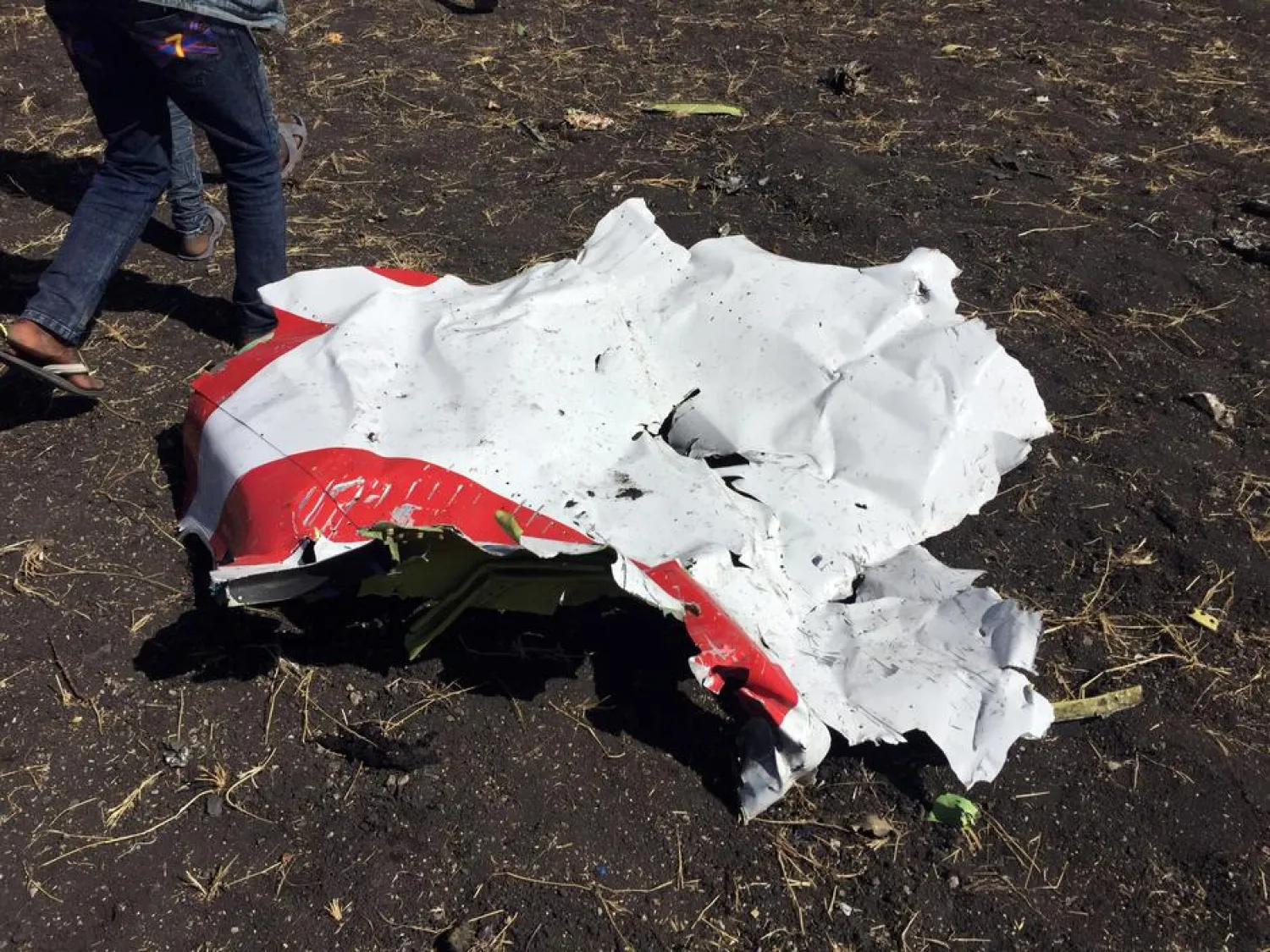

Ethiopian Airlines Flight Crashes, Killing All 157 Aboard

People walk past a part of the wreckage at the scene of the Ethiopian Airlines Flight ET 302 plane crash, near the town of Bishoftu, southeast of Addis Ababa, Ethiopia March 10, 2019. REUTERS/Tiksa Negeri
TT

Ethiopian Airlines Flight Crashes, Killing All 157 Aboard

People walk past a part of the wreckage at the scene of the Ethiopian Airlines Flight ET 302 plane crash, near the town of Bishoftu, southeast of Addis Ababa, Ethiopia March 10, 2019. REUTERS/Tiksa Negeri

An Ethiopian Airlines Boeing 737 passenger jet to Nairobi crashed early on Sunday, killing 149 passengers and eight crew, the airline said, the same model that crashed during a Lion Air flight in Indonesia in October.

Sunday’s flight left Bole airport in Addis Ababa at 8:38 am (0538 GMT), before losing contact with the control tower just a few minutes later at 8:44 am.

“The group CEO who is at the scene right now deeply regrets to confirm there are no survivors,” the airline tweeted alongside a picture of Tewolde GebreMariam in a suit holding a piece of debris inside a large crater.

Passengers from 33 countries were aboard, said Tewolde in a news conference. The dead included Kenyan, Ethiopian, American, Canadian, French, Chinese, Egyptian, Swedish, British, and Dutch citizens.

The US National Transportation Safety Board will send four people to assist in the fatal crash, an NTSB spokesman said on Sunday.

At Nairobi airport, many relatives of passengers were left waiting at the gate for hours, with no information from airport authorities. Some learned of the crash from journalists.

Kenyan officials did not arrive at the airport until 1:30, five hours after the plane went down.

James Macharia, the cabinet secretary for transport, said he heard about the crash via Twitter.

Flight ET 302, registration number ET-AVJ, crashed near the town of Bishoftu, 62 kilometers southeast of the capital Addis Ababa, the airline said.

“The pilot mentioned that he had difficulties and that he wanted to return. He was given the clearance (to return back),” said Tewolde during his news conference.

The flight had unstable vertical speed after takeoff, said flight-tracking website Flightradar24 on its Twitter feed.

The aircraft had shattered into many pieces and was severely burnt.

The airline had earlier incorrectly identified the plane’s model number, but later confirmed it was a 737 MAX 8.

It’s not clear what caused the crash. Boeing sent condolences to the families and said it was ready to help investigate.

“A Boeing technical team is prepared to provide technical assistance at the request and under the direction of the US National Transportation Safety Board,” the company said in a statement.

This is the second recent crash of the relatively new 737 MAX 8, the latest version of Boeing’s workhorse narrowbody jet that first entered service in 2017.

The same model crashed into the Java Sea shortly after take-off from Jakarta on Oct 29, killing all 189 people on board the Lion Air flight.

The cause of that crash is still under investigation. A preliminary report issued in November, before the cockpit voice recorder was recovered, focused on airline maintenance and training and the response of a Boeing anti-stall system to a recently replaced sensor, but did not give a reason for the crash. A final report is due later this year.

The plane is the latest version of the 737, the world’s best selling modern passenger aircraft and one of the industry’s most reliable.

Under international rules, responsibility for leading the crash investigation lies with Ethiopian authorities, while the US National Transportation Safety Board (NTSB) will automatically take part because the Boeing aircraft was designed and built in the United States.

Investigators will seek to secure the crash site and collect evidence starting with black boxes capturing cockpit conversations and data, while compiling records on recent operations of the plane and the crew.

Representatives of Boeing and Cincinnati-based engine-maker CFM, a joint venture between General Electric and General Electric Co and France’s Safran SA will advise the NTSB.

Ethiopian is one of the biggest carriers on the continent by fleet size. It said previously that it expected to carry 10.6 million passengers last year.

New Prime Minister Abiy Ahmed has been promising to open up the state-owned airline to domestic and international investors.

The crash comes as Ethiopian has been snapping up stakes in small carriers around the continent to pre-empt potential rivals and become the dominant pan-African airline.

Its last major crash was in January 2010, when a flight from Beirut went down shortly after take-off, killing all 90 people onboard. The Lebanese blamed pilot error, which was disputed by the airline.



Trump Says Iran Killings Stopped

President Donald Trump speaks in the Oval Office of the White House, Wednesday, Jan. 14, 2026, in Washington. (AP Photo/Alex Brandon)
TT

Trump Says Iran Killings Stopped

President Donald Trump speaks in the Oval Office of the White House, Wednesday, Jan. 14, 2026, in Washington. (AP Photo/Alex Brandon)

US President Donald Trump said Wednesday he had been told the killings of protesters in Iran had been halted, but added that he would "watch it and see" about threatened military action.

Trump had repeatedly talked in recent days about coming to the aid of the Iranian people over the crackdown on protests that rights groups say has left at least 3,428 people dead, AFP said.

But in a surprise announcement at the White House, Trump said he had now received assurances from "very important sources on the other side" that Tehran had now stopped, and that executions would not go ahead.

"They've said the killing has stopped and the executions won't take place -- there were supposed to be a lot of executions today and that the executions won't take place -- and we're going to find out," Trump said.

He offered no details and noted that the United States had yet to verify the claims.

Asked by an AFP reporter in the Oval Office if US military action was now off the table, Trump replied: "We're going to watch it and see what the process is."

Iranian Foreign Minister Abbas Araghchi later said there would be "no hanging today or tomorrow," in an interview with US network Fox News, while accusing Israel of orchestrating violence, without providing evidence.

Araghchi contends the peaceful protests about economic hardship that began December 28 devolved into widespread violence between January 7 and 10 because the protests were infiltrated by external "elements who had a plan to create a big number of killings in order to provoke President Trump to enter into this conflict and start a new war against Iran."

Iran's Minister of Justice Amin Hossein Rahimi echoed that allegation, telling state news agencies that after January 7, "those weren't protests any longer" and anyone who was arrested on the streets then "was definitely a criminal."

A rights group said separately that the execution of an Iranian man arrested during the wave of protests, 26-year-old Erfan Soltani, would not take place as scheduled on Wednesday, citing relatives.

Late Wednesday, UN leadership announced a meeting of the Security Council Thursday for "a briefing on the situation in Iran," as requested by the United States.

Trump's comments sent oil prices plunging on Thursday morning, as concerns eased of a looming supply shock in energy markets. Iran makes up around three percent of global oil production.

- 'Full control' -

Araghchi said the Iranian government was "in full control" and reported an atmosphere of "calm" after what he called three days of "terrorist operation."

Iran also struck a defiant tone about responding to any US attack, as Washington appeared to draw down staff at a base in Qatar that Tehran targeted in a strike last year.

Iran targeted the Al Udeid base in June in retaliation for US strikes on its nuclear facilities. Ali Shamkhani, a senior advisor to Supreme Leader Ali Khamenei, warned Trump the strike showed "Iran's will and capability to respond to any attack."

Fears of possible US military action continued to rile the region.

The British government said its embassy in Tehran had been "temporarily closed," India's government urged its citizens to leave the country.

Germany's Lufthansa on Wednesday said its flights would avoid Iranian and Iraqi airspace "until further notice" after the US threats against Iran.

Trump has threatened to intervene militarily in Iran several times since the protest movement that has shaken the country began in late December. The protests are the largest since the Iranian Republic was proclaimed in 1979.

Rights monitors say that under cover of a five-day internet blackout, Iranian authorities are carrying out their harshest repression in years against demonstrations openly challenging the theocratic system.

Iran's judiciary chief vowed fast-track trials for those arrested, stoking fears authorities will use capital punishment as a tool of repression.

In Tehran, authorities held a funeral for more than 100 security personnel and other "martyrs" killed in the unrest, which officials have branded "acts of terror."

- 'Unprecedented level of brutality' -

G7 nations said Wednesday they were "deeply alarmed at the high level of reported deaths and injuries" and warned of further sanctions if the crackdown continued.

Monitor NetBlocks said Iran's internet blackout had lasted 144 hours. Despite the shutdown, new videos, with locations verified by AFP, showed bodies lined up in the Kahrizak morgue south of Tehran, wrapped in black bags as distraught relatives searched for loved ones.

The US-based Institute for the Study of War said authorities were using "an unprecedented level of brutality to suppress protests," noting reports of protest activity had sharply declined.

A senior Iranian official told journalists there had been no new "riots" since Monday, distinguishing them from earlier cost-of-living protests. "Every society can expect protests, but we will not tolerate violence," he said.

Prosecutors have said some detainees will face capital charges of "waging war against God." State media reported hundreds of arrests and the detention of a foreign national for espionage, without giving details.

Iran Human Rights, based in Norway, said security forces had killed at least 3,428 protesters and arrested more than 10,000.


Iran Closes Its Airspace to Commercial Aircraft for Hours as Tensions with US Remain High

People walk past a large patriotic banner depicting the Iranian flag on Enghelab Square in Tehran on January 14, 2026.  (Photo by ATTA KENARE / AFP)
People walk past a large patriotic banner depicting the Iranian flag on Enghelab Square in Tehran on January 14, 2026. (Photo by ATTA KENARE / AFP)
TT

Iran Closes Its Airspace to Commercial Aircraft for Hours as Tensions with US Remain High

People walk past a large patriotic banner depicting the Iranian flag on Enghelab Square in Tehran on January 14, 2026.  (Photo by ATTA KENARE / AFP)
People walk past a large patriotic banner depicting the Iranian flag on Enghelab Square in Tehran on January 14, 2026. (Photo by ATTA KENARE / AFP)

Iran closed its airspace to commercial flights for hours without explanation early Thursday as tensions remained high with the United States over Tehran’s bloody crackdown on nationwide protests.

The closure ran for over four hours, according to pilot guidance issued by Iran, which lies on a key East-West flight route. International carriers diverted north and south around Iran, but after one extension, the closure appeared to have expired and several domestic flights were in the air just after 7 a.m. The Associated Press said.

Iran previously shut its airspace during the 12-day war against Israel in June and when it exchanged fire with Israel during the Israel-Hamas war. However, there were no signs of current hostilities though the closure immediately rippled through global aviation because Iran is located on a key East-West route for airlines.

“Several airlines have already reduced or suspended services, and most carriers are avoiding Iranian airspace,” said the website SafeAirspace, which provides information on conflict areas and air travel. “The situation may signal further security or military activity, including the risk of missile launches or heightened air defense, increasing the risk of misidentification of civil traffic.”

Iran in the past has misidentified a commercial aircraft as a hostile target. In 2020, Iranian air defense shot down Ukraine International Airlines Flight PS752 with two surface-to-air missiles, killing all 176 people on board. Iran for days adamantly dismissed allegations of downing the plane as Western propaganda before finally acknowledging it.

The airspace closure came as some personnel at a key US military base in Qatar were advised to evacuate. The US Embassy in Kuwait also ordered its personnel to “temporary halt” going to the multiple military bases in the small Gulf Arab country.

The UN Security Council scheduled an emergency meeting on Iran at the request of the United States on Thursday afternoon.

US President Donald Trump made a series of vague statements Wednesday that left unclear what American action, if any, would take place against Iran.

In comments to reporters, Trump said he had been told that plans for executions in Iran have stopped, without providing many details. The shift comes a day after Trump told protesters in Iran that “help is on the way” and that his administration would “act accordingly” to respond to Iran's deadly crackdown.

Iranian Foreign Minister Abbas Araghchi also sought to tone down the rhetoric, urging the US to find a solution through negotiation.

Asked by Fox News what he would say to Trump, Araghchi said: “My message is: Between war and diplomacy, diplomacy is a better way, although we don’t have any positive experience from the United States. But still diplomacy is much better than war.”

The change in tone by the US and Iran came hours after the chief of the Iranian judiciary said the government must act quickly to punish the thousands who have been detained.

Activists warned that hangings of detainees could come soon. The security forces’ crackdown on the demonstrations has killed at least 2,615, the US-based Human Rights Activists News Agency reported. The death toll exceeds that of any other round of protest or unrest in Iran in decades and recalls the chaos surrounding the country’s 1979 Iranian Revolution.


Ukraine’s New Defense Minister Reveals Scale of Desertions as Millions Avoid the Draft

Ukraine's newly appointed Defense Minister Mykhailo Fedorov attends a parliamentary session in Kyiv, Ukraine, 14 January 2026. (EPA)
TT

Ukraine’s New Defense Minister Reveals Scale of Desertions as Millions Avoid the Draft

Ukraine's newly appointed Defense Minister Mykhailo Fedorov attends a parliamentary session in Kyiv, Ukraine, 14 January 2026. (EPA)

Wide-scale desertions and 2 million draft-dodgers are among a raft of challenges facing Ukraine's military as Russia presses on with its invasion of its neighbor after almost four years of fighting, the new defense minister said Wednesday.

Mykhailo Fedorov told Ukraine's parliament that other problems facing Ukraine’s armed forces include excessive bureaucracy, a Soviet-style approach to management, and disruptions in the supply of equipment to troops along the about 1,000-kilometer (600-mile) front line.

“We cannot fight a war with new technologies but an old organizational structure,” Fedorov said.

He said the military had faced some 200,000 troop desertions and draft-dodging by around 2 million people.

President Volodymyr Zelenskyy appointed 34-year-old Fedorov at the start of the year. The former head of Ukraine’s digital transformation policies is credited with spearheading the army's drone technology and introducing several successful e-government platforms.

His appointment was part of a broad government reshuffle that the Ukrainian leader said aimed to sharpen the focus on security, defense development and diplomacy amid a new US-led push to find a peace settlement.

Fedorov said the defense ministry is facing a shortfall of 300 billion hryvnia ($6.9 billion) in funding needs.

The European Union will dedicate most of a massive new loan program to help fund Ukraine’s military and economy over the next two years, European Commission President Ursula von der Leyen said Wednesday.

Fedorov said Ukraine’s defense sector has expanded significantly since Russia’s full-scale invasion in February 2022. At the start of the war, he said, the country had seven private drone companies and two firms developing electronic warfare systems. Today, he said, there are nearly 500 drone manufacturers and about 200 electronic warfare companies in Ukraine.

He added that some sectors have emerged from scratch, including private missile producers, which now number about 20, and more than 100 companies manufacturing ground-based robotic systems.