


Dozens of Casualties in Attack on New Zealand Mosques

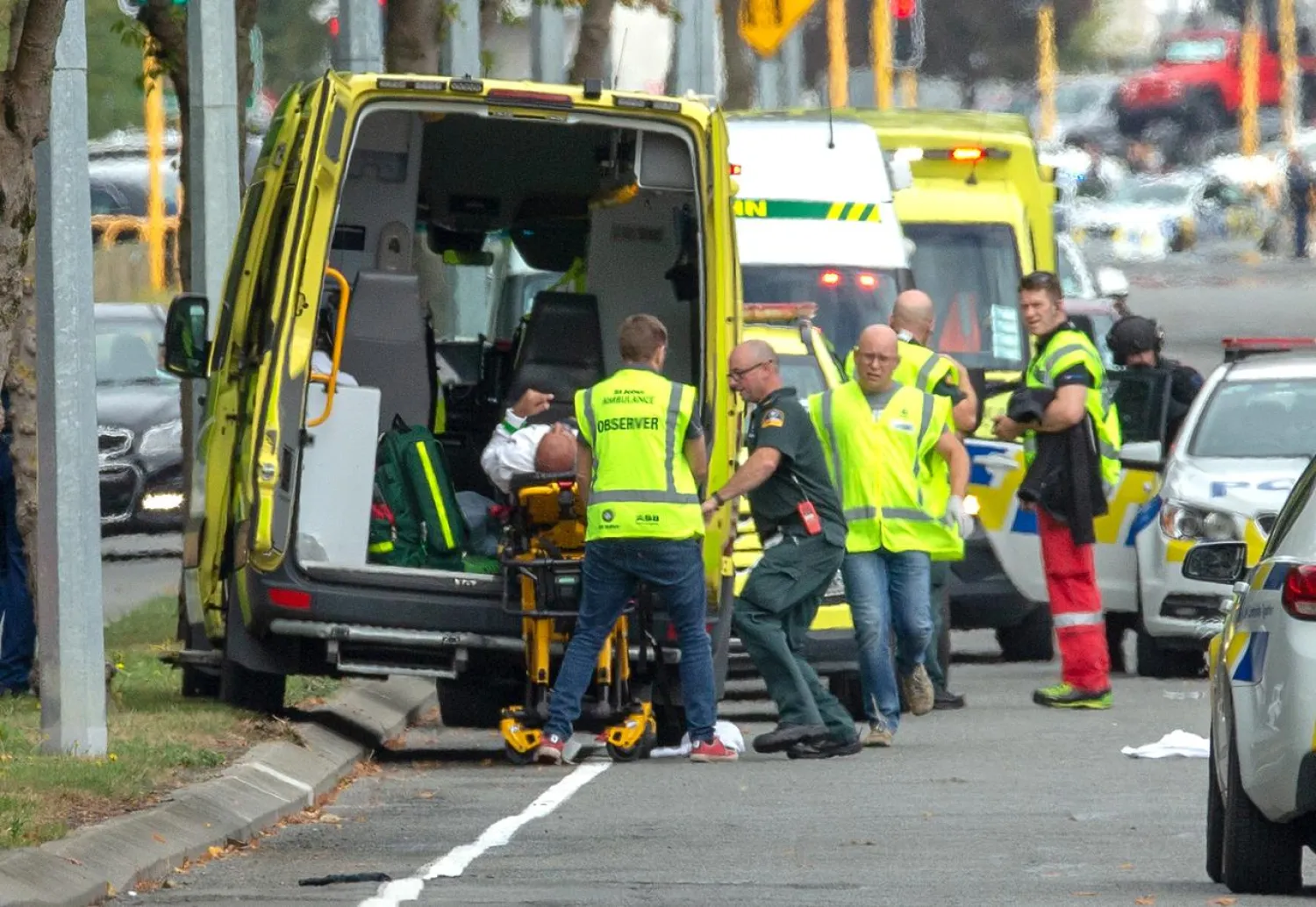
An injured person is loaded into an ambulance following a shooting at the Al Noor mosque in Christchurch, New Zealand, March 15, 2019. Reuters
TT

Dozens of Casualties in Attack on New Zealand Mosques

An injured person is loaded into an ambulance following a shooting at the Al Noor mosque in Christchurch, New Zealand, March 15, 2019. Reuters

Attacks on two mosques in New Zealand left at least 40 dead Friday, with one gunman – identified as an Australian extremist -- apparently livestreaming the assault. Authorities detained four people.

Witnesses spoke of victims being shot at close range, with women and children also believed to be among those killed.

"It is clear that this can now only be described as a terrorist attack," said Prime Minister Jacinda Ardern about the events at Christchurch, adding it marked "one of New Zealand's darkest days". 

"From what we know, it does appear to have been well planned," she said, adding that in addition to the dead another 20 people were seriously injured. 

The gunman at one mosque was an Australian-born citizen, Australian Prime Minister Scott Morrison said in Sydney, describing him as "an extremist, right-wing, violent terrorist".

It was not immediately clear how many attackers were involved. Police Commissioner Mike Bush said police were not aware of other suspects beyond the four who were detained but they couldn't be certain.

Morrison confirmed that one of the four people arrested was an Australian-born citizen.

Two IEDS (improved explosive devices) were also found and neutralized by the military, police said.

A Palestinian man who was in one of the mosques said he saw someone being shot in the head.

"I heard three quick shots, then after about 10 seconds it started again. It must have been an automatic -- no one could pull a trigger that quick," the man, who did not wish to be named, told AFP.

"Then people started running out. Some were covered in blood," he said, adding that he joined the fleeing crowd and managed to escape.

The deadliest attack occurred at Al Noor Mosque in central Christchurch. Arden said 30 people were killed there.

A video that was apparently livestreamed by the shooter shows the attack in horrifying detail. The gunman spends more than two minutes inside the mosque spraying terrified worshipers with bullets again and again, sometimes re-firing at people he has already cut down.

He then walks outside to the street, where he shoots at people on the sidewalk. Children's screams can be heard in the distance as he returns to his car to get another rifle.

The gunman then walks back into the mosque, where there are at least two dozen people lying on the ground. After walking back outside and shooting a woman there, he gets back in his car. The singer bellows, "I am the god of hellfire!" and the gunman drives away. The video then cuts out.

There was a second shooting at the Linwood Mosque that Ardern said killed 10 people.


US Military Strikes Another Alleged Drug Boat in Eastern Pacific, Killing 3

A shot of a boat targeted by a US raid in the Caribbean (archive - Reuters)
TT

US Military Strikes Another Alleged Drug Boat in Eastern Pacific, Killing 3

A shot of a boat targeted by a US raid in the Caribbean (archive - Reuters)

The US military said Friday that it has carried out another deadly strike on a vessel accused of trafficking drugs in the Eastern Pacific Ocean.

US Southern Command said on social media that the boat “was transiting along known narco-trafficking routes in the Eastern Pacific and was engaged in narco-trafficking operations.” It said the strike killed three people. A video linked to the post shows a boat floating in the water before bursting into flames.

Friday’s attack raises the death toll from the Trump administration’s strikes on alleged drug boats to at least 148 people in at least 43 attacks carried out since early September in the Caribbean Sea and eastern Pacific Ocean.

President Donald Trump has said the US is in “armed conflict” with cartels in Latin America and has justified the attacks as a necessary escalation to stem the flow of drugs. But his administration has offered little evidence to support its claims of killing “narcoterrorists.”

Critics have questioned the overall legality of the strikes as well as their effectiveness, in part because the fentanyl behind many fatal overdoses is typically trafficked to the US over land from Mexico.


Afghanistan Quake Causes No ‘Serious’ Damage, Injuries, Says Official

Afghan men prepare meals during the holy fasting month of Ramadan in Kabul, Afghanistan, 19 February 2026. (EPA)
TT

Afghanistan Quake Causes No ‘Serious’ Damage, Injuries, Says Official

Afghan men prepare meals during the holy fasting month of Ramadan in Kabul, Afghanistan, 19 February 2026. (EPA)

A 5.8-magnitude earthquake that rocked eastern Afghanistan including the capital Kabul has resulted in only minor damage and one reported injury, a disaster official told AFP on Saturday.

The quake hit on Friday just as people in the Muslim-majority country were sitting down to break their Ramadan fast.

The epicenter was near several remote villages around 130 kilometers (80 miles) northeast of Kabul, the United States Geological Survey said.

"There aren't any serious casualties or damages after yesterday's earthquake," said Mohammad Yousuf Hamad, spokesman for the National Disaster Management Authority.

He added that one person had sustained "a minor injury in Takhar", in Afghanistan's north, "and three houses had minor damage in Laghman" province.

Zilgay Talabi, a resident of Khenj district near the epicenter, said the tremor was "very strong, it went on for almost 30 seconds".

Earthquakes are common in Afghanistan, particularly along the Hindu Kush mountain range, near where the Eurasian and Indian tectonic plates meet.

In August last year, a shallow 6.0-magnitude quake in the country's east wiped out mountainside villages and killed more than 2,200 people.

Weeks later, a 6.3-magnitude quake in northern Afghanistan killed 27 people.

Large tremors in western Herat, near the Iranian border, in 2023, and in Nangarhar province in 2022, killed hundreds and destroyed thousands of homes.

Many homes in the predominantly rural country, which has been devastated by decades of war, are shoddily built.

Poor communication networks and infrastructure in mountainous Afghanistan have hampered disaster responses in the past, preventing authorities from reaching far-flung villages for hours or even days before they could assess the extent of the damage.


Serbia Urges Citizens to Quit Iran ‘As Soon as Possible’

People walk past an anti-US billboard in Tehran, Iran, January 26, 2026. Majid Asgaripour/WANA (West Asia News Agency) via Reuters
TT

Serbia Urges Citizens to Quit Iran ‘As Soon as Possible’

People walk past an anti-US billboard in Tehran, Iran, January 26, 2026. Majid Asgaripour/WANA (West Asia News Agency) via Reuters

Serbia has urged its citizens in Iran to leave the country "as soon as possible", after US President Donald Trump threatened military action over the country's nuclear program.

The Balkan nation had already invited Serbian nationals in mid-January to leave Iran and not to travel there, as the country's clerical authorities launched a bloody crackdown on a mass protest movement.

"Due to the deteriorating security situation, citizens of the Republic of Serbia are not recommended to travel to Iran in the coming period," the foreign ministry said in a statement on its website published overnight Friday to Saturday.

"All those who are in Iran are recommended to leave the country as soon as possible."

Iran said on Friday that it was hoping for a quick deal with the United States on Tehran's nuclear program, long a source of discord between the two foes.

But Trump, after ordering a major naval build-up in the Middle East aimed at heaping pressure on Tehran, said on Friday that he was "considering" a limited military strike if the negotiations proved unfruitful.
