


Zidane’s Real Madrid Return a Masterstroke and He Has All the Aces

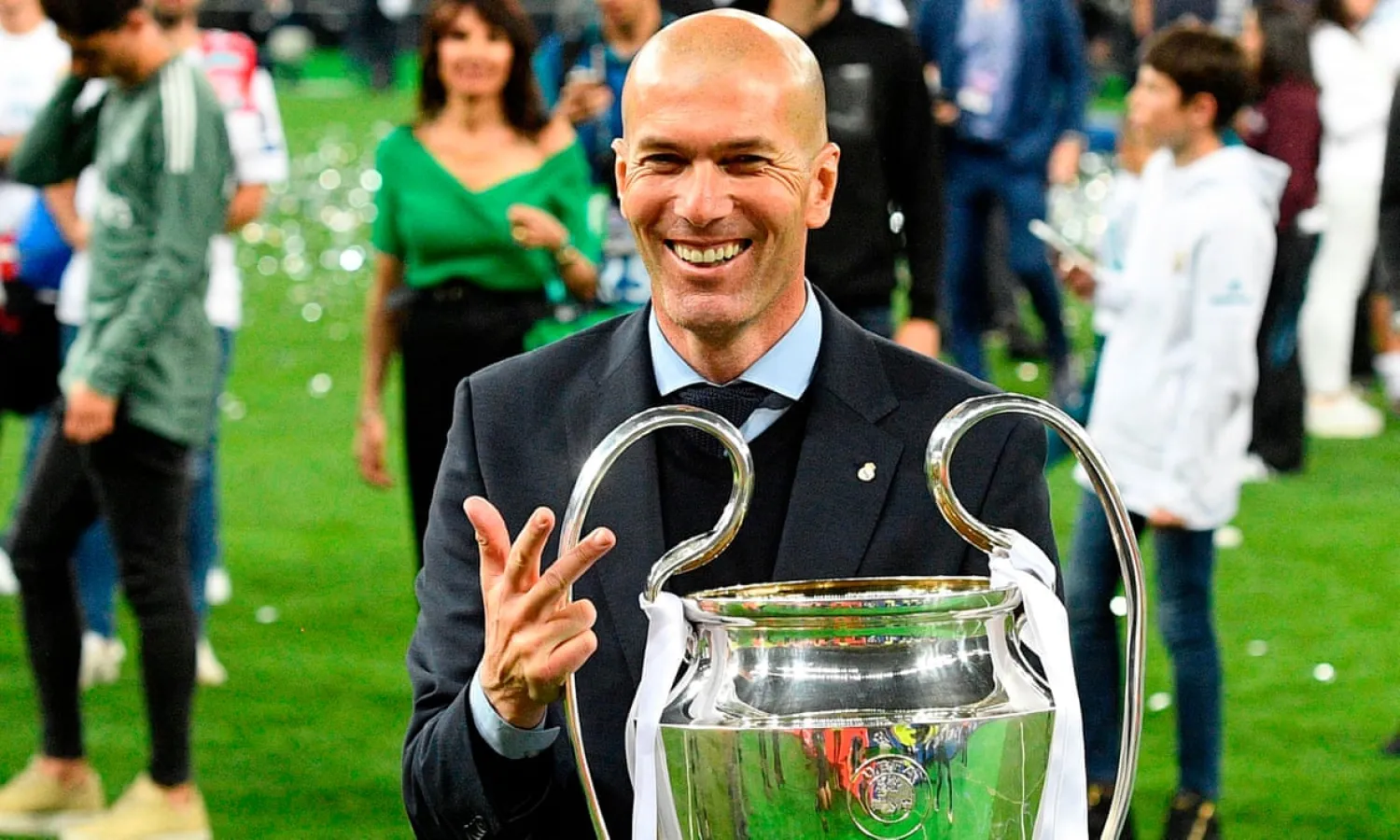
Three and easy: Zidane with the European Cup after the victory over Liverpool last year, a third successive triumph. Photograph: Genya Savilov/AFP/Getty Images
TT

Zidane’s Real Madrid Return a Masterstroke and He Has All the Aces

Three and easy: Zidane with the European Cup after the victory over Liverpool last year, a third successive triumph. Photograph: Genya Savilov/AFP/Getty Images

Pfff, and the crisis was gone. Zinedine Zidane walked into the room at the Santiago Bernabéu a little after eight o’clock and suddenly all was well with the world. It is not of course – Real Madrid’s season is over three months early, there are significant structural problems, and even the president, Florentino Pérez, called this an “especially difficult moment” – but that is how it felt. Whatever happens next, as an act of crisis management this was a masterstroke, the perfect move.

Zidane walked back in 284 days after walking out. Sequels were never any good, they say, but in the warmth of his return no one doubted this was the right decision – even if they dare not believe this will be as good as the first time, when Madrid won three consecutive Champions Leagues.

It can’t begin the same way, that’s for sure: Zidane was a European champion within five months of taking over last time; this time it will be five months before Madrid play a match that matters. Except that they all matter, as much for what happens around them as what happens on the pitch.

His first game is against Celta Vigo on Saturday and 10 more follow, all of them fundamentally irrelevant, but Zidane talked about them as something to enjoy, not endure. Attendances have plummeted this season; watch it rise again this Saturday. The risk was that disaster might follow defeat, the crisis deepening and divisions widening. Zidane’s arrival stems the bleeding. Ilusión was the word repeated: there may yet prove something illusory about it, but it means hope, excitement, enthusiasm, optimism.

Whether that can be maintained, whether a full recovery will follow, is another issue. There are many questions, most of them born of a fundamental doubt standing at the heart of it all: if there was a reason you walked away nine months ago, and there was, what has changed to make you walk back in again? Zidane said there was none, but no one bought that. Asked what his first thought was when the president called him, he replied: “To go back.” Pausing, he added: “And here I am.”

“I love the club, I couldn’t say no to the president,” Zidane said and there is genuinely an emotional connection, but nor did he say yes straight away. The call came last Thursday; he was presented on Monday. The traffic can be bad in Madrid but it doesn’t take that long to get from Arturo Soria to the Bernabéu. He was not forthcoming and replied “no, no” when asked directly whether guarantees had been given, but it is inconceivable that he accepted without concessions. There had been some reluctance at first but he was the man in the position of power, able to mould this to his ideas: Madrid needed him and they needed him now.

There was indeed a reason Zidane walked away in May. Many of them, in fact, all interrelated. Always seen as elegant, almost effortless – even as a coach – that impression disguises that he is a competitor. He talked then about needing a change after three years – for his sake and for theirs. “It’s the right decision,” he said. “I don’t like losing. If I feel like I am not going to win, I have to make a change.” He has been proven right; Madrid have failed to win – and that fact alone changes things. It makes his achievement, perhaps undervalued before, appear all the greater. It also serves almost to ringfence and protect his legacy, whatever happens now.

There is no guarantee how this will end, but Zidane wouldn’t have walked back in if he didn’t feel that he could win now. “It might be a see you later, not a goodbye,” he said under a year ago, but it is not as if he has never been away. Quite the opposite: being away is a key part of his armory now. Going away and coming back is better than never having gone at all.

This season without him provides a corrective, a reminder, and strengthens his hand enormously in the boardroom and the dressing room. The experience alone represents a change, and he said that there would be more. There will be arrivals and departures, with Gareth Bale high on the list of those whose future at Madrid became bleaker on Monday, and he will lead those, handed the authority and the money that he didn’t get before.

There are lessons to be learned from that failure without him and indeed from what he described as the failures with him. Last season they won the European Cup but finished 17 points behind Barcelona, with Zidane himself insisting the domestic title was the one he really valued. Whereas some managers talk endlessly about what they won, he talked about what he had lost. “We won the Champions League, OK, sure,” he said, “but the league was lost from the start.”

For him, this league is lost from the start too. Taking charge now with nothing to play for, with the potential for deepening problems, confrontations and crises like those seen in the five days since Ajax knocked Madrid out, might burn some managers. But with Zidane there is instead gratitude for him taking over at a time like this; his arrival puts out the fire and these failures will not be his. Next season’s will, and then judgments will be made, but if there is success it will be more his than ever before. “I’m happy,” Zidane said, “and that’s what matters.” Everyone else was happy too.

(The Guardian)



Shakhtar Boss Pays Ukrainian Racer $200,000 After Games Disqualification

Ukrainian President Volodymyr Zelenskiy holds helmet as he meets with a Ukrainian skeleton racer Vladyslav Heraskevych , who was disqualified from the Olympic skeleton competition over his "helmet of remembrance" depicting athletes killed since Russia's invasion and his father and coach, Mykhailo Heraskevych, amid Russia's attack on Ukraine, in Munich, Germany February 13, 2026. (Ukrainian Presidential Press Service/Handout via Reuters)
TT

Shakhtar Boss Pays Ukrainian Racer $200,000 After Games Disqualification

Ukrainian President Volodymyr Zelenskiy holds helmet as he meets with a Ukrainian skeleton racer Vladyslav Heraskevych , who was disqualified from the Olympic skeleton competition over his "helmet of remembrance" depicting athletes killed since Russia's invasion and his father and coach, Mykhailo Heraskevych, amid Russia's attack on Ukraine, in Munich, Germany February 13, 2026. (Ukrainian Presidential Press Service/Handout via Reuters)

The owner of ‌Ukrainian football club Shakhtar Donetsk has donated more than $200,000 to skeleton racer Vladyslav Heraskevych after the athlete was disqualified from the Milano Cortina Winter Games before competing over the use of a helmet depicting Ukrainian athletes killed in the war with Russia, the club said on Tuesday.

The 27-year-old Heraskevych was disqualified last week when the International Bobsleigh and Skeleton Federation jury ruled that imagery on the helmet — depicting athletes killed since Russia invaded Ukraine in 2022 — breached rules on athletes' expression at ‌the Games.

He ‌then lost an appeal at the Court ‌of ⁠Arbitration for Sport hours ⁠before the final two runs of his competition, having missed the first two runs due to his disqualification.

Heraskevych had been allowed to train with the helmet that displayed the faces of 24 dead Ukrainian athletes for several days in Cortina d'Ampezzo where the sliding center is, but the International Olympic Committee then ⁠warned him a day before his competition ‌started that he could not wear ‌it there.

“Vlad Heraskevych was denied the opportunity to compete for victory ‌at the Olympic Games, yet he returns to Ukraine a ‌true winner," Shakhtar President Rinat Akhmetov said in a club statement.

"The respect and pride he has earned among Ukrainians through his actions are the highest reward. At the same time, I want him to ‌have enough energy and resources to continue his sporting career, as well as to fight ⁠for truth, freedom ⁠and the remembrance of those who gave their lives for Ukraine," he said.

The amount is equal to the prize money Ukraine pays athletes who win a gold medal at the Games.

The case dominated headlines early on at the Olympics, with IOC President Kirsty Coventry meeting Heraskevych on Thursday morning at the sliding venue in a failed last-minute attempt to broker a compromise.

The IOC suggested he wear a black armband and display the helmet before and after the race, but said using it in competition breached rules on keeping politics off fields of play. Heraskevych also earned praise from Ukraine President Volodymyr Zelenskiy.


Speed Skating-Italy Clinch Shock Men’s Team Pursuit Gold, Canada Successfully Defend Women’s Title

 Team Italy with Davide Ghiotto, Andrea Giovannini, Michele Malfatti, celebrate winning the gold medal on the podium of the men's team pursuit speed skating race at the 2026 Winter Olympics, in Milan, Italy, Tuesday, Feb. 17, 2026. (AP)
Team Italy with Davide Ghiotto, Andrea Giovannini, Michele Malfatti, celebrate winning the gold medal on the podium of the men's team pursuit speed skating race at the 2026 Winter Olympics, in Milan, Italy, Tuesday, Feb. 17, 2026. (AP)
TT

Speed Skating-Italy Clinch Shock Men’s Team Pursuit Gold, Canada Successfully Defend Women’s Title

 Team Italy with Davide Ghiotto, Andrea Giovannini, Michele Malfatti, celebrate winning the gold medal on the podium of the men's team pursuit speed skating race at the 2026 Winter Olympics, in Milan, Italy, Tuesday, Feb. 17, 2026. (AP)
Team Italy with Davide Ghiotto, Andrea Giovannini, Michele Malfatti, celebrate winning the gold medal on the podium of the men's team pursuit speed skating race at the 2026 Winter Olympics, in Milan, Italy, Tuesday, Feb. 17, 2026. (AP)

An inspired Italy delighted the home crowd with a stunning victory in the Olympic men's team pursuit final as

Canada's Ivanie Blondin, Valerie Maltais and Isabelle Weidemann delivered another seamless performance to beat the Netherlands in the women's event and retain their title ‌on Tuesday.

Italy's ‌men upset the US who ‌arrived ⁠at the Games ⁠as world champions and gold medal favorites.

Spurred on by double Olympic champion Francesca Lollobrigida, the Italian team of Davide Ghiotto, Andrea Giovannini and Michele Malfatti electrified a frenzied arena as they stormed ⁠to a time of three ‌minutes 39.20 seconds - ‌a commanding 4.51 seconds clear of the ‌Americans with China taking bronze.

The roar inside ‌the venue as Italy powered home was thunderous as the crowd rose to their feet, cheering the host nation to one ‌of their most special golds of a highly successful Games.

Canada's women ⁠crossed ⁠the line 0.96 seconds ahead of the Netherlands, stopping the clock at two minutes 55.81 seconds, and

Japan rounded out the women's podium by beating the US in the Final B.

It was only Canada's third gold medal of the Games, following Mikael Kingsbury's win in men's dual moguls and Megan Oldham's victory in women's freeski big air.


Lindsey Vonn Back in US Following Crash in Olympic Downhill 

Milano Cortina 2026 Olympics - Alpine Skiing - Women's Downhill 3rd Official Training - Tofane Alpine Skiing Centre, Belluno, Italy - February 07, 2026. Lindsey Vonn of United States in action during training. (Reuters)
TT

Lindsey Vonn Back in US Following Crash in Olympic Downhill 

Milano Cortina 2026 Olympics - Alpine Skiing - Women's Downhill 3rd Official Training - Tofane Alpine Skiing Centre, Belluno, Italy - February 07, 2026. Lindsey Vonn of United States in action during training. (Reuters)

Lindsey Vonn is back home in the US following a week of treatment at a hospital in Italy after breaking her left leg in the Olympic downhill at the Milan Cortina Games.

“Haven’t stood on my feet in over a week... been in a hospital bed immobile since my race. And although I’m not yet able to stand, being back on home soil feels amazing,” Vonn posted on X with an American flag emoji. “Huge thank you to everyone in Italy for taking good care of me.”

The 41-year-old Vonn suffered a complex tibia fracture that has already been operated on multiple times following her Feb. 8 crash. She has said she'll need more surgery in the US.

Nine days before her fall in Cortina d'Ampezzo, Italy, Vonn ruptured the ACL in her left knee in another crash in Switzerland.

Even before then, all eyes had been on her as the feel-good story heading into the Olympics for her comeback after nearly six years of retirement.