


French Company Develops 'Bubble Taxis' for Water Transport

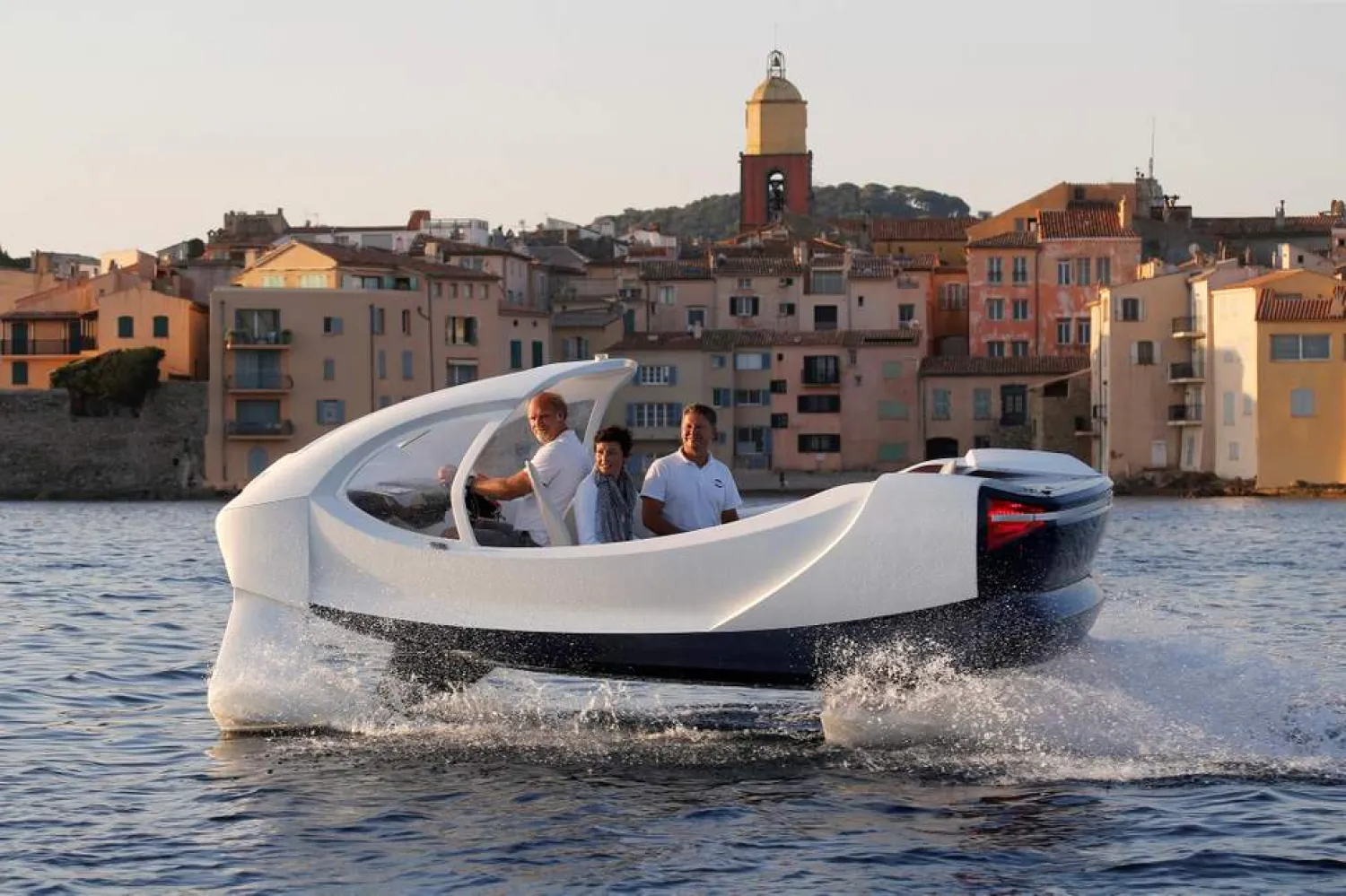
Founders of SeaBubbles, seen aboard a prototype of their water taxi in the harbor of Saint-Tropez, rue the red tape surrounding businesses in France. (Reuters)
TT

French Company Develops 'Bubble Taxis' for Water Transport

Founders of SeaBubbles, seen aboard a prototype of their water taxi in the harbor of Saint-Tropez, rue the red tape surrounding businesses in France. (Reuters)

A French company has developed a mechanism to raise boats out of water by using hydrofoils. This design by the French company, SeaBubbles, uses electric propulsion and an automatic self-stabilizing system to give you clean and quiet water transport, in what could possibly pave the way for the development of so-called “bubble taxis”.

Water Taxi
The Seabubbles team had demonstrated how up to six people can fit into the Bubble Taxi.

The Bubble Taxi offers clean, quiet and comfortable commuting over the water. The SeaBubbles system uses fly-by-wire controls to self-stabilize the watercraft as it flies.

Making its US debut in Miami this week, the SeaBubbles Bubble Taxi is a five-seat design about the size of a family car, with a sleek shape reminiscent of a flying car from “The Fifth Element” movie.

The Bubble Taxi prototype runs two props on a 20-kilowatt electric drive system, and once it hits around 13 kmh, its hydrofoils develop enough lift to make it rise up out of the water, allowing a top speed of 28 kmh as it cruises along about 40 cm above the water.

Getting the main hull out of the drink cuts drag by around 40%, helping squeeze extra range out of its 21.5-kilowatt-hour battery, which is good for up to two hours of use or 40 km in a five-hour charge. Flying on hydrofoils also takes the craft up above a lot of surface choppiness, making for a smooth and comfortable ride.

But, it is worth noting that the numbers above are only for the prototypes. SeaBubbles says its production machines will be faster, with bigger batteries, longer range and 35-minute fast charge times.

Stabilizing wings
If it looks a bit unstable riding on its single, central front hydrofoil and two rear ones, fear not: the Bubble Taxi uses gyroscopic and altitude sensors to measure pitch and roll angles constantly, and the steering system is completely fly-by-wire, allowing the boat to auto-correct for tilt and stabilize itself as you drive.

According to TechCrunch, the Bubble Taxi price is estimated at around US $200,000; a figure that’ll look more attractive due to fuel and maintenance savings if you plan to put a lot of nautical miles on it. But its eye-catching, futuristic look as it glides silently across the water could easily make it a status item for the well-heeled.

Many private buyers are already paid up and waiting for their watercraft in the United States, and the company is also preparing to start production for private and business customers in Moscow, St. Petersburg, Rotterdam and Amsterdam.



Samsung Is Discontinuing Its Texting App, Tells Impacted Users to Switch to Google Messages

Samsung unveils its latest Galaxy smartphones during a showcase in San Francisco, Feb. 25, 2026. (AP)
TT

Samsung Is Discontinuing Its Texting App, Tells Impacted Users to Switch to Google Messages

Samsung unveils its latest Galaxy smartphones during a showcase in San Francisco, Feb. 25, 2026. (AP)

Samsung is saying goodbye its namesake texting app.

According to an end of service announcement published on the tech giant's US support website, Samsung Messages will be discontinued in July. Impacted owners of Samsung smartphones and other gadgets are being asked to switch to Google Messages in the meantime, “to maintain a consistent messaging experience on Android.”

All Samsung Galaxy phones run on Google's Android operating system. To switch to Google Messages, Samsung's website gives users instructions to download the app from the Play Store, if not already on their phone, and set it as the default. Some people may also receive an in-app notification to guide them through the process.

Samsung says switching to Google Messages will give users access to updates like the latest artificial intelligence features from Google's Gemini — which includes an experimental feature called “Remix” to generate images during conversations and AI-powered reply suggestions — and the ability to share higher quality photos between Android and Apple iOS devices through RCS-enabled messages.

Users of older Android operating systems (dating back to Android 11 or older) will not be impacted by the end of Samsung Messages, the company noted. To check what Android OS you have on a Samsung device, open the settings app, click on “software information” and scroll to “Android version.”

Meanwhile, owners of Samsung's latest Galaxy 26 lineup and other newer phones cannot download the Samsung Messages app from the Galaxy Store today.

All devices will no longer be able to download Samsung Messages after it's officially discontinued in July, the company noted. Samsung said users can check their app for the exact date for when service will go offline.

Beyond the US, Samsung did not immediately respond to a request for further information about whether its guidance for Samsung Messages was the same globally.


Microsoft to Invest $10 bn for Japan AI Data Centers

Microsoft's Vice Chair and President Brad Smith (4th L) and (L-R) Sakura Internet Inc President and CEO Kunihiro Tanaka, SoftBank Corp. President and CEO Junichi Miyakawa, Microsoft Japan President Miki Tsusaka, hold a meeitng with Japan's Prime Minister Sanae Takaichi (2nd R) and Vice Minister of Economy, Trade and Industry Toshiro Ino (R) at the Prime Minister's Office in Tokyo on April 3, 2026. Kazuhiro NOGI / POOL/AFP
TT

Microsoft to Invest $10 bn for Japan AI Data Centers

Microsoft's Vice Chair and President Brad Smith (4th L) and (L-R) Sakura Internet Inc President and CEO Kunihiro Tanaka, SoftBank Corp. President and CEO Junichi Miyakawa, Microsoft Japan President Miki Tsusaka, hold a meeitng with Japan's Prime Minister Sanae Takaichi (2nd R) and Vice Minister of Economy, Trade and Industry Toshiro Ino (R) at the Prime Minister's Office in Tokyo on April 3, 2026. Kazuhiro NOGI / POOL/AFP

Microsoft said Friday it will invest $10 billion in Japan over the next four years to build artificial intelligence data centers and related infrastructure.

Power-hungry data centers -- warehouse-like facilities that power AI tools from chatbots to image generators -- are springing up worldwide, and the sector is growing particularly fast in Asia.

Microsoft President Brad Smith met Japanese Prime Minister Sanae Takaichi at her office on Friday to announce the investment, said AFP.

Smith said in a statement that it was a "response to Japan's growing need for cloud and AI services".

Businesses in Japan, the world's fourth-largest economy, are keen to get ahead in the fast-moving AI field.

But data centers expansion there is constrained by limited space and relatively expensive electricity.

The US tech giant will collaborate with Japan's SoftBank Group and Sakura Internet to expand domestic tech infrastructure, it said in a press release.

It follows a $2.9 billion two-year investment Microsoft announced in 2024 to bolster the country's push into AI and strengthen its cyber defenses.

The investment unveiled Friday also includes funds to enhance cybersecurity partnerships with Japanese government agencies, and to train one million engineers in cooperation with telecom and tech giants NTT and NEC.

A rush to build data centers in the Asia-Pacific region, especially in India and Southeast Asia, has sparked concerns over the facilities' environmental impact.

That includes increased demand on electricity grids that are often reliant on fossil fuels, and on local water supplies used to cool the hot servers inside.

Microsoft says it has pledged to become carbon negative, zero-waste and "water positive" by 2030.

On Tuesday, the company announced plans to invest more than $1 billion in cloud and AI data center infrastructure and operations in Thailand over the next two years.


Kia to Sell Lower-priced Electric Vehicle in US

A KIA logo on an electric vehicle is seen on display at the Canadian International AutoShow in Toronto, Ontario, Canada, February 13, 2025. REUTERS/Carlos Osorio
TT

Kia to Sell Lower-priced Electric Vehicle in US

A KIA logo on an electric vehicle is seen on display at the Canadian International AutoShow in Toronto, Ontario, Canada, February 13, 2025. REUTERS/Carlos Osorio

Kia said Wednesday it will begin selling a lower-priced electric vehicle in the United States later this year as automakers work to recharge EV sales.

The Korean automaker said at the New York Auto Show it will offer the EV3 in the US market starting later this year, Reuters reported.

Automakers are facing a tougher EV market in the United States after Congress repealed the $7,500 EV tax credit last year but higher gasoline prices in recent weeks has prompted new interest in the EVs.