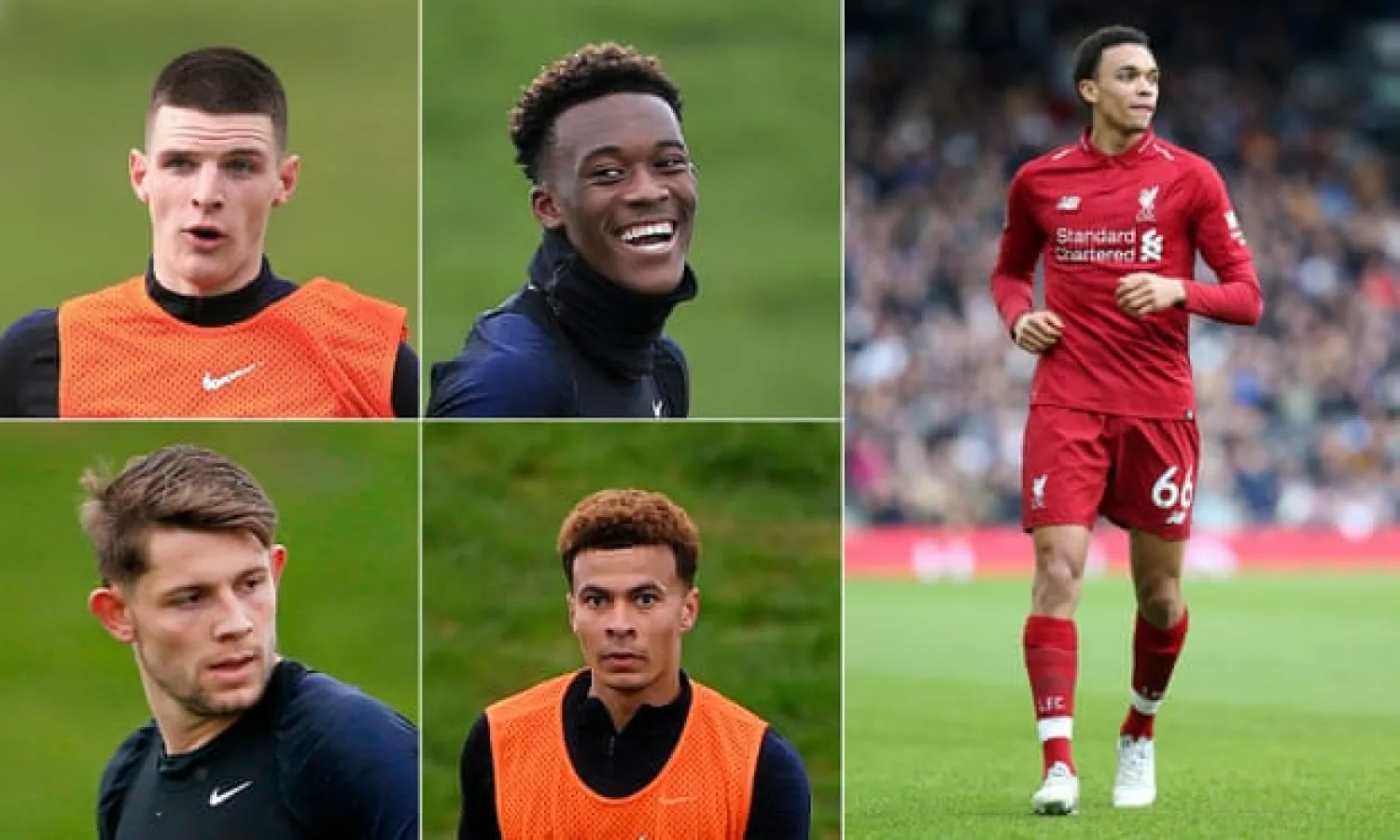

What have Declan Rice, Callum Hudson-Odoi, Dele Alli, James Tarkowski and Trent Alexander-Arnold got in common? Aside from carrying the flame of undying hope (until they lose) for Gareth’s brave lions, the answer is that every one of them could have been playing for someone else this weekend.
In almost every case England were the only realistic option on the table, although John Fashanu did make a doomed, shouty attempt to recruit Alli for Nigeria when he was at MK Dons. Either way England’s gain has been a loss, to varying degrees, for the Republic of Ireland, Ghana, Nigeria, Poland and USA.
And the fact remains playing for England has been a statement of active rather than passive sporting nationality for England’s youthful mixed-heritage players – a state of affairs that makes them either more or less committed to the cause depending on how empurpled your view is of such issues.
Rice has naturally drawn most fire on this, having played for Ireland in friendly internationals before a likely England debut against Czech Republic or Montenegro. It is not hard to see how that line could have been blurred. Rice’s father is Irish enough to have his own collection of green souvenir shirts at home. Rice grew up in Surrey. In a football sense he is entirely a product of the Premier League. This is at the very least a legitimate point of identity for a teenager to wrestle with.
Although, not if you are Gary Neville. “You should know where your allegiance lies,” Neville tweeted last year, apparently stunned that there could be any doubt as to which country a person of mixed race might want to represent. But then this has been a constant, bellicose tone on questions of sporting “allegiance”, the conviction that to feel anything other than certainty is to be in some sense weak, callow, cynical, inadequately poppy-clad.
When Wilfred Zaha elected to play for Ivory Coast three years ago the Daily Mail took a deep breath, inserted its largest sporting dog whistle between its eagerly pursed lips, and announced that Gareth Southgate believed Zaha “didn’t have the heart” to play for England – above an article in which Southgate used the word “heart” exactly zero times.
This is still a tender spot, one that seems certain to become ever more inflamed. Rice and Zaha are simply outliers here. Of 16 England debuts since the key Southgate-era friendly against Germany in 2017, 10 have been dual-qualified. Look at the age groups below and this is not an anomaly. Welcome to the world, England football.
Southgate has pointed out more than half of England’s under-16s have dual nationality, while many could play for more than two countries. It is a theme also picked up by Dan Ashworth. “Of 75 under-15s on our radar, 55 are eligible for more than one country,” Ashworth said. “We cannot be arrogant enough to assume that, if a kid is living here, he automatically wants to play for England. People have different emotional ties, while smaller nations might be able to offer a different pathway.”
These are some fairly startling figures. In the next few years 75% of the FA’s current age-group players could face a similar decision to that of Rice and Zaha. No doubt many outside will take the Neville view, that whatever emotional bonds a mixed-race teenager might feel coming up through the levels must remain unchanged for the next 10 years. It is after all a part of football’s discourse that there must always be villains and heroes, absolute certainties, no shade of grey.
In the real world Ashworth’s more nuanced tone is to be applauded. Times have changed. This is in large part a societal issue. In the first decade of this century around 70% of the overall population increase in the UK came from foreign-born immigration, with many of these people entering the kind of demographic that typically produces footballers. Places such as south London are disproportionately represented, in part because of the large, youthful immigration-led spike in their population. The FA’s age-group teams are the fruits of this, ambassadors of Generation Mass Migration.
There is a careful line to be trod here. The idea you “just know” who you want to play for, the notion that to waver around your sporting identity is to goose the queen, disrespect the flag and all the rest of it, is clearly blinkered.
But football’s rules will still need some tightening. It seems wrong from a planning and resource perspective that playing a senior-level friendly is no bar to switching colours, that a player could in theory play for five different countries before making his final choice. The death of the friendly may well take care of this issue of its own accord. Either way it is surely right to modify the rules so that a senior debut is a senior debut is a senior debut – a senior debut, as the Americans say, period.
Beyond that those who select, support and comment on England teams are likely to have their preconceptions challenged, to face the wider question of what international football is actually for.
The Guardian Sport