


Can European Football Clubs’ Claims About Asian Fanbases Be Believed?

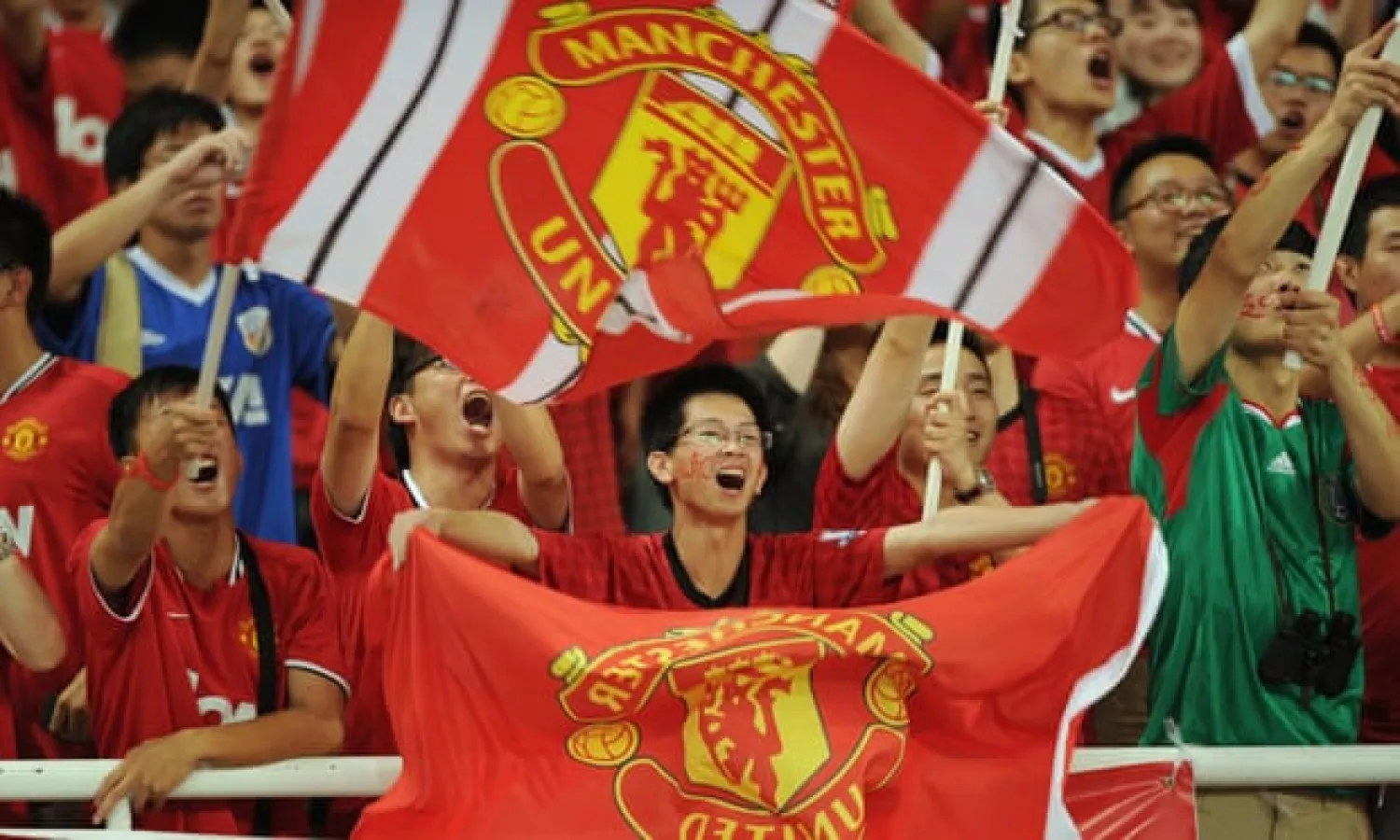
 Manchester United fans wait for the start of a friendly against Shanghai Shenhua in the Chinese city in 2012. Photograph: Peter Parks/AFP/Getty Images
Manchester United fans wait for the start of a friendly against Shanghai Shenhua in the Chinese city in 2012. Photograph: Peter Parks/AFP/Getty Images
TT

Can European Football Clubs’ Claims About Asian Fanbases Be Believed?

 Manchester United fans wait for the start of a friendly against Shanghai Shenhua in the Chinese city in 2012. Photograph: Peter Parks/AFP/Getty Images
Manchester United fans wait for the start of a friendly against Shanghai Shenhua in the Chinese city in 2012. Photograph: Peter Parks/AFP/Getty Images

Espanyol’s Chinese owner, Chen Yansheng, said in December that the best way to increase the club’s popularity in the world’s most populous country would be to sign a Chinese player. In January he signed the best, in the shape of Wu Lei, the top scorer in the 2018 Chinese Super League.

Wu’s La Liga debut against Villarreal on 3 February was decent but overshadowed by Espanyol’s PR department claiming his 13 minutes of action were watched by 40 million Chinese fans. The figures were then broadcast around the world.

That game was not on national television in China but was shown online, where the viewing figures for PPTV, which shows La Liga, were actually 10,584,992. Still impressive, but some way short of the original claim.

Yet Espanyol are only following a long European tradition (remember Mays of yore when BBC commentators talked of a billion people tuning in to FA Cup finals?). When Manchester City, with Sun Jihai, and Everton, with Li Tie, met on New Year’s Day 2003, it was reported that in their homeland anything from 350 million to 600 million watched a match that kicked off at 10pm Chinese time on a Wednesday. It is an unbelievable figure in the sense that it can’t actually be believed, but when it comes to China and Asia, it is not what is true that matters.

How else could Chelsea’s head of the Asia-Pacific region talk in 2015 of 250 million Asian fans? Another figure worthy of doubtful-looking emojis came in 2014 as Liverpool reported 580 million global fans. Two years earlier Manchester United announced 659 million “followers” were discovered in a survey of 59,000 adults, which was commissioned by the club. It stated that 325 million of these were from the Asia-Pacific region.

The club did not respond to an inquiry asking how they reached this figure but there is an explanation in the 2012 prospectus published as the club was listed, coincidentally of course, on the New York stock exchange. “Included in the definition of ‘follower’ [is] a respondent who either watched live Manchester United matches, followed highlights coverage or read or talked about Manchester United regularly.”

A visit to this newspaper’s online match report when the team lose will show quite clearly that not all who read and leave a comment are wishing United well, as Mark Dreyer, a China-based sports business consultant, observes. “The small print defines a ‘follower’ as anyone who takes an interest in Man United’s results, and that – laughably – includes fans of their biggest rivals,” Dreyer says.

China is said to have 108 million United followers. “If over 100 million people in China follow Man Utd in any normal sense of the word, then clubs like Real Madrid, Arsenal, Chelsea, Man City, Liverpool, Bayern Munich, Dortmund, AC Milan, Inter Milan, Juventus and PSG must all have something approaching that level, too. Yes, there are 1.4 billion people in China, but something like a third – at most – would be considered football fans, and so you quickly run out of people.” The same is true in South Korea. Anyone who has spent time there would be surprised to hear there are 15 million football fans in total, never mind that number of United followers.

If such figures were used to discuss “reach” then perhaps it would be different but the term “follower” is often used interchangeably with more traditional descriptions of support. In 2018, Manchester United’s managing director, Richard Arnold, unveiled an app that he said “will allow our 659 million Manchester United followers to easily connect to the club they love, wherever they are in the world”. Now the followers are no longer anyone who has seen or read about United but those with a passion for the club. Arnold never mentions the longer “f-word” again, and switches to fans and global fanbase. The comments are reported around the world.

Does this matter? Well, the lack of realism doesn’t help the perception of Asian players as it feeds the narrative that their abilities off the pitch, which often turn out to be overstated, outrank what they can do on it. For the clubs in question, such figures floating above negotiation tables with potential sponsors or investors cannot do any harm.

That more than 10 million fans in China saw a La Liga game that was watched by a reported 177,000 in Spain is worthy of note, just as Manchester United are the most popular English club in Asia, with impressive levels of support. The European tradition of making wild claims about Asia feels a little like Lionel Messi appealing for a throw-in that he knows is not his: it may not be a major issue in the grand scheme of things but it just feels unnecessary when you are doing pretty well as it is.

The Guardian Sport


Salah Steers Egypt into Africa Cup Knockout Stages After VAR Denies South Africa Late Penalty

 Egypt's forward #10 Mohamed Salah shoots from the penalty spot to score the team's first goal during the Africa Cup of Nations (CAN) Group B football match between Egypt and South Africa at Adrar Stadium in Agadir on December 26, 2025. (AFP)
Egypt's forward #10 Mohamed Salah shoots from the penalty spot to score the team's first goal during the Africa Cup of Nations (CAN) Group B football match between Egypt and South Africa at Adrar Stadium in Agadir on December 26, 2025. (AFP)
TT

Salah Steers Egypt into Africa Cup Knockout Stages After VAR Denies South Africa Late Penalty

 Egypt's forward #10 Mohamed Salah shoots from the penalty spot to score the team's first goal during the Africa Cup of Nations (CAN) Group B football match between Egypt and South Africa at Adrar Stadium in Agadir on December 26, 2025. (AFP)
Egypt's forward #10 Mohamed Salah shoots from the penalty spot to score the team's first goal during the Africa Cup of Nations (CAN) Group B football match between Egypt and South Africa at Adrar Stadium in Agadir on December 26, 2025. (AFP)

Mohamed Salah scored again on Friday as Egypt's 10 men held on to beat South Africa 1-0 to reach the knockout stages of the Africa Cup of Nations.

Salah, who secured the Pharaohs’ opening win with a stoppage-time strike against Zimbabwe on Monday, did it again in Agadir and his penalty before the break secured progression from Group B.

But South Africa should arguably have been given a penalty in stoppage time when Yasser Ibrahim blocked a shot with his arm. After a long delay, the referee decided against awarding the spot kick after consulting video replays and Ibrahim sank to the ground in relief.

“We didn’t have much luck. We also had several refereeing decisions go against us,” South Africa coach Hugo Broos said.

Salah converted his penalty after he was struck in the face by the hand of the retreating South Africa forward Lyle Foster. Salah showed no ill effects from the blow and sent his shot straight down the middle while goalkeeper Ronwen Williams dived to his right.

There was still time before the break for Egypt defender Mohamed Hany to get sent off, after receiving a second yellow card for a foul on Teboho Mokoena.

Goalkeeper Mohamed El Shenawy was Egypt’s key player in the second half.

“We gave our all in this match right until the end, and we also hope for the best for what comes next,” the 37-year-old El Shenawy said.

Earlier, Angola and Zimbabwe drew 1-1 in the other group game, a result that suited neither side after opening losses.

Egypt leads with 6 points from two games followed by South Africa on 3. Angola and Zimbabwe have a point each. The top two progress from each group, along with the best third-place finishers.

Zambia drew 1-1 with Comoros in the early Group A fixture after both lost their opening games, meaning the winner of the late match could be sure of progressing.


Draper to Miss Australian Open Due to Injury

 Jack Draper, of Great Britain, reacts after defeating Federico Agustin Gomez, of Argentina, during the first round of the US Open tennis championships, Aug. 25, 2025, in New York. (AP)
Jack Draper, of Great Britain, reacts after defeating Federico Agustin Gomez, of Argentina, during the first round of the US Open tennis championships, Aug. 25, 2025, in New York. (AP)
TT

Draper to Miss Australian Open Due to Injury

 Jack Draper, of Great Britain, reacts after defeating Federico Agustin Gomez, of Argentina, during the first round of the US Open tennis championships, Aug. 25, 2025, in New York. (AP)
Jack Draper, of Great Britain, reacts after defeating Federico Agustin Gomez, of Argentina, during the first round of the US Open tennis championships, Aug. 25, 2025, in New York. (AP)

Briton Jack Draper said on Friday he will not compete in next month's Australian Open, citing ongoing recovery from an injury.

Draper, 10th in the world rankings, was forced to withdraw from the second round of ‌the US Open ‌in August ‌due ⁠to bone ‌bruising in his left arm.

"Unfortunately, me and my team have decided not to head out to Australia this year. It's a really, ⁠really tough decision," the British ‌number one said in ‍a video ‍posted on X.

The 24-year-old ‍is targeting a February return alongside preparation for the defense of his Indian Wells title in March.

"This injury has been the most difficult ⁠and complex of my career," Draper added. "It's weird, it always seems to make me more resilient. I'm looking forward to getting back out there in 2026 and competing."

The Australian Open begins on January 18 in ‌Melbourne.


Morocco Forced to Wait for AFCON Knockout Place After Mali Draw

Football - CAF Africa Cup of Nations - Morocco 2025 - Group A - Morocco v Mali - Prince Moulay Abdellah Stadium, Rabat, Morocco - December 26, 2025 Morocco's Ismael Saibari reacts after Mali's Lassine Sinayoko scored their first goal. (Reuters)
TT

Morocco Forced to Wait for AFCON Knockout Place After Mali Draw

Football - CAF Africa Cup of Nations - Morocco 2025 - Group A - Morocco v Mali - Prince Moulay Abdellah Stadium, Rabat, Morocco - December 26, 2025 Morocco's Ismael Saibari reacts after Mali's Lassine Sinayoko scored their first goal. (Reuters)

Morocco missed the chance to guarantee their spot in the last 16 of the Africa Cup of Nations after Lassine Sinayoko's second-half penalty earned Mali a 1-1 draw with the hosts on Friday.

The match was a tale of two spot-kicks, with Brahim Diaz giving Morocco the lead from a penalty deep in first-half injury time and Sinayoko replying on 64 minutes.

The stalemate at the Prince Moulay Abdellah Stadium in the capital Rabat ended Morocco's world record winning run which had been taken to 19 matches with their 2-0 victory over Comoros in the tournament's opening game.

It also means Morocco have not yet confirmed their place in the knockout phase, although they are on top of Group A with four points from two games.

Mali come next on two points alongside Zambia, who drew 0-0 with minnows Comoros earlier in Casablanca.

Morocco next face Zambia on Monday and a victory in that match against the 2012 champions will ensure that the hosts go through as group winners.

"We'll look back at the second half and see what the problem was but we didn't play the way we did in the first half. We didn't impose our game and had to drop off. The penalty changed the game a bit," Morocco midfielder Azzedine Ounahi told broadcaster beIN Sports.

"We go into the third game with the same approach, to win the game and finish top of the group."

Morocco captain Achraf Hakimi, the African player of the year, was again an unused substitute as he continues his recovery from an ankle injury suffered playing for Paris Saint-Germain at the start of November.

- Mbappe watches on -

His former PSG teammate Kylian Mbappe, the current Real Madrid superstar and France skipper, was among the spectators in the crowd of 63,844 and appeared to be wearing a Morocco shirt with Hakimi's number two on it.

With Hakimi on the sidelines, Mbappe's Real Madrid teammate Diaz was the main attraction on the pitch -- the little number 10 forced a good save from Mali goalkeeper Djigui Diarra on 17 minutes and then played a key part in the penalty which led to the opening goal just before the interval.

Mali defender Nathan Gassama brushed the ball with his hand as he tried to stop Diaz dribbling past him inside the box, and the referee eventually awarded a spot-kick following a lengthy look at the pitchside VAR monitor.

Morocco's Soufiane Rahimi had a spot-kick saved against Comoros but this time Diaz sent the goalkeeper the wrong way for his second goal of the tournament.

However, Walid Regragui's side, the best team in Africa according to the FIFA rankings, could not build on that as Mali won a penalty of their own just after the hour mark.

Sinayoko went down under a clumsy challenge by Jawad El Yamiq and 29-year-old Cameroonian referee Abdoul Abdel Mefire awarded the penalty after eventually being called over to check his screen.

Auxerre striker Sinayoko, having been booked apparently for something he said to the referee, kept his cool to stroke in the reward and restore parity.

Morocco substitute Youssef En-Nesyri was denied by a good Diarra save and Mali then held on through 10 minutes of stoppage time for a point, as the final whistle was greeted with jeers from the home fans.
