


A Look at the Field: Major Players in Israel's Elections

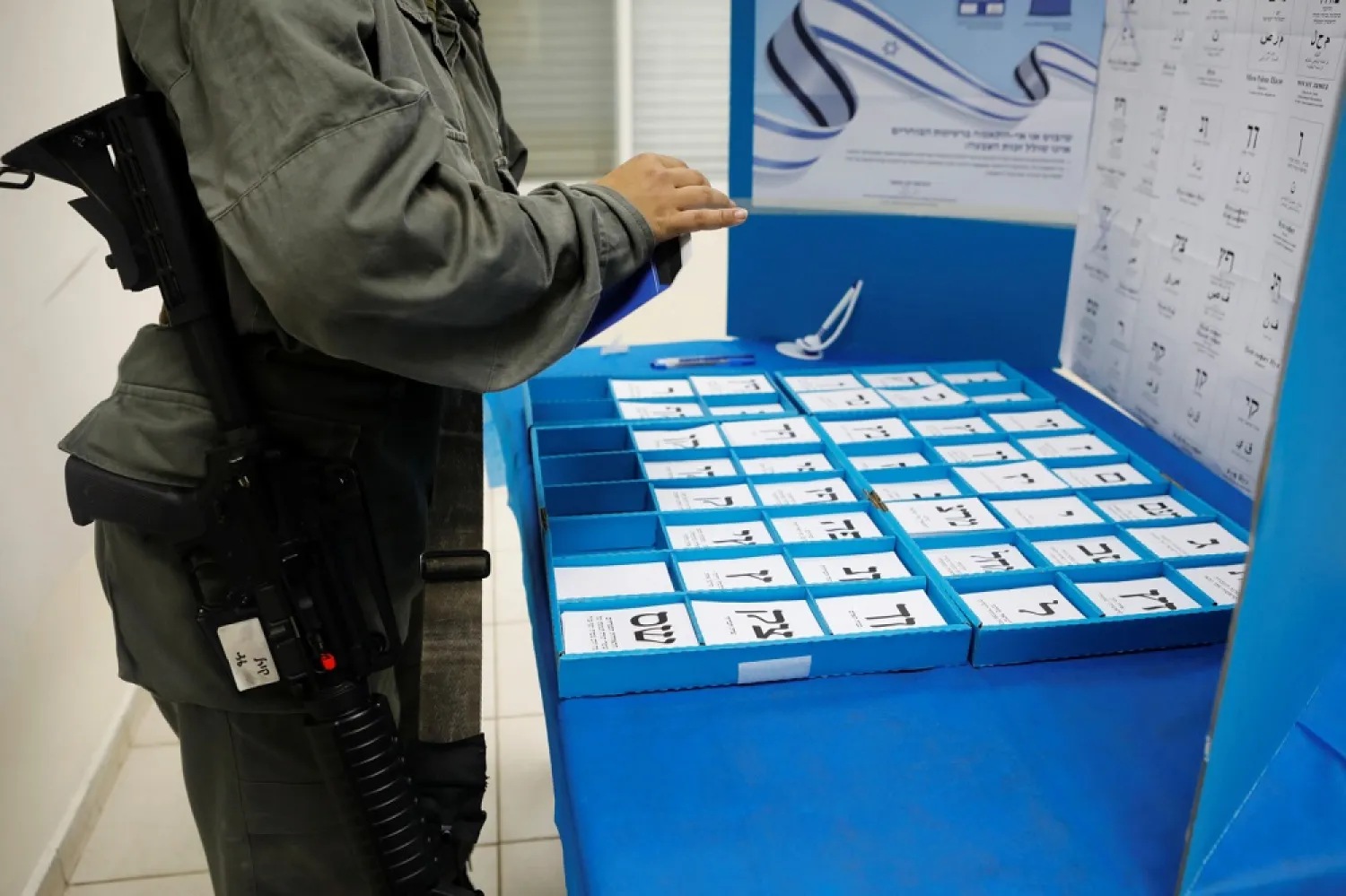
An Israeli policewoman stands behind a voting booth a day before polling stations open in Israel, at the Beit Horon settlement in the Israeli-occupied West Bank April 8, 2019. (Reuters)
TT

A Look at the Field: Major Players in Israel's Elections

An Israeli policewoman stands behind a voting booth a day before polling stations open in Israel, at the Beit Horon settlement in the Israeli-occupied West Bank April 8, 2019. (Reuters)

It's a crowded field in Israel's elections as over 40 parties are slugging it out on Tuesday for seats in the country's parliament.

There is the right-wing flagship, centrist newcomers, ultra-Orthodox parties, Arab parties and fringe movements. But only a handful will win the necessary 3.25 percent of total votes cast to cross the electoral threshold needed to enter the Knesset.

Israeli democracy operates on a parliamentary system of proportional-representation in which the government needs a majority to rule. Since no party has ever earned more than 61 of the 120 seats in the Knesset, a coalition is required.

Polls show Prime Minister Benjamin Netanyahu's rightist Likud in fierce competition with the centrist Blue and White party. Both camps are trying to rile up their bases to become the largest party in parliament while also convincing the smaller parties to join them in a coalition after the results become known.

The Associated Press takes a look at the major players:

Long-ruling Likud
Israel's conservative Likud party has dominated the political stage since 1977 with only a few exceptions, and it has controlled government for the past decade in large part thanks to Netanyahu's personality cult and strong base.

Netanyahu has brazenly allied himself with Israeli settlers and courted nationalist and ultra-Orthodox parties for his current coalition.

In past elections, Likud has depended on a groundswell of populist support from Mizrahi, or Middle Eastern, Jews who harbor deep-seated resentment toward Israel's European-descended founding elite and their social democratic brand of politics, explained the AP.

This constituency appears poised to support Netanyahu again, despite the attorney general's intention to indict him on three serious corruption charges.

If Netanyahu wins another term, he will be on track to become the longest serving leader in Israeli history. He'll also have to simultaneously lead the state while fighting criminal charges against him.

The centrist vanguard
Ex-army chief Benny Gantz shook up the scene when he announced the formation of a new party earlier this year, and several weeks later, when he formed a partnership with centrist politician and former television host Yair Lapid, head of the centrist Yesh Atid. Their joint Blue and White list presents the first viable challenge to Netanyahu's long rule.

If elected, Gantz would lead the government for the first two and a half years with Lapid taking over for the rest of the term.

The new coalition of centrists and former military officers has sought to mobilize a united front to oust the scandal-plagued Netanyahu, carrying the mantle of clean government, economic reform and respect for Israel's state institutions.

Gantz and his slate talk tough about standing up to Iran and striking Palestinian factions to appeal to hard-liners but have also hinted they won't foreclose future peace negotiations.

Although Blue and White has inched ahead of Likud in some polls, the party may find it more difficult to recruit suitable coalition partners.

The new right
A pair of nationalist ministers, Naftali Bennett and Ayelet Shaked, ditched their religious Jewish Home party and formed the "New Right" to attract a broader range of secular but still staunchly pro-settler voters.

They've promised to join Likud's coalition, along with a handful of other right-wing and religious parties, but their sudden maneuver hints that their political aspirations may extend beyond Netanyahu's corruption-stained rule.

Bennett, often the first to slam Netanyahu for his failure to deter Gaza rockets, is jostling for the position of defense minister.

As justice minister, Shaked has clashed with the Supreme Court, which she views as a bastion of the Israeli left that unfairly curtails her party's nationalistic agenda, said the AP.

Their sardonic campaign ads have stirred online debate, including one that features Shaked spritzing herself with a faux perfume called "Fascism."

The old left
The venerable Labor party, once Israel's largest faction that founded the state and promoted a statehood deal with the Palestinians, has languished under decades of Likud rule and an impasse in the peace process. It now appears overtaken by Blue and White and can only hope to join a coalition led by the new front-runner of the center-left bloc.

The liberal Zionist Union party dramatically split early this year after Labor leader Avi Gabbay announced the end of his party's union with former Foreign Minister Tzipi Livni, embarrassing her on live television. Livni subsequently bowed out of politics, ending her storied 20-year career.

The controversial alliance
The religious Zionist party Bennett once headed, Jewish Home, has joined forces with Jewish Power, a far-right faction inspired by the banned Kahanist movement, branded a terrorist organization by the US for an extremist agenda that includes forced expulsion of Palestinians.

Netanyahu helped cut the deal in order to give the parties a better shot at passing the parliamentary threshold and serving as a potential coalition partner.

Both at home and abroad, Netanyahu's overture to Jewish Power drew sharp condemnation.

The Arab vote
Arab parties, which represent over 20 percent of Israel's citizens, could help sway the vote — if their constituents vote.

In the last election cycle, four Arab factions joined forces into a single list, energizing voters and winning a record number seats in the Knesset — 13. But this year, political infighting split the slate, which looks likely to cut away at their overall numbers, said the AP.

Low turnout could also be an issue. Netanyahu's campaign against Arab politicians, seen as incitement in the Arab sector, together with the new alliance with anti-Arab extremists and the passage of last year's contentious nation-state law, which enshrined Israel as the homeland of the Jewish people alone, have deepened calls for a ballot boycott in Arab communities.

But some hope these blows will have the opposite effect, fueling enough frustration to drive up the Arab participation rate. That could complicate Netanyahu's attempts to form a coalition as he fights for a fourth consecutive term.



US Military Jets Hit in Iran War Are the First Shot Down by Enemy Fire in Over 20 Years

An F-15E Strike Eagle turns toward the Panamint range over Death Valley National Park, Calif., on Feb. 27, 2017. (AP)
TT

US Military Jets Hit in Iran War Are the First Shot Down by Enemy Fire in Over 20 Years

An F-15E Strike Eagle turns toward the Panamint range over Death Valley National Park, Calif., on Feb. 27, 2017. (AP)

Iran shooting down two American military jets marks an exceedingly rare assault for the US that has not happened in more than 20 years and shows Iran’s continued ability to hit back despite President Donald Trump asserting it has been “completely decimated.”

The attacks came five weeks after US and Israeli strikes first pounded Iran, with Trump saying earlier this week that Tehran's “ability to launch missiles and drones is dramatically curtailed."

Iran shot down a US F15-E Strike Eagle fighter jet Friday, with one service member getting rescued and the search still underway for a second, US officials say. Iranian state media also said a US A-10 attack aircraft crashed after being hit by Iranian defense forces.

The last time a US warplane was shot down by enemy fire in combat was an A-10 Thunderbolt II during the 2003 US invasion of Iraq, said retired Air Force Brig. Gen. Houston Cantwell, a former F-16 fighter pilot.

But, he said, that’s because the US had largely been fighting insurgents who didn’t have the same anti-aircraft capabilities. The fact that there have not been more fighter jets lost in Iran, Cantwell said, is a testament to the capabilities of US forces.

"The fact that this hasn’t happened until now is an absolute miracle,” said Cantwell, who served four combat tours and is now a senior resident fellow at the Mitchell Institute for Aerospace Studies. “We’re flying combat missions here, they are being shot at every day.”

Shoulder-fired missile likely used, experts say

US Central Command said in a statement Wednesday that American forces have flown more than 13,000 missions in the Iran war while striking more than 12,300 targets.

After more than a month of punishing US-Israeli airstrikes, a degraded Iranian military nonetheless remains a stubborn foe. Its steady stream of strikes against Israel and Gulf Arab neighbors have been causing regional upheaval and global economic shock.

When it comes to American dominance over Iran's airspace, there’s still a distinction between air superiority and air supremacy, said Behnam Ben Taleblu, Iran program senior director at the Foundation for Defense of Democracies, a hawkish Washington think tank.

“A disabled air defense system is not a destroyed air defense system,” he said. “We shouldn’t be shocked that they’re still fighting.”

American planes have been flying missions at lower altitudes, which makes them more vulnerable to Iran's missiles, Taleblu said. It’s possible that Iran fired at the F-15 with a surface-to-air missile, but it's more likely that a portable, shoulder-fired missile was used, he said. Those are much harder to detect and reflect how Iran is “weak but still lethal.”

“This is a regime that is fighting for its life,” he said.

Mark Cancian, a retired Marine colonel and a senior defense adviser with the Center for Strategic and International Studies, agreed that a shoulder-fired missile was likely used against the fighter jet.

Nonetheless, the American air war against Iran has been a “tremendous success” so far, he said.

To put things in perspective, he said the loss rate for American warplanes flying over Germany during World War II was 3% at one point, which would equal about 350 warplanes in the US war against Iran.

“But then there’s the political side — you have an American public that is accustomed to fighting bloodless wars,” Cancian said. “Then a large part of the country doesn’t support the war. So to them, any loss is unacceptable.”

Pilots are trained on what to do if their plane is hit

The last US jet shot down in combat was struck by an Iraqi surface-to-air missile over Baghdad on April 8, 2003. The pilot safely ejected and was rescued, according to the Air Force.

In high-threat environments like missions over Iran, Cantwell, the retired general, said an aviator's blood pressure goes up and they become highly alert to incoming missiles. Those are typically either infrared- or radar-guided missiles, he said, requiring different evasive tactics.

If they are hit and need to eject from their aircraft, they are trained on what to do next, he said.

Pilots learn to check for wounds after a violent ejection and the shock of a missile explosion and, most crucially, how they are going to communicate their location so rescuers can find them.

At the same time, he said, the enemy is likely working to intercept the communications or even spoof the location.

Helicopters are more at risk than other aircraft

The planes that went down Friday were not the first crewed American aircraft to be lost overall in Iran.

A military helicopter and airplane exploded in 1980 during an aborted mission to rescue several dozen American hostages at the US embassy in Tehran, according to the Air Force Historical Support Division.

After a series of setbacks, including severe dust storms and mechanical failures, the mission was called off. As the aircraft took off, the rotor blades of one of the RH-53 helicopters collided with an EC-130 aircraft full of fuel and both exploded, killing eight.

More US helicopters have been shot down in recent decades, including a MH-47 Army Chinook helicopter that was struck by a rocket-propelled grenade in Afghanistan in 2005, killing 16. Helicopters are more dangerous because “the lower and the slower, the more susceptible you are,” Cantwell said.

That’s why those who went out on this week's rescue missions, likely in helicopters, he said, did “such a brave and honorable act.”


Iran Leaders Join Crowds on Tehran’s Streets to Project Control in Wartime

An Iranian flag is seen on a residential building that was damaged by recent strikes at Vahdat town in Karaj, southwest of Tehran on April 3, 2026. (AFP)
TT

Iran Leaders Join Crowds on Tehran’s Streets to Project Control in Wartime

An Iranian flag is seen on a residential building that was damaged by recent strikes at Vahdat town in Karaj, southwest of Tehran on April 3, 2026. (AFP)

After more than a month of being stalked by targeted assassinations, Iran's leadership has adopted a new tactic to show it is still in control - with senior officials walking openly in the streets among small crowds who have gathered in support of the regime.

In recent days, Iran's president and foreign minister have separately mixed with groups of several hundred people in central Tehran. On Tuesday, state television aired footage of the two posing for selfies, talking to members of the public and shaking hands with supporters who had gathered in public areas.

According to insiders and analysts, the appearances are part of a calculated effort by Iran's theocratic leadership to project resilience and authority — not only over the vital Strait of Hormuz but also over the population — despite a sustained US-Israeli campaign aimed at "obliterating" it.

One insider close to the hardline establishment said such public outings are intended to show that the regime is "unshaken by strikes and that it remains in control and vigilant" as the war grinds on.

The US-Israeli war ‌on Iran began on ‌February 28 with the killing of veteran Supreme Leader Ali Khamenei and several senior military ‌commanders ⁠in waves of ⁠strikes that have since continued to target top officials.

Iran's new Supreme Leader, Mojtaba Khamenei, has not been seen in public since taking over on March 8 from his father. Foreign Minister Abbas Araqchi, meanwhile, was removed from Israel's hit list amid mediation efforts last month, including by Pakistan, to bring Tehran and Washington together for talks to end the war.

Talks aimed at ending the war have since appeared to have petered out, as Tehran brands US peace proposals "unrealistic". Against that backdrop, recent public appearances by President Masoud Pezeshkian and Araqchi appear designed to project defiance, if not a convincing display of public support.

A senior Iranian source said officials' public presence demonstrates that "the establishment is not intimidated by Israel's targeted killing of top Iranian ⁠figures".

Asked whether Iran's foreign minister or president were on any sort of kill list, an Israeli ‌military spokesperson, Nadav Shoshani, said on Friday he would not "speak about specific personnel."

NIGHTLY RALLIES TO ‌SHOW RESILIENCE

Despite widespread destruction, Tehran appears emboldened by surviving weeks of intense US-Israeli attacks, firing on Gulf countries hosting US troops and demonstrating its ability ‌to effectively block the Strait of Hormuz.

On Wednesday, US President Donald Trump vowed more aggressive strikes on Iran, without offering a timeline ‌for ending hostilities. Tehran responded by warning the United States and Israel that "more crushing, broader and more destructive" attacks were in store.

Encouraged by clerical rulers, supporters of the regime take to the streets each night, filling public squares to show loyalty even as bombs rain down across the country.

Analysts say the establishment is also seeking to raise the "political and reputational" cost of the strikes at a time when civilian casualties are deeply disturbing for Iranians.

Omid Memarian, ‌a senior Iran analyst at DAWN, a Washington-based think tank, said the decision to send officials into gatherings reflects a layered strategy, including an effort to sustain the morale of core supporters ⁠at a moment of acute pressure.

"The system ⁠relies heavily on this base; if its supporters withdraw from public space, its ability to project control and authority weakens significantly," Memarian said.

Speaking to state television, some in the crowds voice unwavering loyalty to Iran's leadership; others oppose the bombing of their country regardless of politics; and some have a stake in the system, including government employees, students and others whose livelihoods are tied to it.

Hadi Ghaemi, head of the New York-based Center for Human Rights in Iran, said the establishment is using such loyal crowds as human shields to raise the cost of any assassination attempts.

"By being in the middle of large crowds they have protections that would make Israeli-American attacks against them very bloody and generate sympathy worldwide," he said.

POTENTIAL PROTESTERS STAY OFF STREETS AT NIGHT

The Islamic republic emerged from a 1979 revolution backed by millions of Iranians. But decades of rule marked by corruption, repression and mismanagement have thinned that support, alienating many ordinary people.

While there has been little sign so far of anti-government protests that erupted in January and abated after a deadly crackdown, the establishment has adopted harsh measures, such as arrests, executions and large-scale deployment of security forces, to prevent any sparks of dissent.

Rights groups have warned about "rushed executions" during wartime after Iran hanged at least seven political prisoners during the war.

"Many potential protesters are frightened by the continuing presence of armed men and violent crowds in the streets and largely stay at home once darkness falls," Ghaemi said.


'Metals of the Future': Copper and Silver Flow Beneath Poland's Surface

Smelter workers process copper at the Glogow plant in southwestern Poland, owned by KGHM. Wojtek RADWANSKI / AFP
TT

'Metals of the Future': Copper and Silver Flow Beneath Poland's Surface

Smelter workers process copper at the Glogow plant in southwestern Poland, owned by KGHM. Wojtek RADWANSKI / AFP

Thousands of meters beneath the ground, amid suffocating heat, lies one of the keys to Poland's rumbling mining sector -- and the world economy.

Whitish ore, rich in copper and silver, is extracted from the country's depths and exported around the world to fuel technological and energy transitions.

"These are the metals of the future," Ariel Wojciuszkiewicz, a geologist at the Polkowice-Sieroszowice mine in the west of the country, tells AFP, noting that copper and silver are "indispensable for electronic equipment, electric cars, and renewable energy installations".

Driven by the rise of artificial intelligence, renewable energies, and global defense needs, demand for these metals is expected to keep increasing in the future, with copper even being referred to as "red gold" and a "barometer" for world economic development.

Poland, responsible for as much as half of Europe's supply, is one of the industry's key players.

Equipped with a helmet and an emergency breathing device, Wojciuszkiewicz leads AFP journalists through the Polkowice-Sieroszowice mine -- one of three sites operated by KGHM, the Polish metals giant, which also owns local smelters and companies in the Americas.

The 24-hour operation runs at a constant roar as machines grind rock at deafening volumes, its tunnels stretching for hundreds of kilometers beneath Poland's surface.

The world's second-largest silver producer, the KGHM group also supplies between 40 percent and 50 percent of the copper produced in Europe.

Last year, it ranked eighth worldwide in terms of copper extraction volume, behind global giants such as BHP Group, Glencore Plc and Rio Tinto, according to industry statistics.

Global copper demand, already high, is expected to climb by over 40 percent by 2040, according to a 2025 UN Report.

To meet this demand, "it might take 80 new mines and 250 billion dollars in investments by 2030," the organization estimates.

The International Energy Agency (IEA), however, predicts that supply will lag 30 percent behind demand by as early as 2035.

- 1,200 degrees Celsius -

Dependence on copper is growing exponentially across the world economy's most innovative sectors.

"We don't realize how much we are surrounded by copper on all sides," Piotr Krzyzewski, KGHM vice president in charge of finance, explains to AFP.

"An electric car contains 80 kg of copper, compared with 20 kg in a conventional one," he notes, while "a wind turbine contains between four and ten tons of copper per megawatt."

Farther away, at the Glogow smelter, two workers in protective suits, armed with long lances, open huge furnaces where the ore is melted.

They work diligently as sparks fly from metal heated to 1,200C.

Several processing stages later, 99.99 percent pure copper plates, each weighing more than a hundred kilos, are shipped all over the world.

Last year, the KGHM group as a whole generated more than 36 billion zlotys ($9.7 billion) in revenue. Copper production reached 710,000 tons and silver production 1,347 tons, according to the group's annual report, published at the end of March.

No less than half of the silver is used in industry, mainly for electronics, solar panels, and medical applications. The rest goes to jewelery or serves as a safety net and financial asset.

But it is copper, now an irreplaceable metal for the economy, that has become the object of global strategic contention.

"Copper is on the strategic list of critical metals in Europe, the United States, and China," Krzyzewski tells AFP.

The metal's impact on geopolitics is already being noted in real time.

In July, US President Donald Trump announced a 50 percent tariff on copper, eventually limiting the measure to products made with the metal.

To justify his decision, he invoked the need to "defend national security".

"Copper is the second most used material by the Department of Defense!" he said.

- Record prices -

In 2025, copper prices jumped 41.7 percent, before hitting a record high of $14,527.50 a ton in January of this year.

Even in the face of the war in the Middle East and the slowdown of the global economy, the price remains high at about 12,000 dollars per ton.

In this uncertain context, Poland's subsoil appears to be a major asset for the energy sovereignty of the Old Continent.

"It's no longer about the security of our country alone, but the security of all of Europe," Krzyzewski says, adding that KGHM's resources "are still estimated to last for at least 40 years," not counting new exploration and concessions.

But mining consumes enormous amounts of water, making it subject to the effects of global warming and drought.