

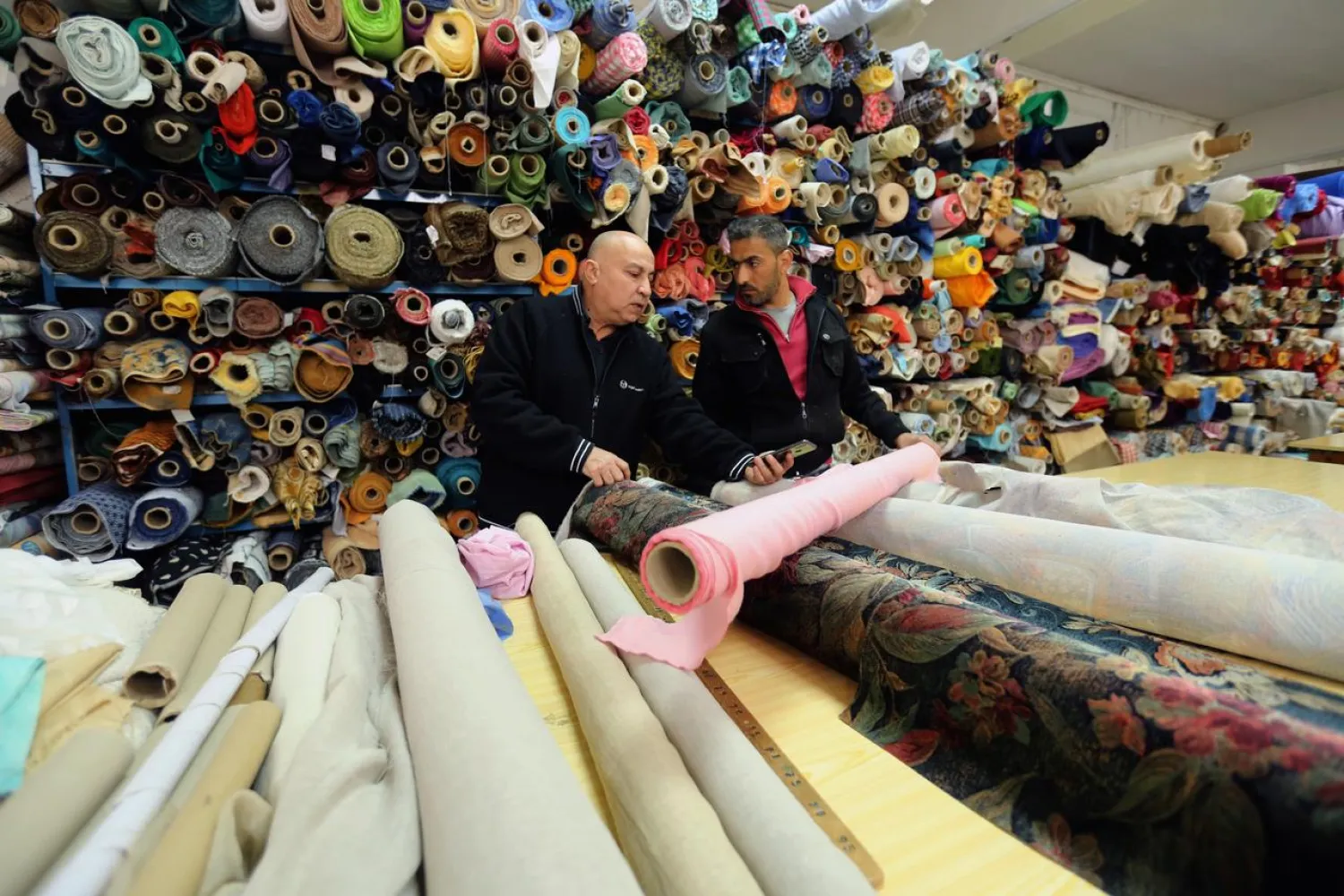

Lebanese Textiles Factory Shuts Its Doors in Dire Economy

Men check fabric inside the Mzannar family's textile shop, in Baabda, Lebanon February 12, 2019. REUTERS/Aziz Taher
TT

Lebanese Textiles Factory Shuts Its Doors in Dire Economy

Men check fabric inside the Mzannar family's textile shop, in Baabda, Lebanon February 12, 2019. REUTERS/Aziz Taher

The Mzannar family’s 300-year-old textile business survived Lebanon’s civil war by making uniforms for militiamen. But its business savvy was no match for years of economic malaise that followed and it has now shut its factory.

The head of Lebanon’s chamber of commerce chief said last year nearly 2,200 businesses had closed, warning that more would collapse. And while there is dispute over those numbers, Lebanese mostly agree the economy is in dire shape.

For Naji Mzannar, who started working at the fabric factory in the 70s before running it, an array of challenges drove the decline of his business and its inability to compete with cheaper goods from abroad.

“It was a build-up. Everything became losses, losses,” he said. “How long are you supposed to keep suffering?”

Built in 1946 and spread over three storeys, the factory made textiles for clothing and household use such as curtains or towels. Mzannar fought to keep it afloat until production came to a halt in 2018.

In interviews with Reuters, business owners such as Mzannar, employees, and experts blamed the slowdown on problems including regional turmoil, lousy infrastructure, government waste or corruption, and high interest rates.

Whether the new government tries to improve conditions, as it vows urgently to do, the effects of years of political sclerosis and stalled reforms are already inescapable: more companies going out of business and workers losing jobs.

The government publishes few reliable economic statistics, and gives no regular unemployment numbers, but last year Prime Minister Saad al-Hariri said it stood at about 30 percent.

With pillars such as tourism and real estate in the doldrums, economic growth has averaged 1-2 percent since the conflict erupted in neighboring Syria in 2011, after averaging 8-9 percent growth in the years before that.

“There is a deterioration. There is a rise in companies closing down and in unemployment. For sure, they come together,” said former economy minister Raed Khoury.

“There are small and medium companies suffering a lot.”

Daily state power and water cuts leave industrialists relying on private supplies that push up costs. Taxes have gone up, but neither infrastructure nor public services have improved.

For some firms, Syria’s war blocked access to neighboring markets and added security measures congesting the roads.

With a risky political climate and a currency pegged to the dollar, Lebanon has high interest rates that keep deposits flowing into its banks. But these rates also discourage borrowing - which producers such as Mzannar need to invest in new machinery.

The policies that have kept the Lebanese pound stable through turmoil at the same time failed to protect or boost local production, Mzannar and others said.

The number of his employees went from a peak of 75 to 40 in about 2010, and eventually only 10 people were left.

They still work for him, but at a shop near the factory selling bales of cloth it had produced, as well as imported textiles from Europe.

While his shop fares much better than the factory, he, like many others, fears people have less to spend. “We felt this the most in 2018.” Sales halved last year and traders he had worked with for many years went bankrupt.

The remaining, old machines, stopped spinning a few months ago. Mzannar remembers playing in the factory when he was a young boy, but his own three children have all gone to work abroad.



Protest-Hit Iran Warily Watches the US After its Raid on Venezuela

Iranians protest a 22-year-old woman Mahsa Amini's death after she was detained by the morality police, in Tehran, Sept. 20, 2022, in this photo taken by an individual not employed by the Associated Press and obtained by the AP outside Iran. (AP Photo/ File)
TT

Protest-Hit Iran Warily Watches the US After its Raid on Venezuela

Iranians protest a 22-year-old woman Mahsa Amini's death after she was detained by the morality police, in Tehran, Sept. 20, 2022, in this photo taken by an individual not employed by the Associated Press and obtained by the AP outside Iran. (AP Photo/ File)

Iran faces a new round of protests challenging the country's theocracy, but it seems like the only thing people there want to talk about is half a world away: Venezuela.

Since the US military seized Venezuelan President Nicolas Maduro, a longtime ally of Tehran, over the weekend, Iranian state media headlines and officials have condemned the operation. In the streets and even in some official conversations, however, there's a growing question over whether a similar mission could target the country's top officials including the supreme leader, 86-year-old Ali Khamenei.

The paranoia feeds into wider worries among Iranians. Many fear that close US ally Israel will target Iran again as it did during the 12-day war it launched against Tehran in June. Israel killed a slew of top military officials and nuclear scientists, and the US bombed Iranian nuclear enrichment sites. Khamenei is believed to have gone into hiding for his protection.

“God bless our leader, we should be careful too," said Saeed Seyyedi, a 57-year-old teacher in Tehran, worried the US could act as it did in Venezuela.

"The US has always been after plots against Iran, especially when issues like oil, Israel are part of the case. In addition, it can be complicated when it is mixed with the Russia-Ukraine war, the Lebanese (group) Hezbollah and drug accusations.”

The US long has accused the Iranian-backed Hezbollah of running drug-smuggling operations to fund its operations, including in Latin America, which the group denies.

‘Please pray’

Immediately after Maduro’s seizure, an analyst on Iranian state television claimed, without offering evidence, that the US and Israel had plans during the war last year to kidnap Iranian officials with a team of dual-national Iranians. Even for conspiracy-minded Iranian television, airing such a claim is unusual.

Then on Sunday night, the prominent cleric Mohammad Ali Javedan warned an audience at prayers in Tehran University that Khamenei's life was in danger.

“Someone said he had a bad dream that the leader’s life is in danger," Javedan said, without elaborating. "Please pray.”

However, Iran is roughly twice the size of Venezuela and has what analysts consider to be a much stronger military and robust security forces. The memory of Operation Eagle Claw, a failed US special forces mission to rescue hostages held after the 1979 US Embassy takeover in Tehran, also haunts Washington.

Then there's the political situation in Iran, with its theocracy protected by hard-liners within the paramilitary Revolutionary Guard, who answer only to Khamenei.

They could launch assassinations, cyberattacks and assaults on shipping in the Middle East, warned Farzin Nadimi, senior fellow at the Washington Institute for Near East Policy who studies Iran’s military.

And crucially, Iran also still has fissile nuclear material.

“In the grand-strategy scheme of things, they need to think about the day after,” Nadimi said of anyone considering a Venezuela-style raid. “Iran is a much more complex political situation. They have to calculate the costs and benefits.”

Not just the Iranians

Others wonder what part of the world the US might take interest in next, while critics have warned about setting a dangerous precedent.

“The regime in Iran should pay close attention to what is happening in Venezuela,” Israeli opposition leader Yair Lapid posted on social media on Saturday.

Israeli Prime Minister Benjamin Netanyahu did not directly link Maduro's detention to Iran but acknowledged the protests sweeping Tehran and other cities, saying: “It is very possible that we are standing at the moment when the Iranian people are taking their fate into their own hands.”

Hours before the US action in Venezuela, US President Donald Trump warned Iran that if Tehran “violently kills peaceful protesters” the US “will come to their rescue.”

On Monday, Iranian Foreign Ministry spokesman Esmail Baghaei denounced the comments by Trump and Netanyahu as an “incitement to violence, terrorism and killing.”

US Rep. Marjorie Taylor Greene, a Republican who had been close to Trump but resigned Monday after a falling-out with the president, directly linked the Venezuela operation to Iran.

“The next obvious observation is that by removing Maduro this is a clear move for control over Venezuelan oil supplies that will ensure stability for the next obvious regime change war in Iran," Greene wrote on social media.

‘Make Iran Great Again’

US Sen. Lindsey Graham, a Republican, put on a “Make Iran Great Again” hat during a Sunday segment on Fox News. He later posted an image showing him and Trump smiling after the president autographed a similar-looking hat.

“I pray and hope that 2026 will be the year that we make Iran great again," Graham said.


Iran at a Critical Crossroads Testing the Survival of its Regime

Burning debris lies in the middle of a street during protests in Hamedan, western Iran, Jan. 1, 2026. (AFP/Getty Images)
TT

Iran at a Critical Crossroads Testing the Survival of its Regime

Burning debris lies in the middle of a street during protests in Hamedan, western Iran, Jan. 1, 2026. (AFP/Getty Images)

Iran is confronting one of the most consequential junctures since the founding of the republic in 1979. The pressures bearing down on the system are no longer confined to economic sanctions or familiar forms of external coercion, but now cut to the heart of the governing formula itself: how to ensure the regime’s survival without accelerating the very forces that threaten to undermine it.

At the center of this moment lies a stark existential dilemma. A permissive response to internal unrest risks allowing protests to spread and harden into a protracted campaign of political attrition, while a sweeping security crackdown would heighten external dangers, at a time of mounting international hostility and unprecedented US warnings.

Caught between these two paths, Tehran finds its room for maneuver shrinking to levels it has rarely faced before.

Passing protests or structural shift?

The evolution of the current protests raises a central question about their nature: are they a containable social wave, or a deeper expression of a shift in public mood? The spread of demonstrations to small and medium-sized cities, and the widening of their social base, reflect an advanced level of discontent, even if it has not yet reached the threshold of a comprehensive explosion.

Farzin Nadimi, a senior Iran analyst at the Washington Institute for Near East Policy, argues that this wave differs from previous ones.

He told Asharq Al-Awsat that the latest protests, unlike earlier waves led by university students or low-income workers in major cities, are now driven by young people in smaller towns and supported by university students nationwide.

He described them as “more entrenched and widespread,” though not yet as large as some previous protests, noting the absence of government employees and oil workers, alongside a strong female presence once again.

This assessment aligns with the reading of Michael Rubin, a scholar at the American Enterprise Institute, who pointed to three key differences defining this wave: the nature of the participating forces, the symbolism of its launch from Tehran’s bazaar, and the impact of Israeli strikes that have punctured the aura surrounding Iran.

By contrast, Michael O’Hanlon, a senior fellow at the Brookings Institution, cautions against overestimating the street’s ability to bring about rapid change, noting that the Iranian system is highly organized and does not hesitate to use violence to control society.

‘Political fuel’

Iran’s economic crisis is no longer a technical issue that can be separated from politics. The collapse of the currency, the erosion of purchasing power, and declining trust in institutions have turned the economy into a direct driver of protest.

With each new round of pressure or sanctions, the sense deepens that the system is incapable of delivering real solutions without making political concessions.

Alex Vatanka, a Senior Fellow at the Middle East Institute in Washington, argues that what is unfolding goes beyond anger over prices or living conditions.

He told Asharq Al-Awsat that the protests reflect a deeper shift in public opinion, in which opposition is no longer directed at specific policies but at the model of governance itself. This shift, he said, confronts the system with a difficult question: can the economy be saved without rethinking the structure of power?

The security establishment: cohesion or fatigue?

Security institutions, from the Revolutionary Guards and their Basij mobilization arm to the intelligence services, form the backbone of the system’s ability to endure. Historically, these institutions have been the primary guarantor of internal stability, but mounting pressures now raise questions about their moral and ideological cohesion.

Rubin said that cracks are widening, pointing to rumors that Tehran has turned to deploying forces from Iraq’s Popular Mobilization Forces and Afghanistan’s Fatemiyoun Brigade due to declining confidence in some Revolutionary Guard units’ willingness to carry out orders.

Vatanka, for his part, acknowledged that these institutions remain cohesive for now, but warned that this cohesion is under growing strain from economic and social exhaustion, which over time could erode morale and produce partial fractures, even if open defections remain unlikely in the foreseeable future.

From deterrence to breaking taboos

If internal challenges are pressing on the structure of power, the external environment multiplies the risks. US-Israeli escalation, coupled with the waning weight of regional allies, places Iran before a radically different strategic landscape.

Threats by US President Donald Trump to support Iranian protesters signal a qualitative shift in US rhetoric, in which the focus is no longer confined to the nuclear program, but now includes Iran’s internal dynamics as part of the pressure equation.

Nadimi said that the developments in Venezuela and the arrest of Nicolas Maduro as carrying troubling implications for Tehran, while stressing the differences between the two cases, arguing that Iran is larger and more complex, and that Washington does not believe its system can be easily overthrown without a clear internal alternative.

Vatanka, however, sees a significant psychological impact from that precedent, saying it has weakened the assumption that leaders are immune from personal targeting.

The regional network: asset or burden?

Israeli strikes in June that targeted military leaders and sovereign symbols inside Iran reflect a shift in Israel’s security doctrine, from containment to direct confrontation.

O’Hanlon said that this pattern, following events in Venezuela and attacks on figures linked to Iran’s nuclear program, has become more likely under Trump, reflecting a willingness to break taboos that once held.

At the same time, questions are resurfacing over the effectiveness of Iran’s regional network. According to Vatanka, these arms are no longer a real deterrent, but have become, given their rising costs, a strategic burden.

Rubin agreed, adding that they have drained the state treasury, although he does not rule out the system turning to them if the crisis intensifies on the domestic front.

Amid this complex entanglement between internal and external pressures, the Iranian system’s options are narrowing as never before.

Between those who see this weakness as an opportunity to rebalance the region and those who fear widespread chaos, the core question remains: Is Tehran facing a manageable crisis of governance or an existential crisis that could shape Iran and the region for decades to come?


‘Nobody Is Going to Run Home’: Venezuelan Diaspora in Wait-and-See Mode

A young protester sits on a large-scale Venezuelan national flag during a protest following US military action in Venezuela, in Rio de Janeiro, Brazil, 05 January 2026. (EPA)
TT

‘Nobody Is Going to Run Home’: Venezuelan Diaspora in Wait-and-See Mode

A young protester sits on a large-scale Venezuelan national flag during a protest following US military action in Venezuela, in Rio de Janeiro, Brazil, 05 January 2026. (EPA)

"A new dawn for Venezuela" is how a top US diplomat described the future awaiting the Caribbean country after Saturday's capture of President Nicolas Maduro by US special forces in a raid on Caracas.

But for some of the eight million Venezuelans who fled the country over the past decade of economic ruin and repression, the joy at seeing Maduro hauled before a New York court on Monday was tempered by the knowledge that his henchmen remain at the helm.

News of Maduro's demise initially triggered scenes of jubilation among the diaspora.

Several people choked up as they recalled the hardship they fled, and the family they left behind, over the course of his increasingly despotic rule.

But while many said they dreamed about returning to their homeland, they made it clear they had no plans to pack their bags just yet.

Most cited the country's tattered economy as a reason to keep working abroad and sending home remittances.

Some also spoke of their fear of Venezuela's security apparatus, pointing to the paramilitaries who roamed the streets of Caracas on Saturday to crack down on anyone rejoicing over Maduro's ouster.

"There has been no change of regime in Venezuela, there is no transition," said Ligia Bolivar, a Venezuelan sociologist and rights activist living in Colombia since 2019.

"In these circumstances nobody is going to run home," she told AFP.

Standing outside the Venezuelan consulate in Bogota, where he was waiting to renew his passport on Monday, Alejandro Solorzano, 35, echoed that view.

"Everything remains the same," he said, referring to US President Donald Trump's decision to work with Maduro's administration rather than the democratic opposition.

Maduro's former deputy Delcy Rodriguez was sworn in as acting president on Monday, becoming the interim head of an administration that still includes hardline Interior Minister Diosdado Cabello and powerful Defense Minister Vladimir Padrino Lopez.

Cabello in particular is a figure of dread for many Venezuelans, after commandeering a crackdown on post-election protests in 2024 in which some 2,400 people were arrested.

Many Venezuelans were particularly shocked by Trump's decision to sideline opposition leader Maria Corina Machado, a Nobel Peace Prize laureate, from the transition.

The European Union on Monday demanded that any transition include Machado and her replacement candidate in the 2024 elections Maduro is accused of stealing, Edmundo Gonzalez Urrutia.

Andrea, a 47-year-old immigration advisor living in Buenos Aires, argued, however, that Machado's hour had not yet come.

"Until Trump sees that the situation is under control, until he has all these criminals by the balls, he won't be able to put Maria Corina in charge. Because that would be throwing her to the wolves," she said.

- 'No other way' -

Luis Peche, a political analyst who survived a gun attack in Bogota last year suspected of being a political hit, also argued in favor of a negotiated transition.

"We have to see this as a process," Peche told AFP, referring to Venezuela's transition.

"You still need part of the state apparatus to remain," he said.

Tamara Suju, a leading Venezuelan rights expert based in Spain, said that keeping the same tainted cast in charge was a necessary evil -- in the short term.

"They are the ones with whom the Trump administration is negotiating the transition because there is no other way to do it," she told Spain's esRadio, predicting they would eventually be forced by Washington to fall on their swords.

Edwin Reyes, a 46-year-old window installer living in Colombia for the past eight years, said that once Venezuela was "completely free" he would consider a move back.

"We've waited so long, another four or five months won't hurt."