



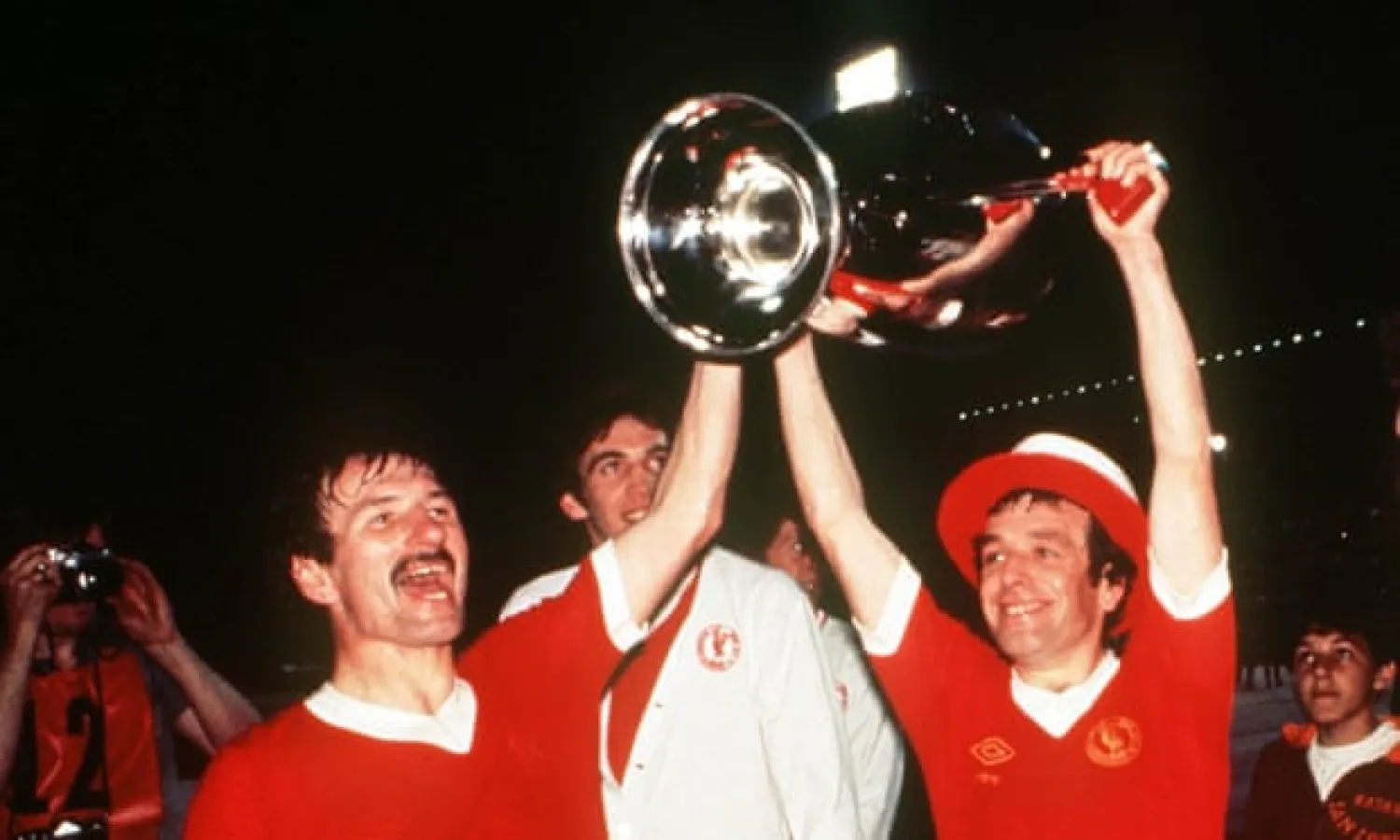

Coincidentally, but pleasingly, Liverpool’s most recent match programme featured a photograph and short tribute to Tommy Smith, who has died at the age of 74.
The photograph captured the ‘Anfield Iron’ in his moment of glory, meeting Steve Heighway’s corner with an unstoppable near-post header to put Liverpool ahead in the 1977 European Cup final against Borussia Mönchengladbach. It was far from typical of Smith to score goals with his head, or to score goals at all, and there was a note of surprise in Barry Davies’s memorable commentary once the ball flew into the net so quickly it was hard for television viewers to keep up.
“It’s Tommy Smith! What a way to end a career.”
Smith’s career did not end with Liverpool’s first European Cup triumph in Rome. The player was then 32 and had announced he planned to retire; predictably he found the game that had been his life difficult to give up and played another season for Liverpool before joining John Toshack for a short while at Swansea. If one player personified Liverpool as they rose to new heights under Bill Shankly it was Smith, who was born and raised in the shadow of Anfield and was taken to the club at the age of 15 by his mother who asked the manager to look after him.
Shankly certainly did that, fast-tracking him and handing him his debut three years later, though Smith was never the sort of player to need much looking after. He was a tough, uncompromising competitor in an era when every team seemed to have a hard man at the back.
But if Smith intimidated opponents it was because he appeared genuinely indestructible; he never needed to ‘put himself about’ to let others know he was around. Variously he was described of being made of iron or granite – always quick with an aphorism Shankly would famously say: “Tommy Smith wasn’t born, he was quarried” – and even Norman Hunter acknowledged that being tackled by Smith had similarities with running into a brick wall.
Rather cruelly the strain on his body caught up with Smith in later life when he encountered mobility problems and needed to use crutches to climb the stairs into press boxes at Anfield and Goodison, where his earthy opinions would enliven many an afternoon as he completed his duties as a columnist for the Liverpool Echo; but even though he would talk himself into trouble on occasions his reputation as a player was unassailable. “He was fearless,” Bob Paisley said admiringly. “Tommy hated losing and was prepared to put himself through all manner of pain and suffering to avoid it.”
Ron Yeats was the defensive colossus brought down from Scotland by Shankly, who called a press conference to invite local journalists to “take a walk round my new centre-half”, though Smith went on to take over the captaincy and make many more appearances, 638 in all, to become an integral part of the winning machine Shankly built and Paisley inherited.
Being local meant he was immensely popular, even if his international career amounted to a solitary cap against Wales in 1971, and he remained sturdy enough to take advantage of the injury to Phil Thompson in the 1976-77 season and write his name into Liverpool legend.
After winning in Rome he said his career, which included four league titles, was now complete. “My biggest disappointments in the game were the European Cup semi-final defeat by Inter Milan in 1965 and the FA Cup final defeat by Arsenal in 1971. We wiped out the Arsenal one by beating Newcastle at Wembley three years later, and now this makes up for everything connected with the Inter game. It’s been a long wait, but it was worth it now.”
Of the goal Smith remembered having a quick chat with Kevin Keegan about where to position themselves for Heighway’s corner. “I knew the defenders were keeping an eye on Kev,” he said. “I’m not the fastest person in the world but I can steal a yard on anyone.
“The defender [Christian Kulik] didn’t know whether to wait for Kev to move or go with me and when the cross came in it was at a perfect height so I went for it. As soon as I hit it I knew it was on target. I can count the number of headers I have scored on the fingers of one hand and I’ve certainly never scored one like that in a game like that. It has to be the greatest feeling I’ve had in my whole life.”
The Guardian Sport


