


Arsenal’s Long Road to Baku Leads to Defining Moment of Their Season

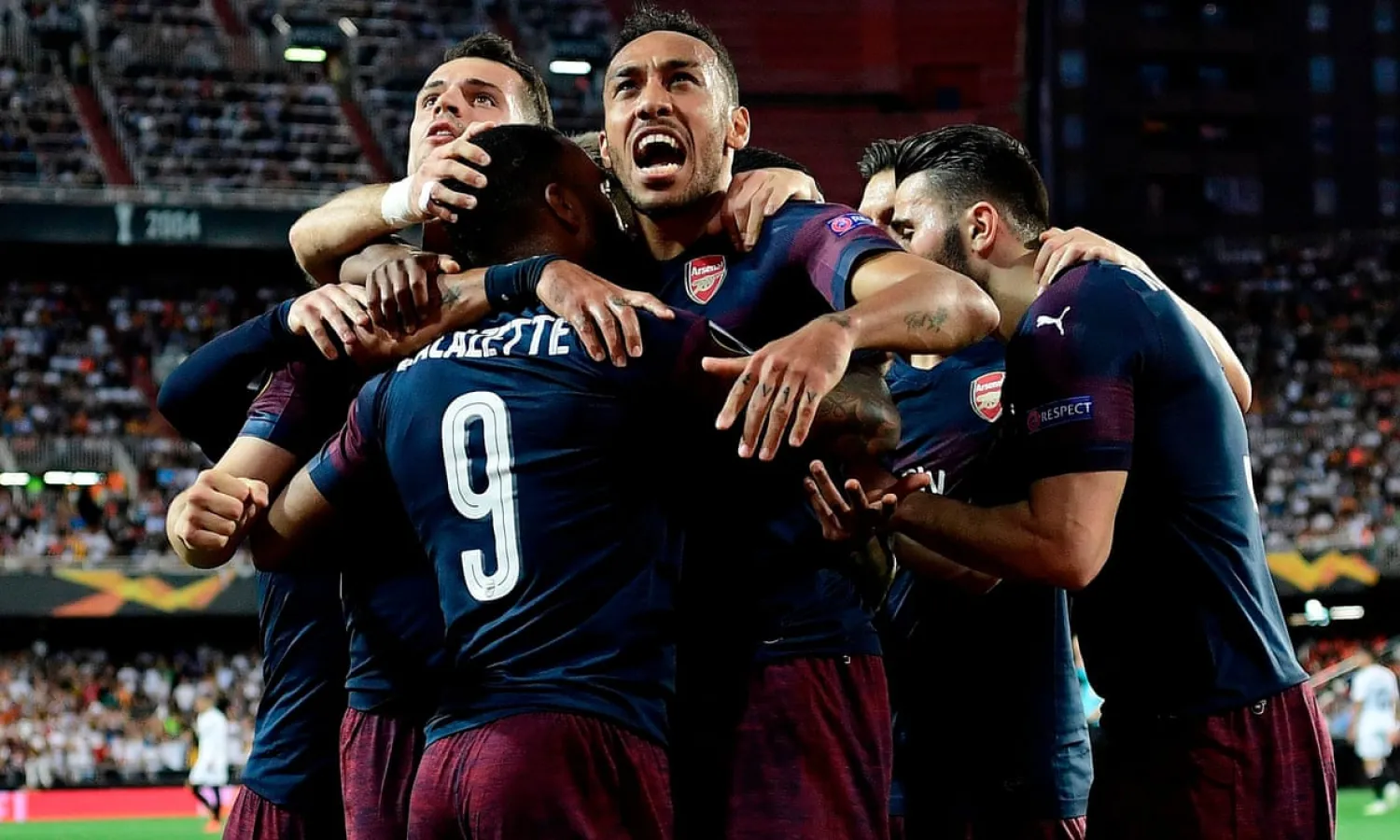
Pierre-Emerick Aubameyang (center), who scored a hat-trick during the 4-2 win at Valencia in the semi-final, leads Arsenal’s celebrations. Photograph: Javier Soriano/AFP/Getty Images
TT

Arsenal’s Long Road to Baku Leads to Defining Moment of Their Season

Pierre-Emerick Aubameyang (center), who scored a hat-trick during the 4-2 win at Valencia in the semi-final, leads Arsenal’s celebrations. Photograph: Javier Soriano/AFP/Getty Images

Last May, in a sequence of pow-wows to determine the chosen candidate to replace Arsène Wenger, Arsenal’s executive team thrashed their way through the shortlist one by one analyzing a series of criteria: style of football, an eye for promoting youth, man-management in the player-power age, and so on. Critical, though, in all of this was one overriding thought. How quickly can this manager get the club back into the Champions League? It did not really matter how they got there, or what it looked like along the way but the mission Arsenal were desperate to accomplish was crystal clear.

Hiring a man whose CV screams Europa League specialist enhanced those odds. Hands were duly shaken with a proven expert in one of the two available routes into the Champions League. He might have come from left field in the debate about who was best to follow Wenger – “where’s Unai Emery come from?” tweeted a bewildered Ian Wright as the news broke – but there was a certain logic at work.

That logic made sense as Emery took this strangely erratic team, a bunch whose form has crumbled in the Premier League, back to his old stamping ground in Valencia. Arsenal were electric going forward – rapid, clinical and supercharged. The strike force of Pierre-Emerick Aubameyang and Alexandre Lacazette put in Champions League performances as they swept their team into the Europa League final. It is Emery’s fourth final in this competition. He has won three.

“That’s what the club saw in him as a coach,” said Lacazette. “He came to take the team to the next step and he did because we reach the final in his first season.” Well, the final represents more like half a step. Progress will be tangible only if they clamber on to the winners’ podium with big smiles in the very early hours of 30 May. So here we are. The interminably long road to Baku (which actually started in Baku in the opening group game at FK Qarabag in a match Arsenal started with a forward line of Danny Welbeck supported by Emile Smith Rowe) boils down to the defining moment of the season.

Win and the campaign has been a successful one by their main criterion. Lose and the problems run deeper. This final is actually a pivotal point for something bigger, something that stretches beyond a contest against Chelsea.

Arsenal have aspirations to try to re-establish themselves higher up the football ladder, as a more robust challenger for the top four, a more competitive contender for the Premier League title, even the rose-tinted hope to become a team capable of a genuine tilt at the senior European title. They know they are off that pace and the best way to build momentum is to get back into the Champions League.

The squad Emery inherited is still in need of surgery, and the operation to attack the transfer market is complicated. Arsenal are expected to announce a heavy loss with the next financial results, their model shows no interest in personal investment from the owner, and logistically they lost their head of recruitment when the enigmatic talent spotter Sven Mislintat left, and they are unable to appoint a director of football, with their former midfielder Edu the favorite, until July. These are hardly ideal circumstances to rebuild with efficiency. Yet again so much boils down to their capacity to qualify for the Champions League and the double boost, in status and finance, that brings.

Last October Arsenal and Emery were still finding each other out – to an extent they still are – as Raúl Sanllehí and Vinai Venkatesham sat down to elaborate on how a return to Europe’s top table is so vital to the club’s model. “We need to regain that positioning, that privilege, to be seen as a Champions League club,” Sanllehí said. “From there the wheel starts rolling again. That is what is going to give us the speed, also to be attractive to better players, to generate more money, it is the virtuous circle. The better we do, the more money will be generated, the better players are going to come, the better we are going to do.”

Tempting as it is to obsess over the bigger picture, the body language of Arsenal’s players and fans at Mestalla emphasized how much it meant to win their semi-final, to play with joy and ambition in their boots. Sport in essence has to be about trying to lift silverware for victory’s sake more than the consequence of a golden ticket.

Lacazette tried to get to the heart of it. “We know it was a great opportunity to go to the Champions League and that is really important,” he said. “But as well it is about trophies. The club needs to win a trophy, the players as well. Above all we have got the chance to win a trophy.”

(The Guardian)


Youngest F1 Title Leader Antonelli to Keep ‘Raising Bar’ After Japan Win

 Mercedes driver Andrea Kimi Antonelli of Italy celebrates on the podium after winning the Formula 1 Japanese Grand Prix at the Suzuka International Racing Course racetrack in Suzuka, Japan, 29 March 2026. (EPA)
Mercedes driver Andrea Kimi Antonelli of Italy celebrates on the podium after winning the Formula 1 Japanese Grand Prix at the Suzuka International Racing Course racetrack in Suzuka, Japan, 29 March 2026. (EPA)
TT

Youngest F1 Title Leader Antonelli to Keep ‘Raising Bar’ After Japan Win

 Mercedes driver Andrea Kimi Antonelli of Italy celebrates on the podium after winning the Formula 1 Japanese Grand Prix at the Suzuka International Racing Course racetrack in Suzuka, Japan, 29 March 2026. (EPA)
Mercedes driver Andrea Kimi Antonelli of Italy celebrates on the podium after winning the Formula 1 Japanese Grand Prix at the Suzuka International Racing Course racetrack in Suzuka, Japan, 29 March 2026. (EPA)

Mercedes' Kimi Antonelli vowed to "keep raising the bar" after winning Sunday's Japanese Grand Prix to become the youngest driver in Formula One history to lead the championship standings.

The 19-year-old Italian took advantage of a mid-race safety car to jump into the lead after a dreadful start from pole position, crossing the line ahead of McLaren's Oscar Piastri and Ferrari's Charles Leclerc.

Antonelli's Suzuka victory came two weeks after the first grand prix win of his career in China and sent him top of the championship standings after three races, nine points ahead of team-mate George Russell.

Mercedes are struggling to contain the excitement building around their young driver, even if Antonelli said he was "not thinking too much about the championship".

"Of course it's great but it's still a long way to go and I need to keep raising the bar, because George is very quick," he said.

"For sure he's going to be back at his usual level and also competitors will eventually get closer."

Antonelli led home Piastri by 13.722sec, with Leclerc a further 1.548sec back in third.

Russell finished fourth to drop to second in the championship standings on 63 points. Leclerc is third on 49.

Russell battled Piastri for the lead over the first half of the race but pitted just before the safety car which dropped him out of contention for the win.

Piastri secured second in his first grand prix start of the season, after crashing on his way to the grid in the opener in Australia and missing the race in China because of a technical problem.

Piastri led for the first half of the race before the safety car gave Antonelli his chance.

"It would have been really interesting to see what would have happened without that," said Piastri.

"A shame that we never got to see what would have happened, but I think for us to be disappointed at this point about finishing second is a pretty good place to be."

- Poor starts 'making life harder' -

McLaren's world champion Lando Norris was fifth ahead of Ferrari's Lewis Hamilton and Alpine's Pierre Gasly.

Red Bull's four-time world champion Max Verstappen, the winner in Japan for the past four years, was eighth after starting from 11th on the grid.

Antonelli had become the youngest pole-sitter in F1 history in China and again was at the head of the grid.

But he suffered a shocking start and was down in sixth by the first corner.

Piastri took the early lead ahead of Leclerc, with Norris, Russell and Hamilton all sweeping past Antonelli.

"It's an area where I need to work a lot because it's definitely not good enough," said Antonelli.

"I'm just making my life a lot harder."

The young Italian had made up some of the lost ground when a crash by Haas driver Ollie Bearman brought out the safety car during the pit stop window.

Piastri had already pitted but Antonelli was able to dive in for fresh tires moments after the safety car was deployed and emerged in front of the Australian, a stroke of luck that effectively won him the race.

"I was very lucky with the timing of the safety car," said Antonelli.

Bearman got out of his car unaided but was limping badly as race marshals helped him off the track.

Haas later said he had "a right knee contusion" and initial X-rays showed no fractures after hitting the barrier at high speed.

Formula One now takes an extended break until the Miami Grand Prix on May 3.

The Bahrain and Saudi Arabia races scheduled for April have been cancelled because of the war in the Middle East.


Mexico, Portugal Draw 0-0 as Azteca Stadium Reopens After World Cup Renovations

Mexican fans cheer for their team during a friendly football match between Mexico and Portugal at the Banorte (formerly known as Azteca) Stadium in Mexico City on March 28, 2026. (AFP)
TT

Mexico, Portugal Draw 0-0 as Azteca Stadium Reopens After World Cup Renovations

Mexican fans cheer for their team during a friendly football match between Mexico and Portugal at the Banorte (formerly known as Azteca) Stadium in Mexico City on March 28, 2026. (AFP)

Mexico and Portugal played to a scoreless draw on Saturday night in a warm-up match that marked the reopening of the Azteca Stadium after nearly two years of renovations for the 2026 World Cup.

Goncalo Ramos had the best scoring chance in the match when he rattled the goalpost in the 26th minute.

The iconic Azteca stadium, which hosted the finals of the 1970 and 1986 World Cup tournaments, has been closed since May 2024 for renovations for the upcoming World Cup, where it will host five matches: three first-round matches and two for the knockout stages.

On Saturday, the Mexicans were without 12 players through injury, including six starters that helped the team win the CONCACAF Nations League and the Gold Cup last year.

The Portuguese also faced the match with absences, most notably those of forwards Cristiano Ronaldo and Rafael Leão.

Mexico opens its tournament June 11 in Mexico City against South Africa in the opening match of the tournament.

The Mexicans will play against Belgium next Tuesday at Soldier Field in Chicago, while Portugal face the United States at the Mercedes-Benz Stadium in Atlanta.

Portugal will make its debut in the World Cup on June 17 against the winner of the intercontinental playoffs match between Jamaica and Congo.


Kit Confusion: US and Belgian Players Can’t Tell Which Team’s Jersey Is Which from Distance

Alexis Saelemaekers #22 of Belgium is challenged by Christian Pulisic #10 of the United States during the International Friendly match between United States and Belgium at Mercedes-Benz Stadium on March 28, 2026 in Atlanta, Georgia. (Getty Images/AFP)
TT

Kit Confusion: US and Belgian Players Can’t Tell Which Team’s Jersey Is Which from Distance

Alexis Saelemaekers #22 of Belgium is challenged by Christian Pulisic #10 of the United States during the International Friendly match between United States and Belgium at Mercedes-Benz Stadium on March 28, 2026 in Atlanta, Georgia. (Getty Images/AFP)

Christian Pulisic couldn't figure out teammates from opposing Belgians in a friendly with kit confusion.

“That can’t happen. It was a bit strange,” the US star said after Saturday's 5-2 loss to Belgium.

The US wore its new Nike jerseys with red and white horizontal stripes that resemble a waving flag, an apparent homage to American jerseys at the 1994 World Cup with vertical red-and-white stripes.

Belgium had on its new Adidas road jerseys with a background of a light color called Frozen Blue mixed with pink and black trim, a tribute to surrealist artist René Magritte.

“It definitely was a little bit difficult whenever you do like a quick glance to tell which was which. It was almost like a 50-50 thing,” American midfielder Weston McKennie said. “So you definitely have to maybe take a little more time on the ball before you made a decision or play one touch to a player.”

Both teams exchanged uniform plans well ahead of the match, according to the US Soccer Federation, and the outfits were cleared before the game by the match officials.

Belgium’s home jersey in a solid red while the US’s other is dark blue with a subtle star pattern and red trim, which it plans to wear for Tuesday’s friendly against Portugal.

While the flawed fashions became apparent during the first half, neither team had different sets of jerseys on site they could switch to at the break.

Decisions could depend on shorts — the US wore blue and Belgium white. The Americans had white socks and the Belgians blue.

Players hadn't been concerned about the game's sartorial aspects.

“I didn’t know until we took off the pre-match, whatever, shirts and then saw it and I was like — everyone was a bit shocked,” Pulisic said. “A lot of times you get the ball, you look up, you can’t really lock in on something. You only can base it off the color of the shirt. That’s how it works. And when it’s very similar, it's difficult.”
