Coffee Smell to Repel Antshttps://english.aawsat.com/home/article/1747681/coffee-smell-repel-ants
Coffee Smell to Repel Ants
Tawny crazy ant is pictured engaging in detoxification behavior next to an imported fire and dispensing venom, in this undated photo. Lawrence Gilbert/Courtesy via Reuters.
Tawny crazy ant is pictured engaging in detoxification behavior next to an imported fire and dispensing venom, in this undated photo. Lawrence Gilbert/Courtesy via Reuters.
The good news is that you do not need mass murder to get rid of the huge numbers of ants at home. All you need is a nice persuasion process to make ants and their families go somewhere else.
Ants are sensitive to smells like humans. Experts recommend enclosing the area where the ants spread with coffee beans or powder, which is also good for the garden soil.
Among the ants repelling factors are the smells of strong herbs such as lavender, juniper and squash. Lemon peel, cinnamon powder and vinegar, as well as antiseptic oils, can also be useful, according to the German news agency.
If this does not work, and ants are still irritating people while eating in open spaces, agriculture experts recommend putting a sponge or a rag soaked in sweetened water on the floor away from where you are sitting.
Ants are slim sized flexible creatures and may be hard to get rid of, however, they are very useful in spreading pollen and seeds and play an important role in the garden ecosystem.
Saudi Leadership Offers Condolences to Emir of Qatar over Victims of Ras Laffan Gas Facility Explosionhttps://english.aawsat.com/gulf/5287682-saudi-leadership-offers-condolences-emir-qatar-over-victims-ras-laffan-gas-facility
Custodian of the Two Holy Mosques King Salman bin Abdulaziz Al Saud and Prince Mohammed bin Salman, Crown Prince and Prime Minister. (Asharq Al-Awsat)
TT
TT
Saudi Leadership Offers Condolences to Emir of Qatar over Victims of Ras Laffan Gas Facility Explosion
Custodian of the Two Holy Mosques King Salman bin Abdulaziz Al Saud and Prince Mohammed bin Salman, Crown Prince and Prime Minister. (Asharq Al-Awsat)
Custodian of the Two Holy Mosques King Salman bin Abdulaziz Al Saud sent on Tuesday a cable of condolence and sympathy to Emir of Qatar Sheikh Tamim bin Hamad Al Thani following the explosion at a gas-processing facility in Ras Laffan industrial zone that resulted in deaths and injuries.
He extended his deepest condolences to the emir, the families of the deceased, and the people of Qatar, and wished the injured a speedy recovery.
Prince Mohammed bin Salman, Crown Prince and Prime Minister, sent Sheikh Tamim a similar cable.
A huge blast at a Qatar gas hub killed 13 people and injured 66 others, the state's energy minister said on Monday.
Authorities are investigating the cause of the explosion, which Saad al-Kaabi said was "an accident and not sabotage or hostile in nature", despite earlier Iranian attacks targeting energy facilities in the Gulf during the Middle East war.
He announced "the tragic loss of 13 lives of our people who hold Indian and Pakistani nationalities. 66 people have been reported injured and are receiving medical treatment, none of whom are in life-threatening condition".
Macron Seeks New Int’l Force for South Lebanon After UNIFIL Mandate Endshttps://english.aawsat.com/arab-world/5287677-macron-seeks-new-int%E2%80%99l-force-south-lebanon-after-unifil-mandate-ends
This picture taken from a position in northern Israel, near the border with Lebanon shows a United Nations Interim Force in Lebanon (UNIFIL) armored vehicle driving past destroyed buildings in southern Lebanon on June 22, 2026. (AFP)
TT
TT
Macron Seeks New Int’l Force for South Lebanon After UNIFIL Mandate Ends
This picture taken from a position in northern Israel, near the border with Lebanon shows a United Nations Interim Force in Lebanon (UNIFIL) armored vehicle driving past destroyed buildings in southern Lebanon on June 22, 2026. (AFP)
French President Emmanuel Macron pressed ahead with efforts to shape a new international force for southern Lebanon after the mandate of the United Nations Interim Force in Lebanon (UNIFIL) expires at the end of this year.
Macron spoke by phone on Tuesday with Lebanese President Joseph Aoun and Prime Minister Nawaf Salam, discussing developments in Lebanon and the region in light of the US-Iran negotiations in Switzerland. They also tackled the situation in southern Lebanon amid the ceasefire between Israel and Hezbollah, the future of international forces operating in the south, and international efforts to support Lebanon.
In his call with Aoun, talks focused on “the situation in the south and the next steps after the announcement of the ceasefire.”
They reviewed the outcome of last week’s G7 summit in the French city of Evian, according to a statement from the Lebanese presidency. Aoun thanked Macron for the position issued by the summit on Lebanon.
UNIFIL’s future took up a central part of the discussion. The two leaders examined the period after its mission ends, especially given the willingness of several European countries, with Lebanon’s backing, to keep forces inside the international area of operations.
Macron told Aoun he would contact several countries to clarify their positions, particularly as UNIFIL’s withdrawal from Lebanon is set to begin at the start of 2027.
The call also covered Lebanese-Syrian relations and coordination between the two countries. Aoun welcomed remarks by Syrian President Ahmed al-Sharaa in his latest television interview, in which he stressed Syria’s commitment to Lebanon’s sovereignty, independence and territorial integrity.
Sharaa said Syria did not intend to intervene militarily in Lebanon, despite comments by US President Donald Trump.
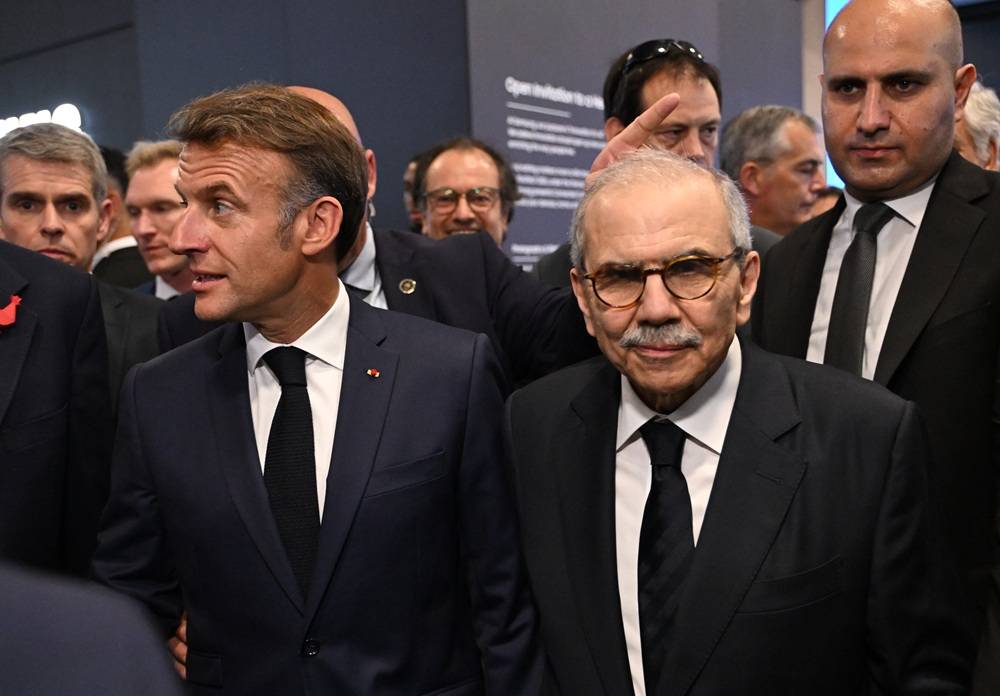
France's President Emmanuel Macron, left, and Lebanon's Prime Minister Nawaf Salam visit the Vivatech fair in Paris, Thursday, June 18, 2026. (AP)
Sharaa stressed that any Syrian role would go exclusively through the Lebanese state and not through other parties, and that Damascus wanted to bolster Lebanon’s stability and strengthen its official institutions.
During Macron’s call with Salam, the two leaders “continued discussions on the results of Salam’s recent visit to Paris, as well as an assessment of the negotiations that began in Switzerland and their repercussions for the region and Lebanon.”
They discussed efforts to secure the necessary conditions for two planned conferences, one to support the army and security forces and another to support reconstruction in wake of the war between Israel and Hezbollah.
The calls come as the future of the international forces in southern Lebanon emerges as one of the most prominent issues under global discussion. At the G7 summit, leaders devoted a significant part of their talks to Lebanon, focusing on the need to find an alternative to UNIFIL once its mandate ends.
According to diplomatic information, discussions are moving toward the creation of a multinational force in which France and other European countries, including Germany, Spain and Italy, have shown readiness to participate.
Its core mission would be to support and train the Lebanese army, equipping it with the capabilities needed to expand its deployment and extend state authority, thereby reinforcing stability and implementing security arrangements in southern Lebanon.
Egypt-Syria Meetings Give Rapprochement New Momentumhttps://english.aawsat.com/arab-world/5287674-egypt-syria-meetings-give-rapprochement-new-momentum
Egypt-Syria Meetings Give Rapprochement New Momentum
Egyptian Foreign Minister Badr Abdelatty and Syrian Foreign Minister Asaad al-Shaibani meet in Jordan on Monday evening. (Egyptian Foreign Ministry)
A series of recent meetings between Egyptian and Syrian officials has given momentum to rapprochement between the two countries, observers said, particularly after a dispute over Syria’s diplomatic mission in Cairo was resolved.
Egyptian Foreign Minister Badr Abdelatty met his Syrian counterpart Asaad al-Shaibani on Monday on the sidelines of an Arab League meeting in the Jordanian capital, Amman.
In a statement on Tuesday, Egypt’s foreign ministry said the two ministers had affirmed “the depth of the historic ties between Egypt and Syria ... and the importance of building on the visit made by the Syrian foreign minister to Cairo in early May.”
They welcomed plans to hold the second Egyptian-Syrian government meeting at the senior official level, with ministries and agencies responsible for trade and investment in both countries participating, to discuss practical steps to boost economic cooperation.
“Relations with Egypt are moving along their natural path, and Syria is keen to develop them,” Mohammad Taha al-Ahmad, Director of the Arab and Regional Affairs Department at Syria’s foreign ministry, told Asharq Al-Awsat.
The two countries had held talks in recent weeks after Egypt raised reservations over names proposed by Syria to represent its diplomatic mission in Cairo, delaying arrangements for the mission’s arrival.
The issue was resolved after Syria put forward another nominee, Yahya Diab, to lead its mission in Egypt.
Amr al-Shobaki, an Egyptian political analyst at Al-Ahram Center for Political and Strategic Studies, said regional challenges made it necessary to develop Egyptian-Syrian ties.
He said cultural, social and political links between the two peoples were strong, adding that Egyptian authorities “had concerns more than disagreements with the new governing system in Syria, given Egypt’s well-known experience with political Islam.”
“Those concerns are being gradually overcome according to two basic principles: respect for each country’s experience and political model, and non-interference in the affairs of the other,” he added. He said Egypt had already established those principles in its relationship with Türkiye.
“The successive Egyptian-Syrian meetings point to an improvement in relations according to the same two principles,” he said.
In late April, Egyptian President Abdel Fattah al-Sisi met his Syrian counterpart Ahmed al-Sharaa on the sidelines of the Arab-European Consultative Summit held in Cyprus.
Media outlets in Cairo and Damascus said at the time that the two had held “friendly” discussions on regional developments and ways to strengthen cooperation.
Damascus hosted the first Egyptian-Syrian economic and investment forum in January, with the participation of leaders and business figures from the Egyptian Chamber of Commerce. The forum aimed to build active partnerships between the two countries and explore cooperation in trade, industry, services, infrastructure and reconstruction.
لم تشترك بعد
انشئ حساباً خاصاً بك لتحصل على أخبار مخصصة لك ولتتمتع بخاصية حفظ المقالات وتتلقى نشراتنا البريدية المتنوعة