


Lebanon: Suzanne Hajj’s Innocence Sparks Political, Judicial Disputes

 Itani, Hajj/NNA
Itani, Hajj/NNA
TT

Lebanon: Suzanne Hajj’s Innocence Sparks Political, Judicial Disputes

 Itani, Hajj/NNA
Itani, Hajj/NNA

Last week’s controversial Military Court ruling that acquitted Internal Security Forces Major Suzanne al-Hajj and sentenced the hacker Elie Ghabash to a year in prison in the Ziad Itani framing case turned Saturday from being a judicial and legal issue to a "rich material" for political bickering, prompting the Public Prosecution office to intervene, and consider a possible judicial appeal in the case and a retrial.

Asharq Al-Awsat learned on Saturday that state prosecutor of the Military Court of Cassation Ghassan Khoury asked the chair of the Permanent Military Court, General Hussein Abdallah of sending him the Hajj-Ghabash file.

Abdallah responded in a letter saying the case was referred to Government commissioner to the military, judge Peter Germanos.

Therefore, Khoury requested from Germanos to hand him the file for a possible judicial appeal in the case before the Supreme Court. The State Prosecutor is expected to receive a response in this regard on Monday.

Last Thursday, Germanos requested the cessation of legal pursuit against Hajj for the absence of incriminated evidence.

In March, Lebanon’s security and judicial investigations uncovered that Major Hajj, the former head of the Lebanese Anti-Cybercrime and Intellectual Property Bureau, played a dangerous role that overpassed hacking the pages of actor Ziad Itani, who was falsely accused of cooperating with and spying for Israel.

Itani was arrested in Beirut last November by the State Security Directorate General, on charges of collaborating and communicating with the Israeli enemy. He was then released in March 2018 after spending 109 days in detention.

Several political figures from the Mustaqbal Movement, the Lebanese Forces and the Progressive Socialist Party continued to lash out Saturday at the judiciary in general and the military court in particulate for being politicized.

Hajj’s attorney, former chief of the north Bar Association, Rashid Derbas, told Asharq Al-Awsat on Saturday that the “political campaign against the court was completely unjustified and had gone out of rationality.”

However, a judicial source told Asharq Al-Awsat that Germanos had deviated from the norms during his pleading by ignoring the content of the indictment and the evidences it included.

Meanwhile, tension intensified on Saturday between the Mustaqbal Movement and the Free Patriotic Movement particularly after Mustaqbal members accused officials close to President Michel Aoun of exerting pressures on the Military Court to stop the legal pursuit against Hajj, referring to a visit conducted by Defense Minister Elias Bu Saab to this court prior to the ruling.

In a tweet posted Saturday, Future Movement Secretary-General Ahmad Hariri described the ruling as “politicized, vindictive and malicious.”



Report: Europe’s Options in the Strait of Hormuz Are Few and Risky

A cargo ship in the Gulf, near the Strait of Hormuz, as seen from northern Ras al-Khaimah, near the border with Oman’s Musandam, amid the US-Israeli conflict with Iran, in United Arab Emirates, March 11, 2026. (Reuters file)
TT

Report: Europe’s Options in the Strait of Hormuz Are Few and Risky

A cargo ship in the Gulf, near the Strait of Hormuz, as seen from northern Ras al-Khaimah, near the border with Oman’s Musandam, amid the US-Israeli conflict with Iran, in United Arab Emirates, March 11, 2026. (Reuters file)

When senior officials from 40 countries met virtually this week to discuss how to bring shipping traffic back to the Strait of Hormuz, Italy’s foreign minister had a proposal. He urged them to establish a “humanitarian corridor” allowing safe passage for fertilizer and other crucial goods headed to impoverished nations.

The plan, described after the meeting by Italian officials, was one of several competing proposals from Europe and beyond that were meant to prevent the Iran war from causing widespread hunger. But it was not endorsed by the envoys on the call, and the meeting ended with no concrete plan to reopen the strait, militarily or otherwise, reported the New York Times.

European leaders are under pressure from US President Donald Trump to commit military assets, immediately, to end Iran’s blockage of the strait and tame a growing global energy and economic crisis. They have refused to meet his demands by sending warships now. Instead, they are hotly debating what to do to help unclog the vital shipping lane once the war ends.

But they are struggling to rally around a plan of action.

That partly reflects the slow gears of diplomacy in Europe and the sheer number of nations, including Gulf states, that are invested in safeguarding the strait once the war ends. Many nations involved in the talks, including Italy and Germany, have insisted that any international effort be blessed by the United Nations, which could slow action further. Military leaders will take up the issue in discussions next week.

More than anything, the struggle reflects how difficult it could be to actually secure the strait under a fragile peace — for Europe or for anyone else. None of the options available to Europe, the Gulf states and other countries look foolproof, even under the assumption that the major fighting will have stopped.

Naval escorts

French officials, including President Emmanuel Macron, have repeatedly raised the possibility that French naval vessels could help escort merchant ships through the strait after the war ends.

American officials have pushed for Europeans and other allies, like Japan, to escort ships sailing under their own countries’ flags.

Naval escorts are expensive. Also, their air defense systems alone might not be sufficient to stop some types of attacks, like drone strikes, should Iran choose to start firing again.

“What does the world expect, what does Donald Trump expect, from let’s say a handful or two handfuls of European frigates there in the Strait of Hormuz,” Defense Minister Boris Pistorius of Germany said last month, “to achieve what the powerful American Navy cannot manage there alone?”

Sweep for mines

German and Belgian officials, among others, say they are prepared to send minesweepers to clear the strait of explosives after the war.

Western military leaders aren’t convinced that Iran has actually mined the strait, in part because some Iranian ships still pass through it. So while minesweepers might be deployed as part of a naval escort, they might not have much to do.

Help from above

Another option is sending fighter jets and drones to intercept any Iranian air assaults on ships. American officials have pushed Europe to do this.

It is quite expensive and still not guaranteed to work. Iran can attack ships with a single soldier in a speedboat, and if just a few attempts succeed, that could be enough to spook insurers and shipowners out of attempting passage.

Diplomacy

Another option are negotiations and economic leverage to pressure Iran to refrain from future attacks, and deploy a variety of military means to enforce that. This effort would go beyond Europe. On Thursday, the German foreign ministry called on China to use its influence with Iran “constructively” to help end the hostilities.

This option is expensive and still not guaranteed. Negotiations seem to have done little to stop the fighting. But this may be Europe’s best bet, for lack of a better one.

What if none of that works?

Iranian officials said this week that they would continue to control traffic through the strait after the war. They have already made plans to make ships pay tolls for passing through the strait, which is supposed to be an unfettered waterway under international law.

A continued blockage risks global economic disaster. Countries around the world rely on shipments through the strait for fuel and fertilizer, among other necessities.

In some regions, shortages loom. In others, like Europe, high oil, gas and fertilizer prices have raised the specter of spiking inflation and cratering economic growth.

“The big threat right now is stagflation,” said Hanns Koenig, a managing director at Aurora Energy Research, a Berlin consultancy. “You’ve got higher prices, and they strangle the tiny growth we would have seen this year.”

*Jim Tankersley for the New York Times


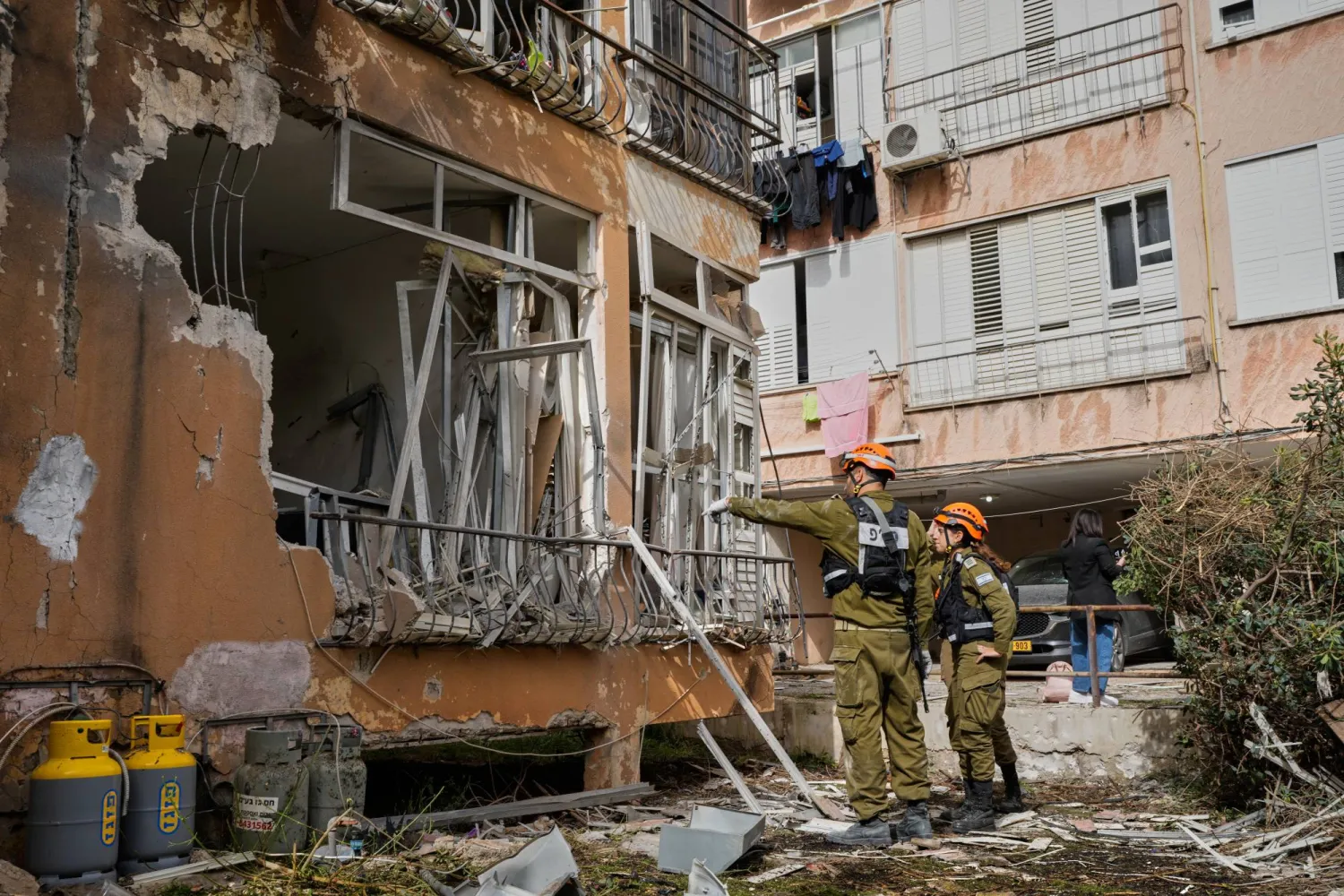
Israel Preparing for Two Weeks of Escalation with Iran

Israeli security forces inspect damage at an apartment building struck by an Iranian missile in Petah Tikva, Israel, Saturday, April 4, 2026. (AP)
TT

Israel Preparing for Two Weeks of Escalation with Iran

Israeli security forces inspect damage at an apartment building struck by an Iranian missile in Petah Tikva, Israel, Saturday, April 4, 2026. (AP)

Israel is prepared for another two weeks of war with Iran and has planned a list of targets for attacks, including infrastructure and economic facilities, while continuing to hit Iran's defense industries.

“The Iranian economy would be Israel’s next target,” the Kan public broadcaster reported.

Security officials told the channel that Israel has prepared a list of targets for attacks in the coming weeks, including infrastructure and bridges, as well as less frequently targeted sites such as energy and oil facilities.

Kan said Israeli officials believe the war could last longer than two weeks, and Israel is preparing accordingly.

The new timeframe extends past the four to six weeks initially set by the White House.

Meanwhile, Israel’s i24NEWS quoted senior Israeli officials as saying there is no expectation of a slowdown in operations in Iran, quite the opposite. The campaign to dismantle key infrastructure is intensifying, as this remains the primary arena shaping wider regional developments.

Sources said Israeli high-ranking military officials and US Central Command (CENTCOM) Commander Brad Cooper agreed in a meeting to continue strikes on Iran for another two to three weeks with a bank of targets including economic centers and banks.

Israel’s second phase represents a major strategic shift in the bank of targets against Iran, setting the military’s sights on the country’s economy, according to Kan.

In addition to the ongoing attacks on military facilities, Israel and the United States plan to hit Iran’s economic sectors, including financial institutions, banks, energy infrastructure, and petrochemical facilities that form the regime’s main “lifeline”.

According to the plan, the United States will operate in the designated areas under its responsibility, while the Israeli army will deepen its attacks on Iran’s basic infrastructure in various regions.

The new decisions were taken as US President Donald Trump told Tehran that his latest deadline for a deal to end the war was fast approaching.

“Remember when I gave Iran ten days to MAKE A DEAL or OPEN UP THE HORMUZ STRAIT. Time is running out — 48 hours before all Hell will reign (sic) down on them,” he wrote in a post on Truth Social.

Trump's messaging about the war has veered between hinting at diplomatic progress and making threats to bomb Iran “back to the Stone Ages.”

Kan noted that the new target list awaits Trump’s approval as the US President has not yet given up on negotiations with Iran.


Egypt Says It Held Calls with US Witkoff, Regional Counterparts

 Egyptian Foreign Minister Badr Abdelatty speaks during a joint news conference with Russian Foreign Minister Sergei Lavrov following their meeting in Moscow, Russia April 3, 2026. (Pavel Bednyakov/Pool via Reuters)
Egyptian Foreign Minister Badr Abdelatty speaks during a joint news conference with Russian Foreign Minister Sergei Lavrov following their meeting in Moscow, Russia April 3, 2026. (Pavel Bednyakov/Pool via Reuters)
TT

Egypt Says It Held Calls with US Witkoff, Regional Counterparts

 Egyptian Foreign Minister Badr Abdelatty speaks during a joint news conference with Russian Foreign Minister Sergei Lavrov following their meeting in Moscow, Russia April 3, 2026. (Pavel Bednyakov/Pool via Reuters)
Egyptian Foreign Minister Badr Abdelatty speaks during a joint news conference with Russian Foreign Minister Sergei Lavrov following their meeting in Moscow, Russia April 3, 2026. (Pavel Bednyakov/Pool via Reuters)

Egypt's Foreign Minister Badr Abdelatty held separate calls to discuss proposals for regional de-escalation with ‌US Envoy ‌Steve Witkoff ‌and ⁠regional counterparts including Iranian ⁠Foreign Minister Abbas Araqchi, the ministry said in a ⁠statement on ‌Sunday.

Egypt, ‌Türkiye and ‌Pakistan have ‌emerged as active intermediaries in the crisis, with ‌Islamabad recently hosting a meeting to ⁠discuss ⁠regional de-escalation and proposals to reopen the Strait of Hormuz.