


Jordan Henderson’s Embrace Captures the Magic of Liverpool’s Triumph

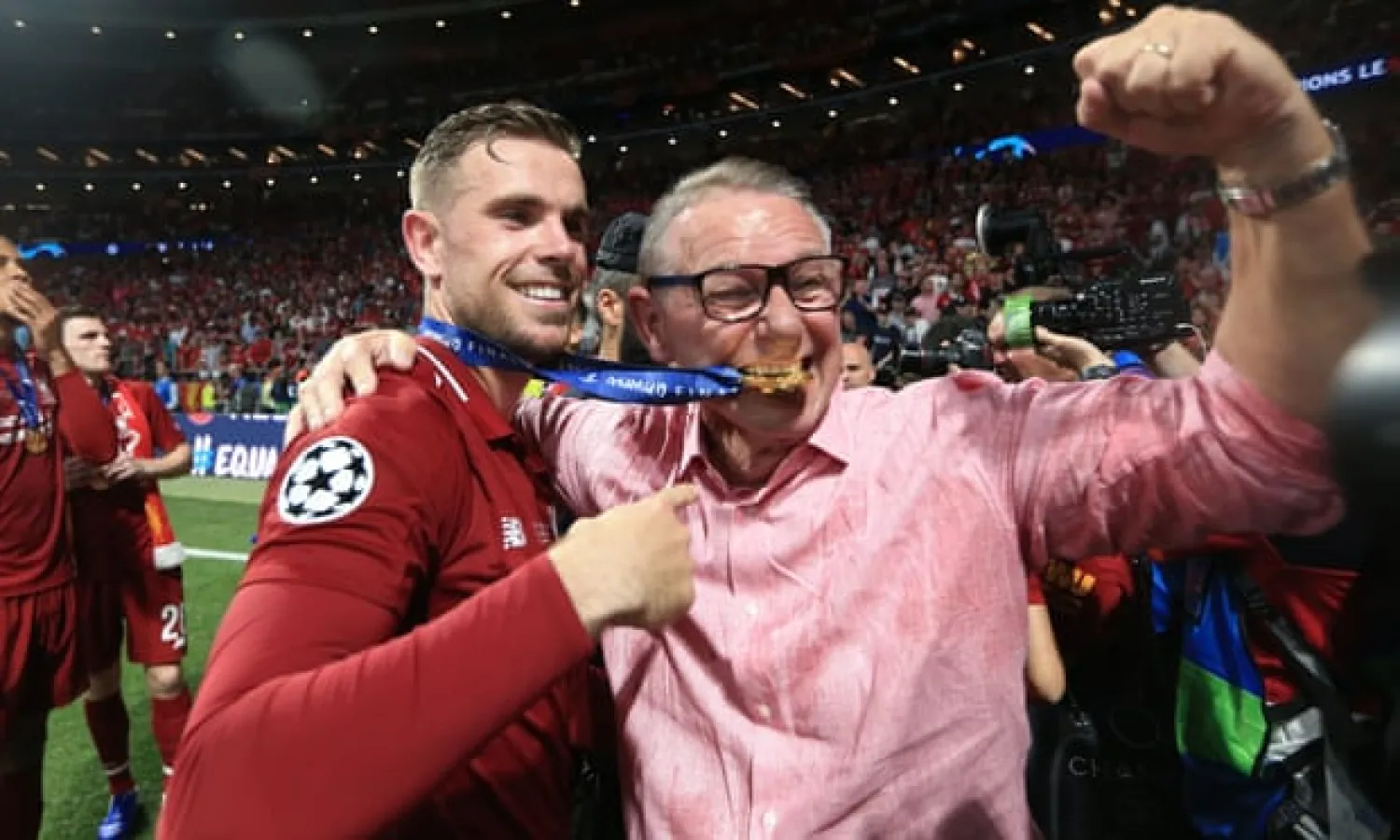
 Jordan Henderson hugs his father Brian after Liverpool’s Champions League triumph. Photograph: BPI/Rex/Shutterstock
Jordan Henderson hugs his father Brian after Liverpool’s Champions League triumph. Photograph: BPI/Rex/Shutterstock
TT

Jordan Henderson’s Embrace Captures the Magic of Liverpool’s Triumph

 Jordan Henderson hugs his father Brian after Liverpool’s Champions League triumph. Photograph: BPI/Rex/Shutterstock
Jordan Henderson hugs his father Brian after Liverpool’s Champions League triumph. Photograph: BPI/Rex/Shutterstock

It was just before Christmas in 2013 when Brian Henderson, a retired police officer from Washington, Tyne and Wear, went to have a cyst removed from his neck only to be told it was cancer and that there was no guarantee, as there never is with that cruel, indiscriminate disease, that he would see it off.

At first he did not want to tell his son, Jordan, because he was worried about how it might affect the performances of a player, then 23, who was already finding it hard enough to prove he was worthy of succeeding Steven Gerrard at Liverpool. Then, when father and son finally had that dreadful, life‑changing conversation, the 59-year-old decided it would be better for Jordan not to see him while he was undergoing treatment.

It is brutal, radiotherapy. “The worst thing I’ve ever had in my life,” Brian says. He reckons he lost four stone during the long, gruelling process to shrivel the carcinoma in his throat. A tumour had to be cut out of his tongue, leaving a hole the size of a 50p piece, and he needed surgery to remove the lymph nodes from both sides of his neck.

Brian had once played on the wing for the England police team but in the summer of 2014 he was too unwell to catch a flight to Brazil to watch his son play in the World Cup for England.

All of which might offer a little extra context if you have seen that wonderful clip of father and son meeting by the side of the pitch in the Estadio Metropolitano, an hour or so after Jordan had lifted the European Cup on Liverpool’s behalf, and holding one another in an embrace that was so tight, so loving, so beautifully spontaneous, it felt as if we were witnessing a moment that might surpass anything we had seen during the final itself.

It was difficult to know how long they were clamped together. It was quite some time, though, before they prised themselves apart. And, again, it would have needed a flint heart not to be moved by the power of that father-son bond when a television reporter from Optus Sport stopped Brian – spectacles, pink shirt, grey hair – to ask if it was even possible to sum up his emotions.

He started by telling the story of taking a 12-year-old Jordan to Old Trafford to see the 2003 Champions League final between Juventus and Milan. Jordan, he said, had been so mesmerised by the size of the occasion, the full stands, the colour, the noise, he had told his father on the journey home he would play in such a game one day.

How did it feel, Brian was asked, at that precise moment when his son was about to lift the trophy and the entire football world was watching? “It’s just very emotional,” he said, with that lovely north-east accent. “The tears come. You start shaking. You grab your wife, you grab your daughter-in-law, you grab anybody that’s around you … just so, so happy.”

By this stage the stands were virtually empty and the crowds were on their way back to the beer‑soaked pavements of central Madrid where, if you had seen how many Liverpudlians were shoehorned into Spain’s capital, it is fair to say the city could forget about getting too much sleep.

Those supporters probably did not realise that, if they had hung around a bit longer inside the stadium, they would have seen some of the night’s more tender moments. The scene, for example, when a couple of Trent Alexander-Arnold’s mates somehow found their way on to the pitch to have a kickabout with one of the red-shirted heroes. They started off with some keepie‑ups. Then Alexander‑Arnold was generous enough to play one of his defence-splitting passes and suddenly one of his friends was running through the middle, bearing down on goal with the chance to stick the ball into the net. Never mind the fact it was past midnight and the beaten Tottenham players had already started boarding their coach outside.

Usually the team who win this trophy would disappear into the tunnel for their champagne and dressing-room selfies. Here, most of them stayed on the pitch because that was the easiest place for their families to locate them. Toddlers wearing Liverpool shirts with their dad’s names emblazoned across the back frolicked in the silver tickertape. Alisson’s wife, Natalia, could not be there because she was expecting their second child, so Liverpool’s goalkeeper Face-timed her to show the medal he had just won.

The only minor problem came when Dejan Lovren took a pair of scissors to the goal where Divock Origi had swivelled on his left foot to score a goal described by one commentator as his own version of that Gary Lineker, Italia 90, finish.

Lovren tried to cut away a piece of the netting to take away as a souvenir. At which point a clutch of worried-looking men in suits – Uefa officials, no doubt – pointed out they could not be absolutely certain this was permitted. Virgil van Dijk fancied a bit of that net, too, and was not impressed at all by their jobsworthiness. It did not make any difference. No player had found a way past Van Dijk all season, but this was one battle he was not going to win.

No matter. Kevin Keegan, one of the heroes of the 1977 final, always used to say that when Liverpool brought back European trophies to Merseyside it made him feel as though they were in Ancient Rome, like warriors returning from a bloody conquest to show off all the gold and loot they had plundered. Jürgen Klopp and his players will find out for themselves when their open-top bus sets off from Allerton Maze into the city centre.

It was estimated there would be 50,000 Liverpool fans in Madrid but it turned out there might have been twice that – outnumbering their Spurs counterparts in such a way it was possible to wander along Gran Via or any of the main thoroughfares in Madrid and forget there were two English clubs in the final.

That is not intended to belittle Spurs, who have a 62,000-capacity stadium now and are regarded by some as possessing the best away support of all the London clubs. Yet the past few days have served as a reminder about the sheer size of Liverpool, their right to be considered one of the giants of the sport and – judging by the number of Asian, American and Australian accents (and that is just the As) – their global reach in this internet age.

There are only Real Madrid, with 13, and Milan, on seven, who have won the European Cup more times than Liverpool’s six and Klopp was right when he said his players have to soak in these moments – cherish them, remember them, recognise this kind of euphoria does not come along too often.

It would be easy to write that Liverpool must use this victory as the platform to find a way past Manchester City next season and to dwell on the fact they still have the aching disappointment of going 29 years without winning the English championship.

Right now, though, is this the moment for think‑pieces about how a team who have won the European Cup, reached consecutive finals and accumulated 97 points in the league, setting all sorts of club records in the process, can do any better? They have not done too badly.

Next season, Klopp promised, he could guarantee another epic battle with City. But first he wanted to celebrate and drink and sing, including his own version of Salt‑N‑Pepa’s Let’s Talk About Sex (Klopp making it “six”) during one interview.

Enjoy it now, he said, because you never know what the future can bring. Something Brian Henderson, one of the proudest dads you will ever see, knows very well.

The Guardian Sport


Shakhtar Boss Pays Ukrainian Racer $200,000 After Games Disqualification

Ukrainian President Volodymyr Zelenskiy holds helmet as he meets with a Ukrainian skeleton racer Vladyslav Heraskevych , who was disqualified from the Olympic skeleton competition over his "helmet of remembrance" depicting athletes killed since Russia's invasion and his father and coach, Mykhailo Heraskevych, amid Russia's attack on Ukraine, in Munich, Germany February 13, 2026. (Ukrainian Presidential Press Service/Handout via Reuters)
TT

Shakhtar Boss Pays Ukrainian Racer $200,000 After Games Disqualification

Ukrainian President Volodymyr Zelenskiy holds helmet as he meets with a Ukrainian skeleton racer Vladyslav Heraskevych , who was disqualified from the Olympic skeleton competition over his "helmet of remembrance" depicting athletes killed since Russia's invasion and his father and coach, Mykhailo Heraskevych, amid Russia's attack on Ukraine, in Munich, Germany February 13, 2026. (Ukrainian Presidential Press Service/Handout via Reuters)

The owner of ‌Ukrainian football club Shakhtar Donetsk has donated more than $200,000 to skeleton racer Vladyslav Heraskevych after the athlete was disqualified from the Milano Cortina Winter Games before competing over the use of a helmet depicting Ukrainian athletes killed in the war with Russia, the club said on Tuesday.

The 27-year-old Heraskevych was disqualified last week when the International Bobsleigh and Skeleton Federation jury ruled that imagery on the helmet — depicting athletes killed since Russia invaded Ukraine in 2022 — breached rules on athletes' expression at ‌the Games.

He ‌then lost an appeal at the Court ‌of ⁠Arbitration for Sport hours ⁠before the final two runs of his competition, having missed the first two runs due to his disqualification.

Heraskevych had been allowed to train with the helmet that displayed the faces of 24 dead Ukrainian athletes for several days in Cortina d'Ampezzo where the sliding center is, but the International Olympic Committee then ⁠warned him a day before his competition ‌started that he could not wear ‌it there.

“Vlad Heraskevych was denied the opportunity to compete for victory ‌at the Olympic Games, yet he returns to Ukraine a ‌true winner," Shakhtar President Rinat Akhmetov said in a club statement.

"The respect and pride he has earned among Ukrainians through his actions are the highest reward. At the same time, I want him to ‌have enough energy and resources to continue his sporting career, as well as to fight ⁠for truth, freedom ⁠and the remembrance of those who gave their lives for Ukraine," he said.

The amount is equal to the prize money Ukraine pays athletes who win a gold medal at the Games.

The case dominated headlines early on at the Olympics, with IOC President Kirsty Coventry meeting Heraskevych on Thursday morning at the sliding venue in a failed last-minute attempt to broker a compromise.

The IOC suggested he wear a black armband and display the helmet before and after the race, but said using it in competition breached rules on keeping politics off fields of play. Heraskevych also earned praise from Ukraine President Volodymyr Zelenskiy.


Speed Skating-Italy Clinch Shock Men’s Team Pursuit Gold, Canada Successfully Defend Women’s Title

 Team Italy with Davide Ghiotto, Andrea Giovannini, Michele Malfatti, celebrate winning the gold medal on the podium of the men's team pursuit speed skating race at the 2026 Winter Olympics, in Milan, Italy, Tuesday, Feb. 17, 2026. (AP)
Team Italy with Davide Ghiotto, Andrea Giovannini, Michele Malfatti, celebrate winning the gold medal on the podium of the men's team pursuit speed skating race at the 2026 Winter Olympics, in Milan, Italy, Tuesday, Feb. 17, 2026. (AP)
TT

Speed Skating-Italy Clinch Shock Men’s Team Pursuit Gold, Canada Successfully Defend Women’s Title

 Team Italy with Davide Ghiotto, Andrea Giovannini, Michele Malfatti, celebrate winning the gold medal on the podium of the men's team pursuit speed skating race at the 2026 Winter Olympics, in Milan, Italy, Tuesday, Feb. 17, 2026. (AP)
Team Italy with Davide Ghiotto, Andrea Giovannini, Michele Malfatti, celebrate winning the gold medal on the podium of the men's team pursuit speed skating race at the 2026 Winter Olympics, in Milan, Italy, Tuesday, Feb. 17, 2026. (AP)

An inspired Italy delighted the home crowd with a stunning victory in the Olympic men's team pursuit final as

Canada's Ivanie Blondin, Valerie Maltais and Isabelle Weidemann delivered another seamless performance to beat the Netherlands in the women's event and retain their title ‌on Tuesday.

Italy's ‌men upset the US who ‌arrived ⁠at the Games ⁠as world champions and gold medal favorites.

Spurred on by double Olympic champion Francesca Lollobrigida, the Italian team of Davide Ghiotto, Andrea Giovannini and Michele Malfatti electrified a frenzied arena as they stormed ⁠to a time of three ‌minutes 39.20 seconds - ‌a commanding 4.51 seconds clear of the ‌Americans with China taking bronze.

The roar inside ‌the venue as Italy powered home was thunderous as the crowd rose to their feet, cheering the host nation to one ‌of their most special golds of a highly successful Games.

Canada's women ⁠crossed ⁠the line 0.96 seconds ahead of the Netherlands, stopping the clock at two minutes 55.81 seconds, and

Japan rounded out the women's podium by beating the US in the Final B.

It was only Canada's third gold medal of the Games, following Mikael Kingsbury's win in men's dual moguls and Megan Oldham's victory in women's freeski big air.


Lindsey Vonn Back in US Following Crash in Olympic Downhill 

Milano Cortina 2026 Olympics - Alpine Skiing - Women's Downhill 3rd Official Training - Tofane Alpine Skiing Centre, Belluno, Italy - February 07, 2026. Lindsey Vonn of United States in action during training. (Reuters)
TT

Lindsey Vonn Back in US Following Crash in Olympic Downhill 

Milano Cortina 2026 Olympics - Alpine Skiing - Women's Downhill 3rd Official Training - Tofane Alpine Skiing Centre, Belluno, Italy - February 07, 2026. Lindsey Vonn of United States in action during training. (Reuters)

Lindsey Vonn is back home in the US following a week of treatment at a hospital in Italy after breaking her left leg in the Olympic downhill at the Milan Cortina Games.

“Haven’t stood on my feet in over a week... been in a hospital bed immobile since my race. And although I’m not yet able to stand, being back on home soil feels amazing,” Vonn posted on X with an American flag emoji. “Huge thank you to everyone in Italy for taking good care of me.”

The 41-year-old Vonn suffered a complex tibia fracture that has already been operated on multiple times following her Feb. 8 crash. She has said she'll need more surgery in the US.

Nine days before her fall in Cortina d'Ampezzo, Italy, Vonn ruptured the ACL in her left knee in another crash in Switzerland.

Even before then, all eyes had been on her as the feel-good story heading into the Olympics for her comeback after nearly six years of retirement.
