



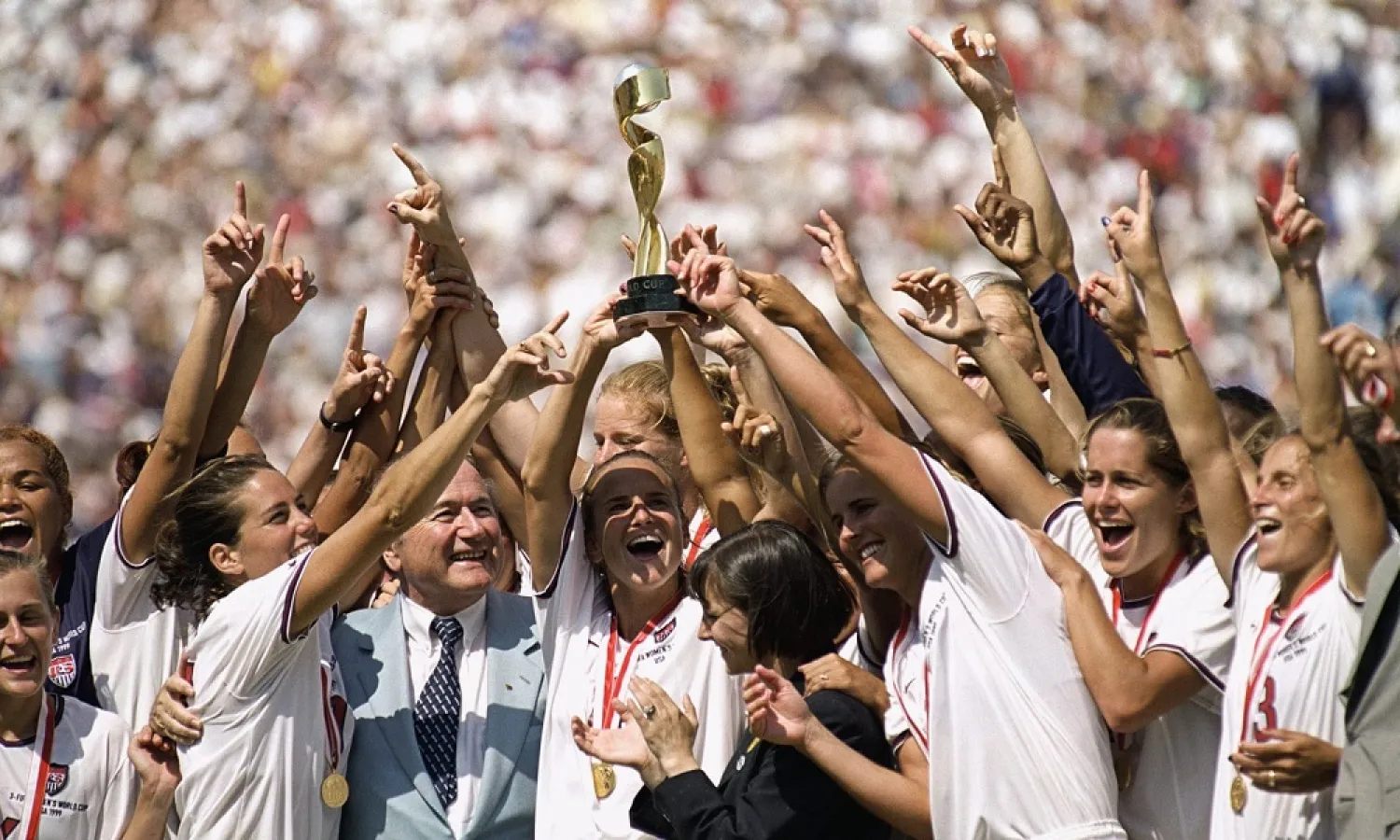

On the morning after the national team won the 1999 World Cup, the celebrations continued. While the players were off to do a victory parade at Disneyland, officials from the US Soccer Federation opened the sports pages of local newspapers, eager to see the coverage of the victory.
The Los Angeles Times used the headline “America the Bootiful” alongside a large photo of Briana Scurry’s penalty-kick save. Some of the US Soccer brass probably cracked a smile at the pun. But when they turned to page 5, they saw a different headline—one that would touch off a bitter dispute and mark a permanent change in the relationship between the players and their boss, the federation. It was on a full-page advertisement for an indoor victory tour the national team players had scheduled for that fall.
Hank Steinbrecher, the secretary general of US Soccer, was shocked. The players were calling themselves the All-American Soccer Stars but essentially planned to travel to 12 cities as the World Cup–winning US national team to play exhibition games against an all-star team of world internationals. Robert Contiguglia, the president of US Soccer, was furious.
But the players had already asked US Soccer how the federation planned to capitalize on hosting the Women’s World Cup on home soil. The answer they got back, essentially, was that the federation wasn’t really thinking about that.
“We pressed them on it and said, Hey, what are you doing? What are the plans?” remembers Julie Foudy. “They said we were going to Africa. We were like, Africa? We need to grow the game here. Why are we going to Africa? We had never even been to Africa.”
Yes, for some reason, US Soccer president Robert Contiguglia and secretary general Hank Steinbrecher wanted to send the players on tour in South Africa and Egypt after the 1999 World Cup, when interest in the team at home would be at an all-time high.
To this day, the players don’t understand what US Soccer’s higher-ups were thinking. To say the federation lacked foresight or ambition to help the national team keep up its momentum is to put it mildly. There was no strategy to grow interest in the sport from the federation responsible for it, to say nothing of cashing in and hosting games that would sell lots of tickets. It was a strange response from the federation that only deepened the team’s mistrust of their boss.
“They had nothing for us,” Kate Markgraf says. “They had no plan. They didn’t think the World Cup would be what it was.”
So the players started talking through the details of a tour they could put on themselves. They agreed to hire event-marketing firm SFX, which could handle logistics of the tour. But it wasn’t done in secret behind US Soccer’s back, as the federation later made it seem.
Langel and the players sent letters to US Soccer notifying the federation of their plans, but officials just ignored their messages. The team attempted again just before the Women’s World Cup to see if US Soccer wanted to have anything to do with the tour.
For the national team, the tour represented a unique opportunity to make some real money: a guaranteed $1.2 million for the 12-city tour. Most importantly, it was income shared equally among all the players, $60,000 each, because the top players—those like Mia Hamm and Julie Foudy—insisted it be that way.
It was another step toward securing financial independence as more individual players started to earn their own endorsement deals and didn’t need to rely on US Soccer as much. By then, Nike had expanded its footprint in soccer beyond Mia Hamm. They’d added Brandi Chastain, Briana Scurry, Tiffeny Milbrett and Tisha Venturini to their roster of sponsored athletes and featured all five of them in advertisements that promoted the Women’s World Cup. Nike’s expansion into women’s soccer was a game-changer for the players who benefited from it.
Not everyone had that same opportunity for sponsorship, but now, with this collective group effort to launch a tour—by the team and for the team—financial freedom was available across the board. It was a payday for all players.
And in another sense, the players were doing the federation’s job for them. The tour allowed the national team to play in front of fans who did not attend World Cup games, which would grow a fan base at home in America. Yes, it gave the players money, but it also spread the gospel of the Beautiful Game, as soccer is known around the world. It did everything that US Soccer’s haphazard plan for an African tour would not.
As Julie Foudy put it in a press statement after the tour was announced: “The one thing we’ve learned recently is that our fans want to see more of us and more of soccer. We’re answering their call.”
So there were Hank Steinbrecher and Robert Contiguglia opening their newspapers on the morning of July 11, 1991. They were “shocked” by the tour the players warned them about and furious the players weren’t going along with the African tour, which would’ve certainly pushed the national team back into relative obscurity.
“US Soccer went apoplectic,” Langel says. “They immediately hired a Chicago law firm, and they sent a complaint to my law firm that they’re going to go into federal court to get an injunction.”
An injunction, if granted, could have stopped the tour in its tracks. John Langel and his legal team worked through the night to prepare their responses to try to stop the federation from seeking a court-ordered moratorium on the tour. Then came two days of marathon meetings between Langel and Alan Rothenberg, the head of the 1999 Women’s World Cup organizing committee. Rothenberg, who had been the president of US Soccer through 1998, played a sort of mediator role.
“They had achieved success and popularity, and they had to properly take advantage of that,” Rothenberg says. “But to go around on tour as a unit, no matter what they call themselves—effectively as the national team—that right belonged to the federation.”
In a panicked move to retake control, US Soccer offered $2 million to essentially buy out the tour from the national team and send them to Africa as planned. Even though this would be more money than they had ever been paid for playing soccer, the players were having none of it.
Negotiations with US Soccer became incredibly tense and acrimonious. It was as if everything—contract disputes, lack of communication, and perceived slights—was finally coming to a head. When Mia Hamm, Julie Foudy and John Langel met with US Soccer president Robert Contiguglia and federation counsel John Collins in Washington DC, the players were ready to stand up.
Asked about these specific negotiations now, Contiguglia says he doesn’t remember them, but he does recall that over the years, the relationship between the federation and the players was hostile. At one point, he admits, “I did lose my cool,” but he adds: “The last thing I ever wanted was an adversarial relationship with our athletes.”
“That’s what happens in collective bargaining when you don’t have a relationship of mutual trust,” Contiguglia says. “It was a horrible, horrible environment. It was not healthy, but I blame lawyers.”
While the federation was certainly unhappy the players defied them by moving forward with the indoor tour, there were other practical considerations behind their opposition to the tour. The federation had its own sponsors at the time, and if the national team was going on an unsanctioned tour where they used a competitor’s equipment or wore another company’s uniforms, it could damage US Soccer’s existing business relationships.
After two days of meetings in DC—and some sharp-tongued exchanges between the federation and the players—the two sides worked out an understanding: The tour would incorporate all of US Soccer’s existing sponsors. The tour the players had worked on was going to happen after all.
After that concession, the players and Langel were fired up. They knew they had some real leverage for the first time. Outside the second meeting, Foudy and Hamm joked with Langel: “Who’s driving the bus? We’re driving the bus! That’s right, we’re driving the bus!”
The tour belonged to the players, not US Soccer, and it gave them a new collective revenue stream that wasn’t controlled by the federation. It was set to earn them $2.4 million over two tours—one after the 1999 World Cup and one again after the 2000 Olympics—and, in addition to the ticket sales, the team also signed balls and photos, which generated another $250,000 to be shared. Eleven of the players appeared in a Chevrolet commercial together. The players were finding financial freedom they had never experienced before.
As part of the final understanding to make US Soccer happy, the players gave the federation the opportunity to take over the tour afterward if they wanted to do it again. Now, it is built into the national team’s contract, and to this day, after major tournaments, the team still goes on the same victory tour. It started with the 1999 team and a “shocking” full-page ad, and it has lasted two decades.
This is an extract from The National Team: The Inside Story of the Women Who Changed Soccer by Caitlin Murray.
The Guardian Sport


