


German Prisons Use Bees to Teach Inmates Patience

Beehives in an apiary. (Getty Images)
TT

German Prisons Use Bees to Teach Inmates Patience

Beehives in an apiary. (Getty Images)

The 24-year-old German, who has Moroccan roots, has been serving his sentence in the Remscheid correctional facility in the state of North Rhine-Westphalia since May last year. Wearing white gloves and a mask over his mouth, Mohamed concentrates as he measures out the amber-colored honey from the big steel container and screws on the lid of a glass jar.

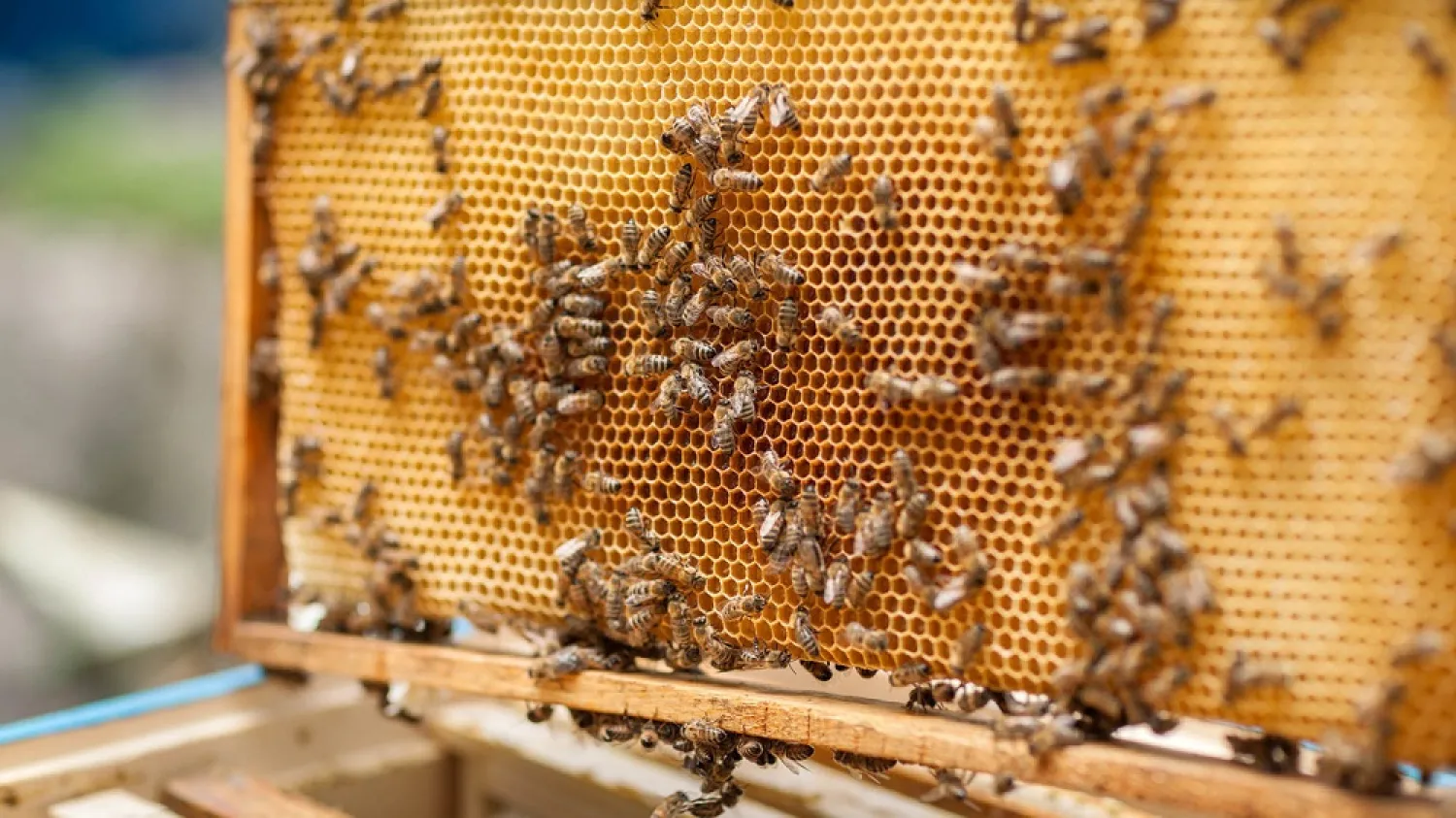
According to the German news agency, Mohamed has been taking part in a beekeeping program that the institution hopes will help it break new ground, by giving prisoners meaningful work with a therapeutic effect that can also help the environment in cooperation with 3 million “prison bees”.

State Justice Minister Peter Biesenbach says the program "sets a precedent beyond state borders."

While there are beekeeping courses at other prisons in Germany, North Rhine-Westphalia uses a distinct approach: several institutions are involved in the project, and they cooperate with farm shops and farmers, who allow prisoners to care for the bees in their orchards.

The nurturing work of beekeeping is an odd fit with a men's prison, where many of the inmates prefer to distinguish themselves with their muscles and rude behavior. It was Juergen Kraemer, director of the prison's employment agency, who came up with the idea of beekeeping.

He has spent 40 years as a prison official and long pondered how prisoners could use their time inside more productively to prepare them for life afterwards. The 62-year-old director said: "Employment outside has changed. It's no longer easy to find a job as a carpenter or metal worker after prison."

Kraemer launched his beekeeping program in early 2016 and other prisons in the state have also joined. They currently work with 68 bee colonies with an annual population of between 3 and 4 million, producing around one ton of honey. The facilities share out the work, which includes making beehives, preparing wax plates, caring for the bees, harvesting the honey and regularly cleaning all the materials needed.

Mohamed is busy building honey presentation boxes from left over bits of wood and old palettes. "I used to be very aggressive with my family. That's over after the bees. You have to be very patient," says the 48-year-old, who was jailed in August after assaulting his ex-wife.

Kraemer smiles and says: "Those who work with bees have to follow the rules or they get punished immediately: one mistake, one sting and it hurts."

Kraemer is convinced about the benefits of his project: "It's an integration program for everybody: for refugees, for prisoners from Turkey, North Africa, Russia, the Middle East, who often don't speak much German, as well as many others who only have this one chance. Otherwise they would just make trouble and stay in their cells."

Only those in open prisons are allowed out of their cells to work in the orchards with the bees. The Bergische Bauernhof Conrads farm shop in nearby Leichlingen has allowed the prison in Remscheid to set up hives around its orchards and let the prisoners work there.

Thousands of bees fly around in the sun from bloom to bloom, diligently collecting pollen to take back to their hives.

"With bees you're connecting with nature. You slow down and get another picture of the world. Lots of people never get that. In prisons there are a lot of people who have deficiencies. They're used to confirming their self-worth through aggression," says Kraemer, as he looks out over the country idyll.

"Aggressive prisoners aren't allowed on the beekeeping program, which is very popular. There are people who can't be helped with therapy. They're locked up," he adds.

He hopes that many prisoners who take part in the program will later join beekeeping associations outside of the correctional facility.

Kraemer sees that inmates can continue to apply the things they have learned.

"It's something else apart from getting drunk and hanging around in bars. That doesn't mean it alone will stop them from committing further crimes," he concludes.



Nine Skiers Missing, Six Rescued after California Avalanche

FILE PHOTO: The snow-covered Sierra Nevada Mountains are seen from the air during a Pacific Gas and Electric snowpack survey near Nevada City, California, US April 3, 2017.  REUTERS/Bob Strong/File Photo
FILE PHOTO: The snow-covered Sierra Nevada Mountains are seen from the air during a Pacific Gas and Electric snowpack survey near Nevada City, California, US April 3, 2017. REUTERS/Bob Strong/File Photo
TT

Nine Skiers Missing, Six Rescued after California Avalanche

FILE PHOTO: The snow-covered Sierra Nevada Mountains are seen from the air during a Pacific Gas and Electric snowpack survey near Nevada City, California, US April 3, 2017.  REUTERS/Bob Strong/File Photo
FILE PHOTO: The snow-covered Sierra Nevada Mountains are seen from the air during a Pacific Gas and Electric snowpack survey near Nevada City, California, US April 3, 2017. REUTERS/Bob Strong/File Photo

Nine skiers were missing after an avalanche in California's Sierra Nevada mountains on Tuesday, but six others, who had been stranded, have since been rescued, authorities said.

The avalanche swept the Castle Peak area of Truckee, California, about 10 miles north of Lake Tahoe, at about 11:30 a.m. Pacific time, engulfing a group of skiers, according to a Facebook statement posted by the Nevada County Sheriff's Office.

Those rescued have varying injuries and two were ‌sent to a hospital ‌for treatment.

The sheriff's office revised the number of ‌people ⁠in the group to ⁠15 from an earlier estimate of 16, adding that no further updates were expected on Tuesday evening.

If all nine of the missing skiers should perish, the incident would rank among the deadliest single avalanches on record in the United States. The Colorado Avalanche Information Center has tallied six US avalanche fatalities so far this season.

Avalanches have claimed an average of 27 lives ⁠each winter in the United States over the past ‌decade, the center reported.

A winter storm warning ‌was in effect for much of northern California on Tuesday, with heavy snow ‌forecast in the upper elevations of the Sierra Nevada.

The Sierra Avalanche Center ‌had posted an alert before dawn on Tuesday, warning of a "high avalanche danger" in the ski region, the sheriff's statement said.

"I don't think it was a wise choice," Greene said of the decision of a ski tour company to take paying ‌customers out into the backcountry under such conditions, adding, "but we don't know all the details yet." He declined to ⁠name the company involved.

Rescue ⁠ski teams were dispatched to the avalanche zone from the Boreal Mountain Ski Resort and Tahoe Donner's Alder Creek Adventure Center.

The survivors had taken refuge in a makeshift shelter, constructed partly from tarpaulin sheets and communicated with rescuers via radio beacon and text messaging.

Greene declined to say how many of the ski guides and how many of their customers were among the missing.

Weather conditions remained hazardous in the Sierra backcountry slopes, with additional avalanche activity expected through Tuesday night and into Wednesday, according to the sheriff's statement.

California Governor Gavin Newsom was briefed on the avalanche, and state authorities were "coordinating an all-hands search-and-rescue effort" in conjunction with local emergency teams, his office said in a posting on X.


Surprise Shark Caught on Camera for 1st Time in Antarctica’s Near-freezing Deep

In this image made from video and released by the University of Western Australia, a sleeper shark swims into the spotlight of a video camera in Antarctica in January 2025. (Minderoo-UWA Deep-Sea Research Centre, Inkfish, Kelpie Geoscience via AP)
TT

Surprise Shark Caught on Camera for 1st Time in Antarctica’s Near-freezing Deep

In this image made from video and released by the University of Western Australia, a sleeper shark swims into the spotlight of a video camera in Antarctica in January 2025. (Minderoo-UWA Deep-Sea Research Centre, Inkfish, Kelpie Geoscience via AP)

An ungainly barrel of a shark cruising languidly over a barren seabed far too deep for the sun’s rays to illuminate was an unexpected sight.

Many experts had thought sharks didn’t exist in the frigid waters of Antarctica before this sleeper shark lumbered warily and briefly into the spotlight of a video camera, researcher Alan Jamieson said this week. The shark, filmed in January 2025, was a substantial specimen with an estimated length of between 3 and 4 meters (10 and 13 feet).

“We went down there not expecting to see sharks because there’s a general rule of thumb that you don’t get sharks in Antarctica,” Jamieson said.

“And it’s not even a little one either. It’s a hunk of a shark. These things are tanks,” he added.

The camera operated by the Minderoo-UWA Deep-Sea Research Centre, which investigates life in the deepest parts of the world’s oceans, was positioned off the South Shetland Islands near the Antarctic Peninsula. That is well inside the boundaries of the Antarctic Ocean, also known as the Southern Ocean, which is defined as below the 60-degree south latitude line.

The center on Wednesday gave The Associated Press permission to publish the images.
The shark was 490 meters (1,608 feet) deep where the water temperature was a near-freezing 1.27 degrees Celsius (34.29 degrees Fahrenheit).

A skate appears in frame motionless on the seabed and seemingly unperturbed by the passing shark. The skate, a shark relative that looks like a stingray, was no surprise since scientists already knew their range extended that far south.

Jamieson, who is the founding director of the University of Western Australia-based research center, said he could find no record of another shark found in the Antarctic Ocean.

Peter Kyne, a Charles Darwin University conservation biologist independent of the research center, agreed that a shark had never before been recorded so far south.

Climate change and warming oceans could potentially be driving sharks to the Southern Hemisphere’s colder waters, but there was limited data on range changes near Antarctica because of the region’s remoteness, Kyne said.

The slow-moving sleeper sharks could have long been in Antarctica without anyone noticing, he said.

“This is great. The shark was in the right place, the camera was in the right place and they got this great footage,” Kyne said. “It’s quite significant.”

The sleeper shark population in the Antarctic Ocean was likely sparse and difficult for humans to detect, Jamieson said.

The photographed shark was maintaining a depth of around 500 meters (1,640 feet) along a seabed that sloped into much deeper water. The shark maintained that depth because that was the warmest layer of several water layers stacked upon each other to the surface, Jamieson said.

The Antarctic Ocean is heavily layered, or stratified, to a depth of around 1,000 meters (3,280 feet) because of conflicting properties including colder, denser water from below not readily mixing with fresh water running off melting ice from above.

Jamieson expects other Antarctic sharks live at the same depth, feeding on the carcasses of whales, giant squids and other marine creatures that die and sink to the bottom.

There are few research cameras positioned at that specific depth in Antarctic waters.

Those that are can only operate during the Southern Hemisphere summer months, from December through February.

“The other 75% of the year, no one’s looking at all. And so this is why, I think, we occasionally come across these surprises,” Jamieson said.


17th Century Wreck Reappears from Stockholm Deep

The remains of a 17th century shipwreck is pictured after resurfacing in Stockholm, Sweden, on February 17, 2026. (Photo by Jonathan NACKSTRAND / AFP)
TT

17th Century Wreck Reappears from Stockholm Deep

The remains of a 17th century shipwreck is pictured after resurfacing in Stockholm, Sweden, on February 17, 2026. (Photo by Jonathan NACKSTRAND / AFP)

A 17th century Swedish Navy shipwreck buried underwater in central Stockholm for 400 years has suddenly become visible due to unusually low Baltic Sea levels.

The wooden planks of the ship's well-preserved hull have since early February been peeking out above the surface of the water off the island of Kastellholmen, providing a clear picture of its skeleton.

"We have a shipwreck here, which was sunk on purpose by the Swedish Navy," Jim Hansson, a marine archeologist at Stockholm's Vrak - Museum of Wrecks, told AFP.

Hansson said experts believe that after serving in the navy, the ship was sunk around 1640 to use as a foundation for a new bridge to the island of Kastellholmen.

Archeologists have yet to identify the exact ship, as it is one of five similar wrecks lined up in the same area to form the bridge, all dating from the late 16th and early 17th centuries.

"This is a solution, instead of using new wood you can use the hull itself, which is oak" to build the bridge, Hansson said.

"We don't have shipworm here in the Baltic that eats the wood, so it lasts, as you see, for 400 years," he said, standing in front of the wreck.

Parts of the ship had already broken the surface in 2013, but never before has it been as visible as it is now, as the waters of the Baltic Sea reach their lowest level in about 100 years, according to the archaeologist.

"There has been a really long period of high pressure here around our area in the Nordics. So the water from the Baltic has been pushed out to the North Sea and the Atlantic," Hansson explained.

A research program dubbed "the Lost Navy" is underway to identify and precisely date the large number of Swedish naval shipwrecks lying on the bottom of the Baltic.