


Qiddiya Reveals First Look at Saudi ‘Capital of Entertainment, Sports and Arts’

The Qiddiya Investment Company unveils the much-anticipated Master Plan for Qiddiya. (SPA)
TT

Qiddiya Reveals First Look at Saudi ‘Capital of Entertainment, Sports and Arts’

The Qiddiya Investment Company unveils the much-anticipated Master Plan for Qiddiya. (SPA)

The Qiddiya Investment Company has unveiled the much-anticipated Master Plan for Qiddiya, the “Giga-Project” being constructed on the doorstep of Riyadh that will deliver on many of the goals of the Vision 2030. Qiddiya is set to become the Kingdom’s “Capital of Entertainment, Sports and the Arts”, with facilities and experiences that will bring together new opportunities and exposure at a scale and format never before seen.

By bringing together the elements for an active, healthy and ambitious lifestyle, Qiddiya will generate enormous economic opportunities, and thousands of new jobs that will prompt the development of new sectors, contributing to a diversified and prosperous economy.

“The people of Saudi Arabia share the universal desire for enriching experiences, and our plan allows Qiddiya to unlock access to these experiences in a new and culturally relevant way, encouraging personal and professional pursuits that foster enrichment,” said Michael Reininger, Chief Executive Officer of Qiddiya Investment Company.

The Master Plan, created in conjunction with Bjarke Ingles Group, a Denmark-based company, was constructed with careful consideration to the natural patterns that have been etched on the site throughout history, giving rise to a green-belt network carrying visitors throughout the property on roads, bike paths and walkways built within an enhanced landscape environment.

Located just 45 km from Riyadh, the 334 square kilometer site envisions development covering only 30 percent of the land leaving the majority of the majestic site dedicated for natural conservation.

“This project sets a new global standard for the seamless integration of visitor-focused experiences and an innovative mix of program pieces, delivering an unparalleled entertainment destination,” said Bob Ward, Chairman of the Qiddiya Advisory Board.

The site is organized around five primary attractions.

The Resort Core represents the heart of Qiddiya, where four gated-attractions surround a central specialty retail, dining, resort hotel and entertainment district. Adjacent to this 15-hectare lies is a major outdoor entertainment venue that can host events of a capacity of 5,000 to 40,000 visitors.

The 2022 opening phase features Six Flags Qiddiya, a family-oriented park filled with rides and attractions distributed throughout six themed lands. A second feature park is a water-oriented sports and entertainment attraction, which includes an integrated resort hotel.

The third feature is the “Speed Park” which brings together events and experiences from the world of motor sports in a venue that places equal emphasis on spectator and driver. The Speed Park includes tracks, showrooms, retail, a driver’s club and a luxury hotel within its gates.

Overlooking the Resort Core from its perch 200m above on the edge of the Tuwaiq escarpment, the City Center is a mixed-use village dedicated to sports and the arts. Coupled to the entertainment core below by a funicular transportation system, residential, retail and workplace environments are organized around two intersecting pedestrian circulation spines linking a portfolio of feature facilities.

The City Center is home to a collection of sports venues including a 20,000 seat cliff-top stadium, an 18,000 seat multi-purpose indoor arena, an aquatic center and a sports hub capable of hosting a cross-section of individual sports activities and events.

Arts and entertainment create a buzz throughout the city as they emerge from an innovative arts center, a signature 2,000 seat performing arts theater and a premier multiplex cinema that dot the central walkways as primary destinations.

A creative campus offers workspace, media production and education facilities. A grand mosque anchors one end of the city with a place for worship and community gathering. A private school, a sports medicine hospital, and beautiful private villas along a biking/walking path on the Cliff’s Edge complete the composition.

To the northwest of the Resort Core sits the Eco Core designed around a series of nature and wildlife encounters, an ecologically-sensitive golf course, outdoor sporting adventures and several unique hospitality offerings that take advantage of the picturesque desert environment.

The Motion Core, to the southeast of the Resort Core, will be home to events, experiences, residential and hospitality offerings that are driven by the science and technology of people in motion.

Along with a Race Resort, where homes and club facilities provide access to a beautiful and challenging 15 km performance driving course, facilities for both on-road and off-road driving experiences, driver education and destination motor sports events will be constructed within a landscape surrounded by a mountain side backdrop.

A Golf and Residential Neighborhood sits near the center of the property where panoramic vistas of the project are available from an array of residential and resort offerings that include a championship 18-hole golf course and club house facilities, a luxurious resort hotel and spa and equestrian facilities—all accessed from villas, townhomes and private retreats.

A range of additional retail, residential, community services and commercial support facilities are distributed throughout the property for ease of access and utility that support the modern lifestyle Qiddiya is designed to deliver.

Qiddiya brings together an expansive range of attractions and opportunities in a singular and easily accessible destination, delivered to “best-in-class” standards and allows Saudis to enjoy the entertainment and professional experiences that inspire them without having to leave the Kingdom to fulfill their ambitions.


Two Holy Mosques Exhibition Welcomes Visitors for Founding Day Celebrations

The exhibition is open daily from 10:00 a.m. to 1:30 a.m - SPA
TT

Two Holy Mosques Exhibition Welcomes Visitors for Founding Day Celebrations

The exhibition is open daily from 10:00 a.m. to 1:30 a.m - SPA

In celebration of the Kingdom’s Founding Day, the Exhibition of the Two Holy Mosques Architecture in Makkah is welcoming visitors to explore a comprehensive historical journey.

The exhibition presents the evolution of the Two Holy Mosques through rare artifacts, historical photographs, and documentation of successive Saudi expansions, according to SPA.

The halls highlight the Kingdom’s long-standing dedication to serving the Two Holy Mosques. They combine heritage and modern technology to present the architectural development of Islam’s holiest sites.

The exhibition is open daily from 10:00 a.m. to 1:30 a.m.


Photos Show Filming of Ramadan TV Drama Series on the War-scarred Streets of Syria's Aleppo

Extras stand by as a television crew films an episode of the TV series “Al-Souriyoun al-Aada” (“The Syrian Enemies”), based on a novel of the same name that was banned under Bashar Assad, along a transformed street in central Aleppo, Syria, Friday, Feb. 13, 2026. (AP Photo/Ghaith Alsayed)
TT

Photos Show Filming of Ramadan TV Drama Series on the War-scarred Streets of Syria's Aleppo

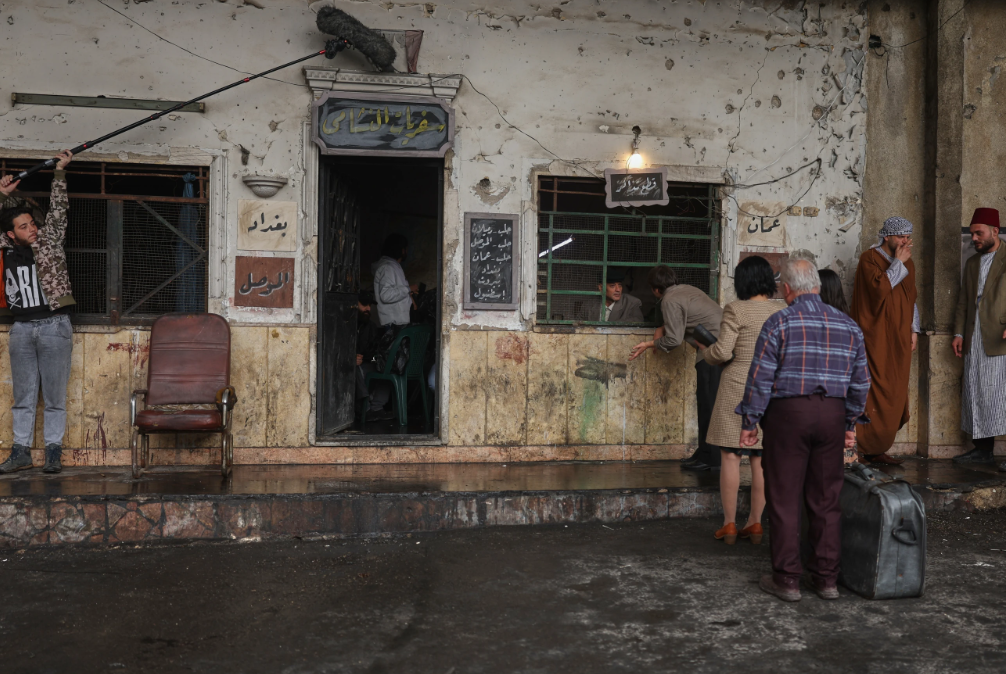
Extras stand by as a television crew films an episode of the TV series “Al-Souriyoun al-Aada” (“The Syrian Enemies”), based on a novel of the same name that was banned under Bashar Assad, along a transformed street in central Aleppo, Syria, Friday, Feb. 13, 2026. (AP Photo/Ghaith Alsayed)

Ramadan in the Arab world is a month of fasting and prayer by day — and television by night. For decades, families have gathered after the iftar, the evening meal that breaks the daytime fast, to follow the season’s highly anticipated drama series, produced specially to air during the Islamic holy month.

In the week before Ramadan, a television crew in central Aleppo was busy preparing one of those productions, with a battered street in the historic city transformed into a scene from decades past.

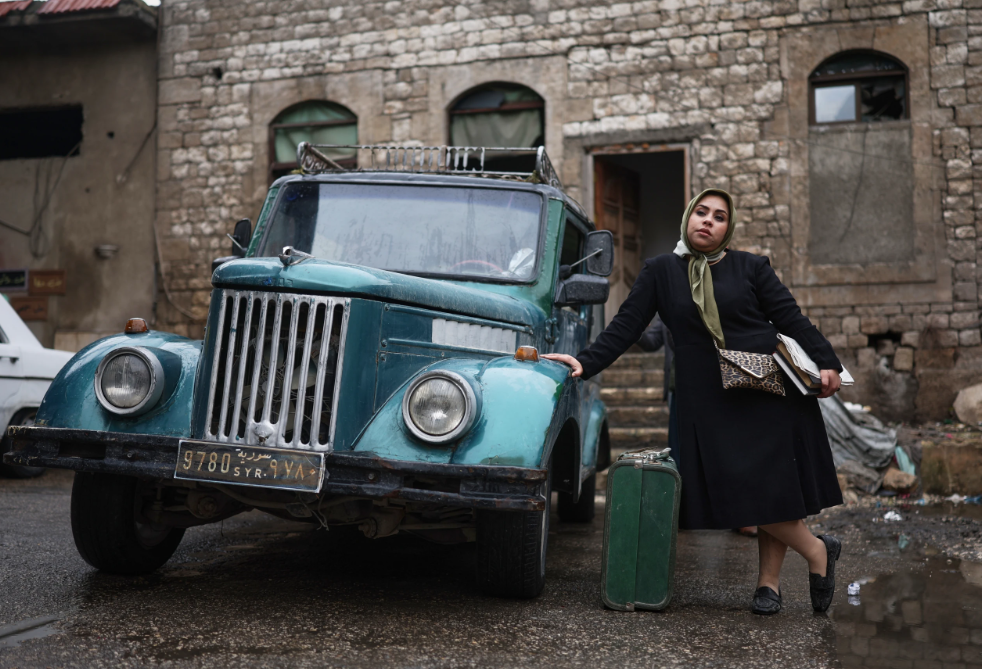
Lamees Al-Ali, an extra in the series, poses for a photograph during the filming of an episode of the TV series “Al-Souriyoun al-Aada” (“The Syrian Enemies”), based on a novel of the same name that was banned under Bashar Assad, along a transformed street in central Aleppo, Syria, Friday, Feb. 13, 2026. (AP Photo/Ghaith Alsayed)

Classic 1970s cars lined the curb. A horse-drawn cart rolled through the frame. A vendor in a red tarboush, a brimless cone-shaped hat, stood beside steaming pots of sahlep — a sweet, thickened milk drink flavored with spices and associated with winter evenings.

Just outside the camera’s view stood a stark reminder of Syria's more recent history. Collapsed buildings and damaged facades testified to Aleppo’s role as a major battleground during the country's civil war. However, with costumes, props and careful framing, the production temporarily carried the street back to what it portrays as a more innocent era, according to The AP news.

A television crew films an episode of the TV series “Al-Souriyoun al-Aada” (“The Syrian Enemies”), based on a novel of the same name that was banned under Bashar Assad, along a transformed street in central Aleppo, Syria, Friday, Feb. 13, 2026.(AP Photo/Ghaith Alsayed)

The series being filmed — “Al-Souriyoun al-Aada,” or “The Syrian Enemies” — is based on a novel that was banned during the rule of former President Bashar Assad. The story examines painful chapters of Syria’s past, including the 1982 events in Hama, when government forces crushed an uprising led by the Muslim Brotherhood, killing or disappearing an estimated 10,000 to 40,000 people and leaving the city in ruins.

As filming continues into Ramadan, the production reflects both a cherished seasonal tradition and Syria’s complex, layered history.


How Bomb Cyclones Form and Create Dangerous Conditions 

A man works in a snowstorm, Sunday, Feb. 22, 2026, in New York. (AP)
TT

How Bomb Cyclones Form and Create Dangerous Conditions 

A man works in a snowstorm, Sunday, Feb. 22, 2026, in New York. (AP)

When turbulent weather with whipping winds and heavy snow is in the forecast, meteorologists sometimes warn that a storm could “bomb out” or become a bomb cyclone. But what exactly does this mean?

According to the US National Oceanic and Atmospheric Administration, certain storms undergo bombogenesis, which happens when a storm’s central pressure drops at least 24 millibars in 24 hours. These storms are sometimes called bomb cyclones. Storm intensity is measured by central pressure, so the lower the pressure, the stronger the storm.

Such rapidly strengthening storms are capable of producing heavy rain, blizzard conditions and intense winds that can create dangerous conditions such as downed trees and power outages.

“If you’re watching TV at night and the weather report comes on and you’re hearing ‘bomb cyclone’ being used, that usually means there’s quite a bit of active weather going on,” said Andrew Orrison, a meteorologist with the National Weather Service in College Park, Maryland.

Bomb cyclones can happen in any season, but mainly occur during fall and winter when frigid air from the Arctic can creep south and clash with warmer air masses.

“It’s really the clash of those air masses that really kind of helps to generate the areas of low pressure in the first place,” said Orrison.

Regions in North America that are prone to seeing bomb cyclones include Alaska, the Pacific Northwest and the Great Lakes region.
