‘Mandela Brought Extra Pressure’: The Story of South Africa’s Afcon Triumph

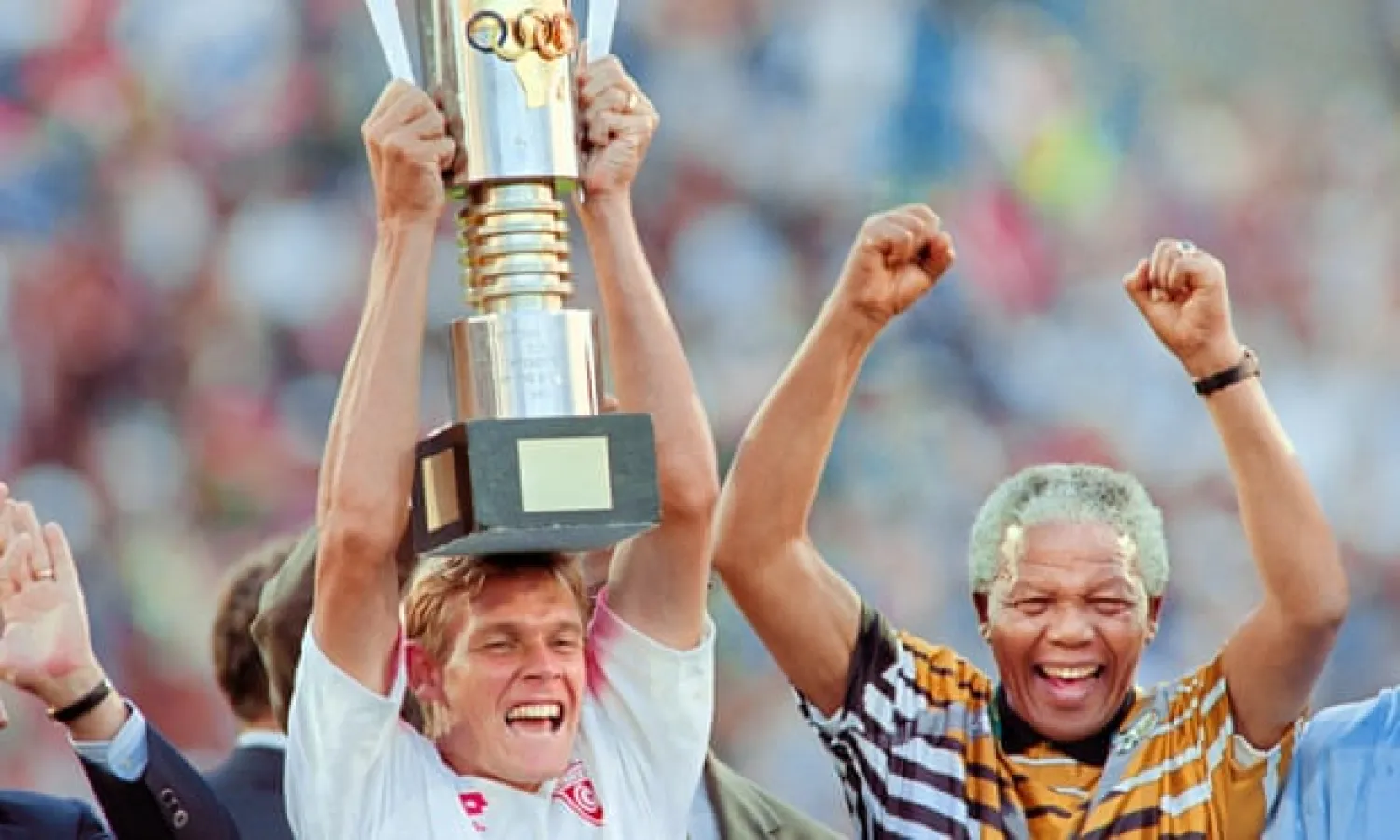
 Nelson Mandela celebrates as South Africa’s captain, Neil Tovey, lifts the African Cup of Nations trophy in 1996. Photograph: AFP/Getty Images
Nelson Mandela celebrates as South Africa’s captain, Neil Tovey, lifts the African Cup of Nations trophy in 1996. Photograph: AFP/Getty Images
TT

‘Mandela Brought Extra Pressure’: The Story of South Africa’s Afcon Triumph

 Nelson Mandela celebrates as South Africa’s captain, Neil Tovey, lifts the African Cup of Nations trophy in 1996. Photograph: AFP/Getty Images
Nelson Mandela celebrates as South Africa’s captain, Neil Tovey, lifts the African Cup of Nations trophy in 1996. Photograph: AFP/Getty Images

For Clive Barker victory over Cameroon in South Africa’s opening game of the 1996 Africa Cup of Nations was a huge relief. Ever since he had watched Joel Stransky execute his drop goal at Ellis Park six months earlier the head coach felt Bafana Bafana had taken on some emotional freight.

The South Africa rugby team had made the most of their hosting a showpiece; could the football team do the same? The pressure was not spoken so much as strongly hinted at, as Barker sensed when one weekend in Durban well ahead of the Afcon his eight-year-old niece, Suzie, called to him that he had a phone call. “It’s Nelson,” said the schoolgirl, “and he says he wants to talk to you, Uncle Clive.”

Over the following months the president engaged with Barker and the team regularly, privately inspiring, publicly nation-building.

“He brought an extra pressure because he made sure you got the sort of message: ‘You know what happened with the rugby,’” recalls Barker. “But he was great with the players, always asking after their families, very hands-on when he mingled with them. Sometimes he would bring his grandchildren to the hotel. It was a real influence on us.’

In his let-the-games-begin speech Nelson Mandela had talked of ‘Africa rising’. And it was: Cameroon broke through a glass ceiling at the first World Cup of the 1990s, Nigeria performed thrillingly at the second, and, three weeks before the 1996 Afcon, an African international had for the first time been awarded the Ballon d’Or, the sport’s highest individual accolade. That was George Weah, of Milan, and captain of Liberia. Weah arrived at Durban airport before Liberia’s first fixture with a regal bearing and a faint aura of entitlement. He was probably due it. The best footballer in the world was in the habit of funding flights, hotels and equipment for the cash-strapped Liberia team, as well as scoring and setting up a very high proportion of their goals.

Meanwhile, in Port Elizabeth, a star-studded Ghana would be led by Abedi Pele, the playmaker and former Champions League winner with Marseille. Up front was Tony Yeboah, whose muscular performances and astonishing goals from long range for Leeds United had made Philomen Masinga something of an understudy at that club.

Lucas Radebe sat in the stands at Soccer City for the opening game against Cameroon. A week later he crossed a significant threshold, trotting on to a wet pitch as a substitute for the final 13 minutes of the next group match, against Angola. Mark Williams, once again the penalty-box predator, quickest to a loose ball, had given Bafana Bafana a 1–0 lead. Radebe came on to help insure it, and to test his knee.

This was welcome news for a Bafana Bafana who could begin to plan for the knockouts. A fortnight after cutting through Cameroon they met Algeria for a place in the last four at Soccer City. Doctor Khumalo had a first-half penalty saved just when the contest seemed to plead for some calm. Happily, into this pell-mell dived Mark Fish, stabbing at Masinga’s neat lay-off to put Bafana Bafana ahead with 18 minutes left. The South Africa defender was, alas, then beaten to a header for Algeria’s equaliser, nodded in from a corner. John ‘Shoes’ Moshoeu settled any debate almost instantly, with an arrowed shot from outside the Algeria penalty area: 2–1 to the hosts. The open bowl of a soaked Soccer City turned into a jelly of bouncing umbrellas.

The big setback, though, was Masinga’s booking. He would be out of the semi-final, to where Ghana were en route, having defeated Zaire in Port Elizabeth, thanks to a goal from Yeboah. Such was Yeboah’s broad skill-set that there was a logic in assigning a dedicated marker to him. Barker had a volunteer. “I won’t let you down,” Radebe told his coach. As the teams lined up, Yeboah greeted his Leeds colleague, and made mention of the long injury. “Take it easy,” said Yeboah to Radebe, “you don’t want to hurt that knee again.”

Thus began the duel, the riveting centrepiece to the semi-final. First strike to Yeboah. Radebe, playing a straightforward pass across the defence, underhit it terribly. Yeboah pounced, teed up a confrontation with the goalkeeper, Andre Arendse, and the rapt crowd, hearts in mouths, watched the Ghanaian waste the opportunity. There were no further gifts but rather an exemplary study in adhesive man-marking. Radebe became Yeboah’s shadow.

At the other end of the pitch South Africa turned on the style with another Moshoeu showreel. He took Bafana Bafana’s first bold step to the final in spectacular fashion, planting a volley into the Ghanaian goal. Very soon after half-time Shaun Bartlett, in for the suspended Masinga, finished off a move begun by Radebe to thump Bafana Bafana two goals in front. Another Moshoeu virtuoso made it 3–0, with three minutes to go.

South Africa would now be meeting Tunisia, whose progress to the final had turned ominously stealthy. They had lost to Ghana in the group stage, squeaked past Gabon via a penalty shootout in the last eight and then apparently come into blossom as 4–2 winners against Zambia.

Barker then had a harder piece of information to give out: Williams was to be left out of the starting XI. Barker had seen Bartlett lead the line impressively against Ghana, and Masinga – the most naturally gifted of his strikers – was back from suspension. Setting out on the journey from Parktown to Soccer City, where spectators – thousands without tickets – had gathered many hours before kick-off, Williams was crestfallen. “It was a bit quiet in the bus,” recalls Barker, “and Mark sensed it. So then he got up and started dancing and singing and I thought: ‘What a great team man.’ I wouldn’t have taken it so lightly.”

Come the final, Williams waited restlessly through a goalless, tense first hour. He heard Barker bellow, “What the fuck are you doing?” at Fish for an unauthorised ramble upfield, and then, as he trotted up the touchline, Williams hatched a plan.

“They tell me that when he was warming up as a substitute, Mark Williams was telling the crowd, ‘Get the coach to play me!’” smiles Barker. “Well, he got his chance.”

Williams came on for Masinga in the 65th minute, the score still 0–0. In the 73rd a Doctor Khumalo free-kick picked out Fish, whose header fell to Eric Tinkler and, via a blocked effort, to the full-back Sizwe Motaung. From his cross, Williams headed the breakthrough goal. Two minutes later South Africa’s snubbed supersub did it again, Williams guiding a Khumalo through-ball across the goalkeeper with a purposeful left-footed finish, his fourth goal of the tournament and the end of Tunisia’s ambitions. In the VIP seats the president whooped.

The Guardian Sport


Alonso to Enter Dakar Rally with Loeb and Aston Martin Team

November 5, 2026 Aston Martin's Fernando Alonso during a press conference ahead of the F1 Sao Paulo Grand Prix. (Reuters)
TT

Alonso to Enter Dakar Rally with Loeb and Aston Martin Team

November 5, 2026 Aston Martin's Fernando Alonso during a press conference ahead of the F1 Sao Paulo Grand Prix. (Reuters)

Double Formula One champion Fernando Alonso will compete in next January's Dakar Rally in an Aston Martin Dreadnought entry run by engineering partner Prodrive.

The 45-year-old Spaniard, a 32-time Grand Prix winner and two-time Le Mans 24 Hours winner, will be racing in the annual event for the second time after competing with Toyota in 2020, finishing 13th.

France's nine-time world rally champion Sebastien Loeb and Brazil's reigning world rally-raid champion Lucas Moraes will be his teammates in a three-car entry.

The 49th edition of the Dakar Rally will ‌be held in ‌Morocco from January 9 to 23, with a prologue and first ‌stage ⁠in Portugal, after ⁠being moved from Saudi Arabia due to security concerns.

The 24-round Formula One season is due to start in Bahrain in March after testing in late February.

Alonso, who will again have compatriot and five-time motorcycle Dakar winner Marc Coma as co-driver, is racing in the Las Vegas Grand Prix this weekend. He said he had turned his thoughts to Dakar after deciding to continue in Formula One with Aston Martin.

“In the end, the decision became simple. I wanted to embrace ⁠the challenge completely and take on both Formula One and the ‌Dakar Rally in the same year," he explained in ‌a statement.

"In 2020, Dakar was one of the most challenging and enjoyable experiences of my career. ‌I have enormous respect for this race and the specialists who have mastered it.

"Formula One ‌remains my priority. But I am a racing driver, and challenges like this are why I love competing. I’m looking forward to seeing what we can achieve."

LOEB CHASES FIRST DAKAR WIN

In October, Alonso told reporters at the Singapore Grand Prix that he felt the desert endurance race would be physically ‌incompatible with his Formula One commitments.

Loeb, 52, will also be chasing a first Dakar win after 10 previous attempts that have brought ⁠him 28 stage ⁠wins to date.

“Winning the Dakar is very important to me,” said the Frenchman, who will be partnered by Belgian Fabian Lurquin. “We have come close several times, and the motivation is there to keep working until we achieve it."

The Dreadnought is a digital-only tactical SUV created exclusively for gamers playing "Call of Duty: Modern Warfare 4" that will now be brought into the real world by Prodrive, Aston Martin's partners in endurance GT racing.

The Dakar will be Aston Martin Racing’s debut in the world rally-raid championship.

"Aston Martin's ambition for this program has been clear from the outset: to create a car capable of competing at the front of the world's toughest motorsport event," said Prodrive Chairman David Richards.

"By combining Aston Martin's vision with Prodrive's experience in rallying, endurance racing and Dakar competition, we have built a strong foundation. With an exceptional driver line-up and a highly capable engineering team, we look forward to seeing Dreadnought take on this remarkable challenge."


Owono Does Not Deserve 12-Match Ban Over De Miguel Death, Says Andorra Owner Pique

Equatorial Guinea's goalkeeper #01 Jesus Owono leaves the pitch at half time during the Africa Cup of Nations (CAN) Group E football match between Equatorial Guinea and Algeria at Moulay Hassan Stadium in Rabat on December 31, 2025. (AFP)
TT

Owono Does Not Deserve 12-Match Ban Over De Miguel Death, Says Andorra Owner Pique

Equatorial Guinea's goalkeeper #01 Jesus Owono leaves the pitch at half time during the Africa Cup of Nations (CAN) Group E football match between Equatorial Guinea and Algeria at Moulay Hassan Stadium in Rabat on December 31, 2025. (AFP)

FC Andorra owner Gerard ‌Pique said goalkeeper Jesus Owono did not deserve the 12-match suspension he received following the challenge that led to the death of Tenerife forward Jesus de Miguel.

Owono and De Miguel collided during a Spanish second-tier match on November 2. De Miguel was taken to intensive care and died the following day.

The disciplinary committee of the Spanish football federation (RFEF) banned Owono for violent conduct which resulted in serious ‌injury last week.

"Players, ‌former players, coaches, goalkeepers, everyone has ‌called ⁠it an accident," ⁠Pique said in a video posted on social media late on Monday.

"I truly believe that imposing the maximum sanction on Jesus for this action puts him in a situation he does not deserve, because he is not to blame for all of ⁠this having happened."

Former Barcelona player Pique ‌pointed to the three-match ‌ban handed to Albacete's Jose Corpas for accidentally kicking Sabadell ‌player Quadri Liameed in the head during a ‌recent match in Spain.

"Fortunately Quadri is fine, the consequences in this case were not fatal, and the committee decided to sanction Corpas with three matches," Pique added.

"With ‌all this, my reflection is: what is being sanctioned, the action or the ⁠consequences?"

The RFEF ⁠did not immediately respond to a request for comment outside regular business hours in Spain.

Owono, 25, has withdrawn from Equatorial Guinea's squad for Africa Cup of Nations qualifiers against Zimbabwe this month and Pique said it was unlikely the goalkeeper would return to action as soon as his suspension is up.

"Jesus is going to need far more than 12 matches before he is available and able to compete," he added. "No sanction is going to bring Demi (De Miguel) back to us."


Alcaraz Says Experience Helped Him Crack Indoor Code after Back-to-back Title Wins

Tennis - ATP Finals - Palasport Olimpico, Turin, Italy - November 16, 2026  Spain's Carlos Alcaraz in action during his group stage match against Francis Tiafoe of the US. REUTERS/Guglielmo Mangiapane
Tennis - ATP Finals - Palasport Olimpico, Turin, Italy - November 16, 2026 Spain's Carlos Alcaraz in action during his group stage match against Francis Tiafoe of the US. REUTERS/Guglielmo Mangiapane
TT

Alcaraz Says Experience Helped Him Crack Indoor Code after Back-to-back Title Wins

Tennis - ATP Finals - Palasport Olimpico, Turin, Italy - November 16, 2026  Spain's Carlos Alcaraz in action during his group stage match against Francis Tiafoe of the US. REUTERS/Guglielmo Mangiapane
Tennis - ATP Finals - Palasport Olimpico, Turin, Italy - November 16, 2026 Spain's Carlos Alcaraz in action during his group stage match against Francis Tiafoe of the US. REUTERS/Guglielmo Mangiapane

Carlos Alcaraz said experience has finally taught him how to get the best out of his game on indoor courts, with the world number three carrying his title-winning form from Vienna and Paris into this week's ATP Finals in Turin.

Only three of his 29 career titles have come on indoor hard courts, with his first coming in Rotterdam last year.

The 23-year-old has enjoyed a strong run of form since ⁠returning to the ⁠tour in August after nearly five months out with a right wrist injury.

His 6-2 6-2 win over Frances Tiafoe in his opening match at the ATP Finals on Monday showed he could be a real force at ⁠the season finale.

"I've always said that I'm not bad on indoor courts," the seven-times Grand Slam champion told reporters. "I just feel like others are a little bit better than me.

"It was about time, it was about getting more experience and it was about understanding how I should play on indoor courts,” Reuters quoted him as saying.

The faster conditions can mean Alcaraz has less time to ⁠impose ⁠his game, but he said he was confident of going toe-to-toe with the big servers and flatter hitters.

Tiafoe was in no doubt about Alcaraz's current level.

"He has moments where he's definitely Superman and he's playing pretty insane," Tiafoe said.

"But again, it's one of those things, you've got to appreciate greatness."

Alcaraz continues his campaign for a first ATP Finals crown when he takes on former champion Daniil Medvedev on Wednesday.