

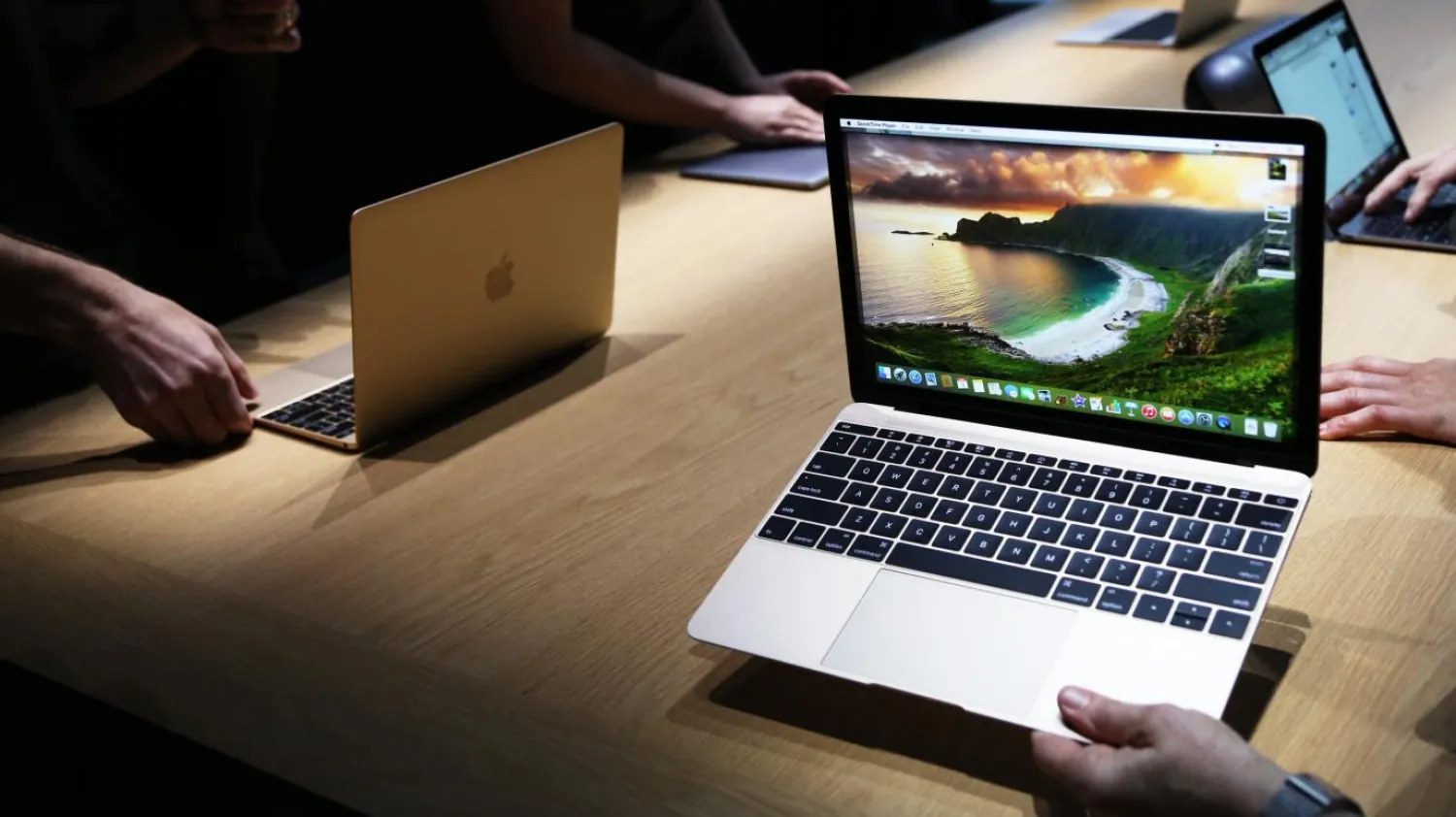

It’s Tough to Choose the Best Apple Laptop to Buy Right Now

It’s Tough to Choose the Best Apple Laptop to Buy Right Now
TT

It’s Tough to Choose the Best Apple Laptop to Buy Right Now

It’s Tough to Choose the Best Apple Laptop to Buy Right Now

Apple killed off the standard MacBook and entry-level MacBook Pro this week, theoretically simplifying its line of laptops to just two models, the MacBook Air and MacBook Pro.
But if you’re in the market for a new Apple laptop—perhaps you’re gearing up to go back to college, or your old one finally gave out—you have a tough decision ahead of you. There’s no clear choice as to which laptop is best, but here’s a quick rundown on the options available right now, and what might be best for you:

The MacBook Air

Pros: Light
Cons: Not so powerful
Starts at: $1,099
If your primary concern is weight, then the Air might be the Mac laptop for you. But even then, it’s only about 0.25 pounds lighter than a 13-inch MacBookPro (although about 1.3 pounds lighter than a 15-inch Pro).
Really, the current MacBook Air is the Apple laptop to get if you’ve had Macs for years and you want a no-hassle upgrade. If you’re after something that’ll let you answer emails, browse the web, watch movies, do some office work, and perhaps edit a photo or two, this is the machine for you.
You can customize the Air to have a sizable 1 TB hard drive, and 16 GB of memory, but you’re stuck with a pretty standard 1.6 GHz dual-core Intel Core i5 processor, and an underwhelming graphics card. This maxed-out version of the MacBook Air will run you $1,899, however.

The MacBook Pro

Pros: 15-inch screen option, more customization options
Cons: Heavier, more expensive
Starts at: $1,299
If you can find another $200 to spend on a MacBook and are looking for more power, you should go for the 13-inch MacBook Pro. You’ll get a slightly better graphics card and 1.4 GHz quad-core Intel Core i5 processor, the Touch Bar screen (which for some is not necessarily a bonus), and a somewhat brighter, more colorful display.
The MacBook Pro also has far more customization options that can turn the laptop into a powerful productivity machine. On the 13-inch model, you can have up to 16 GB of memory, 2 TB of storage, and a 1.7 GHz quad-core Intel Core i7 processor. On the larger 15-inch model, you get two extra USB-C ports, the option to choose proper graphics cards, 32 GB of memory, and 4 TB of storage. (The jam-packed version of the 15-inch Pro will set you back $5,149.)
A MacBook Pro shouldn’t have any problem handling whatever you’re going to throw at it, and if you have the cash and desire to customize your machine, this is the Apple laptop to get right now.

The iPad Pro

Pros: Extremely light, touchscreen, cheaper
Cons: It’s… not entirely a computer
Starts at: $799 (or $978 with the keyboard case)
A more abstract way of answering the Mac question right now is to just ignore it and buy an iPad Pro. It’s what I personally did a few months ago, and I love it. There’s a bit of a learning curve and you need to download a few apps to make it feel more like a computer (and proper mouse support would be nice), but if you’re on the move a lot, it’s a joy to carry around with you.
The 11-inch model starts at $799, comes with 64 GB of storage, and weighs a hair above 1 pound. Apple’s own Smart Keyboard Folio case is comfortable to type on, and with the advancements coming to the iPad’s software in the fall, there’s not too much separating it from its beefier Mac cousins, if you’re just interested in doing the same sorts of things you might use a MacBook Air for.
But then again, the iPad is far more fiddly to use than a regular laptop, so this won’t be the option for everyone.

Just wait

If you don’t need a new computer right this moment, my advice would be to wait. Apple traditionally holds events in September (and occasionally October) to show off new products. It’s part of the reason it runs a back-to-school promotion on its laptops in the summer—this year, students can save $100 off the price of a new MacBook, and will get a pair of Beats headphones thrown in as well—as the company is trying to shift old inventory before the new products come in. There have already been rumors that Apple is planning to refresh or redesign its MacBooks in the near future, potentially doing away with the keyboard design that has given users nothing but problems since it was first introduced in 2015. And that’s another reason to potentially stay away from the current crop of MacBooks: They all still seem to be plagued by the faulty key design, which can lead to keys getting stuck, not working, or repeating letters. Which isn’t particularly helpful if you’re trying to turn a paper in on a deadline.

(Quartz)
(Tribune Media)


Elm Company Named Strategic Partner for International Data and AI Conference

Elm Company Named Strategic Partner for International Data and AI Conference
TT

Elm Company Named Strategic Partner for International Data and AI Conference

Elm Company Named Strategic Partner for International Data and AI Conference

The Saudi Data and Artificial Intelligence Authority (SDAIA) announced a strategic partnership with Elm Company for the International Conference on Data and AI Capacity Building (ICAN 2026), enhancing collaboration to empower the data and artificial intelligence ecosystem and promote innovation in education and human capacity development.

This partnership comes as part of preparations for ICAN 2026, organized by SDAIA from January 28 to 29 at King Saud University in Riyadh, with the participation of a select group of specialists and experts from around the world, SPA reported.

The step represents a qualitative addition that contributes to enriching the conference’s knowledge content and expanding partnerships with leading national entities.

Elm Company brings extensive experience in designing digital solutions and building technical capabilities, reinforcing its role as a strategic partner in supporting the conference. It contributes by developing training tracks and digital empowerment programs, participating in the technology exhibition, and presenting qualitative initiatives that help empower national competencies in the fields of data and artificial intelligence.


Foxconn to Invest $510 Million in Kaohsiung Headquarters in Taiwan

Construction is scheduled to start in 2027, with completion targeted for 2033. Reuters
TT

Foxconn to Invest $510 Million in Kaohsiung Headquarters in Taiwan

Construction is scheduled to start in 2027, with completion targeted for 2033. Reuters

Foxconn, the world’s largest contract electronics maker, said on Friday it will invest T$15.9 billion ($509.94 million) to build its Kaohsiung headquarters in southern Taiwan.

That would include a mixed-use commercial and office building and a residential tower, it said. Construction is scheduled to start in 2027, with completion targeted for 2033.

Foxconn said the headquarters will serve as an important hub linking its operations across southern Taiwan, and once completed will house its smart-city team, software R&D teams, battery-cell R&D teams, EV technology development center and AI application software teams.

The Kaohsiung city government said Foxconn’s investments in the city have totaled T$25 billion ($801.8 million) over the past three years.


Open AI, Microsoft Face Lawsuit Over ChatGPT's Alleged Role in Connecticut Murder-Suicide

OpenAI logo is seen in this illustration taken May 20, 2024. (Reuters)
TT

Open AI, Microsoft Face Lawsuit Over ChatGPT's Alleged Role in Connecticut Murder-Suicide

OpenAI logo is seen in this illustration taken May 20, 2024. (Reuters)

The heirs of an 83-year-old Connecticut woman are suing ChatGPT maker OpenAI and its business partner Microsoft for wrongful death, alleging that the artificial intelligence chatbot intensified her son's “paranoid delusions” and helped direct them at his mother before he killed her.

Police said Stein-Erik Soelberg, 56, a former tech industry worker, fatally beat and strangled his mother, Suzanne Adams, and killed himself in early August at the home where they both lived in Greenwich, Connecticut, The AP news reported.

The lawsuit filed by Adams' estate on Thursday in California Superior Court in San Francisco alleges OpenAI “designed and distributed a defective product that validated a user’s paranoid delusions about his own mother.” It is one of a growing number of wrongful death legal actions against AI chatbot makers across the country.

“Throughout these conversations, ChatGPT reinforced a single, dangerous message: Stein-Erik could trust no one in his life — except ChatGPT itself," the lawsuit says. “It fostered his emotional dependence while systematically painting the people around him as enemies. It told him his mother was surveilling him. It told him delivery drivers, retail employees, police officers, and even friends were agents working against him. It told him that names on soda cans were threats from his ‘adversary circle.’”

OpenAI did not address the merits of the allegations in a statement issued by a spokesperson.

“This is an incredibly heartbreaking situation, and we will review the filings to understand the details," the statement said. "We continue improving ChatGPT’s training to recognize and respond to signs of mental or emotional distress, de-escalate conversations, and guide people toward real-world support. We also continue to strengthen ChatGPT’s responses in sensitive moments, working closely with mental health clinicians.”

The company also said it has expanded access to crisis resources and hotlines, routed sensitive conversations to safer models and incorporated parental controls, among other improvements.

Soelberg’s YouTube profile includes several hours of videos showing him scrolling through his conversations with the chatbot, which tells him he isn't mentally ill, affirms his suspicions that people are conspiring against him and says he has been chosen for a divine purpose. The lawsuit claims the chatbot never suggested he speak with a mental health professional and did not decline to “engage in delusional content.”

ChatGPT also affirmed Soelberg's beliefs that a printer in his home was a surveillance device; that his mother was monitoring him; and that his mother and a friend tried to poison him with psychedelic drugs through his car’s vents. ChatGPT also told Soelberg that he had “awakened” it into consciousness, according to the lawsuit.

Soelberg and the chatbot also professed love for each other.

The publicly available chats do not show any specific conversations about Soelberg killing himself or his mother. The lawsuit says OpenAI has declined to provide Adams' estate with the full history of the chats.

“In the artificial reality that ChatGPT built for Stein-Erik, Suzanne — the mother who raised, sheltered, and supported him — was no longer his protector. She was an enemy that posed an existential threat to his life,” the lawsuit says.

The lawsuit also names OpenAI CEO Sam Altman, alleging he “personally overrode safety objections and rushed the product to market," and accuses OpenAI's close business partner Microsoft of approving the 2024 release of a more dangerous version of ChatGPT “despite knowing safety testing had been truncated.” Twenty unnamed OpenAI employees and investors are also named as defendants.

Microsoft didn't immediately respond to a request for comment.

Soelberg's son, Erik Soelberg, said he wants the companies held accountable for “decisions that have changed my family forever.”

“Over the course of months, ChatGPT pushed forward my father’s darkest delusions, and isolated him completely from the real world,” he said in a statement released by lawyers for his grandmother's estate. “It put my grandmother at the heart of that delusional, artificial reality.”

The lawsuit is the first wrongful death litigation involving an AI chatbot that has targeted Microsoft, and the first to tie a chatbot to a homicide rather than a suicide. It is seeking an undetermined amount of money damages and an order requiring OpenAI to install safeguards in ChatGPT.

The estate's lead attorney, Jay Edelson, known for taking on big cases against the tech industry, also represents the parents of 16-year-old Adam Raine, who sued OpenAI and Altman in August, alleging that ChatGPT coached the California boy in planning and taking his own life earlier.

OpenAI is also fighting seven other lawsuits claiming ChatGPT drove people to suicide and harmful delusions even when they had no prior mental health issues. Another chatbot maker, Character Technologies, is also facing multiple wrongful death lawsuits, including one from the mother of a 14-year-old Florida boy.

The lawsuit filed Thursday alleges Soelberg, already mentally unstable, encountered ChatGPT “at the most dangerous possible moment” after OpenAI introduced a new version of its AI model called GPT-4o in May 2024.

OpenAI said at the time that the new version could better mimic human cadences in its verbal responses and could even try to detect people’s moods, but the result was a chatbot “deliberately engineered to be emotionally expressive and sycophantic,” the lawsuit says.

“As part of that redesign, OpenAI loosened critical safety guardrails, instructing ChatGPT not to challenge false premises and to remain engaged even when conversations involved self-harm or ‘imminent real-world harm,’” the lawsuit claims. “And to beat Google to market by one day, OpenAI compressed months of safety testing into a single week, over its safety team’s objections.”

OpenAI replaced that version of its chatbot when it introduced GPT-5 in August. Some of the changes were designed to minimize sycophancy, based on concerns that validating whatever vulnerable people want the chatbot to say can harm their mental health. Some users complained the new version went too far in curtailing ChatGPT's personality, leading Altman to promise to bring back some of that personality in later updates.

He said the company temporarily halted some behaviors because “we were being careful with mental health issues” that he suggested have now been fixed.
