


Iran's Rouhani Threatens Top Waterways Safety If US Halts Oil Exports

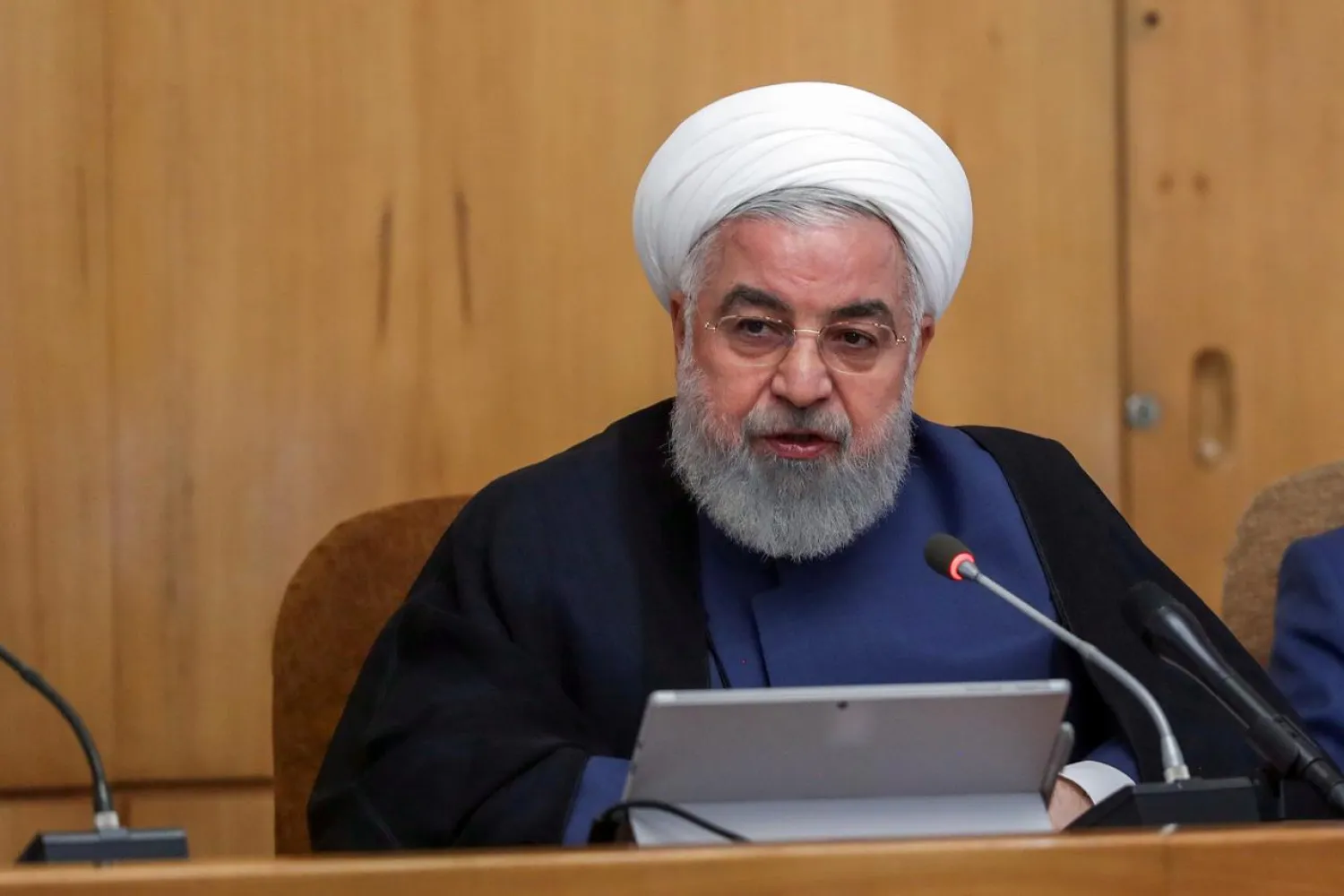
Iranian President Hassan Rouhani speaks during the cabinet meeting in Tehran, Iran, August 14, 2019. Official President website/Handout via REUTERS
TT

Iran's Rouhani Threatens Top Waterways Safety If US Halts Oil Exports

Iranian President Hassan Rouhani speaks during the cabinet meeting in Tehran, Iran, August 14, 2019. Official President website/Handout via REUTERS

If Iran's oil exports are cut to zero, international waterways will not have the same security as before, its president said on Wednesday, cautioning Washington against upping pressure on Tehran in an angry confrontation between the longtime foes.

The comment by President Hassan Rouhani coincided with a remark by Iranian Foreign Minister Mohammad Javad Zarif that Tehran might act "unpredictably" in response to "unpredictable" US policies under President Donald Trump.

"World powers know that in the case that oil is completely sanctioned and Iran's oil exports are brought down to zero, international waterways can't have the same security as before," Rouhani said while meeting Supreme Leader Ayatollah Ali Khamenei, according to Khamenei's official website.

"So unilateral pressure against Iran can't be to their advantage and won't guarantee their security in the region and the world."

Tensions between Tehran and Washington have risen since Trump's administration last year quit an international deal to curb Iran´s nuclear ambitions and began to ratchet up sanctions. Iranian officials have denounced the new penalties as "economic warfare".

In a speech at the Stockholm International Peace Research Institute (SIPRI), Zarif appeared to echo Rouhani's tone.

"Mutual unpredictability will lead to chaos. President Trump cannot expect to be unpredictable and expect others to be predictable. Unpredictability will lead to mutual unpredictability and unpredictability is chaotic," Zarif said.

Global commodity trading has been rocked in recent months after a series of attacks on international merchant vessels, which the United States has blamed on Iran, and the seizure of a British tanker. Tehran has denied the accusations.

Washington, which has by far the strongest Western naval contingent in the Gulf, has been calling for its allies to join it in an operation to guard shipping in the Strait of Hormuz, a vital gateway for the world´s oil industry.

So far, Britain, Australia, and Bahrain have joined the US-led security mission to protect merchant vessels traveling through key Middle East waterways.

Reiterating Iran's chilly response to the security mission, Iranian Rear Admiral Ali Fadavi, a deputy commander of the elite Revolutionary Guards, said no one can secure the Gulf other than Iran and countries of the region, according to the semi-official Fars news agency.

"Securing the Persian Gulf is the responsibility of Iran and the countries of the region," Fadavi said. "Other than us, no one can secure the Persian Gulf."



Turkish Police Detain Deutsche Welle Journalist over Social Media Posts

19 February 2026, Canada: Deutsche Welle (DW) logo is seen displayed on a smartphone screen. Photo: Thomas Fuller/SOPA Images via ZUMA Press Wire/dpa
TT

Turkish Police Detain Deutsche Welle Journalist over Social Media Posts

19 February 2026, Canada: Deutsche Welle (DW) logo is seen displayed on a smartphone screen. Photo: Thomas Fuller/SOPA Images via ZUMA Press Wire/dpa

Turkish police have detained investigative journalist Alican Uludag on suspicion of insulting President Recep Tayyip Erdogan and spreading misinformation, sparking outrage among journalism groups.
Uludag, who works for German broadcaster Deutsche Welle’s Turkish service, was taken from his home in Ankara late Thursday as part of an investigation into social media posts. The Istanbul Chief Prosecutor’s Office said he is suspected of “insulting the president” and “disseminating misleading information.”
The journalist, whose reporting focuses mainly on the judiciary and on corruption cases, was later transferred to Istanbul for questioning.
His detention drew sharp condemnation from press freedom advocates, who described it as an attack on media independence and democratic norms, The Associated Press said.
Deutsche Welle’s director‑general, Barbara Massing, demanded his release, calling the arrest “a deliberate act of intimidation.”
On Friday, journalists gathered outside Istanbul’s Çaglayan Courthouse to protest Uludag’s detention and to call for his immediate release.
The advocacy group, Reporters Without Borders considers Türkiye to be one of the most repressive countries for journalists, nothing that most media organizations are under government control and journalists face frequent legal pressure or intimidation.
At least 14 journalists or media sector workers are currently in prison, according to the Turkish Journalists Syndicate.


South Korea’s Ex-President Yoon Apologizes After Life Sentence Over Martial Law 

South Korean President Yoon Suk Yeol  delivers a speech to declare martial law in Seoul, South Korea, December 3, 2024. (The Presidential Office/Handout via Reuters/File Photo)
South Korean President Yoon Suk Yeol delivers a speech to declare martial law in Seoul, South Korea, December 3, 2024. (The Presidential Office/Handout via Reuters/File Photo)
TT

South Korea’s Ex-President Yoon Apologizes After Life Sentence Over Martial Law 

South Korean President Yoon Suk Yeol  delivers a speech to declare martial law in Seoul, South Korea, December 3, 2024. (The Presidential Office/Handout via Reuters/File Photo)
South Korean President Yoon Suk Yeol delivers a speech to declare martial law in Seoul, South Korea, December 3, 2024. (The Presidential Office/Handout via Reuters/File Photo)

Former ‌South Korean President Yoon Suk Yeol apologized on Friday for his short-lived declaration of martial law in December 2024, a day after a Seoul court sentenced him to life in prison for masterminding an insurrection.

In a statement released by his lawyers, Yoon said that while he was sorry for the "frustration and hardship" brought upon the people by his martial law decree, he stood behind the "sincerity and purpose" behind his actions.

The Seoul Central District Court's decision ‌to hand him ‌a life sentence on Thursday was "predetermined," he ‌said, ⁠adding that the verdict ⁠against him was political retaliation.

"Forces that seek to smear a decision made to save the nation as an 'insurrection' and to use it beyond political attacks as an opportunity to purge and eliminate their opponents will only grow more rampant going forward," he said.

Yoon also questioned ⁠whether an appeal would have meaning ‌in what he described as an ‌environment where judicial independence could not be guaranteed, while telling ‌supporters to "unite and rise."

His lawyers separately said the statement ‌did not amount to an intention to forgo an appeal.

Yoon's martial law declaration lasted around six hours before being voted down by parliament, but it sent shockwaves through the country and ‌sparked street protests.

The court found Yoon guilty of subverting constitutional order by deploying troops ⁠to storm ⁠parliament and move to detain opponents, capping a dramatic fall that saw him stripped of office and end up behind bars.

Yoon, a former career prosecutor, denied the charges, arguing he had presidential authority to declare martial law and his action was aimed at sounding the alarm over opposition parties' obstruction of government.

A special prosecutor had sought the death penalty for Yoon, though South Korea has not carried out an execution since 1997.

A prosecutor said on Thursday the team had some "regret" over the sentencing, but declined to say whether they planned to appeal.


Russia Hits Ukraine's Oil, Gas Infrastructure in Poltava Region, Naftogaz Says

FILE PHOTO: A Ukrainian service member of the 14th Unmanned Aerial Systems Regiment prepares a deep strike unmanned aerial vehicle before its launch toward Russian territory, amid Russia's attack on Ukraine, in an undisclosed location in Ukraine, undisclosed date, 2025. REUTERS/Valentyn Ogirenko/File Photo
TT

Russia Hits Ukraine's Oil, Gas Infrastructure in Poltava Region, Naftogaz Says

FILE PHOTO: A Ukrainian service member of the 14th Unmanned Aerial Systems Regiment prepares a deep strike unmanned aerial vehicle before its launch toward Russian territory, amid Russia's attack on Ukraine, in an undisclosed location in Ukraine, undisclosed date, 2025. REUTERS/Valentyn Ogirenko/File Photo

Russian drones hit Ukraine's oil and gas infrastructure in the central Poltava region, causing ‌damage ‌and a ‌fire, ⁠the state energy company ⁠Naftogaz said on Friday.

"This is yet another targeted ⁠attack on ‌our ‌oil and ‌gas infrastructure. ‌Since the beginning of the year, the ‌enemy has attacked Naftogaz Group facilities ⁠more ⁠than 20 times," Sergii Koretskyi, Naftogaz CEO said in a post on Facebook.