


PMF Leaders Divided over Blaming US for Arms Deport Blasts

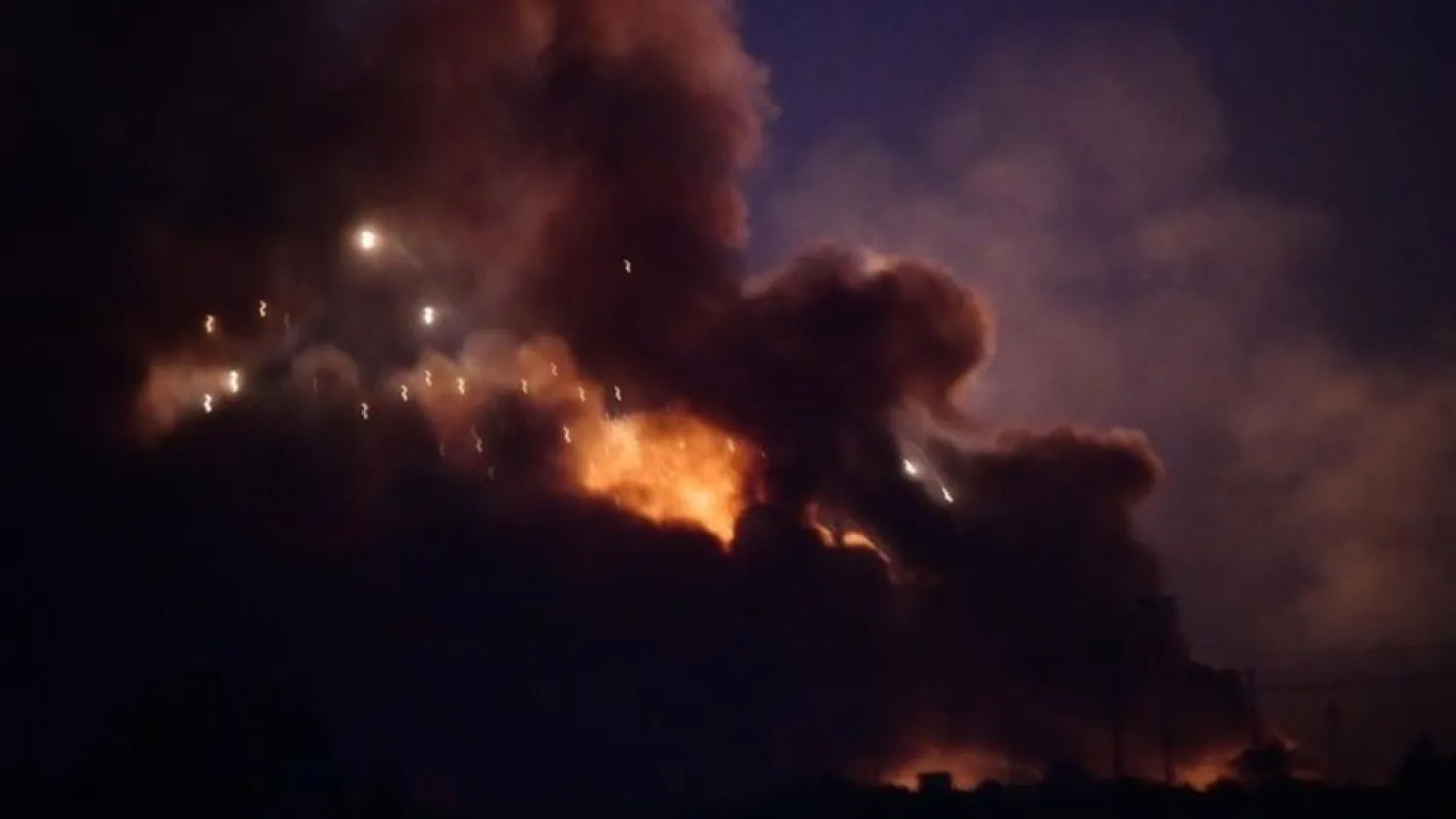
An explosion on August 12 near Baghdad sent rockets shooting though the capital. (EPA)
TT

PMF Leaders Divided over Blaming US for Arms Deport Blasts

An explosion on August 12 near Baghdad sent rockets shooting though the capital. (EPA)

Head of Iraq's Popular Mobilization Forces Faleh al-Fayyadh appeared on Thursday to renege on statements made by his deputy in blaming Israeli drones and the US for a series of attacks on bases run by the militia.

Fayyadh said the statement by his deputy, Abu Mahdi al-Muhandis, did not represent the view of the PMF or that of the Iraqi government.

He instead alleged that the attacks on the bases over the past weeks "were the result of an act organized by a foreign side," without naming that side.

The statement highlights divisions within thePMF, which is mostly run by the deputy, Muhandis, a military commander known for his anti-American sentiments.

In laying blame on the US, Muhandis said Wednesday: “We announce that the first and last entity responsible for what happened are American forces, and we will hold them responsible for whatever happens from today onwards.”

The PMF said it had carried out its own investigation and pointed the finger at the US military.

It claimed it had information that the US brought four Israeli drones from Azerbaijan to Iraq "as part of the US fleet" to carry out reconnaissance and targeting of militia positions.

Four bases used by the PMF have been hit by mysterious explosions over the past month, but there have been no claims of responsibility or media access to the facilities.

The most recent of the explosions came Tuesday night, at a munitions depot north of Baghdad. The deadliest, a July 19 blast, was blamed on a drone that hit a base in Amirli, northern Iraq, killing two Iranians and causing a huge fire.

A massive explosion on August 12 at the al-Saqr military base near Baghdad shook the capital, destroyed several homes, killed one civilian and wounded 28 others. The base housed a weapons depot for the Iraqi federal police and the PMF.

A panel created by the government to investigate that blast ruled out earlier suggestions that it was caused by an electrical short circuit or faulty storage of munitions. Instead, it said it was caused by a drone strike, according to a copy of the panel's report obtained by The Associated Press.

The report did not say who the drone belonged to.

Following a national security meeting last week to discuss the string of attacks, Iraqi Prime Minister Adel Abdul Mahdi ordered a ban on all military flights throughout the country — including by members of the US-led coalition in Iraq — unless specifically authorized by the Defense Ministry.

The US military's Central Command quickly said it would comply with that order as its forces are "guests within Iraq's sovereign borders."

An estimated 5,200 US troops are in bases across Iraq in training and advisory roles.


Israeli Reservist Rams Vehicle into Palestinian Man Praying in West Bank

Israeli security forces secure a street as they leave the Palestinian village of Bizariya, in the occupied West Bank, where Israeli authorities demolished the house of a Palestinian man killed in July after he and another man reportedly killed an Israeli settler on the same day, on December 24, 2025. (AFP)
TT

Israeli Reservist Rams Vehicle into Palestinian Man Praying in West Bank

Israeli security forces secure a street as they leave the Palestinian village of Bizariya, in the occupied West Bank, where Israeli authorities demolished the house of a Palestinian man killed in July after he and another man reportedly killed an Israeli settler on the same day, on December 24, 2025. (AFP)

An Israeli reservist soldier rammed his vehicle into a Palestinian man as he prayed on a roadside in ​the occupied West Bank on Thursday, after earlier firing shots in the area, the Israeli military said.

"Footage was received of an armed individual running over a Palestinian individual," it said in a statement, adding the individual was a reservist ‌and his ‌military service had ‌been terminated.

The ⁠reservist ​acted "in severe ‌violation of his authority" and his weapon had been confiscated, the military said.

Israeli media reported that he was being held under house arrest.

The Israeli police did not immediately respond to a Reuters request for comment.

The ⁠Palestinian man went to hospital for checks after ‌the attack, but was unhurt ‍and is now ‍at home.

Video which aired on Palestinian ‍TV shows a man in civilian clothing with a gun slung over his shoulder driving an off-road vehicle into a man praying on ​the side of the road.

This year ​was one of the most violent on ⁠record for Israeli civilian attacks against Palestinians in the West Bank, according to United Nations data that shows more than 750 injuries.

More than a thousand Palestinians were killed in the West Bank between October 7, 2023 and October 17, 2025, mostly in operations by security forces and some by settler violence, according to the UN In ‌the same period, 57 Israelis were killed in Palestinian attacks.


Deadly Blast Hits Mosque in Syria’s Homs, Saraya Ansar al-Sunna Claims Responsibility

Syrian security forces stand inside a damaged mosque after several people were killed in an explosion at a mosque as the Syrian Arab News Agency (SANA) said, in Homs, Syria December 26, 2025. REUTERS/Ali Ahmed al-Najjar
TT

Deadly Blast Hits Mosque in Syria’s Homs, Saraya Ansar al-Sunna Claims Responsibility

Syrian security forces stand inside a damaged mosque after several people were killed in an explosion at a mosque as the Syrian Arab News Agency (SANA) said, in Homs, Syria December 26, 2025. REUTERS/Ali Ahmed al-Najjar

A bombing at a mosque in Syria during Friday prayers killed at least eight people and wounded 18 others, authorities said.

Images released by Syria’s state-run Arab News Agency showed blood on the mosque’s carpets, holes in the walls, shattered windows and fire damage. The Imam Ali bin Abi Talib Mosque is located in Homs, Syria's third-largest city.

SANA, citing a security source, said that preliminary investigations indicate that explosive devices were planted inside the mosque. Authorities were searching for the perpetrators, who have not yet been identified, and a security cordon was placed around the building, Syria’s Interior Ministry said in a statement.

In a statement on Telegram, the Saraya Ansar al-Sunna said its fighters "detonated a number of explosive devices" in the mosque.

The same group had previously claimed a suicide attack in June in which a gunman opened fire and then detonated an explosive vest inside a Greek Orthodox church in Dweil’a, on the outskirts of Damascus, killing 25 people as worshippers prayed on a Sunday.

Several countries, including Saudi Arabia, Jordan and Lebanon, condemned the attack. 


Fuel Shortage Forces Gaza Hospital to Suspend Most Services

The sun sets behind a makeshift tent camp for displaced Palestinians set up in an area of al-Bureij camp, in the central Gaza Strip, Wednesday, Dec. 24, 2025. (AP)
TT

Fuel Shortage Forces Gaza Hospital to Suspend Most Services

The sun sets behind a makeshift tent camp for displaced Palestinians set up in an area of al-Bureij camp, in the central Gaza Strip, Wednesday, Dec. 24, 2025. (AP)

A major Gaza hospital has suspended several services because of a critical fuel shortage in the devastated Palestinian territory, which continues to face a severe humanitarian crisis, it said.

Devastated by more than two years of war, the Al-Awda Hospital in the central Gaza district of Nuseirat cares for around 60 in-patients and receives nearly 1,000 people seeking medical treatment each day.

"Most services have been temporarily stopped due to a shortage of the fuel needed for the generators," said Ahmed Mehanna, a senior official involved in managing the hospital.

"Only essential departments remain operational: the emergency unit, maternity ward and pediatrics."

To keep these services running, the hospital has been forced to rent a small generator, he added.

Under normal conditions, Al-Awda Hospital consumes between 1,000 and 1,200 liters of diesel per day. At present, however, it has only 800 liters available.

"We stress that this shutdown is temporary and linked to the availability of fuel," Mehanna said, warning that a prolonged fuel shortage "would pose a direct threat to the hospital's ability to deliver basic services".

He urged local and international organizations to intervene swiftly to ensure a steady supply of fuel.

Despite a fragile truce observed since October 10, the Gaza Strip remains engulfed in a severe humanitarian crisis.

While the ceasefire agreement stipulated the entry of 600 aid trucks per day into Gaza, only 100 to 300 carrying humanitarian assistance can currently enter, according to the United Nations and non-governmental organizations.

The remaining convoys largely transport commercial goods that remain inaccessible to most of Gaza's 2.2 million people.

- Health hard hit -

On a daily basis, the vast majority of Gaza's residents rely on aid from UN agencies and international NGOs for survival.

Gaza's health sector has been among the hardest hit by the war.

During the fighting, the Israeli miliary repeatedly struck hospitals and medical centers across Gaza, accusing Hamas of operating command centers there, an allegation the group denied.

International medical charity Doctors Without Borders now manages roughly one-third of Gaza's 2,300 hospital beds, while all five stabilization centers for children suffering from severe malnutrition are supported by international NGOs.

The war in Gaza was sparked on October 7, 2023, following an unprecedented Hamas attack on Israel that resulted in the deaths of 1,221 people, most of them civilians, according to an AFP tally based on official Israeli figures.

In Israel's ensuing military campaign in Gaza, at least 70,942 people - also mostly civilians - have been killed, according to the health ministry in the Hamas-run territory.
