


Inside the VAR Bunker: A Test for My Irrational Suspicion of Referees

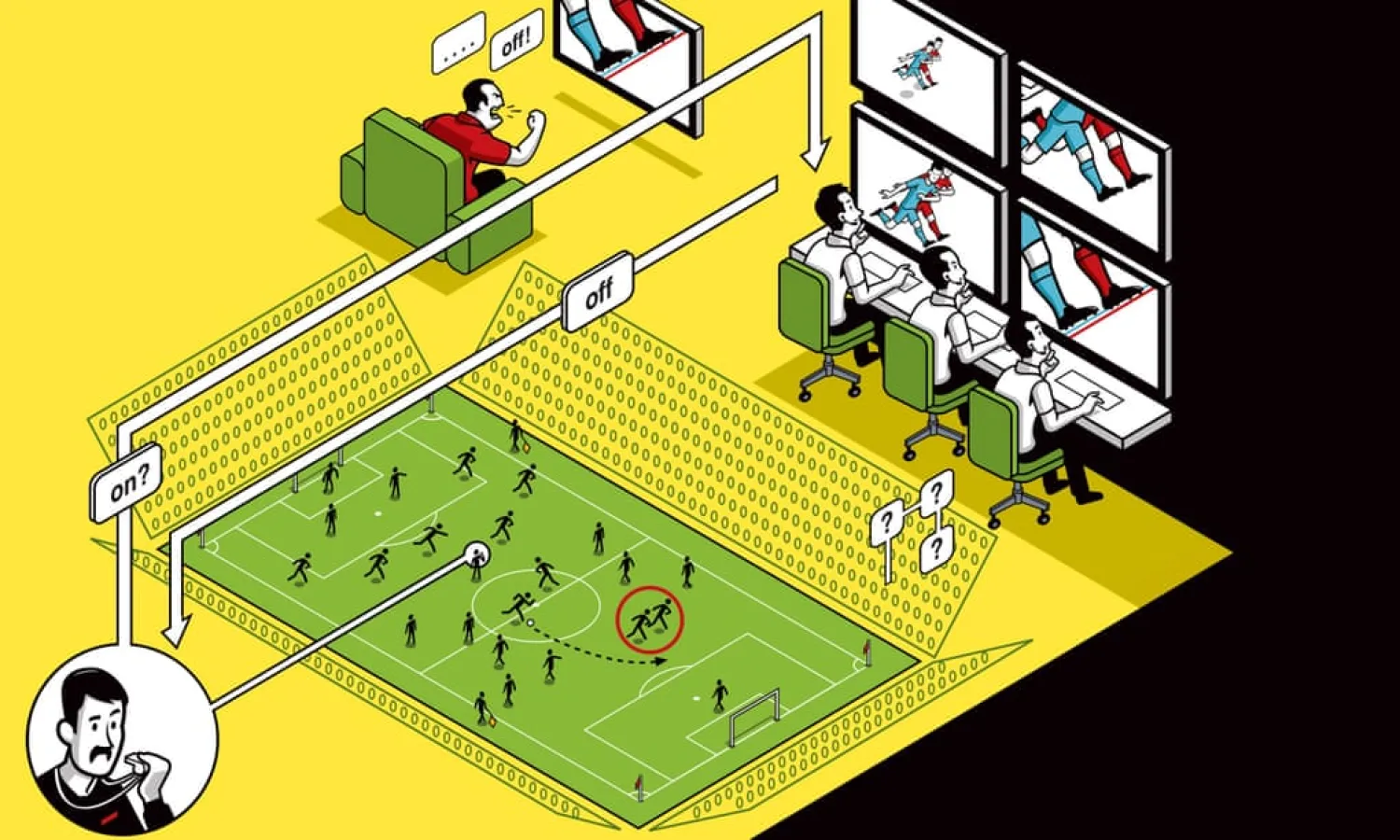
 ‘The room is full of TVs, much like a Bond villain’s lair, but with more life-size posters of Paul Tierney and Craig Pawson.’ Illustration: Nathan Daniels/The Guardian
‘The room is full of TVs, much like a Bond villain’s lair, but with more life-size posters of Paul Tierney and Craig Pawson.’ Illustration: Nathan Daniels/The Guardian
TT

Inside the VAR Bunker: A Test for My Irrational Suspicion of Referees

 ‘The room is full of TVs, much like a Bond villain’s lair, but with more life-size posters of Paul Tierney and Craig Pawson.’ Illustration: Nathan Daniels/The Guardian
‘The room is full of TVs, much like a Bond villain’s lair, but with more life-size posters of Paul Tierney and Craig Pawson.’ Illustration: Nathan Daniels/The Guardian

“What we have to do is find a way to help referees out.” This is Tony Pulis – then manager of West Brom – speaking in 2015. “I would definitely call now for managers to have two calls each and every game, where there are 30 seconds and they can have a video link-up with people upstairs who can watch it on video. It will eradicate the major decisions referees are getting wrong that actually affect games of football. The sooner that comes in the better.”

It was after a defeat at Manchester City. Gareth McAuley had been sent off for a professional foul early on. Wilfried Bony was clean through. It was the right decision in every aspect except one. It wasn’t Gareth McAuley. It was Craig Dawson. The referee who made the mistake was Neil Swarbrick.

“I thought they were twin brothers,” Swarbrick jokes. “I sent Gareth off and a few weeks later I saw him and he said not to worry – he and Craig got mistaken all the time. I asked him why he didn’t complain at the time, and he said it was first minute, they were playing City. He was glad to go off!”

The video footage doesn’t quite tally – McAuley seems to be saying “it wasn’t me” – but to be fair to Swarbrick it takes Peter Drury and Jim Beglin a good minute in the commentary box to realise McAuley is walking off the pitch. “I would have liked VAR 100%,” Swarbrick says. “It can only benefit you. There’s nothing worse than driving home from a game knowing you’ve made an error. A key one.”

We are at the home of VAR – Stockley Park. Swarbrick is now VAR Hub Command, which makes it sound as if he should be dressed as a Stormtrooper. Sadly he isn’t. He isn’t even in full referee’s kit. Unlike during the World Cup in Russia, the Premier League VARs wear polo shirts and tracksuit trousers.

The room is full of TVs, much like a Bond villain’s lair, but with more life-size posters of Paul Tierney and Craig Pawson. It is wallpapered in referees. Swarbrick runs the whole thing on a matchday – overseeing all the games. Each one has a VAR, an assistant and a Hawk-Eye operator who presses the buttons.

And Swarbrick is happy with VAR’s start to the season. “I think it’s been really positive. It shows that the work we’ve put in over the past two and a half years has been really beneficial. We’re not getting overly involved. There’s always going to be criticism because there are people who just don’t really like VAR, so it’s our role going forward to try and convert them and show that we’re not trying to interrupt the game.”

The Premier League and Professional Game Match Officials Limited have put on sessions for reporters and journalists to help explain how VAR will be used. Simon Morgan, head of football relations at the Premier League, kicks off by saying he’s heard some people in the industry refer to this course as a “brainwashing exercise” – which is exactly what we’ve been calling it on Football Weekly. And here I am, ready to have what little is in my mind wiped completely.

Manchester City fans have been given plenty of reasons to dislike VAR after they saw a winner chalked off against Spurs again last weekend. Photograph: Phil Noble/Reuters
Like all football fans I have been brought up to be irrationally suspicious of referees. They occupy this strange space in our consciousness – on our screens every week, yet we never hear them speak. So it’s with great disappointment when Swarbrick and the head of the PGMOL, Mike Riley, reveal themselves to be thoroughly pleasant and reasonable – even when one of the journalists suggests robot linesman as the solution to offsides.

The explanation of VAR is split into two parts: factual (fouls inside or outside the box, offsides, mistaken identity); and subjective, (possible fouls, such as Érik Lamela on Rodri last weekend).

“The ref will make the decision,” Swarbrick says. “He will explain why he’s given a penalty or not. He’ll put the meat on the bones for the VAR so then when the VAR looks it, if what the referee is saying is replicated on the screen then it doesn’t matter what the VAR’s opinion is – whether he thinks its a penalty or not is irrelevant. So if everything matches up, then the referee’s opinion sticks.”

It’s a bit like umpire’s call in cricket – it’s easy to argue that the decision is wrong, but it’s debatable and you can make a case that it’s correct, so it stays as it is. As Swarbrick explains of a Vincent Kompany lunge on Mo Salah in a City-Liverpool game last season: “[It’s] down to the explanation of the referee. Anthony [Taylor] gave a yellow card and he gave his reasons for giving it. If he’d given a red card, then once again the VAR would look at it and support that. So you can have two different instances in different games with different outcomes, but that is just the subjective nature of football.”

For fans in the stadium, it isn’t good enough. Only overturned decisions will be shown on big screens in the Premier League. In cricket DRS decisions are replayed on the big screen as they happen and you can hear the decisions with those commentary earpieces. There isn’t that agonising wait. In fact the third umpire explains things with such clarity that it soothes my whole existence. Hearing Marais Erasmus say “just rock and roll it there please”, helps me reach a heightened state.

In the classroom, we get to hear a conversation between the referee and the VAR. It’s an FA Cup game between Crystal Palace and Grimsby last season. Grimsby’s Andrew Fox goes over the top on Andros Townsend. It looks bad. The on-field ref, Martin Atkinson, gives Palace the advantage and says he’s going to book the player when play stops. Jon Moss is back at base. He tells Atkinson to hold off and ultimately tells him to send off the player – which Atkinson does. It’s not as calming as Marais Erasmus (nothing is) but when will football fans get to see and hear what’s going on?

“It’s taken cricket six or seven years to be in a comfortable position where they are,” Swarbrick says. “That could happen with football. I don’t want them [the VARs] to be worrying about how they’re saying things. Down the line we might get to that. Ultimately it’s down to Ifab [the International Football Association Board].”

The emotion of the celebration is the biggest problem. And it is hard to see how to rectify it. Cricket fans have learned to deal with an overturned decision, and perhaps football fans will too. It is imperfect, but the PGMOL is desperate to make everything as quick as possible. When everyone can check on their phone whether a goal was offside or not in a few seconds, VAR probably has to be there – or perhaps I’ve been brainwashed by Neil Swarbrick.

The Guardian Sport


Jeddah to Host Opening Round of UIM E1 World Championship

Hosting the season premiere aligns with Saudi Vision 2030 goals to diversify the economy and promote sports tourism. SPA
TT

Jeddah to Host Opening Round of UIM E1 World Championship

Hosting the season premiere aligns with Saudi Vision 2030 goals to diversify the economy and promote sports tourism. SPA

Jeddah is set to host the opening round of the third season of the E1 Series, the world's first all electric raceboat championship, on January 23 and 24.

Organized by the Saudi Water Sports and Diving Federation in partnership with the Public Investment Fund and the UIM, the event underscores Saudi Arabia’s commitment to modern sports and environmental sustainability.

The 2026 season features eight international rounds. Following the Jeddah opener, the series will travel to Lake Como (Italy), Dubrovnik (Croatia), and Monaco, followed by a second unannounced European round. The championship then heads to Lagos (Nigeria) and Miami (US), before reaching its grand finale in the Bahamas.

Hosting the season premiere aligns with Saudi Vision 2030 goals to diversify the economy and promote sports tourism. As Jeddah's shores transform into a global hub for advanced electric marine racing, the event solidifies the Kingdom's status as a leading destination for major international sporting competitions.


Djokovic Says 'Addiction' to Tennis Keeps him Going at 38

Tennis - Australian Open - Melbourne Park, Melbourne, Australia - January 17, 2026 Serbia's Novak Djokovic during the press conference REUTERS/Tingshu Wang
TT

Djokovic Says 'Addiction' to Tennis Keeps him Going at 38

Tennis - Australian Open - Melbourne Park, Melbourne, Australia - January 17, 2026 Serbia's Novak Djokovic during the press conference REUTERS/Tingshu Wang

Novak Djokovic said Saturday he still gets a "drug-like" adrenaline rush from tennis and is not thinking about retiring anytime soon.

The 38-year-old is about to embark on his 21st Australian Open and remains among the top contenders, behind defending champion Jannik Sinner and top-ranked Carlos Alcaraz.

Melbourne Park is his favorite hunting ground, claiming 10 titles.

Despite scaling back his tournament appearances in recent years the Serbian great remains confident he can still compete with the best and is not ready to leave the sport behind.

"I'm still living my dream to be honest," the former world number one said on the eve of the opening Grand Slam of the year.

"It's passion and love for the game. It's the interaction with people. It's the energy that you feel when you walk out on the court.

"That adrenaline rush, it's almost like a drug.

"I think that a lot of the top athletes from different sports can relate to that. I have been at least hearing them speak about that.

"It's so addictive, you know, the feeling of competing."

His long-time rivals Roger Federer and Rafael Nadal have both hung up their racquets and Djokovic said he constantly got asked about when he would join them.

"I have been asked a lot about obviously when is the end date going to come for me, but I don't want to talk or think about it yet because I'm here, I'm competing," AFP quoted him as saying.

"When that arrives and kind of becomes ripe in my head, I'll share it with you, and then we can all discuss on the farewell tour.

"But right now I'm still number four in the world, still competing at the highest level, and I feel like there is no need to draw the attention to that discussion."


World Number Ones Sabalenka, Alcaraz Begin Australian Open Campaigns

This handout picture released by Tennis Australia on January 16, 2026, shows Aryna Sabalenka of Belarus speaking at a press conference ahead of the 2026 Australian Open. (Photo by Vince Caligiuri / TENNIS AUSTRALIA / AFP)
TT

World Number Ones Sabalenka, Alcaraz Begin Australian Open Campaigns

This handout picture released by Tennis Australia on January 16, 2026, shows Aryna Sabalenka of Belarus speaking at a press conference ahead of the 2026 Australian Open. (Photo by Vince Caligiuri / TENNIS AUSTRALIA / AFP)

The first round of the Australian Open begins in Melbourne on Sunday.

World number one Carlos Alcaraz, who could complete a career Grand Slam if he wins the tournament, faces Adam Walton, while Aryna Sabalenka takes on Tiantsoa Rakotomanga Rajaonah as she seeks a third title at Melbourne Park.

TOP MEN'S MATCH: ALCARAZ V WALTON
At 22, Alcaraz could replace Don Budge as the youngest man to achieve the career Grand Slam with victory at the Australian Open. The Spaniard has left no one in any doubt what his main goal is for the 2026 season, saying in November he would rather win a first Melbourne Park crown than retain his French and US Open titles.

His quest to make history will begin with a first-round tie against Australian Walton, Reuters reported.

The pair have crossed paths once before, with Alcaraz beating the Australian ⁠6-4 7-6(4) during his title-winning run at the Queen's Club Championships last year.

TOP WOMEN'S MATCH: SABALENKA V RAKOTOMANGA RAJAONAH
Sabalenka will be bidding to continue her incredible record in hard court Grand Slam tournaments when she begins her campaign against Frenchwoman Rakotomanga Rajaonah.

The Belarusian world number one has reached the final of the last six majors she has played on the surface, winning four of those.

She enters the competition in fine form after retaining her Brisbane International title this ⁠month without losing a set, and should have little trouble when she takes on the 118th-ranked Rakotomanga Rajaonah.

VENUS WILLIAMS IS BACK
Venus Williams, a two-times Australian Open singles finalist, returns to the tournament for the first time since 2021 after receiving a wildcard.

The 45-year-old faces Olga Danilovic in the first round, where she is set to become the oldest woman to feature in the Australian Open main draw by surpassing Japan's Kimiko Date, who was 44 when she bowed out in the first round in 2015.

Williams has endured a poor start to the season, losing to Magda Linette in the first round in Auckland and to Tatjana Maria in her opening match at the Hobart International.

Despite her defeats, she ⁠said she was happy with her level.

"I can't expect perfection right now, but I know I'm playing good tennis.

Winning and losing doesn't know any age. Once you walk on court, you're there to compete," Williams said before her defeat in Hobart.
