Malaria Can be Eradicated by 2050, Health Experts

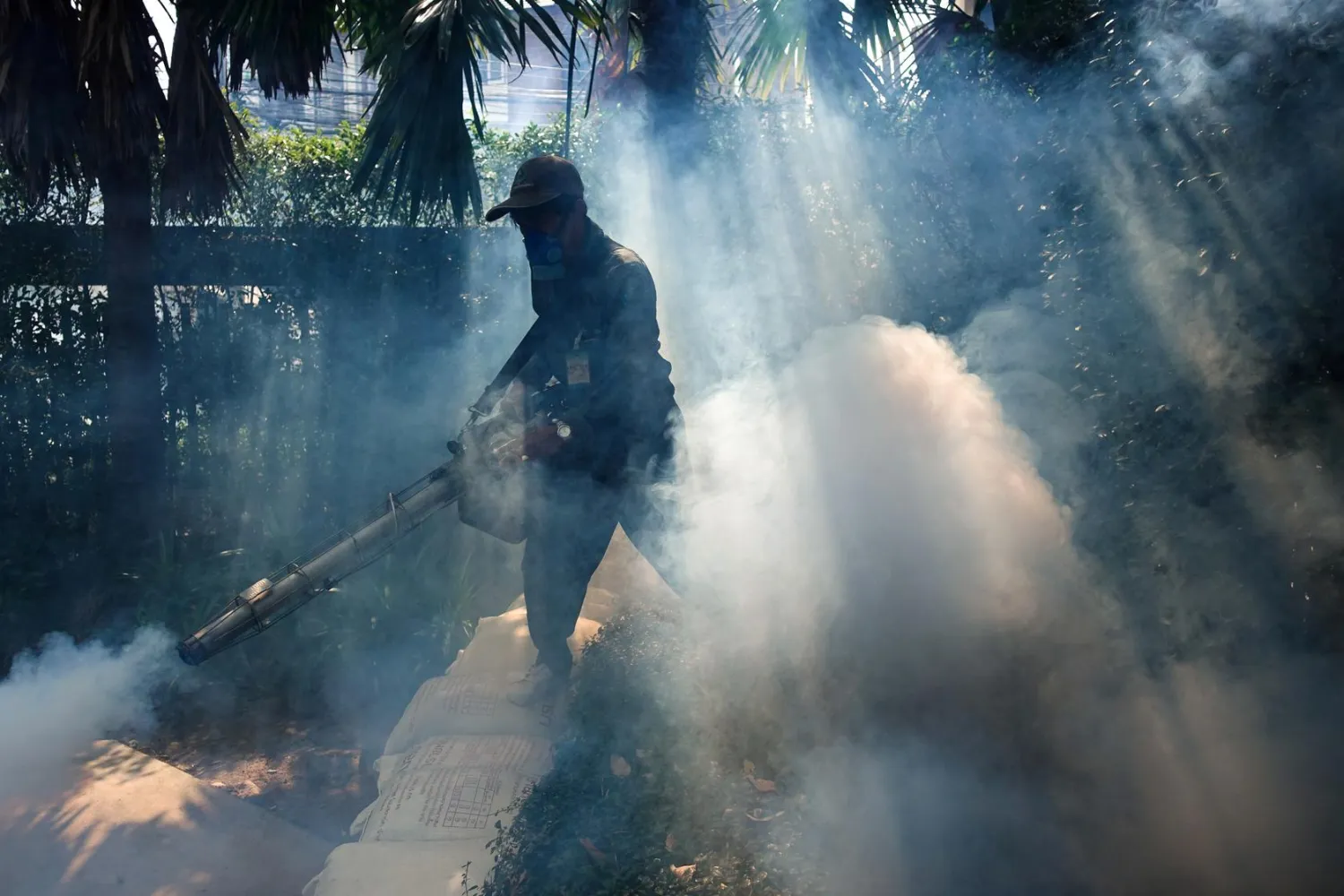
FILE PHOTO: A worker sprays insecticide for mosquitos at a village in Bangkok, Thailand, December 12, 2017. REUTERS/Athit Perawongmetha/File Photo
TT

Malaria Can be Eradicated by 2050, Health Experts

FILE PHOTO: A worker sprays insecticide for mosquitos at a village in Bangkok, Thailand, December 12, 2017. REUTERS/Athit Perawongmetha/File Photo

Malaria can be eradicated within 30 years, and the WHO should not shy away from this "goal of epic proportions," global health experts have said.

In a major report that contradicted the conclusions of a malaria review by the World Health Organization last month, 41 specialists said a future free of malaria, can be achieved as early as 2050.

To meet that target, however, governments, scientists and public health leaders need to inject more money and innovation into fighting the disease and the mosquitoes that carry it, the report said, something that will require "ambition, commitment and partnership like never before," reported Reuters.

Richard Feachem, director of the Global Health Group at the University of California, San Francisco, who co-chaired a review of malaria eradication commissioned by The Lancet medical journal, said: "For too long, malaria eradication has been a distant dream, but now we have evidence that malaria can and should be eradicated by 2050. We must challenge ourselves with ambitious targets and commit to the bold action needed to meet them."

The Lancet Commission's view comes a few weeks after the WHO published its own report on whether malaria can be wiped out, concluding that eradication cannot be achieved soon, and that setting unrealistic goals with unknown costs and endpoints could lead to "frustration and backlashes."

Malaria infected about 219 million people in 2017 and killed around 435,000 of them, with the vast majority being babies and children in the poorest parts of Africa.


India's Skyroot Aerospace Readies Country's 1st Private Orbital Rocket Launch

FILE PHOTO: Naga Bharath Daka and Pawan Kumar Chandana, founders of Skyroot Aerospace, pose in front of Vikram-I, India's first private commercial rocket, at the campus of Skyroot Aerospace during the inauguration ceremony of Infinity Campus, India's largest private rocket factory, in Hyderabad, India, November 27, 2025. REUTERS/Priyanshu Singh/File Photo
TT

India's Skyroot Aerospace Readies Country's 1st Private Orbital Rocket Launch

FILE PHOTO: Naga Bharath Daka and Pawan Kumar Chandana, founders of Skyroot Aerospace, pose in front of Vikram-I, India's first private commercial rocket, at the campus of Skyroot Aerospace during the inauguration ceremony of Infinity Campus, India's largest private rocket factory, in Hyderabad, India, November 27, 2025. REUTERS/Priyanshu Singh/File Photo

Indian space startup Skyroot Aerospace said on Thursday it was preparing for the launch of its Vikram-1 rocket, the first attempt by an Indian private company to place a satellite in orbit.

Founded by former Indian Space Research Organization engineers, Skyroot is developing small rockets similar to those built by Rocket Lab and Firefly Aerospace.

The Vikram-1, a seven-stories-tall, multi-stage ⁠launch vehicle, is designed ⁠to carry payloads of up to 350 kilograms into the low Earth orbit, Reuters reported.

Skyroot, which became India's first space startup to reach a $1 billion valuation after raising $60 million from ⁠GIC and Sherpalo Ventures in May, has set a July 12 - August 4 launch window for the maiden flight from the country's main spaceport, the Satish Dhawan Space Center.

The test flight, carrying a mix of domestic and international customers, aims primarily to collect in-flight performance data across propulsion, guidance and stage separation systems, ⁠the ⁠company said.

The launch comes as India opens its state-dominated space sector to private companies, seeking a bigger share of the global market for satellite launches and related services.

Industrial groups such as Larsen & Toubro and Hindustan Aeronautics Limited are also moving into rocket manufacturing as the government pushes to build a $44 billion space economy by 2033.


Coffee with a View: Tourists Flock to Starbucks Overlooking North Korea

TOPSHOT - A visitor holding a Starbucks cup takes a selfie as he looks at the North Korean side from a South Korean observation deck at Aegibong Peace Ecopark in Gimpo on July 1, 2026. (Photo by Jung Yeon-je / AFP)
TT

Coffee with a View: Tourists Flock to Starbucks Overlooking North Korea

TOPSHOT - A visitor holding a Starbucks cup takes a selfie as he looks at the North Korean side from a South Korean observation deck at Aegibong Peace Ecopark in Gimpo on July 1, 2026. (Photo by Jung Yeon-je / AFP)

The contrast cannot be starker: selfie-taking tourists sipping coffee at Starbucks -- an icon of globalization and capitalism -- while looking out over reclusive, communist North Korea.

Welcome to Aegibong Starbucks in Gimpo -- less than an hour's drive from South Korea's capital Seoul but a world away from its closed-off northern neighbor less than two kilometers (1.2 miles) across the Han river.

Perched on a hilltop beneath the Aegibong Peace Ecopark observatory where telescopes peek into the secluded state, the shop has drawn tens of thousands from South Korea and abroad since opening in November 2024.

Kim Jong-hyun, who lives in San Diego and was visiting South Korea with his family, said it was the irony of the contrast that drew him to the hilltop.

"When I heard there was a Starbucks here, I naturally thought I had to come and see it for myself. It's quite unusual," he told AFP.

Customers need to book ahead to enter the park that houses the coffee house.

They then travel from a parking lot in a shuttle operated by park authorities and cross a military checkpoint guarded by armed South Korean marines.

The journey is part of the experience -- walking the last stretch inside South Korea while looking out on agricultural and mountain landscapes in a country whose outside image the government under Kim Jong Un seeks to manage entirely.

Very few foreign journalists or tourists -- mainly from allies Russia and China -- can enter North Korea, and then under tightly controlled conditions.

South and North Korea are technically at war because their 1950-53 conflict ended in an armistice rather than a peace treaty.

The nations are separated by an ironically-named Demilitarized Zone.

The South, an important US security ally, rose from the ruins of war to become an advanced economy home to Samsung Electronics and other tech giants.

But the North -- ruled with an iron fist by a third-generation leader -- is crippled by sanctions over its pursuit of nuclear weapons.

- 'On a different scale' -

James Seymour, an Irish tourist, told AFP the scene from the lookout point was one of "polar opposites."

"We're from Belfast and we're kind of used to war... the Troubles and all that if you know what I mean," he said, referring to the sectarian conflict that gripped Northern Ireland in the late 20th century.

But standing near the border, sipping coffee from a global chain while looking at the North's nondescript low-rise buildings, was "on a different scale completely", he said.

"You couldn't get any more American than Starbucks and you couldn't get any further than America, you know... North Korea."

The number of visitors to Aegibong Peace Ecopark has more than doubled since the Starbucks opened, according to figures provided by park management.

The number of foreign visitors last year rose 275 percent to 56,829 from a year earlier, with Chinese tourists accounting for the largest share, nearly a third.

Lee Chun-woo of the Gimpo Cultural Foundation, which oversees the park, told AFP the increase was "totally attributable to the Starbucks store".

- 'Death to Communism' -

Starbucks Korea said it chose the setting for the "scenic confluence of the Han and Imjin rivers" that offer visitors a "unique place to relax amid nature".

In a statement to AFP, it did not mention the proximity of the 136-square-meter (1,464 square foot) store to North Korea.

But Chung Yong-jin, chairman of the Shinsegae Group that operates Starbucks Korea under a licensing agreement, has been more vocal about the South's secretive neighbor.

In several Instagram posts -- all of which he has since deleted -- Chung used the phrase "Death to Communism" multiple times.

"Whenever North Korea fired missiles, investors pulled their money out," Chung said in a 2022 social media post explaining his comments.

He described himself as "a business owner and as a South Korean citizen who lives with the daily uncertainty of not knowing when a missile might strike" his country.

"To some people, Death to Communism is a political slogan. To me, it's reality," said Chung.


Bear Spray Goes Off in Japan Post Office, Five Hospitalized

(FILES) A staff member sorts bells next to an advertisement for bear spray at a store in Hanamaki, Iwate prefecture on October 24, 2025. (Photo by Caroline GARDIN / AFP)
TT

Bear Spray Goes Off in Japan Post Office, Five Hospitalized

(FILES) A staff member sorts bells next to an advertisement for bear spray at a store in Hanamaki, Iwate prefecture on October 24, 2025. (Photo by Caroline GARDIN / AFP)

Five people needed hospital treatment in Japan after a man accidentally set off an anti-bear spray in a city-center post office, reports and officials said, as the country grapples with a sharp rise in maulings.

A 22-year-old Vietnamese national apologized and told police that he discharged the repellant unintentionally in the incident on Wednesday in the central city of Nagoya, the reports said.

The man, named as Huynh Nhat Duy, was nonetheless arrested on Thursday on suspicion of obstruction of business, police spokesman Kenji Goto told AFP.

"Eight people felt sick, and of those, five were sent to hospital. But there was no report of serious injuries or illness," fire department official Ryohei Asano told AFP.

At least five people have been killed by bears in Japan since April 1 after a record 13 deaths last fiscal year.

This week, authorities said they were investigating a sixth possible fatality after a man's body with bite marks was found in a mountainous area in the north.

Environment ministry data dating back to the year to March 2018 shows that this year is the first to see more than two deaths in the period from April to June.

Scientists attribute the sharp rise in incidents to an increase in the bears' population, a declining number of people in rural areas and other factors including variations in the availability of bears' usual food.

Authorities recommend people avoid going alone into the mountains -- which make up some 80 percent of Japan -- to attach a bell to their bags, and to carry bear sprays.

These aerosols, sold in outdoor activity stores, contain capsaicin -- the chemical component in spicy chili peppers -- and cause a burning and irritating sensation.

Bears are also encroaching increasingly into towns and cities in Japan.

In June, dozens of police, hunters and city officials needed four days to trap a bear roaming Utsunomiya, north of Tokyo, forcing mass school closures.

Before that another bear described as "extremely intelligent" -- it opened a window and turned on a tap -- attacked four people at two factories in Fukushima and remained at large for days.

Last week authorities in Hachioji on the Tokyo outskirts announced plans to buy 700 anti-bear sprays for schools and community organizations, as well as movable electric fences and devices that make high-pitched sounds.