


Turning Our Clubs Into Global Brands Means There Will Be More Burys

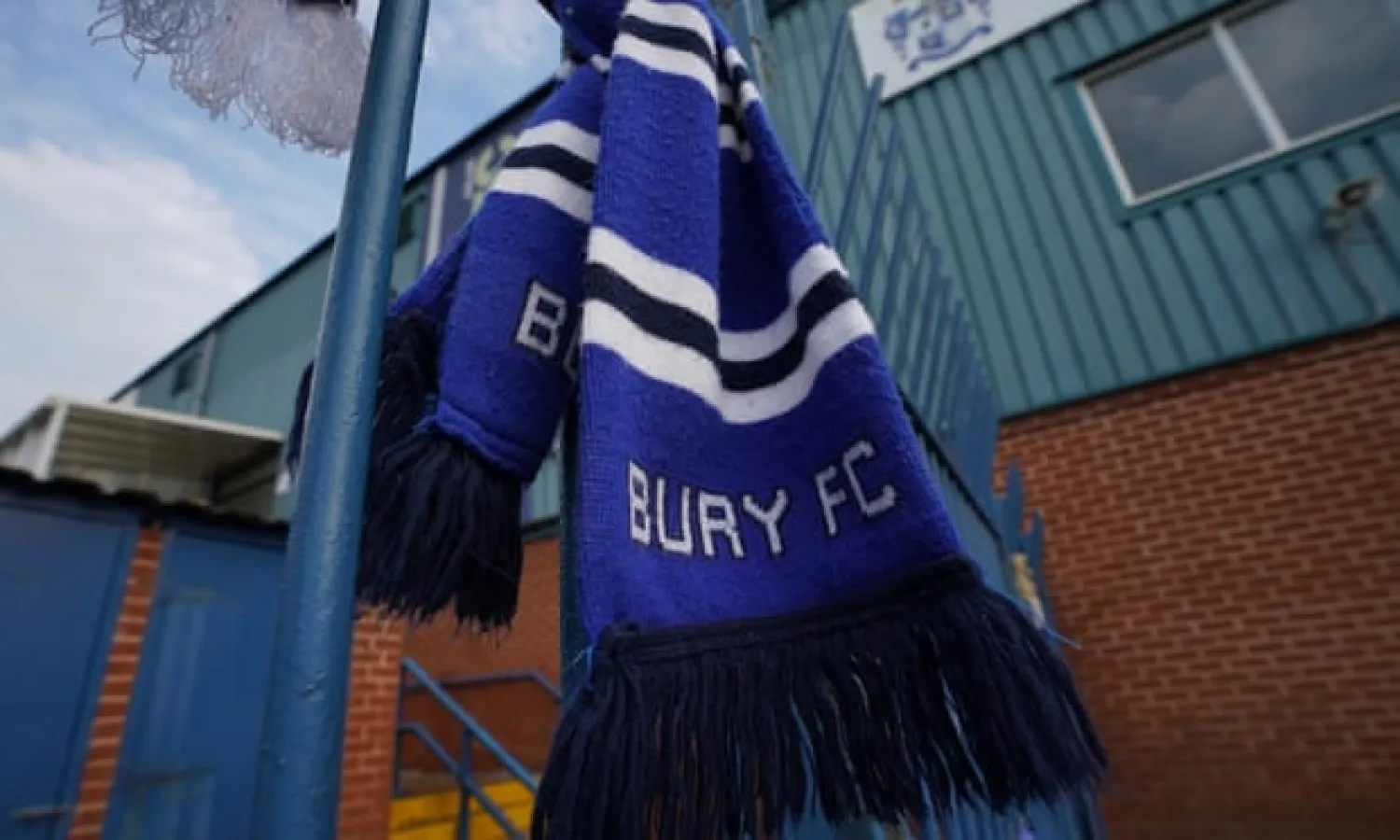
 A scarf hanging at Bury’s Gigg Lane ground this week. Photograph: Jon Super/The Guardian
A scarf hanging at Bury’s Gigg Lane ground this week. Photograph: Jon Super/The Guardian
TT

Turning Our Clubs Into Global Brands Means There Will Be More Burys

 A scarf hanging at Bury’s Gigg Lane ground this week. Photograph: Jon Super/The Guardian
A scarf hanging at Bury’s Gigg Lane ground this week. Photograph: Jon Super/The Guardian

A recent Set-Piece Menu podcast eloquently made the case for fandom as a broad church. When the Premier League is marketed so aggressively all over the world, when overseas television rights bring it so much revenue, when players and managers and owners are often foreign, they argued – quite reasonably – who is to deny the travelling supporter from Baltimore or Bangalore their seat in the stadium, the right to call themselves a fan? All of that made sense.

On an intellectual level I agreed with it. It fitted my general liberal, globalised worldview. And yet, I realised, viscerally I disagreed: of course, I paid lip service to all that but actually I regarded my form of fandom as being more authentic and more important.

Sunderland is part of me in a way that is beyond choice. I grew up there and my family is from there. Sunderland is the unsatisfactory repository for the emotions linked to memories of my dad and of all the mates I went to games with as a teenager.

But it is also for something less rational, for a nebulous and no doubt over-romanticised sense of home, for the family who long ago came from Ireland and Scotland looking for work in the shipyards and found belonging by going to games. Sunderland is who I am in a way that matters far more than individual results or whichever clowns happen to be wearing the shirts this season.

That is why it matters and it is why Bury matter and Bolton matter: if a clod be washed away by the sea, football is less. And frankly I find it hard to reconcile that sense with respecting the rights and feelings of a fan from outside who had a choice. I am also aware that this places me uncomfortably on the opposite side of the current cultural struggle to the one I would usually occupy.

But we should not be naive. Money has always played a significant role in football. The clubs who dominated the league in its early days – Preston, Sunderland and Aston Villa – did so largely by buying in the best Scottish talent. When, as English champions, Sunderland beat the Scottish champions, Hearts, 5-3 at Tynecastle in the first club world cup in 1895, all 22 players were Scots. Liverpool and Chelsea were established by stadium owners with the specific aim of getting people to pay to watch them play. The league was never some cosy alliance of community ventures.

Yet the gulf between football’s rich and poor has never been so stark. The agglomeration of highly remunerated talent at the top end of the game is producing football of exceptional quality and recent Champions Leagues, at least in the knockout stages, have produced extraordinary drama. The question is, is it worth it?

At Bury and Bolton, specific mistakes have been made by specific owners in an environment that has done little to regulate who is allowed to own clubs or how they behave. But the issues that have taken them to the brink are not unique to them. This is a systemic problem. There are those who would shrug and point out no other country sustains a league of 92 clubs (plus other professional teams in non-league) and that a certain natural wastage is inevitable. But that is one of the great joys of English football: the economic logic of the vast supermarket chains gobbling up the corner shop should not apply.

As David Goldblatt’s new book The Age of Football makes clear, this is part of a much wider trend, as everything – players, managers, investment, attention – is sucked towards a handful of clubs in a handful of leagues in western Europe. To watch an Argentinian or Brazilian league game is to be shocked by how low the quality is given the global familiarity of their best players.

Africa Cups of Nations are habitually played out in front of empty stadiums, in large part because, across the continent, the culture of going to games has gone. The football people care about is played in Europe and so it is consumed via satellite television in bars and video halls. So little consideration is the match-going fan given that the rash of new stadiums built for each Cup of Nations tend to be built on the outskirts of towns: fine for VIPs and television, rather less convenient for locals who may want to attend matches.

The terrible irony is that the pressure on smaller clubs in England is intensifying even though attendances across the four divisions are as good as they have been in four decades. The crisis stems from the chasm between the Premier League and the rest, and the various gambles being taken to try to bridge it. It is a result of the greed of the breakaway clubs in 1992.

What are those clubs now? With foreign owners, foreign managers, foreign players and, increasingly, foreign fans, they are global brands that happen to be based in England. Even at Liverpool, where the community feel is far stronger than at most of the superclubs, the dead hand of finance lurks. It is there in the slogan “This means more”, the sort of self-absorbed scouse exceptionalism that has always raised wry smiles among fans of other clubs repackaged and delivered back to fans as a (non‑ironic) marketing campaign. And it is there in the ill-judged attempt to trademark the word “Liverpool”, as though the city itself could somehow be taken from its people and transformed into a token to be bought and sold. And, frankly, even that is probably preferable to being a propaganda tool for a nation state.

What place has my irrational sense of Sunderland identity in the modern game? Is it possible to have the benefits of globalisation without the rich-getting-richer creed that underpins it, to be cosmopolitan without destroying communities? That feels the central cultural question of our age, and football is nowhere near answering it.

The standard of play has never been better but the cost is devastating.

The Guardian Sport


Real Coach Alonso Looking for Team to Bounce Back Against Man City 

Real Madrid's Spanish coach Xabi Alonso gestures to players during the Spanish league football match between Real Madrid CF and RC Celta de Vigo at the Santiago Bernabeu Stadium in Madrid on December 7, 2025. (AFP)
TT

Real Coach Alonso Looking for Team to Bounce Back Against Man City 

Real Madrid's Spanish coach Xabi Alonso gestures to players during the Spanish league football match between Real Madrid CF and RC Celta de Vigo at the Santiago Bernabeu Stadium in Madrid on December 7, 2025. (AFP)

Real Madrid go into Wednesday’s Champions League clash against Manchester City reeling from a surprise home setback at the weekend and a lengthy injury list, but coach Xabi Alonso says they need to bounce back quickly.

Real lost their 100% home record in the Spanish league on Sunday in a shock 2-0 defeat to Celta Vigo, and fell four points behind leaders Barcelona, but have little time to reflect on the setback before their Champions League assignment.

“We need to turn the page as quickly as possible,” Alonso said as Monday’s Spanish sports press speculated on the state of his relationship with his players.

“There's a long way to go in La Liga. And we have the Champions League match against City to react and get rid of this bad taste in our mouths.”

With Real winning only one of their last five LaLiga fixtures, Alonso has come under scrutiny for his relationship with players, system of playing and tactical decisions, while injuries have suddenly piled up again.

“We're struggling with injuries. It was hard for us to react,” added Alonso, whose side finished Sunday’s game with two red cards.

“It hurts, we're angry, and we understand why people are angry."

Defender Eder Militao hobbled off the Estadio Santiago Bernabeu pitch in the first half on Sunday and joins David Alaba, Trent Alexander-Arnold, Dani Carvajal, Dean Huijsen and Ferland Mendy on the injury list. Jude Bellingham also suffered a cut above the eye but is expected to feature against Manchester City.

“The situation is tight due to injuries. We have to make adjustments for each match, and we'll see how things go for Wednesday,” added the coach, who took over from Carlo Ancelotti at the start of the season.

Sports newspaper AS said Alonso was unable to motivate his team while Marca claimed he would not be able to fix things.

But the coach offered a different outlook: “We're all united and know that we can turn things around. There's still a long way to go, and you can have a bad game at home. We know what the demands are at this club. Defeats hurt a lot, but we have to look ahead.”


Tearful Norris Takes F1 Title as Verstappen Wins Abu Dhabi Race

 McLaren driver Lando Norris of Britain reacts after becoming a world champion after the Abu Dhabi Formula One Grand Prix in Abu Dhabi, United Arab Emirates, Sunday, Dec. 7, 2025. (AP)
McLaren driver Lando Norris of Britain reacts after becoming a world champion after the Abu Dhabi Formula One Grand Prix in Abu Dhabi, United Arab Emirates, Sunday, Dec. 7, 2025. (AP)
TT

Tearful Norris Takes F1 Title as Verstappen Wins Abu Dhabi Race

 McLaren driver Lando Norris of Britain reacts after becoming a world champion after the Abu Dhabi Formula One Grand Prix in Abu Dhabi, United Arab Emirates, Sunday, Dec. 7, 2025. (AP)
McLaren driver Lando Norris of Britain reacts after becoming a world champion after the Abu Dhabi Formula One Grand Prix in Abu Dhabi, United Arab Emirates, Sunday, Dec. 7, 2025. (AP)

McLaren's Lando Norris sobbed tears of joy and relief as he won the Formula One championship for the first time and ended Max Verstappen's four-year reign with a nervy third place at the Abu Dhabi Grand Prix on Sunday.

Red Bull's Verstappen, who ended the campaign with more wins (eight) than any driver, triumphed in the season-ender with McLaren's Oscar Piastri second and 12.5 seconds behind at the chequered flag.

Norris, Britain's 11th Formula One world champion, took his points tally to 423 with Verstappen on 421 and Piastri third with 410.

McLaren, who secured the constructors' championship in October for the second year in a row, won both titles in the same season for the first time since 1998.

"I've not cried in a while. I didn't think I would cry but I did," said an emotional Norris in a post-race interview, after also shedding tears inside his helmet.

"It feels amazing. I now know what Max feels like a little bit.

"I want to congratulate Max and Oscar, my two biggest competitors the whole season. It's been a pleasure to race against both of them. It's been an honor, I've learned a lot from both," he added.

Norris's mother Cisca gave Piastri a consoling hug while both Verstappen and the Australian congratulated the new champion in a show of sportsmanship.

The victory denied Verstappen the achievement of five titles in a row, something only Ferrari great Michael Schumacher has managed so far.

Charles Leclerc finished fourth in Sunday's race for Ferrari with George Russell fifth for Mercedes and Fernando Alonso sixth for Aston Martin.

Esteban Ocon was seventh for Haas, ahead of Ferrari's seven-times world champion Lewis Hamilton -- who failed to stand on the podium all year in a career low for the 40-year-old who joined the Italian team this year from Mercedes.

Sauber's Nico Hulkenberg was ninth in the German's 250th race and Lance Stroll 10th for Aston Martin.


Chelsea’s Maresca Says Delap Shoulder Injury Looks Bad

Football - Premier League - Leeds United v Chelsea - Elland Road, Leeds, Britain - December 3, 2025 Chelsea's Liam Delap on the pitch before the match. (Reuters)
TT

Chelsea’s Maresca Says Delap Shoulder Injury Looks Bad

Football - Premier League - Leeds United v Chelsea - Elland Road, Leeds, Britain - December 3, 2025 Chelsea's Liam Delap on the pitch before the match. (Reuters)

Chelsea forward Liam Delap may face another spell on the sidelines with a shoulder injury after being forced off in the first half of Saturday’s 0-0 Premier League draw at Bournemouth, manager Enzo Maresca said.

Delap, who moved to Stamford Bridge from Ipswich Town in June, had also picked up a hamstring injury early on in the season and returned to the side only last month.

"He has been unlucky. We are also a bit unlucky because we need that kind of a No. 9," Maresca told reporters after the match.

"Unfortunately, he has already been out for two months and he has to be out again. We don't know for how long, but it looks quite bad, his shoulder."

Chelsea, who played to their first goalless draw since a home clash with Crystal Palace in August, were left in fourth place in the league table with 25 points from their 15 games.

"I think it was a game where we lacked and we missed a little bit of quality in the last third," Maresca said.

"For me, there were many mistakes. We missed some passes in the last third, some moments that we could shoot and didn’t."

Chelsea will next face Atalanta in a Champions League clash on Tuesday before hosting Everton on Saturday.
