


Turning Our Clubs Into Global Brands Means There Will Be More Burys

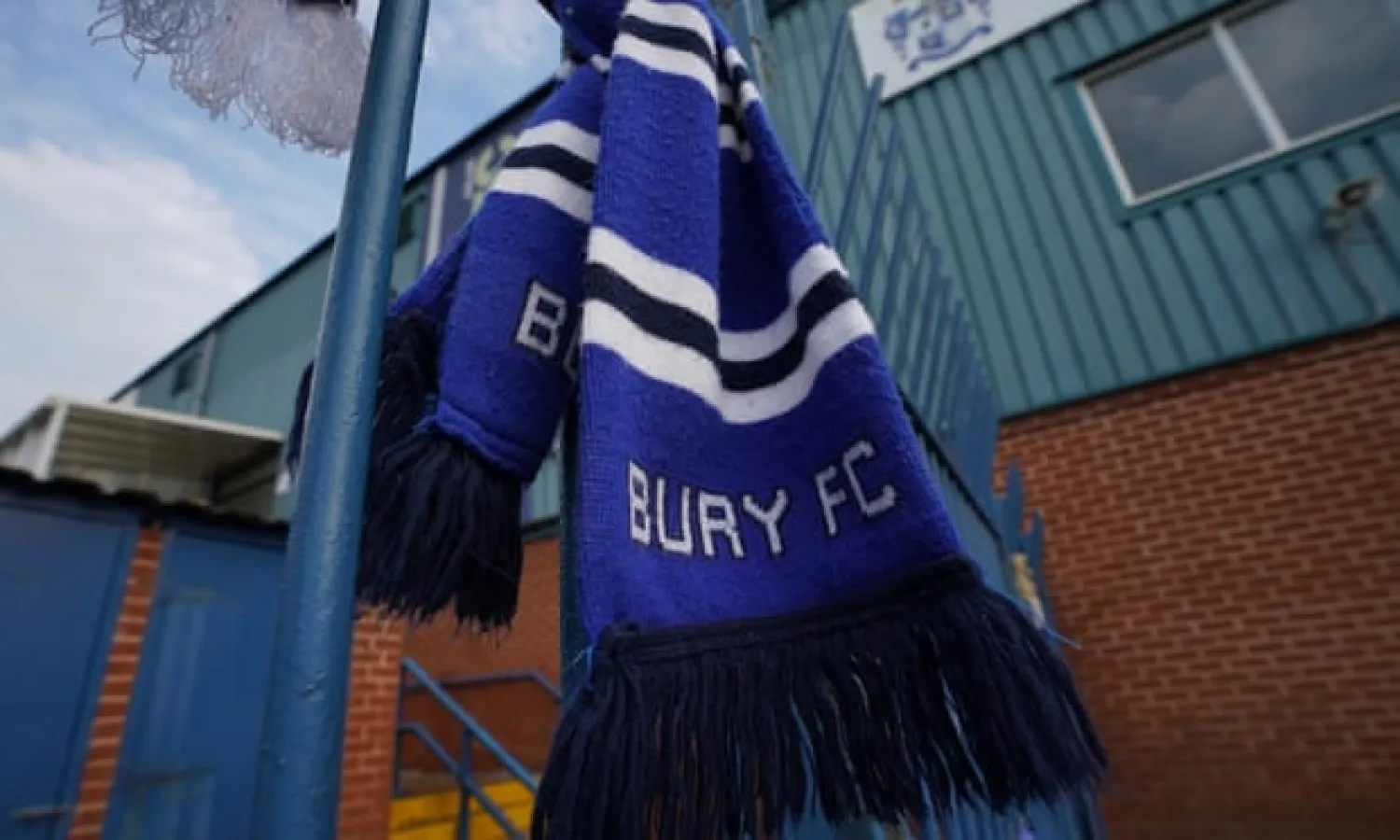
 A scarf hanging at Bury’s Gigg Lane ground this week. Photograph: Jon Super/The Guardian
A scarf hanging at Bury’s Gigg Lane ground this week. Photograph: Jon Super/The Guardian
TT

Turning Our Clubs Into Global Brands Means There Will Be More Burys

 A scarf hanging at Bury’s Gigg Lane ground this week. Photograph: Jon Super/The Guardian
A scarf hanging at Bury’s Gigg Lane ground this week. Photograph: Jon Super/The Guardian

A recent Set-Piece Menu podcast eloquently made the case for fandom as a broad church. When the Premier League is marketed so aggressively all over the world, when overseas television rights bring it so much revenue, when players and managers and owners are often foreign, they argued – quite reasonably – who is to deny the travelling supporter from Baltimore or Bangalore their seat in the stadium, the right to call themselves a fan? All of that made sense.

On an intellectual level I agreed with it. It fitted my general liberal, globalised worldview. And yet, I realised, viscerally I disagreed: of course, I paid lip service to all that but actually I regarded my form of fandom as being more authentic and more important.

Sunderland is part of me in a way that is beyond choice. I grew up there and my family is from there. Sunderland is the unsatisfactory repository for the emotions linked to memories of my dad and of all the mates I went to games with as a teenager.

But it is also for something less rational, for a nebulous and no doubt over-romanticised sense of home, for the family who long ago came from Ireland and Scotland looking for work in the shipyards and found belonging by going to games. Sunderland is who I am in a way that matters far more than individual results or whichever clowns happen to be wearing the shirts this season.

That is why it matters and it is why Bury matter and Bolton matter: if a clod be washed away by the sea, football is less. And frankly I find it hard to reconcile that sense with respecting the rights and feelings of a fan from outside who had a choice. I am also aware that this places me uncomfortably on the opposite side of the current cultural struggle to the one I would usually occupy.

But we should not be naive. Money has always played a significant role in football. The clubs who dominated the league in its early days – Preston, Sunderland and Aston Villa – did so largely by buying in the best Scottish talent. When, as English champions, Sunderland beat the Scottish champions, Hearts, 5-3 at Tynecastle in the first club world cup in 1895, all 22 players were Scots. Liverpool and Chelsea were established by stadium owners with the specific aim of getting people to pay to watch them play. The league was never some cosy alliance of community ventures.

Yet the gulf between football’s rich and poor has never been so stark. The agglomeration of highly remunerated talent at the top end of the game is producing football of exceptional quality and recent Champions Leagues, at least in the knockout stages, have produced extraordinary drama. The question is, is it worth it?

At Bury and Bolton, specific mistakes have been made by specific owners in an environment that has done little to regulate who is allowed to own clubs or how they behave. But the issues that have taken them to the brink are not unique to them. This is a systemic problem. There are those who would shrug and point out no other country sustains a league of 92 clubs (plus other professional teams in non-league) and that a certain natural wastage is inevitable. But that is one of the great joys of English football: the economic logic of the vast supermarket chains gobbling up the corner shop should not apply.

As David Goldblatt’s new book The Age of Football makes clear, this is part of a much wider trend, as everything – players, managers, investment, attention – is sucked towards a handful of clubs in a handful of leagues in western Europe. To watch an Argentinian or Brazilian league game is to be shocked by how low the quality is given the global familiarity of their best players.

Africa Cups of Nations are habitually played out in front of empty stadiums, in large part because, across the continent, the culture of going to games has gone. The football people care about is played in Europe and so it is consumed via satellite television in bars and video halls. So little consideration is the match-going fan given that the rash of new stadiums built for each Cup of Nations tend to be built on the outskirts of towns: fine for VIPs and television, rather less convenient for locals who may want to attend matches.

The terrible irony is that the pressure on smaller clubs in England is intensifying even though attendances across the four divisions are as good as they have been in four decades. The crisis stems from the chasm between the Premier League and the rest, and the various gambles being taken to try to bridge it. It is a result of the greed of the breakaway clubs in 1992.

What are those clubs now? With foreign owners, foreign managers, foreign players and, increasingly, foreign fans, they are global brands that happen to be based in England. Even at Liverpool, where the community feel is far stronger than at most of the superclubs, the dead hand of finance lurks. It is there in the slogan “This means more”, the sort of self-absorbed scouse exceptionalism that has always raised wry smiles among fans of other clubs repackaged and delivered back to fans as a (non‑ironic) marketing campaign. And it is there in the ill-judged attempt to trademark the word “Liverpool”, as though the city itself could somehow be taken from its people and transformed into a token to be bought and sold. And, frankly, even that is probably preferable to being a propaganda tool for a nation state.

What place has my irrational sense of Sunderland identity in the modern game? Is it possible to have the benefits of globalisation without the rich-getting-richer creed that underpins it, to be cosmopolitan without destroying communities? That feels the central cultural question of our age, and football is nowhere near answering it.

The standard of play has never been better but the cost is devastating.

The Guardian Sport


Liverpool Boss Slot Says Isak in 'Final Stages of Rehab'

Soccer Football -  FA Cup - Fourth Round - Liverpool v Brighton & Hove Albion - Anfield, Liverpool, Britain - February 14, 2026 Liverpool manager Arne Slot celebrates after the match REUTERS/Phil Noble
Soccer Football - FA Cup - Fourth Round - Liverpool v Brighton & Hove Albion - Anfield, Liverpool, Britain - February 14, 2026 Liverpool manager Arne Slot celebrates after the match REUTERS/Phil Noble
TT

Liverpool Boss Slot Says Isak in 'Final Stages of Rehab'

Soccer Football -  FA Cup - Fourth Round - Liverpool v Brighton & Hove Albion - Anfield, Liverpool, Britain - February 14, 2026 Liverpool manager Arne Slot celebrates after the match REUTERS/Phil Noble
Soccer Football - FA Cup - Fourth Round - Liverpool v Brighton & Hove Albion - Anfield, Liverpool, Britain - February 14, 2026 Liverpool manager Arne Slot celebrates after the match REUTERS/Phil Noble

Liverpool manager Arne Slot said on Thursday he believes striker Alexander Isak is in the "final stages of rehab" and could return by the end of next month to bolster the Reds' push for Champions League qualification.

The British record signing has been sidelined since mid-December when he fractured a bone in his lower leg and needed ankle surgery following a sliding tackle from Tottenham's Micky van de Ven.

His injury came just as 26-year-old Sweden international Isak, who joined Premier League champions Liverpool for £125 million ($169 million) from top-flight rivals Newcastle in September, was finding his form at Anfield with two goals in six matches.

"Alex has been on the pitch, not with his football boots but with his running shoes for the first time this week," Slot told reporters, according to AFP.

"The next step is doing work with the ball, which every player likes most, then the next step is to come into the group and then it takes a while before you're ready to play.

"It will be some time around there, end of March, start of April, where he is hopefully back with the group. That is not to say you are ready to play, let alone start a game.

"But it's nice that rehab goes well; that's a compliment to him and our medical staff.

"I think we all know the moment you go on the pitch it doesn't take three months but these final stages of rehab can also make it change."

Isak is one of five Liverpool first-team players currently sidelined, with only Jeremie Frimpong close to a return.

The right-back has been out since the end of last month with a hamstring injury but is expected to be available for next weekend's visit of West Ham.

Liverpool have had a rare week without a match ahead of Sunday's trip to Nottingham Forest.

"It is nice and useful as the players we are having, nine out of 10 go to the national team so for seven, eight, nine months they hardly have a time off," said Dutch boss Slot, who insisted he had no need of a rest himself.

"It was nice but I did not really need it. Last season I felt I needed it more in this period of time. I am enjoying the work I do here."

Liverpool, after a slow start to their title defense -- are now sixth and within three points of the top four with 12 games to go.

They next play three of the bottom four clubs as they look to get themselves into a Champions League position.

Premier League leaders Arsenal were left just five points clear of second-placed Manchester City after blowing a two-goal lead in a shock 2-2 draw away to rock-bottom Wolves on Wednesday.

Slot, however, said: "We didn't need yesterday to know how difficult it is to win a Premier League game. What has made the Premier League nicer this season than three, four, five, six years ago is it's more competitive."


Familiar Face Returns to Marseille where Habib Beye Takes Charge

(FILES) Rennes' French-Senegalese head coach Habib Beye looks on before the French L1 football match between Le Havre AC (HAC) and Rennes at the Oceane Stadium in Le Havre, Northwestern France, on April 13, 2025. (Photo by Lou BENOIST / AFP)
TT

Familiar Face Returns to Marseille where Habib Beye Takes Charge

(FILES) Rennes' French-Senegalese head coach Habib Beye looks on before the French L1 football match between Le Havre AC (HAC) and Rennes at the Oceane Stadium in Le Havre, Northwestern France, on April 13, 2025. (Photo by Lou BENOIST / AFP)

Marseille is looking to reignite its season with a new coach on board.

The nine-time French champion appointed Habib Beye to replace Roberto De Zerbi following a bad patch of form that saw the club exit the Champions League and drop 12 points behind Ligue 1 leader Lens.

Beye, a former Senegal international who played for Marseille, will be in charge of Friday's trip to Brest.

After leading Red Star to promotion to Ligue 2, Beye spent the last year and a half as the Rennes coach. The club sacked Beye this month.

Key matchups Marseille has failed to win its past three league games, badly damaging its title hopes. The results including a 5-0 mauling at PSG have left fans fuming. The club hopes Beye, a disciplinarian advocating ball possession and a strong attacking identity, will produce a jolt.

Beye's hiring "refocuses us on the challenges we still need to tackle between now and the end of the season,” The Associated Press quoted Marseille owner Frank McCourt as saying.

Since McCourt bought Marseille in 2016, the former powerhouse has failed to find any form of stability in a succession of coaches and crises. It hasn’t won the league title since 2010.

PSG abandoned the top spot to Lens after losing to Rennes 3-1 last week. Luis Enrique's team bounced back with a 3-2 win at Monaco in the first leg of their Champions League playoff and hosts last-placed Metz on Saturday. Lens welcomes Monaco the same day.

Third-placed Lyon, on a stunning 13-match winning run, plays at Strasbourg on Sunday.
Players to watch With the World Cup in his country looming, former Arsenal striker Folarin Balogun is hitting form at the right time. The American forward scored twice inside 18 minutes against PSG and has 10 goals and four assists this season.

At PSG, the man in form is Désiré Doué.

After his team quickly fell behind by two goals against Monaco midweek, Doué came to the rescue to turn things around. The France international was relentless and left his mark on the match after coming on as a replacement for Ousmane Dembélé. He first reduced the deficit, played a role in Achraf Hakimi’s equalizer then netted the winner.
Out of action Dembélé is expected to miss PSG's match against Metz because of an injured left calf.

Off the field PSG was sanctioned with the partial closure of the Auteuil stand for two matches and a 10,000 euros ($11,800) fine by the disciplinary committee of the French league following banners displayed and insults directed by supporters during the match against Marseille on Feb. 8. at the Parc des Princes. There were brief discriminatory chants about Marseille at the start of the game and the referee stopped play for about one minute around the 70th.


Verona Prepares its Ancient Arena for the Olympics Closing Ceremony on Sunday

A view of the Arena ahead of the closing ceremony at the 2026 Winter Olympics, in Verona, Italy, Tuesday, Feb. 17, 2026. (AP Photo/Antonio Calanni)
TT

Verona Prepares its Ancient Arena for the Olympics Closing Ceremony on Sunday

A view of the Arena ahead of the closing ceremony at the 2026 Winter Olympics, in Verona, Italy, Tuesday, Feb. 17, 2026. (AP Photo/Antonio Calanni)

A city forever associated with Romeo and Juliet, Verona will host the final act of the Milan Cortina Winter Olympics on Sunday inside the ancient Roman Arena, where some 1,500 athletes will celebrate their feats against a backdrop of Italian music and dance.

Acclaimed ballet dancer Roberto Bolle has been rehearsing for the closing ceremony inside the Arena di Verona this week under a veil of secrecy, along with some 350 volunteers, for a spectacle titled “Beauty in Motion," which frames beauty as something inherently dynamic.

“Beauty cannot be fixed in time. This ancient monument is beautiful if it is alive, if it continues to change,” said the ceremony's producer, Alfredo Accatino. “This is what we want to narrate: An Italy that is changing, and also the beauty of movement, the beauty of sport and the beauty of nature."

Other headlining Italian artists include singer Achille Lauro and DJ Gabry Ponte, whose hits could be heard blasting from the Arena during rehearsals this week.

Inside a tent serving as a dressing room, seamstresses put the finishing touches on costumes inspired by the opera world as volunteers prepped for the stage, The Associated Press reported.

“It’s really special to be inside the Arena,” said Matilde Ricchiuto, a student from a local dance school. "Usually, I am there as a spectator and now I get to be a star, I would say. I feel super special.”

The Arena has been a venue for popular entertainment since it was first built in 1 A.D., predating the larger Roman Colosseum by decades. Accatino said the ancient monument will produce some surprises from within its vast tunnels.

“Under the Arena there is a mysterious world that hides everything that has happened. At a certain point, this world will come out," Accatino said, promising “something very beautiful."

The ceremony will open with athletes parading triumphantly through Piazza Bra into the Arena, which once served as a stage for gladiator fights and hunts for exotic beasts.

The closing ceremony stage was inspired by a drop of water, meant to symbolically unite the Olympic mountain venues with the Po River Valley, where Milan and Verona are located, while serving as a reminder that the Winter Games are being reshaped by climate change.

While the opening ceremony was held in Milan, the other host city, Cortina d’Ampezzo, nestled in the Dolomite mountains, was considered too small and remote to host the closing ceremony. Verona, in the same Veneto region as Cortina, was chosen for its unique venue and relatively central location, said Maria Laura Iascone, the local organizing committee's head of ceremonies.

“Only Italians can use such monuments to do special events, so this is very unique, very rare," Iascone said of the Arena.

She promised a more intimate evening than the opening ceremony in Milan's San Siro soccer stadium, with about 12,000 people attending the closing compared with more than 60,000 for the opening.

Iascone said about 1,500 of the nearly 3,000 athletes participating in the most spread-out Winter Games in Olympic history are expected to drive a little over an hour from Milan and between two and four hours from the six mountain venues.

The ceremony will close with the Olympic flame being extinguished. A light show will substitute fireworks, which are not allowed in Verona to protect animals from being disturbed.

The Verona Arena will also be the venue for the Paralympic opening ceremony on March 6. For the ceremonies, the ancient Arena has been retrofitted with new wheelchair ramps and accessible restrooms along with other safety upgrades. The six Paralympic events will be held in Milan and Cortina until March 15.
