

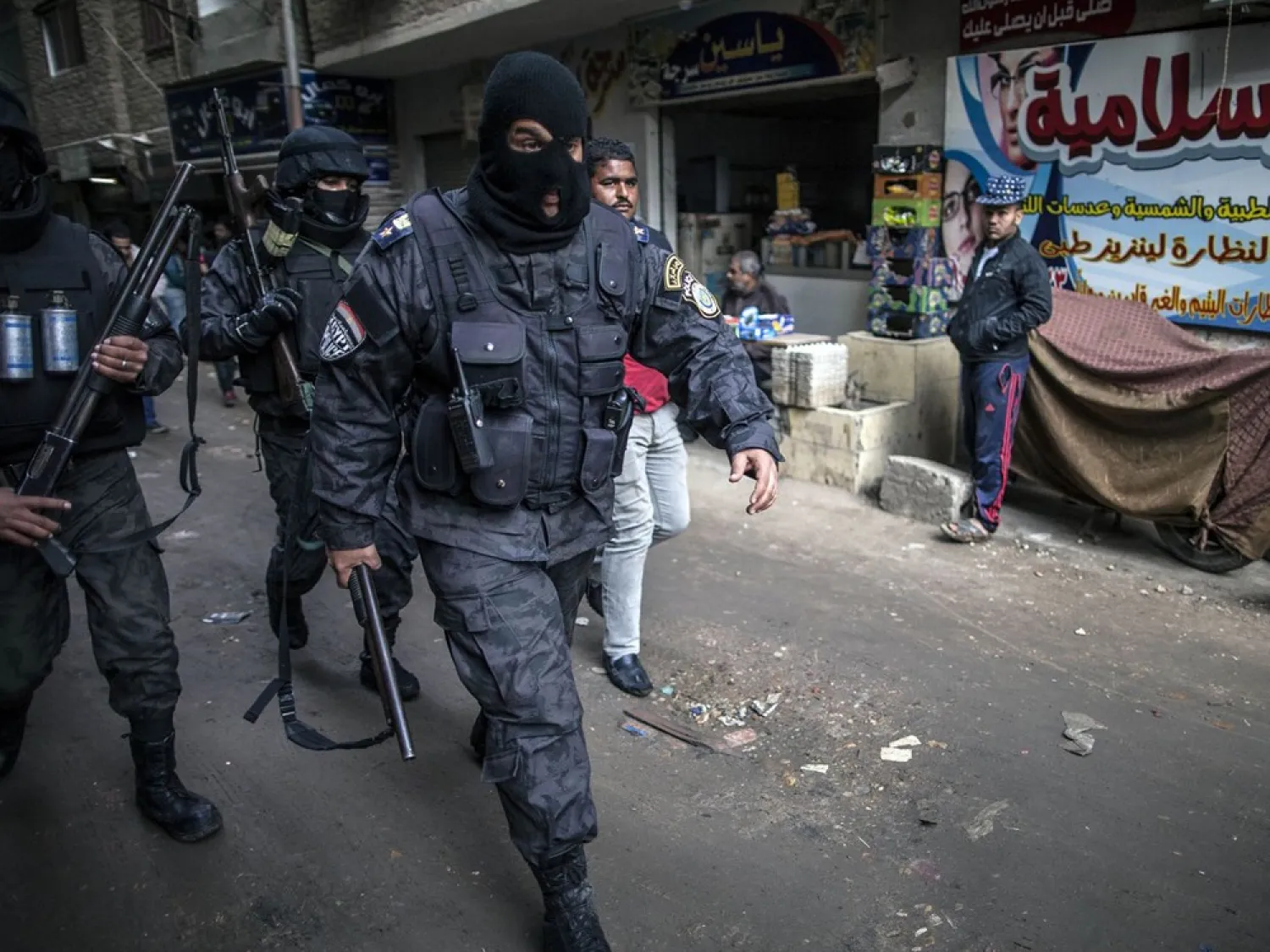

Sudan Extradites Wanted Takfiri Leader to Egypt

Egyptian police special forces. (Getty Images)
TT

Sudan Extradites Wanted Takfiri Leader to Egypt

Egyptian police special forces. (Getty Images)

An Egyptian security source revealed that Cairo is waiting for the arrival of a wanted fugitive takfiri leader extradited from Sudan named Madin Ibrahim Mohamed Hassanein.

The leader had fled to Sudan after being convicted of killings and violence against police officers in Egypt.

“Hassanein arrived at Khartoum airport last night ahead of his deportation to Cairo, and it is only a matter of time before he arrives to Egypt,” said the security source, who spoke on condition of anonymity.

“There is full coordination between Egyptian and Sudanese security, and it will be followed by the extradition of other wanted criminals to Egypt,” he added.

Hassanein, according to Islamist movements researcher Amro Abdulmoneim, was sentenced to 15 years in prison in 2013.

In the case known as “Asharqiyya unrest,” Hassanein was tried alongside 16 other fugitives for killing police officers and incitement against public order.

According to Abdulmoneim, Hassanein is also an ex-affiliate of a takfiri network founded by Shawqi al-Sheikh in the Faiyum province, southwest of Cairo.

“Hassanein encouraged others to kill police and army officers in his village in Sharqia governorate (Egypt Delta) after Hosni Mubarak stepped down from power in 2011,” he said.

“He established a terror organization called Ansar al-Sharia in al-Sharqia, formed cells in the following governorates: Beni Suef, Giza and Faiyum, and he shared ties to the terrorist Adel Habara,” Abdulmoneim added.

Egyptian authorities had executed Habara in December 2016 after he was convicted of the murder of 25 soldiers in the north Sinai province in August 2013.

“Hassanein had fled to Sudan, along with other convicts,” Abdulmoneim noted, adding that there are “approximately 70 Muslim Brotherhood youth fugitives in Sudan.”



Iraq Criminalizes Volunteering in Russia-Ukraine War

A photo circulated on social media shows a 24-year-old Iraqi who traveled to Russia to join its armed forces. (AFP)
TT

Iraq Criminalizes Volunteering in Russia-Ukraine War

A photo circulated on social media shows a 24-year-old Iraqi who traveled to Russia to join its armed forces. (AFP)

The Iraqi judiciary warned on Wednesday that people involved in the war between Russia and Ukraine will face jail as it attempts to crack down on the recruitment of Iraqis joining the conflict.

Faiq Zidan, the head of Iraq's Supreme Judicial Council, received on Wednesday National Security Advisor Qasim Al-Araji and members of a committee tasked with combating the recruitment of Iraqis.

Zaidan stressed that Iraq criminalizes any Iraqi who joins the armed forces of another nation without the approval of the government.

The judiciary does not have a fixed prison term for anyone accused of the crime, but a court in Najaf last week sentenced to life an Iraqi accused of human trafficking.

He was convicted of belonging to an international criminal gang that recruits Iraqis to fight for Russia in its war against Ukraine.

In November, Prime Minister Mohammed Shia al-Sudani ordered the formation of a committee, headed by Araji, to crack down on the recruitment of Iraqis to fight for the Russian and Ukrainian militaries.

Iraq does not have official figures detailing how many of its citizens have joined the war. Media reports said some 50,000 Iraqis have joined Russian ranks, while unofficial figures put the number at around 5,000, with 3,000 fighting for Russia and 2,000 for Ukraine.

The debate over the recruitment played out over the media between the Russian and Ukrainian ambassadors to Iraq.

Ukrainian Ambassador Ivan Dovhanych accused Russia of recruiting Iraqis. Last week, the Ukrainian government sent a letter to the Iraqi government about the recruitment.

It hailed Baghdad’s criminalization of such activity. The letter also revealed that Ukrainian authorities had arrested an Iraqi who was fighting for Russia.

Ukraine has denied that it has recruited Iraqis to join the conflict, but reports indicate otherwise.

Meanwhile, Russian Ambassador to Baghdad Elbrus Kutrashev acknowledged that Iraqi fighters had joined the Russian army.

Speaking to the media, he declined to give exact figures, but dismissed claims that they reached 50,000 or even 5,000, saying instead they number no more than a few hundred.

He confirmed that Iraqis had joined the Russian army and “that some four to five had lost their lives”.

He revealed that the Russian embassy in Baghdad had granted visas to Russia to the families of the deceased on humanitarian grounds.

Russian law allows any foreign national residing in Russia and who speaks Russian to join its army with a salary of around 2,500 to 3,000 dollars.

There have been mounting calls in Iraq for the authorities to crack down on human trafficking gangs.

Would-be recruits are often lured by the monthly salary and the possibility of gaining the Russian or Ukrainian nationality.

Critics of the authorities have said Iraqi youths are lured to join foreign wars given the lack of job opportunities in Iraq.


Somalia's Capital Votes in First Step toward Restoring Universal Suffrage

Members of the Justice and Solidarity Party (JSP) campaign in the streets as they share their political aims with voters in Mogadishu, Somalia, 22 December 2025. EPA/SAID YUSUF WARSAME
TT

Somalia's Capital Votes in First Step toward Restoring Universal Suffrage

Members of the Justice and Solidarity Party (JSP) campaign in the streets as they share their political aims with voters in Mogadishu, Somalia, 22 December 2025. EPA/SAID YUSUF WARSAME

Residents of Somalia's capital Mogadishu will vote on Thursday in municipal elections meant to pave the way for the East African country's first direct national polls in more than half a century.

With the exception of votes in the semi-autonomous region of Puntland and the breakaway region of Somaliland, Somalia last held direct elections in 1969, months before military general, Mohamed Siad Barre, took power in a coup, Reuters said.

After years of civil ‌war that ‌followed Barre's fall in 1991, indirect elections ‌were ⁠introduced in ‌2004. The idea was to promote consensus among rival clans in the face of an armed insurgency, although some Somalis say politicians prefer indirect elections because they create opportunities for corruption.

Under the system, clan representatives elect lawmakers, who then choose the president. The president, in turn, has been responsible for appointing Mogadishu's mayor.

The vote in Mogadishu, a ⁠city of some 3 million people where security conditions have improved in recent years ‌despite continuing attacks by al Qaeda-linked al ‍Shabaab militants, is seen as ‍a test run for direct elections at the national level.

Around ‍1,605 candidates are running on Thursday for 390 posts in Mogadishu's district councils, said Abdishakur Abib Hayir, a member of the National Electoral Commission. Council members will then choose a mayor.

"It shows Somalia is standing on its feet and moving forward," Hayir told Reuters. "After the local election, elections can and will take place in ⁠the entire country."

A 2024 law restored universal suffrage ahead of federal elections expected next year. However, President Hassan Sheikh Mohamud reached a deal in August with some opposition leaders stipulating that while lawmakers would be directly elected in 2026, the president would still be chosen by parliament.

Opposition parties have argued the rapid introduction of a new electoral system would benefit Mohamud's re-election prospects.

They also question whether the country is safe enough for mass voting given al Shabaab's control over vast areas of the countryside and regular strikes ‌on major population centers.


Sudan's RSF Says Captured Areas Near Chad Border

Sudanese refugee girls carry water supplies near a polling station in the refugee camp of Zamzam, on the outskirts of el-Fasher, Darfur, Sudan, on April 13, 2010. (AP)
TT

Sudan's RSF Says Captured Areas Near Chad Border

Sudanese refugee girls carry water supplies near a polling station in the refugee camp of Zamzam, on the outskirts of el-Fasher, Darfur, Sudan, on April 13, 2010. (AP)

Sudan’s Rapid Support Forces (RSF) announced on Wednesday that it had seized full control of areas bordering Chad in North Darfur in western Sudan.

The RSF released videos of its forces as they deployed in several towns in the regions.

The Sudanese army has yet to comment on the development.

In a statement, the RSF said that along with allies forces, it captured the regions of Um Qamra and Abu Barro in the westernmost point in North Darfur.

It accused the army and its allied forces of carrying out “systematic attacks” and “reprisals” against civilians in the area.

The RSF said the capture of the regions “ends the deployment of armed forces” and puts and end to the “reprisals and chaos”.

It added that it has deployed military units “to protect the civilians and secure roads and public areas to restore normal life there.”

On Tuesday, prior to the capture, Darfur region governor and leader of the Sudan Liberation Movement/Army Minni Minnawi had warned of an imminent RSF attack.

He had called on the people to defend themselves and their property, adding: “Defend your existence... the land that is not protected by its people gets stolen, and the dignity that is not defended is killed.”

His call had prompted harsh criticism in Darfur who accused him of attempting to embroil the people in an uneven confrontation with the RSF that is far better equipped and ready to fight.

They wondered why the joint forces of various parties had withdrawn from the area and not held their ground to fight the RSF.

The RSF had in the early hours of Wednesday launched attacks on the towns of al-Tina and Kernoi, capturing them without resistance.

With its latest capture, the RSF now has control of Sudan’s borders with Chad, Libya, Central Africa and South Sudan.