

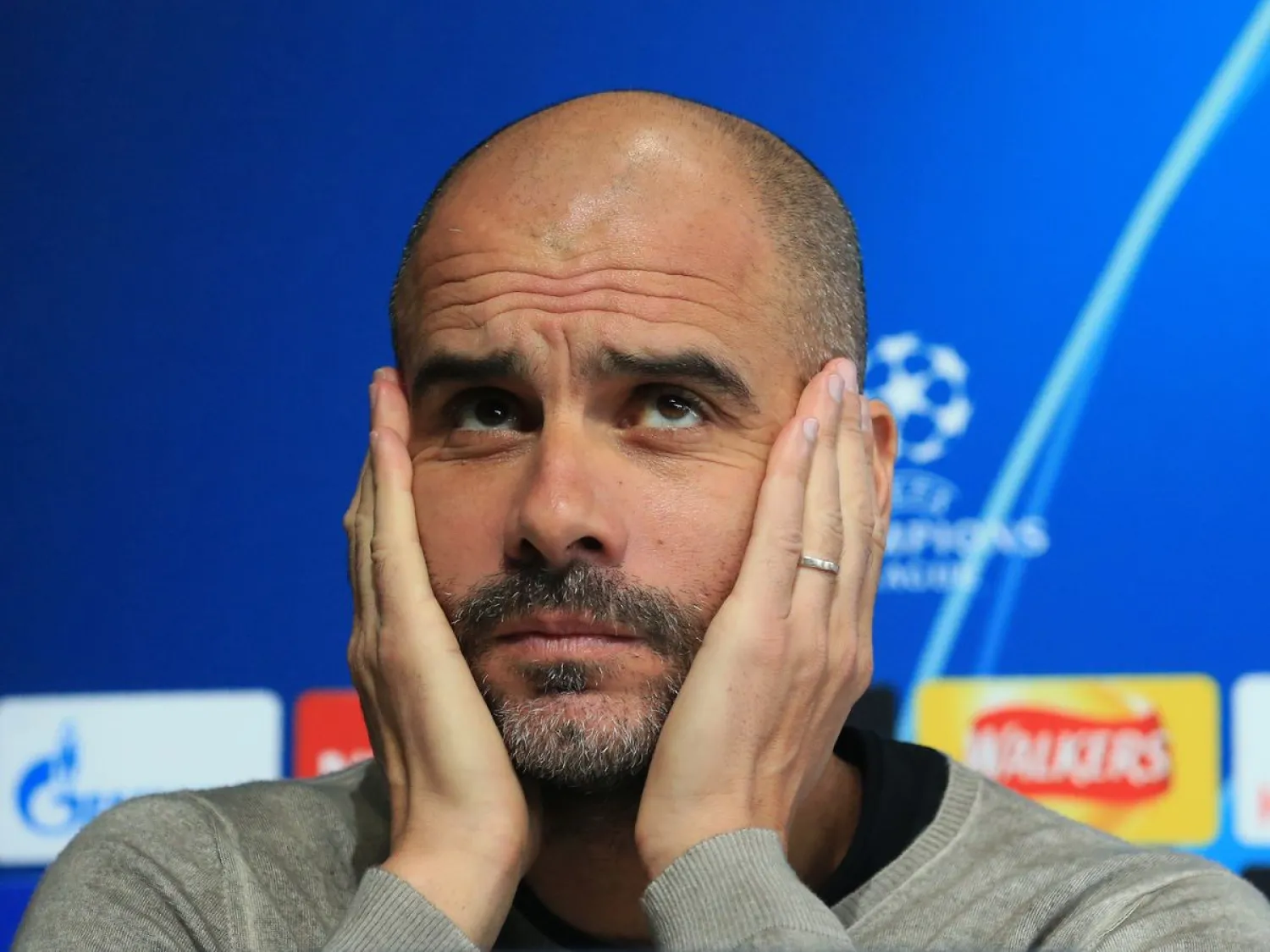

Has Guardiola Changed English Football?

Manchester City manager Pep Guardiola. (Getty Images)
TT

Has Guardiola Changed English Football?

Manchester City manager Pep Guardiola. (Getty Images)

Last month, Rochdale scored a brilliant goal against Southend, working the ball from front to back in 16 rapid passes. As is the way of things these days, clips circulating on social media have not merely celebrated the artistry and the technical mastery of the goal, the courage to attempt it, but have rapidly followed football’s equivalent of Godwin’s Law and degenerated into deeply tedious rows about Pep Guardiola.

To parse these as briefly as possible: somebody invents an army of straw men and tweets something like: “Who says Guardiola isn’t having an influence on English football?” To which the correct answer, you would think, would be hardly anybody. Except then the straw army comes to life and social media convokes its usual symposium of sneeriness as everybody shouts that people passed the ball before, you know, and that the bald fraud hasn’t won the Champions League since 2011. Somewhere along the way the point is lost that although Guardiola has, admittedly, only done it with hugely rich clubs packed with talented players (almost as though, being at the top of the game, he wants to work with the best), Brian Barry-Murphy is somehow doing it with Rochdale.

Guardiola has been at the forefront of a revolution. He approaches 11-a-side as others once treated five-a-side. The game becomes about passing and possession, about technical skill and the generation of space, rather than about power and physique and aerial duels. The football his sides have played has demonstrated what is possible, changing perceptions, and that, allied to the unprecedented imbalance in resources in the modern game, has led to possession in games being dominated by one side in a way that was never possible before. But Guardiola could do that because the conditions were right.

Football changed in 2008. In the 14 years before that, the knockout stages of the Champions League featured an average of three goals per game twice; in the 11 years since, it has been below three once. 2008 happens to be the year Guardiola became a manager and he is responsible in part for that upswing. But he is not fully responsible. He couldn’t have imposed his football in an era when pitches were frequently mudbaths or when sports science and understanding of nutrition were too limited for players to press at full tilt for 90 minutes.

From the 1990 World Cup onwards, the laws had been tweaked to make the game more open, abolishing the back-pass to the goalkeeper’s arms, cracking down on the tackle from behind and liberalizing offside. By 2008, all those factors were in place and the game was ready for a visionary to lead the revolution.

While the top end of the game concerns itself with trying to match or thwart Guardiola’s style, leading to the increasing prevalence and sophistication of gegen-pressing, the environment that encouraged Guardiola’s radicalism still exists and is leading to innovation at all levels. The most startling, perhaps, is Sheffield United and their overlapping center-backs.

The notion of central defenders stepping out from the back is not new and has had numerous iterations, from the Danubian center-halves of the 1930s through liberos such as Franz Beckenbauer and Gaetano Scirea to Louis van Gaal’s observation in the 90s that one of his central defenders had to be a playmaker because it was the only position on the pitch that was regularly afforded time.

Similarly, the idea that full‑backs should effectively function as midfielders, providing width and allowing a sudden injection of pace into a move with a burst from deep, has in effect become the orthodoxy. But blending those two trends as Chris Wilder has done is something startling.

United essentially set up with a 3-5-2 formation. The central of the three defenders, John Egan, is a fixed point but the defenders flanking him – Chris Basham and Jack O’Connell – have license to make long diagonal runs that carry them outside the wing-backs, George Baldock and Enda Stevens, who in turn can then cut in off the flanks. Cover is offered by a trio of technically accomplished midfielders, Oliver Norwood supported by John Lundstram and John Fleck or the summer signing Luke Freeman. They are not merely a shield, though: Norwood and Fleck registered 18 assists between them last season.

The idea seems initially to have sprung from the mind of Wilder’s assistant, Alan Knill, who had hitherto perhaps been best known for having narrowly avoided serious injury after his bike collided with a squirrel when he was manager of Scunthorpe.

In League One in 2016-17, the Blades often came up against sides who packed players behind the ball against them. As the defenders had little defending to do it made sense for them, Knill reasoned, rather than being redundant, to be used to provide an overload. At the same time, having mobile center-backs makes it relatively straightforward to slip into 4-4-2 in the defensive phase if a wing-back is called out to shut down an attack from the flank.

There were teething problems, notably in a 4-1 defeat at Walsall, but the system was tweaked to prevent it becoming too open and it worked – at least in part because opponents, in looking to track a surge from an opposing central defender, ended up with no players upfield to spring a counter.

There will be further modifications. The central midfield has been notably more circumspect this season than last. Bournemouth’s 3-4-3 on the opening weekend restricted the movement of United’s center-backs, which may offer a clue as to how to combat them.

But the broader point is that Wilder and Knill’s solution to the issue of a massed defense would not in the past have been possible. Football is quicker than ever and yet it has become increasingly a game less of power than of strategy. The environment that emboldened Guardiola to seek an approach based almost entirely on positional control similarly inspired Wilder and Knill to redeploy their pieces.

Has Guardiola changed football? Yes, but football was ripe for the changing.

The Guardian Sport


Verona Prepares its Ancient Arena for the Olympics Closing Ceremony on Sunday

A view of the Arena ahead of the closing ceremony at the 2026 Winter Olympics, in Verona, Italy, Tuesday, Feb. 17, 2026. (AP Photo/Antonio Calanni)
TT

Verona Prepares its Ancient Arena for the Olympics Closing Ceremony on Sunday

A view of the Arena ahead of the closing ceremony at the 2026 Winter Olympics, in Verona, Italy, Tuesday, Feb. 17, 2026. (AP Photo/Antonio Calanni)

A city forever associated with Romeo and Juliet, Verona will host the final act of the Milan Cortina Winter Olympics on Sunday inside the ancient Roman Arena, where some 1,500 athletes will celebrate their feats against a backdrop of Italian music and dance.

Acclaimed ballet dancer Roberto Bolle has been rehearsing for the closing ceremony inside the Arena di Verona this week under a veil of secrecy, along with some 350 volunteers, for a spectacle titled “Beauty in Motion," which frames beauty as something inherently dynamic.

“Beauty cannot be fixed in time. This ancient monument is beautiful if it is alive, if it continues to change,” said the ceremony's producer, Alfredo Accatino. “This is what we want to narrate: An Italy that is changing, and also the beauty of movement, the beauty of sport and the beauty of nature."

Other headlining Italian artists include singer Achille Lauro and DJ Gabry Ponte, whose hits could be heard blasting from the Arena during rehearsals this week.

Inside a tent serving as a dressing room, seamstresses put the finishing touches on costumes inspired by the opera world as volunteers prepped for the stage, The Associated Press reported.

“It’s really special to be inside the Arena,” said Matilde Ricchiuto, a student from a local dance school. "Usually, I am there as a spectator and now I get to be a star, I would say. I feel super special.”

The Arena has been a venue for popular entertainment since it was first built in 1 A.D., predating the larger Roman Colosseum by decades. Accatino said the ancient monument will produce some surprises from within its vast tunnels.

“Under the Arena there is a mysterious world that hides everything that has happened. At a certain point, this world will come out," Accatino said, promising “something very beautiful."

The ceremony will open with athletes parading triumphantly through Piazza Bra into the Arena, which once served as a stage for gladiator fights and hunts for exotic beasts.

The closing ceremony stage was inspired by a drop of water, meant to symbolically unite the Olympic mountain venues with the Po River Valley, where Milan and Verona are located, while serving as a reminder that the Winter Games are being reshaped by climate change.

While the opening ceremony was held in Milan, the other host city, Cortina d’Ampezzo, nestled in the Dolomite mountains, was considered too small and remote to host the closing ceremony. Verona, in the same Veneto region as Cortina, was chosen for its unique venue and relatively central location, said Maria Laura Iascone, the local organizing committee's head of ceremonies.

“Only Italians can use such monuments to do special events, so this is very unique, very rare," Iascone said of the Arena.

She promised a more intimate evening than the opening ceremony in Milan's San Siro soccer stadium, with about 12,000 people attending the closing compared with more than 60,000 for the opening.

Iascone said about 1,500 of the nearly 3,000 athletes participating in the most spread-out Winter Games in Olympic history are expected to drive a little over an hour from Milan and between two and four hours from the six mountain venues.

The ceremony will close with the Olympic flame being extinguished. A light show will substitute fireworks, which are not allowed in Verona to protect animals from being disturbed.

The Verona Arena will also be the venue for the Paralympic opening ceremony on March 6. For the ceremonies, the ancient Arena has been retrofitted with new wheelchair ramps and accessible restrooms along with other safety upgrades. The six Paralympic events will be held in Milan and Cortina until March 15.


Arsenal Blows 2-goal Lead at Wolves to Boost Man City's Premier League Title Chances

Soccer Football - Premier League - Wolverhampton Wanderers v Arsenal - Molineux Stadium, Wolverhampton, Britain - February 18, 2026  Wolverhampton Wanderers' Tom Edozie celebrates scoring their second goal with teammates REUTERS/Chris Radburn
Soccer Football - Premier League - Wolverhampton Wanderers v Arsenal - Molineux Stadium, Wolverhampton, Britain - February 18, 2026 Wolverhampton Wanderers' Tom Edozie celebrates scoring their second goal with teammates REUTERS/Chris Radburn
TT

Arsenal Blows 2-goal Lead at Wolves to Boost Man City's Premier League Title Chances

Soccer Football - Premier League - Wolverhampton Wanderers v Arsenal - Molineux Stadium, Wolverhampton, Britain - February 18, 2026  Wolverhampton Wanderers' Tom Edozie celebrates scoring their second goal with teammates REUTERS/Chris Radburn
Soccer Football - Premier League - Wolverhampton Wanderers v Arsenal - Molineux Stadium, Wolverhampton, Britain - February 18, 2026 Wolverhampton Wanderers' Tom Edozie celebrates scoring their second goal with teammates REUTERS/Chris Radburn

Arsenal blew a two-goal lead at last-place Wolves on Wednesday to give a huge boost to Manchester City in the race for the Premier League title.

The league leader was held to a surprise 2-2 draw at Molineux, having led 2-0 in the second half.

Teenage debutant Tom Edozie scored in the fourth minute of added time to complete Wolves' comeback.

“There was a big difference in how we played in the first half and the second half. We dropped our standards and we got punished for it,” Arsenal forward Bukayo Saka told the BBC.

The draw means Arsenal has dropped points in back-to-back games and leaves it just five ahead of second-place City, having played a game more.

With the top two still to play each other at City's Etihad Stadium, the title race is too close to call.

“(It's) time to focus on ourselves, improve our standards and improve our performances and it is in our control,” Saka said.

Arsenal has led the way for the majority of the season and one bookmaker paid out on Mikel Arteta's team winning the title after it opened up a nine-point lead earlier this month.

But Wednesday's result was the latest sign that it is feeling the pressure, having finished runner-up in each of the last three seasons. It has won just two of its last seven league games.

Having blown a lead against Brentford last week, it was even worse at a Wolves team that has won just one game all season.

Victory looked all but secured after Saka gave Arsenal the lead with a header in the fifth minute and Piero Hincapie ran through to blast in the second in the 56th.

But Wolves' fightback began with Hugo Bueno's curling shot into the top corner in the 61st.

The 19-year-old Edozie was sent on as a substitute in the 84th and his effort earned the home team only its 10th point of a campaign that looks certain to end in relegation.

While it did little for Wolves' chances of survival, it may have had a major impact at the top of the standings.

“Incredibly disappointed that we gave two points away,” Arteta said. "I think we need to fault ourselves and give credit to Wolves. But what we did in the second half was nowhere near our standards that we have to play in order to win a game in the Premier League.

“When you don’t perform you can get punished, and we got punished and we have to accept the hits because that can happen when you are on top."

Arsenal plays Tottenham on Sunday. Its lead could be cut to two points before it kicks off if City wins against Newcastle on Saturday.


Sinner Sees off Popyrin to Reach Doha Quarters

 Italy's Jannik Sinner greets the fans after defeating Australia's Alexei Popyrin in their men's singles match at the Qatar Open tennis tournament in Doha on February 18, 2026. (AFP)
Italy's Jannik Sinner greets the fans after defeating Australia's Alexei Popyrin in their men's singles match at the Qatar Open tennis tournament in Doha on February 18, 2026. (AFP)
TT

Sinner Sees off Popyrin to Reach Doha Quarters

 Italy's Jannik Sinner greets the fans after defeating Australia's Alexei Popyrin in their men's singles match at the Qatar Open tennis tournament in Doha on February 18, 2026. (AFP)
Italy's Jannik Sinner greets the fans after defeating Australia's Alexei Popyrin in their men's singles match at the Qatar Open tennis tournament in Doha on February 18, 2026. (AFP)

Jannik Sinner powered past Alexei Popyrin in straight sets on Wednesday to reach the last eight of the Qatar Open and edge closer to a possible final meeting with Carlos Alcaraz.

The Italian, playing his first tournament since losing to Novak Djokovic in the Australian Open semi-finals last month, eased to a 6-3, 7-5 second-round win in Doha.

Sinner will play Jakub Mensik in Thursday's quarter-finals.

Australian world number 53 Popyrin battled gamely but failed to create a break-point opportunity against his clinical opponent.

Sinner dropped just three points on serve in an excellent first set which he took courtesy of a break in the sixth game.

Popyrin fought hard in the second but could not force a tie-break as Sinner broke to grab a 6-5 lead before confidently serving it out.

World number one Alcaraz takes on Frenchman Valentin Royer in his second-round match later.
