


For Decadent, Deficient Real Madrid the Problems Start in Midfield

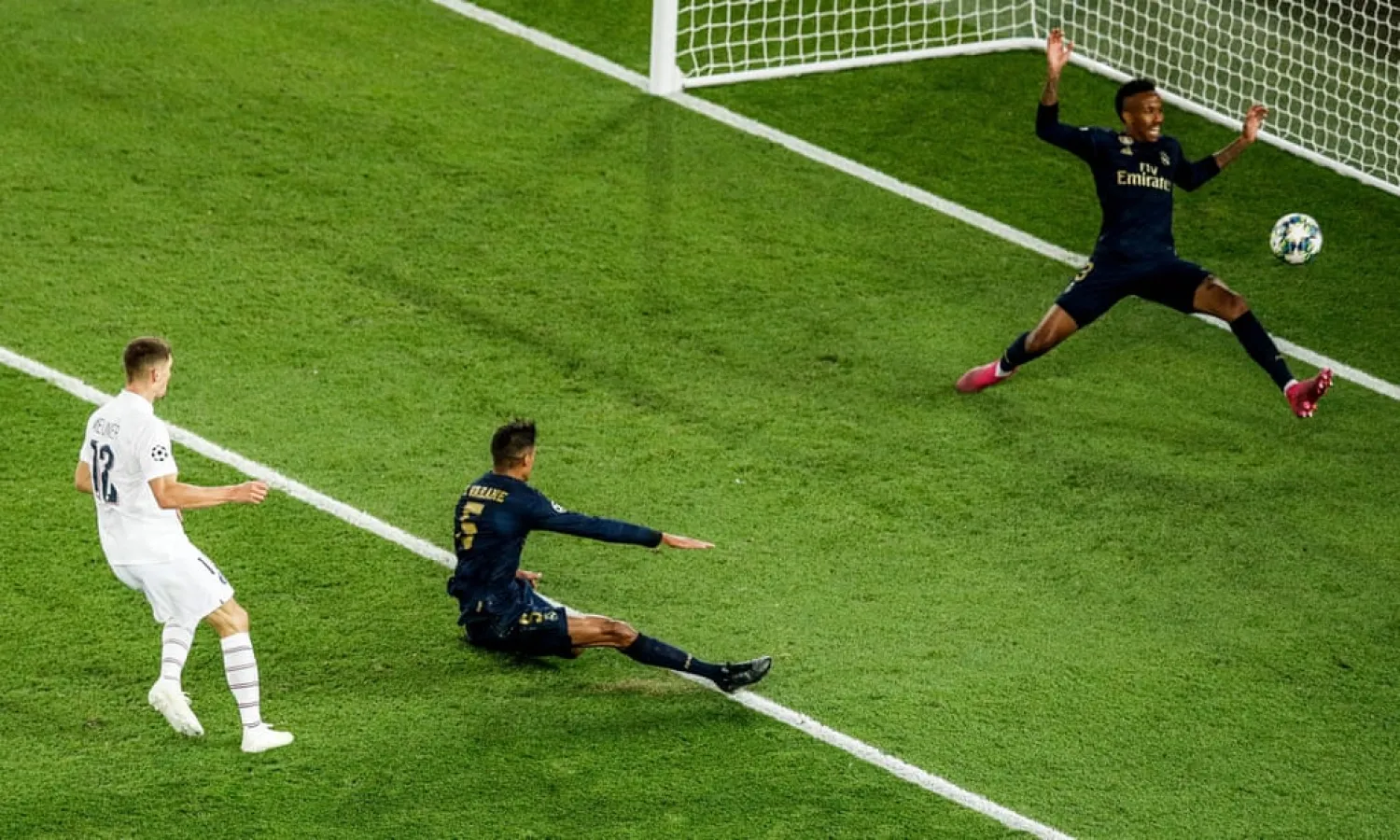
 Thomas Meunier scores PSG’s final goal in the 3-0 Champions League win at home to Real Madrid. Photograph: Yoan Valat/EPA
Thomas Meunier scores PSG’s final goal in the 3-0 Champions League win at home to Real Madrid. Photograph: Yoan Valat/EPA
TT

For Decadent, Deficient Real Madrid the Problems Start in Midfield

 Thomas Meunier scores PSG’s final goal in the 3-0 Champions League win at home to Real Madrid. Photograph: Yoan Valat/EPA
Thomas Meunier scores PSG’s final goal in the 3-0 Champions League win at home to Real Madrid. Photograph: Yoan Valat/EPA

As Thomas Meunier and Juan Bernat capered through the open savannah that archaeologists believe was once populated by the Real Madrid midfield, the mind was drawn to another Parisian night two and a half years ago, when Ángel Di María orchestrated an even more emphatic victory for Paris Saint-Germain over a Spanish side. As it turned out, that 4-0 win over Barcelona didn’t turn out particularly well for PSG but, more generally, what on earth is going on with midfields in La Liga?

On a night when Atlético twice conceded goals on the break at home to Juventus, the issue seems particularly acute. Last season the big three Spanish sides leaked three or more in games against Liverpool (Barcelona); CSKA Moscow and Ajax (Real Madrid); and Borussia Dortmund and Juventus (Atlético). In each case the major problem was the same: a ponderous midfield being shredded in transition. There had been glimmers of the issue the season before, in Real Madrid’s defeat at Tottenham and Barcelona’s embarrassing collapse in Rome, which itself had been foreshadowed by the problems they’d had against Chelsea in the previous round.

In that sense Di María, a player who carries the ball on the counter as well as anybody in world football, is kryptonite to a Spanish midfield – or even, as Bayern found when Di María, still playing for Madrid, devastated them, to a midfield managed by a Spaniard. The sense lingers that Di María never quite gets the credit he deserves.

Although his contract demands were perhaps excessive, Madrid might have made more effort to keep hold of him had he been more obviously charismatic and not borne such a striking resemblance to Franz Kafka. Di María’s time at Manchester United was scuppered by the wider sweep of the club’s decline and struggles with settling in, exacerbated by a burglary at his home. With Argentina, he is a useful scapegoat, largely because he is almost always there, coaches liking his diligence even though the team, not unreasonably focused on Lionel Messi, rarely play in a way that would get the best out of him.

With PSG, Di María is overshadowed by the star quality of Neymar, Kylian Mbappé and Edinson Cavani. Not for the first time, it was apparent without the three on Wednesday how much better they are when the celebrity worship is toned down and they function as a team. That said, Madrid did everything they could to make it easy for them.

The one-two that released Bernat in the buildup to the first goal was neat, but was it really enough to bypass Dani Carvajal that straightforwardly? Raphaël Varane was then drawn towards the full-back, leaving a huge gap for Di María to move into as Éder Militão, who had a dreadful game, failed to cover. Di María’s strike for the second was powerful and accurate but why was he afforded so much room five yards outside the box? These are basics of defending. By the time of the third, Madrid’s midfield had collapsed completely.

Drawing general conclusions is never without risk, and both Madrid and Barça have had problems refreshing ageing midfields (Frenkie de Jong should help), but there is a question of how both have been allowed to sink into such decadence. Why have La Liga sides not exploited more such obvious deficiencies in midfield? Perhaps the gulf in resources, and the psychological barriers that erects, are simply too great; perhaps towards the end of last season, opponents had begun to expose Madrid.

There may also, though, be a sense of the evolutionary wheel turning. The possession-oriented game of a decade ago has slowly yielded to something quicker and more rooted in the construction of rapid transitions. Success often breeds stagnation – why change something that works? It may be that after so much success – six Champions Leagues in the past nine years – Spanish football has slipped back into the pack.

Given how profound Madrid’s issues appear, Barça and Atlético will be the real test of that. Zinedine Zidane’s success as a manager, winning three successive Champions Leagues, always seemed a little freakish, the result less of any great tactical acumen – important as his substitutions often were – than of a talented squad that effectively ran itself, elevated by the goalscoring of Cristiano Ronaldo and capable of peaking at just the right moment.

The surgery Zidane demanded on his return has not happened and the result is a slow midfield that, with little support from a detached forward line, could not cope with a PSG side that, with Marquinhos, Idrissa Gueye and Marco Verratti together in the middle, played with real energy and aggression. Even in the good days, Casemiro sometimes struggled to hold the bridge alone. Here, with James Rodríguez weirdly uninvolved and Toni Kroos looking a decade older than his 29 years, he was overwhelmed.

Perhaps when Sergio Ramos returns from suspension, Madrid will do what they have in the past and raise themselves for the knockouts, borne by some deep-rooted muscle memory of past successes. But this was a troubling display, flaccid and unfocused. A bunch of ageing stars yoked loosely together for one last job may play well for some content producers but football still requires at least some zest, some organisation. This was a Madrid side seemingly incapable even of the basics.

PSG, meanwhile, shorn of their stars, looked a team at last.

The Guardian Sport


Lindsey Vonn Back in US Following Crash in Olympic Downhill 

Milano Cortina 2026 Olympics - Alpine Skiing - Women's Downhill 3rd Official Training - Tofane Alpine Skiing Centre, Belluno, Italy - February 07, 2026. Lindsey Vonn of United States in action during training. (Reuters)
TT

Lindsey Vonn Back in US Following Crash in Olympic Downhill 

Milano Cortina 2026 Olympics - Alpine Skiing - Women's Downhill 3rd Official Training - Tofane Alpine Skiing Centre, Belluno, Italy - February 07, 2026. Lindsey Vonn of United States in action during training. (Reuters)

Lindsey Vonn is back home in the US following a week of treatment at a hospital in Italy after breaking her left leg in the Olympic downhill at the Milan Cortina Games.

“Haven’t stood on my feet in over a week... been in a hospital bed immobile since my race. And although I’m not yet able to stand, being back on home soil feels amazing,” Vonn posted on X with an American flag emoji. “Huge thank you to everyone in Italy for taking good care of me.”

The 41-year-old Vonn suffered a complex tibia fracture that has already been operated on multiple times following her Feb. 8 crash. She has said she'll need more surgery in the US.

Nine days before her fall in Cortina d'Ampezzo, Italy, Vonn ruptured the ACL in her left knee in another crash in Switzerland.

Even before then, all eyes had been on her as the feel-good story heading into the Olympics for her comeback after nearly six years of retirement.


Japan Hails ‘New Chapter’ with First Olympic Pairs Skating Gold 

Gold medalists Japan's Riku Miura and Japan's Ryuichi Kihara pose after the figure skating pair skating free skating final during the Milano Cortina 2026 Winter Olympic Games at Milano Ice Skating Arena in Milan on February 16, 2026. (AFP)
TT

Japan Hails ‘New Chapter’ with First Olympic Pairs Skating Gold 

Gold medalists Japan's Riku Miura and Japan's Ryuichi Kihara pose after the figure skating pair skating free skating final during the Milano Cortina 2026 Winter Olympic Games at Milano Ice Skating Arena in Milan on February 16, 2026. (AFP)

Japan hailed a "new chapter" in the country's figure skating on Tuesday after Riku Miura and Ryuichi Kihara pulled off a stunning comeback to claim pairs gold at the Milan-Cortina Olympics.

Miura and Kihara won Japan's first Olympic pairs gold with the performance of their careers, coming from fifth overnight to land the title with personal best scores.

It was the first time Japan had won an Olympic figure skating pairs medal of any color.

The country's government spokesman Minoru Kihara said their achievement had "moved so many people".

"This triumph is a result of the completeness of their performance, their high technical skill, the expressive power born from their harmony, and above all the bond of trust between the two," the spokesman said.

"I feel it is a remarkable feat that opens a new chapter in the history of Japanese figure skating."

Newspapers rushed to print special editions commemorating the pair's achievement.

Miura and Kihara, popularly known collectively in Japan as "Rikuryu", went into the free skate trailing after errors in their short program.

Kihara said that he had been "feeling really down" and blamed himself for the slip-up, conceding: "We did not think we would win."

Instead, they spectacularly turned things around and topped the podium ahead of Georgia's Anastasiia Metelkina and Luka Berulava, who took silver ahead of overnight leaders Minerva Fabienne Hase and Nikita Volodin of Germany.

American gymnastics legend Simone Biles was in the arena in Milan to watch the action.

"I'm pretty sure that was perfection," Biles said, according to the official Games website.


Mourinho Says It Won’t Take ‘Miracle’ to Take Down ‘Wounded King’ Real Madrid in Champions League

Benfica's coach Jose Mourinho reacts during a press conference on the eve of their UEFA Champions League knockout round play-off first leg football match against Real Madrid at Benfica Campus in Seixal, outskirts of Lisbon, on February 16, 2026. (AFP)
TT

Mourinho Says It Won’t Take ‘Miracle’ to Take Down ‘Wounded King’ Real Madrid in Champions League

Benfica's coach Jose Mourinho reacts during a press conference on the eve of their UEFA Champions League knockout round play-off first leg football match against Real Madrid at Benfica Campus in Seixal, outskirts of Lisbon, on February 16, 2026. (AFP)

José Mourinho believes Real Madrid is "wounded" after the shock loss to Benfica and doesn't think it will take a miracle to stun the Spanish giant again in the Champions League.

Benfica defeated Madrid 4-2 in the final round of the league phase to grab the last spot in the playoffs, and in the process dropped the 15-time champion out of the eight automatic qualification places for the round of 16.

Coach Mourinho's Benfica and his former team meet again in Lisbon on Tuesday in the first leg of the knockout stage.

"They are wounded," Mourinho said Monday. "And a wounded king is dangerous. We will play the first leg with our heads, with ambition and confidence. We know what we did to the kings of the Champions League."

Mourinho acknowledged that Madrid remained heavily favored and it would take a near-perfect show for Benfica to advance.

"I don’t think it takes a miracle for Benfica to eliminate Real Madrid. I think we need to be at our highest level. I don’t even say high, I mean maximum, almost bordering on perfection, which does not exist. But not a miracle," he said.

"Real Madrid is Real Madrid, with history, knowledge, ambition. The only comparable thing is that we are two giants. Beyond that, there is nothing else. But football has this power and we can win."

Benfica's dramatic win in Lisbon three weeks ago came thanks to a last-minute header by goalkeeper Anatoliy Trubin, allowing the team to grab the 24th and final spot for the knockout stage on goal difference.

"Trubin won’t be in the attack this time," Mourinho joked.

"I’m very used to these kinds of ties, I’ve been doing it all my life," he said. "People often think you need a certain result in the first leg for this or that reason. I say there is no definitive result."
